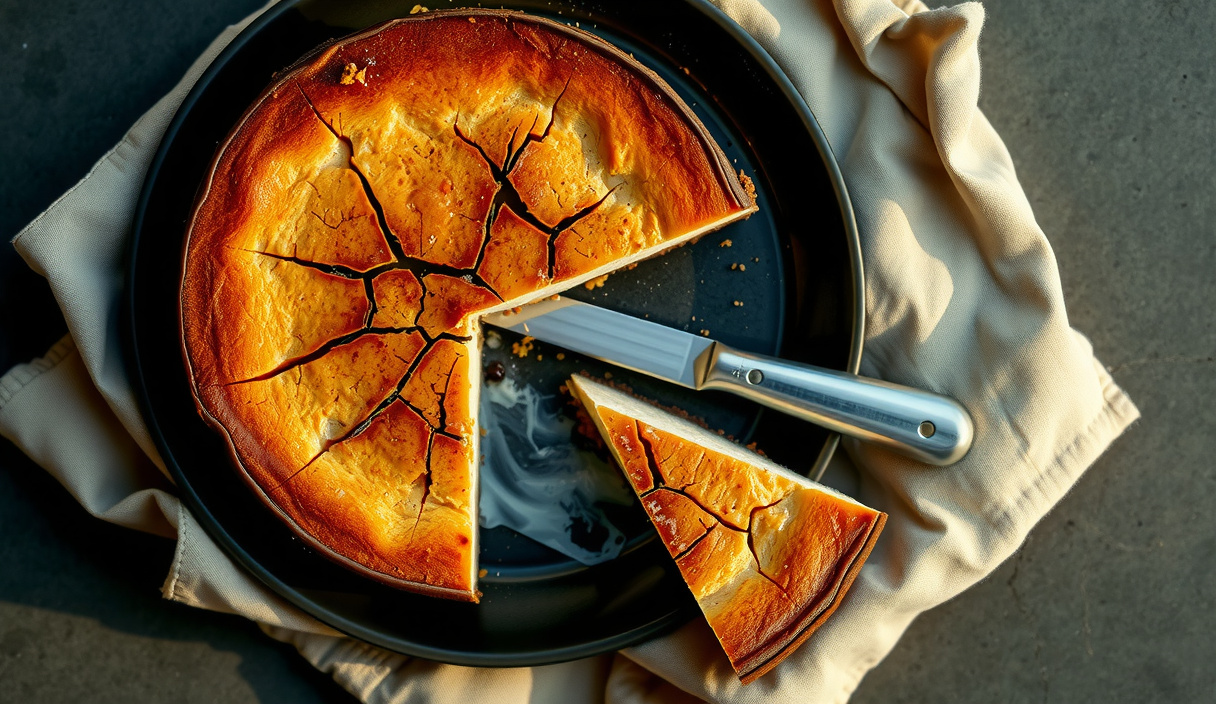
Keto Smoked Cheesecake — Almond Crust

A full-fat cream cheese and sour cream filling, sweetened with powdered erythritol and set by egg proteins at a precise 150°F internal temperature, all inside a buttery almond-flour crust kissed by cherry-wood smoke at 225°F. Strict keto, deeply savory-sweet, and unlike any cheesecake you have pulled off a smoker before.
Equipment
- 1 Offset smoker, pellet grill, or kettle grill with indirect setup Must hold a stable 225°F chamber temperature for 3 hours
- 1 9-inch springform pan Aluminum preferred; wrap exterior in two layers of heavy-duty foil
- 1 Instant-read or leave-in probe thermometer Accurate to within 1°F — this is the only reliable doneness signal
- 1 Stand mixer or hand mixer Use medium-low speed only; excess aeration causes surface cracks
- 2-3 Cherry wood chunks Fist-sized pieces; do not use chips, which burn too fast and spike temp
- 1 Wire cooling rack Required for staged cooling — allows airflow under the pan
Ingredients
Almond Crust
- 2 cups blanched almond flour Super-fine grind; coarse almond meal will produce a crumbly, greasy crust
- 4 tablespoons unsalted butter Melted and cooled to room temperature
- 3 tablespoons granular erythritol Granular is fine here; it provides slight crunch in the finished crust
- 1 teaspoon pure vanilla extract
- ¼ teaspoon fine sea salt
Smoked Cheesecake Filling
- 24 oz full-fat block cream cheese Three 8-oz blocks; room temperature for 2 hours — non-negotiable for a lump-free batter
- 1 cup powdered erythritol Confectioners-style, finely milled; granular will not dissolve fully in the cold fat matrix
- ¾ cup full-fat sour cream Adds lactic acid tang and softens the gel structure for a creamier set
- 3 large eggs Room temperature; cold eggs seize the cream cheese and create lumps
- 1 tablespoon pure vanilla extract
- 1 tablespoon fresh lemon juice Brightens the dairy flavor and lowers pH slightly to support casein network stability
- 1 teaspoon lemon zest Optional; adds limonene that pairs cleanly with cherry-wood guaiacol

Instructions
Build and Pre-Bake the Crust
- Preheat your conventional oven to 325°F. Combine almond flour, granular erythritol, and sea salt in a bowl and mix until uniform. Drizzle in melted butter and vanilla extract, then mix with a fork until the mixture clumps when pressed between your fingers.3 tablespoons granular erythritol, 1/4 teaspoon fine sea salt, 4 tablespoons unsalted butter, 1 teaspoon pure vanilla extract
- Press the crust mixture firmly and evenly into the bottom of the foil-wrapped 9-inch springform pan. Use a flat-bottomed glass to compact the surface — target a thickness of 6 to 8mm. The crust should not climb the sides.
- Bake the crust blind in the 325°F oven for 10 minutes until the edges are just turning golden and the center feels set to the touch. Remove and cool on a wire rack for 20 minutes. This step creates the Maillard-browned foundation and prevents the crust from absorbing filling moisture during the smoke phase.
Mix the Filling
- In the bowl of a stand mixer fitted with the paddle attachment, beat room-temperature cream cheese on medium-low speed for 90 seconds until completely smooth and free of any lumps. Scrape the bowl thoroughly.24 oz full-fat block cream cheese
- Add powdered erythritol and beat on low for 60 seconds until fully incorporated, then increase to medium-low for 30 additional seconds. Scrape the bowl again. Do not beat on high at any point — excess air causes the filling to puff and then crack during baking as the air expands.1 cup powdered erythritol
- Add sour cream, vanilla extract, lemon juice, and lemon zest. Mix on low until just combined, about 30 seconds. Scrape bowl.3/4 cup full-fat sour cream, 1 tablespoon pure vanilla extract, 1 tablespoon fresh lemon juice, 1 teaspoon lemon zest
- Add eggs one at a time, mixing on low after each addition only until the yolk disappears — approximately 15 to 20 seconds per egg. Overmixing after egg addition is the single most common cause of cracking. The finished batter should be silky, slightly fluid, and completely homogeneous.3 large eggs
- Pour the filling over the cooled crust and smooth the top with a small offset spatula. Tap the pan gently on the counter three times to release any trapped air pockets near the surface.
Set Up and Smoke
- Prepare your smoker for indirect cooking at a stable 225°F chamber temperature. Add two to three fist-sized cherry wood chunks directly to your heat source. Allow the smoker to reach temperature and the initial white smoke to transition to thin blue or nearly invisible smoke — this takes approximately 15 to 20 minutes. Thick white smoke contains higher creosote levels that will make the filling bitter.
- Place the foil-wrapped springform pan on the center grate of the indirect cooking zone. Insert the leave-in probe thermometer through the foil collar and into the center of the filling. Close the lid.
- Smoke at 225°F without opening the lid for the first 90 minutes. After 90 minutes, check the chamber temperature and make any fuel adjustments without allowing a prolonged lid-open period. Continue cooking until the probe reads 150°F internal temperature in the center of the filling — this will take approximately 2.5 to 3 hours total depending on your smoker. The filling should jiggle as one cohesive mass, not slosh. The surface will carry a faint golden-tan smoke blush.
Staged Cooling and Refrigeration
- When the cheesecake reaches 150°F internal, shut down the heat source and prop the smoker lid open 2 to 3 inches. Allow the cheesecake to rest in the cooling smoker for 45 minutes. This prevents thermal shock cracking.
- Transfer the pan (still in its foil wrap) to a wire cooling rack at room temperature. Rest uncovered for another 45 minutes, until the pan is barely warm to the touch on the sides.
- Remove the foil wrap, run a thin offset spatula around the interior edge of the springform pan to release any stuck spots, then transfer the entire pan — without releasing the springform latch — to the refrigerator. Refrigerate uncovered on a wire rack for a minimum of 8 hours, ideally 12 to 24 hours. The erythritol must fully dissolve into the aqueous gel matrix before slicing or you will taste residual grittiness.
- To serve: release the springform latch and remove the ring. Run a sharp knife under hot water, dry it, and slice in a single downward motion without dragging. Wipe the knife clean and reheat between each slice for the cleanest cut.
Notes
Why 150°F and not 165°F? Egg proteins in a cheesecake filling denature sequentially. Ovalbumin sets between 140°F and 149°F (60°C to 65°C), forming a loose but stable viscoelastic gel. Ovomucin and ovotransferrin continue to reinforce the network up to 165°F, but above approximately 155°F the actomyosin-analog contraction of the egg proteins begins to expel free water — the physical cause of weeping syneresis on the cut face of an overcooked cheesecake. Pulling at 150°F captures the first-stage ovalbumin set while leaving the network under minimal contractile stress. The residual heat carried by the thermal mass of the cream cheese (carryover of approximately 3°F to 5°F after removal from heat) will gently push the center to a final hold temperature in the safe zone.
Cherry wood VOC chemistry: Guaiacol (2-methoxyphenol) is the signature aroma compound of fruit woods, produced by the thermal degradation of lignin in the 400°F to 700°F combustion zone. Its octanol-water partition coefficient (log P ≈ 1.32) means it partitions strongly into lipid phases — making fat-rich cream cheese an exceptionally efficient smoke absorber. Syringol (2,6-dimethoxyphenol), also high in cherry wood smoke, carries a smoky-spicy note that reinforces the dairy without overpowering it. Hickory and mesquite smoke has a higher proportion of polycyclic aromatic hydrocarbons and lower guaiacol-to-total-phenol ratios, which is why they taste harsh on delicate dairy matrices.
Erythritol crystallization management: Erythritol has a first-order crystallization rate that accelerates sharply above its saturation limit in water (approximately 37 g per 100 mL at room temperature). In the cream cheese filling, the high fat fraction physically coats erythritol molecules and delays nucleation. However, during refrigeration, as free water activity decreases and the gel structure contracts slightly, crystallization pressure increases. The minimum 8-hour chill time gives the erythritol sufficient time to equilibrate — any micro-crystals that form during the first 4 hours will re-dissolve into the aqueous phase of the gel as it continues to equilibrate. If you detect any residual grittiness, the filling was sliced too soon.
Water bath versus no water bath: Traditional cheesecake recipes use a bain-marie (water bath) to moderate heat and maintain high humidity around the pan, which prevents the surface from drying and cracking. In a smoker, a water bath would create a steam curtain around the pan that prevents smoke VOCs from reaching the filling surface and penetrating the fat phase. The staged cooling protocol described in this recipe replaces the function of the water bath by slowing the temperature drop in three distinct phases rather than one abrupt transition.
Nutrition
Calories: 385kcalCarbohydrates: 6.2gProtein: 8.5gFat: 36gSaturated Fat: 17.5gCholesterol: 122mgSodium: 290mgFiber: 1.8gSugar: 1.4g
Tried this recipe?Let us know how it was!