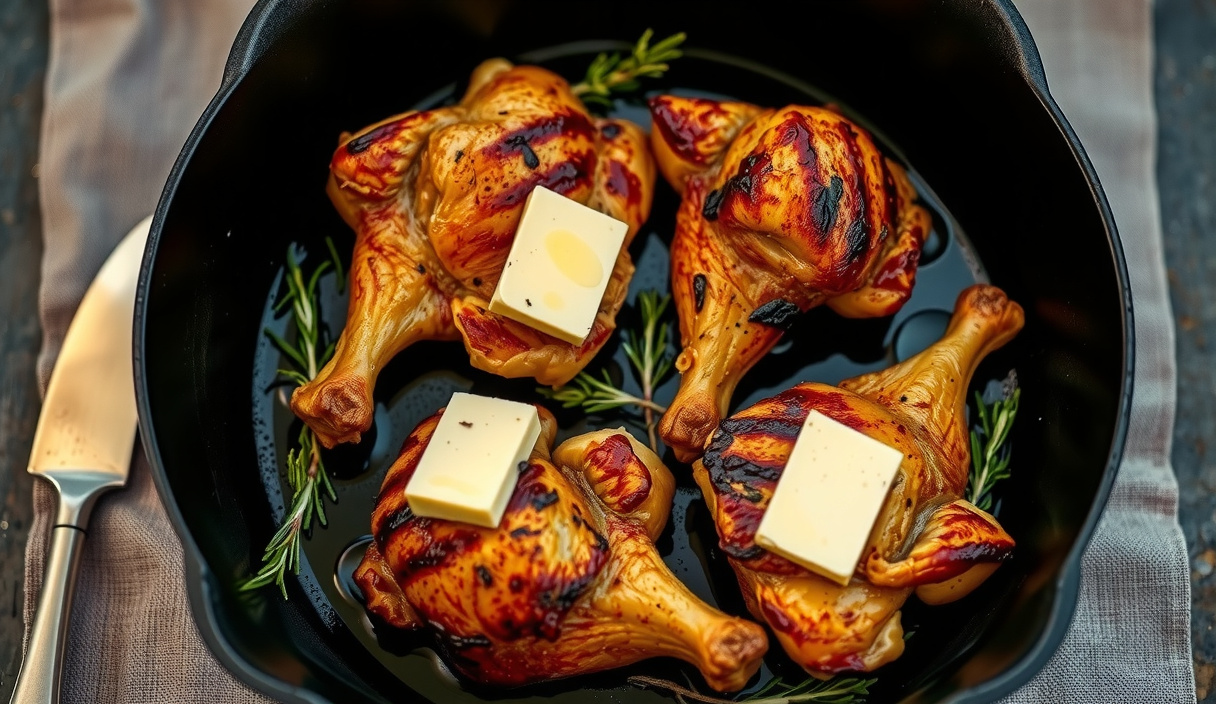
Keto Smoked Chicken Thighs with Garlic-Herb Compound Butter

Bone-in, skin-on chicken thighs smoked low and slow over cherry wood with a garlic-herb compound butter pressed under the skin, finished at high heat for crackling skin. A sugar-free erythritol-paprika rub delivers authentic bark and Maillard browning with just 1g net carb per serving — built for keto without compromise.
Equipment
- 1 Smoker or kettle grill with indirect-heat setup Must hold a stable 250–275°F and ramp to 400°F for the sear finish
- 2–3 chunks Cherry or apple wood chunks Do not use wood chips — chunks provide sustained smoke without flaring
- 1 Instant-read thermometer Target 175°F at deepest point of thigh muscle, not touching bone
- 1 Wire rack set over a sheet pan For the overnight dry-brine step — airflow on all sides is essential
Ingredients
Chicken
- 4 bone-in, skin-on chicken thighs Approximately 2.5 to 3 lbs total — trim excess overhanging fat but leave the main skin cap intact
Sugar-Free Dry Rub
- 1 tbsp granular erythritol Granular only — powdered dissolves too quickly and muddies the bark
- 2 tsp smoked paprika Spanish pimentón de la Vera preferred for its Maillard-reactive pentose sugar content
- 1 tsp kosher salt
- 1 tsp garlic powder
- 0.5 tsp onion powder
- 0.5 tsp dried thyme
- 0.5 tsp dried rosemary Finely crushed between fingers before adding to improve bark adhesion
- 0.25 tsp black pepper, coarse ground
- 0.25 tsp cayenne pepper Optional — omit for a mild profile
Garlic-Herb Compound Butter
- 4 tbsp unsalted European-style butter 82–84% fat content; softened to room temperature
- 3 cloves garlic Minced to a paste using the side of a knife with a pinch of salt
- 1 tbsp fresh thyme leaves Stripped from stems; substitute 1 tsp dried if fresh unavailable
- 1 tbsp fresh rosemary Finely minced; woody stems discarded
- 0.5 tsp kosher salt
- 0.25 tsp black pepper
- 0.5 tsp lemon zest Optional but recommended — adds brightness without adding water or carbs

Instructions
Make the Compound Butter
- Combine the softened butter, minced garlic paste, thyme, rosemary, salt, pepper, and lemon zest (if using) in a small bowl. Mix vigorously with a fork until the aromatics are fully incorporated and the butter is homogeneous. Taste and adjust salt. Transfer to a small piece of plastic wrap, shape into a rough log, and refrigerate until firm — at least 30 minutes. The butter must be fully softened when you mix it — cold butter will not incorporate the herbs evenly, leaving pockets rather than a uniform aromatic matrix.3 cloves garlic, 1 tbsp fresh thyme leaves, 1 tbsp fresh rosemary, 0.5 tsp kosher salt, 0.25 tsp black pepper, 0.5 tsp lemon zest
Apply Rub and Dry Brine
- Combine all dry rub ingredients in a small bowl and mix until the erythritol and spices are evenly distributed. Pat the chicken thighs completely dry with paper towels — any surface moisture will impede bark formation by raising the boundary-layer water activity above the Maillard-optimal range.2 tsp smoked paprika, 1 tsp kosher salt, 1 tsp garlic powder, 0.5 tsp onion powder, 0.5 tsp dried thyme, 0.5 tsp dried rosemary, 0.25 tsp black pepper, coarse ground, 0.25 tsp cayenne pepper
- Using your fingers, carefully loosen the skin from the flesh of each thigh, working from the thick end inward without tearing. Push approximately 1 tablespoon of compound butter under the skin of each thigh and press from the outside to spread it into an even layer across the muscle. Work quickly — the heat of your hands will soften the butter fast. If the butter becomes too soft, return it to the refrigerator for 10 minutes before continuing.3 cloves garlic
- Apply a generous, even coat of the dry rub to all surfaces of each thigh — including the underside and any exposed meat at the edges. Place the thighs skin-side up on a wire rack set over a sheet pan. Refrigerate uncovered for a minimum of 8 hours and up to 24 hours. This dry-brine rest solubilizes the surface proteins, draws and redistributes moisture via osmosis, and critically drops the skin's surface water activity — the key setup for clean bark formation and skin crispness on the smoker.2 tsp smoked paprika, 1 tsp kosher salt, 1 tsp garlic powder, 0.5 tsp onion powder, 0.5 tsp dried thyme, 0.5 tsp dried rosemary, 0.25 tsp black pepper, coarse ground, 0.25 tsp cayenne pepper
Fire Up and Smoke
- Remove the thighs from the refrigerator 30 minutes before cooking to temper slightly. Prepare your smoker for indirect cooking at 250–275°F. Add 2 to 3 chunks of cherry or apple wood to the coals or wood box — this is the full wood addition for the cook. Do not add more wood mid-cook. Excess smoke on poultry generates bitter creosote compounds that the limited connective tissue mass of chicken cannot absorb and buffer the way brisket does.
- Place the thighs skin-side up on the smoker grate over indirect heat, maintaining at least 1 inch of airspace between each piece for even convective flow. Close the lid and smoke at 250–275°F until the internal temperature reaches 165°F at the deepest point of the thigh muscle, measured away from the bone. This typically takes 2 to 2.5 hours depending on thigh size and smoker consistency. Resist opening the lid repeatedly — each opening drops pit temperature by 25–50°F and extends the cook unpredictably.
- If your smoker is capable of high heat, ramp the temperature to 400°F now. If using a kettle or offset, open the vents fully and add fresh coals to boost heat. Cook skin-side up for an additional 8–12 minutes, until the skin is deep mahogany, visibly bubbled, and audibly crackling. Monitor the internal temperature closely — you are targeting 175°F final internal. The skin-side-up orientation during the high-heat finish allows the fat to render upward through the skin rather than pooling on the grate beneath, driving crispness from within.
Rest and Serve
- Remove the thighs from the smoker when the internal temperature reads 175°F. Transfer to a clean cutting board or platter and tent loosely with foil — do not seal tightly, as trapped steam will reverse the skin crispness achieved in the last 10 minutes of cooking. Rest for 10 minutes. During this window the temperature gradient within the thigh equalizes and the muscle fibers relax, reducing juice loss at the cut. Serve immediately after the rest.
Notes
Why 175°F and not 165°F (the USDA safe minimum)? The USDA 165°F threshold is a pasteurization endpoint calibrated for instantaneous pathogen kill. At that temperature, bone-in thigh meat is technically safe but texturally undercooked — the connective tissue around the joint has not fully softened and the innermost muscle near the bone remains slightly translucent. Dark meat thighs are best at 175°F, where the collagen around the joint has hydrolyzed sufficiently, the texture is fully relaxed, and the lipid phase from the compound butter has fully distributed through the muscle. The water-holding capacity has dropped significantly past 165°F (actin denatures between 74°C and 78°C / 165–172°F), which is exactly why the compound butter step is mechanically necessary — it provides the exogenous lipid buffer that compensates for the WHC loss.
The erythritol-Maillard mechanism in detail: Erythritol (C4H10O4) is a non-reducing polyol with no free aldehyde or ketone group available for Schiff base formation. It does not participate directly in the Maillard cascade. However, its contribution is physical: it increases the total dissolved solids at the rub surface, which raises the local water activity into the 0.5–0.7 optimal window for the highly reactive pentose sugars and free amino acids native to pimentón de la Vera smoked paprika. These paprika-native reactants drive the color (melanoidin formation) and aroma (pyrazines, furanones, Strecker aldehydes) of the bark. The erythritol is the scaffolding that sets the reaction conditions — the paprika is the actual reactant.
Fat partitioning and compound butter aromatics: Diallyl disulfide and allicin degradation products from garlic, plus monoterpenes (linalool, carvacrol, thymol) from thyme and rosemary, are all highly lipophilic with log P values between 2 and 4. Dissolved in 4 tablespoons of high-fat European butter per thigh, their vapor-condensed phase partition coefficients strongly favor the lipid phase at rest. As the butter melts during smoking (beginning around 90°F internal), these aroma compounds are released slowly into the surrounding muscle tissue and re-sequestered in the intramuscular fat. At consumption temperature, mouthfeel and chewing shear the fat globules, releasing the volatiles in a time-delayed burst. This sustained aromatic release is the defining sensory difference between compound butter under the skin and a surface herb rub.
Nutrition
Calories: 520kcalCarbohydrates: 2gProtein: 42gFat: 38gSaturated Fat: 14gCholesterol: 195mgSodium: 680mgFiber: 0.5g
Tried this recipe?Let us know how it was!