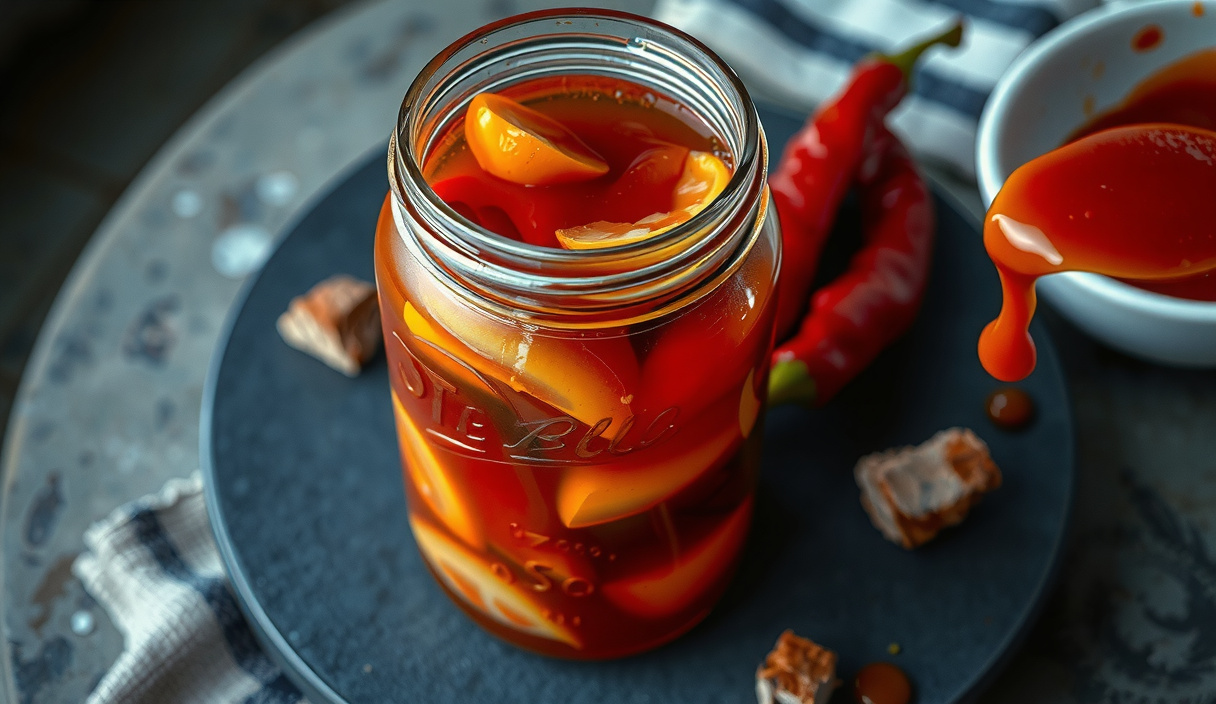
Lacto-Fermented Smoked Pepper Hot Sauce

Fresno chiles and jalapeños cold-smoked over cherry wood, then submerged in a precisely weighted 3.5% salt brine and fermented at 65–72°F for 7 days. The result is a complex, shelf-stable hot sauce with a backbone of lactic brightness, living smoke depth, and genuine heat — achieved through controlled microbial kinetics rather than vinegar shortcuts.
Equipment
- 1 Smoker or kettle grill with wood chips Cherry or apple wood preferred. Chamber temp 180–200°F.
- 1 1-quart wide-mouth mason jar Clean thoroughly with hot soapy water; no need to sterilize as the salt brine is the primary selective agent.
- 1 pH meter or precision pH strips (range 3.0–5.0) Non-negotiable safety tool. Target final pH is 3.4–3.6.
- 1 Kitchen scale For precise salt measurement in grams. Volumetric salt measurement is unreliable.
- 1 Blender High-speed preferred. Wear splash protection when blending hot or acidic liquids.
- 1 Fine-mesh strainer or nut-milk bag For straining seed fragments and coarse pulp post-blend.
- 2 Glass hot sauce bottles or mason jars for storage Swing-top or standard cap bottles, 8–12 oz each. Sanitize before filling.
Ingredients
Peppers and Aromatics
- 300 g red Fresno chiles Fully ripe, stems removed. Slice lengthwise to expose flesh for smoke penetration.
- 150 g jalapeños Green preferred. Stems removed, sliced lengthwise.
- 6 cloves garlic Peeled, left whole. Will ferment and mellow considerably.
Brine
- 600 mL filtered or non-chlorinated water Chlorine in tap water inhibits Lactobacillus. Use filtered, bottled, or water left uncovered overnight.
- 21 g non-iodized kosher salt or pickling salt This is exactly 3.5% w/v of 600 mL water. Do not use iodized salt — iodine is antimicrobial.

Instructions
Smoke the Peppers
- Prepare your smoker or kettle grill with cherry or apple wood chips. Bring the chamber to 180–200°F. Arrange the sliced Fresno chiles and jalapeños cut-side down on the grates. Smoke for 40–50 minutes — you want visible smoke color penetration and a slight tackiness on the flesh, not a fully cooked or dried pepper.150 g jalapeños
- Remove the peppers and allow them to cool completely to room temperature, about 20–30 minutes. The goal is maximum retention of fat-soluble smoke phenolics in the cell matrix before the aqueous brine environment is introduced. Do not rinse the peppers after smoking.150 g jalapeños
Prepare the Brine
- Weigh 21 g of non-iodized salt on a kitchen scale. Combine with 600 mL of filtered water and stir until the salt is fully dissolved. This produces a precise 3.5% w/v brine. Test with a finger — it should taste aggressively salty, well beyond seasoning-level salt.21 g non-iodized kosher salt or pickling salt, 600 mL filtered or non-chlorinated water
Pack the Fermentation Jar
- Pack the smoked Fresno chiles, jalapeños, and garlic cloves tightly into a clean 1-quart wide-mouth mason jar. The tight pack helps keep pieces submerged once the brine is added.150 g jalapeños, 6 cloves garlic
- Pour the prepared 3.5% brine over the peppers until they are fully covered, leaving approximately 1 inch of headspace. Fill a small zip-seal bag with additional brine (or water as a backup), seal it, and press it down over the peppers to act as a weight, keeping all vegetable matter below the brine surface. Alternatively, use a dedicated fermentation weight.600 mL filtered or non-chlorinated water, 21 g non-iodized kosher salt or pickling salt
- Cover the jar loosely with the lid (do not seal airtight — the fermentation produces CO2 that needs to escape) or fit with an airlock. Label the jar with the start date and target end date. Place in a location that holds 65–72°F consistently. A kitchen counter away from direct sunlight is ideal; avoid areas near the oven or refrigerator exhaust.
Ferment 5–7 Days
- Check the jar once daily for the first 3 days. You should see brine cloudiness beginning by day 2 and visible CO2 bubbling by day 2–3. If a white film forms on the surface (kahm yeast), skim it off with a clean spoon and ensure all pepper pieces remain submerged. Kahm yeast is harmless but should be controlled.
- On day 5, begin pH monitoring. Remove a small sample of brine from the jar and test with a pH meter or precise strips. A reading below pH 4.0 indicates active fermentation is well underway. Continue fermenting until the brine reaches pH 3.4–3.6. Depending on your ambient temperature, this occurs between day 5 and day 7. Do not rely solely on the calendar — the pH reading is the definitive safety and flavor endpoint.
Blend and Strain
- Once the target pH is reached, transfer the peppers, garlic, and all of the brine to a blender. Blend on high speed for 60–90 seconds until completely smooth. The brine carries active cultures, lactic acid, and dissolved smoke compounds — do not discard it.150 g jalapeños, 6 cloves garlic, 600 mL filtered or non-chlorinated water, 21 g non-iodized kosher salt or pickling salt
- Pour the blended sauce through a fine-mesh strainer or nut-milk bag into a clean bowl. Press the solids firmly with a spatula or squeeze the bag to extract maximum liquid. Discard the dry pulp. Taste the strained sauce and confirm the brightness, smoke depth, and heat are in balance. If the sauce tastes too sharp, allow it to rest refrigerated for 48 hours — the lactic acid integration smooths considerably.
- Transfer the finished sauce into clean glass bottles or mason jars. For a live-culture (probiotic) product: store sealed in the refrigerator at 38–40°F and use within 6–12 months. The sauce continues to evolve slowly in flavor. For shelf-stable pasteurized product: place sealed bottles in a 185°F water bath for 15 minutes, then cool completely before storing at room temperature for up to 18 months. Label each bottle with the pH reading and bottling date.
Notes
Why 3.5% brine and not 2% or 5%? Salt concentration is the primary microbial selection variable. At 3.5% w/v NaCl, the osmotic pressure differential across bacterial cell membranes specifically inhibits salt-sensitive spoilage organisms (Enterobacteriaceae, most molds) while the halotolerant Lactobacillus and Leuconostoc strains native to pepper surfaces remain metabolically active. Below 2%, the selection window is insufficient and the risk of early-stage pathogen proliferation rises. Above 4%, even Lactobacillus strains begin experiencing osmotic stress, extending the lag phase and slowing pH drop. The 3–3.5% band is the validated sweet spot for open vegetable fermentation without commercial starter culture.
Why does pH matter more than time? Lactic acid accumulation — not calendar days — creates the hostile acid environment that inhibits Clostridium botulinum (fully inhibited below pH 4.6), Listeria monocytogenes (inhibited below pH 3.5), and Staphylococcus aureus toxin production (inhibited below pH 4.5). A pH of 3.4 provides a safety margin below all three thresholds simultaneously. Ambient temperature variability means the same recipe can hit pH 3.4 in 5 days at 72°F or 8 days at 62°F — only measuring pH confirms actual acid development.
Why smoke before fermenting? Guaiacol and syringol — the primary phenolic compounds responsible for smoke character — are highly lipophilic and embed deeply into the pepper's intracellular lipid environment during smoking. They partition into fat-rich cellular domains where the aqueous brine has minimal access. This means they survive 7 days of acid fermentation largely intact, while water-soluble volatile compounds from raw garlic or fresh herbs would be partially purged by the CO2 outgassing of active fermentation. Pre-ferment smoking locks the char flavor in permanently.
Capsaicin stability across pH: Capsaicin and dihydrocapsaicin are lipid-soluble alkaloids that are chemically stable across the pH range of this ferment (3.4–7.0). Their perceived heat intensity in the final sauce is not diminished by lactic acid production — though the bright lactic acid note creates a faster finish that subjectively reads as cleaner heat compared to vinegar-based sauces, which can prolong the perception of heat through the acetic acid interaction with salivary enzymes.
Nutrition
Calories: 5kcalCarbohydrates: 1gProtein: 0.2gFat: 0.1gSodium: 290mgFiber: 0.3gSugar: 0.5g
Tried this recipe?Let us know how it was!