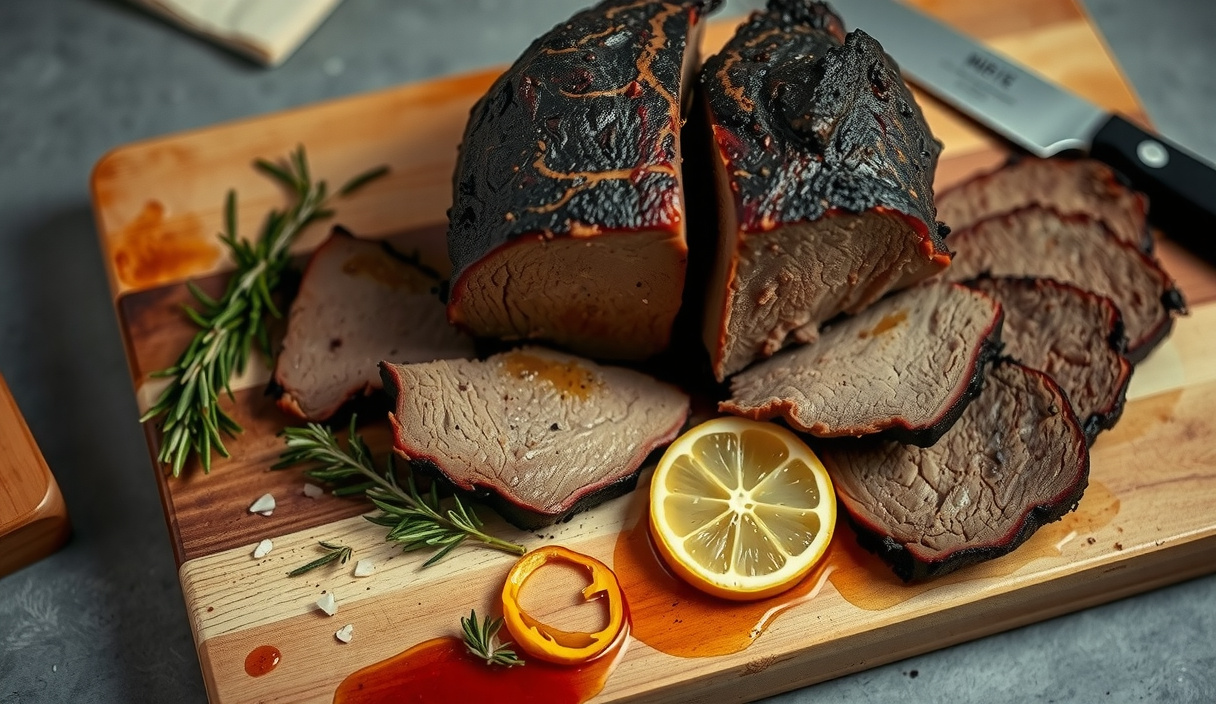
Low-Sodium Smoked Brisket — Herb-Forward

A full packer brisket smoked low-and-slow over oak with a coffee-cocoa-paprika rub built around a 50/50 KCl/NaCl salt-substitute blend. The rub's roasted bitterness compounds mask the metallic register of potassium chloride while building a lacquered, near-black bark. Collagen hydrolysis runs to completion in the 185°F–205°F internal window, yielding pull-apart, gelatin-rich slices with a deep smoke ring — all under 300mg sodium per serving.
Equipment
- 1 Offset smoker, kamado, kettle, or pellet grill Must hold 225°F–250°F with indirect heat for 10–14 hours. Pellet grill users: add a smoke tube for dense smoke in the first 4 hours.
- 1 Instant-read thermometer For probe-tender check and final internal temperature verification.
- 1 Leave-in probe thermometer Insert into the thickest part of the flat, not the point. Grate-level placement of the pit sensor, not dome.
- 4 feet Pink butcher paper Unwaxed. Do not substitute aluminum foil — foil traps steam and softens bark.
- 1 Wire rack set over a half-sheet pan For the 60–90 minute post-cook rest. Resting in a cooler traps steam and ruins the bark.
- 1 Sharp 12-inch slicing knife or long chef's knife A dull knife drags and shreds. Sharpen before service.
- 1 Large cutting board
- 1 Spray bottle For apple juice spritz during the unwrapped post-stall phase.
Ingredients
The Brisket
- 1 full packer brisket (point + flat), 12–15 lb USDA Choice or Prime. Do not use flat-only unless you plan to inject with gelatin-fortified broth (see Variations).
KCl Salt-Substitute Dry Brine
- 2 tablespoons kosher salt (NaCl) Diamond Crystal preferred. Contributes ~50% of the salt-blend sodium.
- 2 tablespoons potassium chloride salt substitute (100% KCl) Morton Salt Substitute or Nu-Salt. Blended 1:1 with kosher salt to create the 50/50 KCl/NaCl blend.
Coffee-Cocoa-Paprika Rub
- 3 tablespoons finely ground dark roast coffee (espresso grind) Provides pyrazines and methylfurfuryl compounds that mask KCl metallic bitterness. Fine grind maximizes surface contact area.
- 2 tablespoons natural (non-alkalized) cocoa powder Do not use Dutch-process or sweetened mixes. Theobromine content is critical for bitter-receptor competition against KCl.
- 3 tablespoons smoked paprika Provides carotenoid pigments (capsanthin, capsorubin) that deepen bark color and compensate for reduced ionic-strength Maillard progression.
- 2 tablespoons coarse black pepper, freshly cracked 1/4-inch crack preferred. Provides aromatic complexity and contributes to bark texture.
- 1 tablespoon garlic powder Sodium-free. Provides sulfurous depth that partially compensates for reduced NaCl umami amplification.
- 1 tablespoon onion powder Sodium-free. Adds a base-note sweetness that rounds the KCl's metallic edge.
- 1 teaspoon dried thyme, crumbled The herb-forward element. Thymol and carvacrol compounds add a resinous note that complements smoke.
- 1 teaspoon dried rosemary, finely ground Grind whole dried rosemary in a spice grinder or with a mortar and pestle to prevent large needles that don't adhere to the bark.
- 1 teaspoon sweet paprika Adds sweetness depth to complement the smoked paprika.
- ½ teaspoon cayenne pepper Optional. Capsaicin stimulates TRPV1 thermoreceptors, creating a perceived warmth that amplifies savory character.
Smoke and Spritz
- 6 chunks oak or hickory wood chunks (fist-sized) For offset or kettle. Pellet grill users: use a smoke tube loaded with oak pellets in addition to the hopper charge.
- 1 cup unsweetened apple juice For spritz bottle. Applied after butcher paper comes off during the final unwrapped phase only. Do not spritz before wrapping — it interferes with pellicle formation.

Instructions
Trim and Dry Brine (12–24 hours before cook)
- Place the brisket fat-side up on a large cutting board. Using a sharp boning or chef's knife, trim the fat cap to a uniform 1/4 inch. Remove any hard "flap" fat between the point and flat that will not render during the cook. Trim excess fat from the sides of the flat down to the meat. Flip and remove any remaining silver skin or hard sinew from the meat side.
- Combine the kosher salt and potassium chloride salt substitute in a small bowl and mix thoroughly — this is your 50/50 KCl/NaCl blend. Apply the blend evenly across all surfaces of the brisket, including the sides. Use approximately 1 tablespoon of the combined blend per 5 lb of meat. Do not skip the dry brine: the potassium ions need 12–24 hours to penetrate the surface muscle layers where they can suppress bitter receptor activation from within during eating.2 tablespoons potassium chloride salt substitute (100% KCl)
- Place the dry-brined brisket uncovered on a wire rack set over a sheet pan and refrigerate for 12–24 hours. The uncovered refrigeration allows the surface to dry further, tightening the pellicle the smoke will adhere to.
Build the Rub and Prep the Smoker
- Combine all rub ingredients — ground coffee, cocoa powder, smoked paprika, cracked black pepper, garlic powder, onion powder, dried thyme, ground rosemary, sweet paprika, and cayenne — in a bowl and whisk until uniform. The rub will look very dark; this is correct. The cocoa and coffee give it a near-black appearance that becomes your bark base.3 tablespoons finely ground dark roast coffee (espresso grind), 2 tablespoons natural (non-alkalized) cocoa powder, 3 tablespoons smoked paprika, 2 tablespoons coarse black pepper, freshly cracked, 1 tablespoon garlic powder, 1 tablespoon onion powder, 1 teaspoon dried thyme, crumbled, 1 teaspoon dried rosemary, finely ground, 1 teaspoon sweet paprika, 1/2 teaspoon cayenne pepper
- Remove the brisket from the refrigerator 45–60 minutes before cook time to allow the outer surface to temper slightly. Apply the rub generously across all surfaces, pressing it into the meat rather than dusting it on. Aim for a dense, even coating — do not be shy. Place the brisket back on the wire rack, fat-side up, while you prepare the smoker.3 tablespoons finely ground dark roast coffee (espresso grind), 2 tablespoons natural (non-alkalized) cocoa powder, 3 tablespoons smoked paprika, 2 tablespoons coarse black pepper, freshly cracked, 1 tablespoon garlic powder, 1 tablespoon onion powder, 1 teaspoon dried thyme, crumbled, 1 teaspoon dried rosemary, finely ground, 1 teaspoon sweet paprika, 1/2 teaspoon cayenne pepper
- Fire your smoker and bring it to a stable 225°F at grate level. Add 3 fist-sized wood chunks of oak or hickory (or load a smoke tube on a pellet grill). No water pan for the first 4 hours — lower ambient humidity in the pit accelerates surface desiccation, which drives the bark surface into the low water-activity window (a_w 0.50–0.65) where Maillard reactions run efficiently despite reduced ionic strength from the KCl blend.6 chunks oak or hickory wood chunks (fist-sized)
First 4-Hour Smoke Phase (Bark Development)
- Place the brisket fat-side up over the indirect zone of your smoker. Close the lid and do not open it for the first 4 hours. Every lid-lift loses 15–20 minutes of accumulated smoke and disrupts the convective heat environment around the developing pellicle. Add 1–2 additional wood chunks at the 2-hour mark by feeding through the firebox (offset) or adding a second smoke tube charge (pellet grill) without opening the main chamber.6 chunks oak or hickory wood chunks (fist-sized)
- At the 4-hour mark, check the bark development: the surface should be deeply mahogany-to-black, dry to the touch, and show the beginning of surface cracking at the fat cap edges. If it still looks wet or tacky, give it another 30–45 minutes uncovered before proceeding.
The Stall and Butcher Paper Wrap
- Continue smoking at 225°F–235°F with your leave-in probe monitoring the thickest part of the flat. The stall will occur when the internal temperature plateaus — typically anywhere in the 155°F–168°F range — for 30 minutes or longer without moving. This is evaporative cooling at work: surface moisture is absorbing heat as fast as the smoker delivers it. This is normal. Do not panic and raise the pit temperature.
- When the stall begins, bump the pit temperature to 245°F–250°F and prepare two overlapping sheets of unwaxed pink butcher paper (approximately 4 feet total). Lay the brisket fat-side down on the paper and wrap tightly, folding the edges over firmly. The butcher paper wrap suppresses evaporation (ending the stall) while allowing steam to slowly escape through the paper's pores, preventing the bark from going soft the way foil-wrapping would.
- Return the wrapped brisket to the smoker fat-side down. The higher pit temperature (245°F–250°F) combined with the humid wrapped environment accelerates collagen hydrolysis in the connective tissue, converting the remaining tough cross-linked collagen into soluble gelatin. This is the phase where the flat transitions from tight to pull-apart.
Final Cook Phase and Probe-Tender Test
- Cook wrapped until the internal temperature of the flat reaches approximately 195°F–205°F, then perform the probe-tender test: insert the probe into the thickest part of the flat at multiple points. The brisket is done when the probe slides in with zero resistance — like inserting a hot skewer into softened butter. Stiff resistance means the collagen hydrolysis is incomplete; continue cooking.
- Optional final unwrapped phase: If you want to re-crisp the bark after the wrapped phase, unwrap the brisket, return it to the smoker fat-side up at 250°F for 20–30 minutes, and spritz lightly with apple juice every 10 minutes. The apple juice provides trace reducing sugars that reactivate the Maillard surface chemistry as the bark dries and re-sets. Watch carefully — the bark darkens quickly at this stage.1 cup unsweetened apple juice
Rest and Slice
- Remove the brisket from the smoker and place it — still wrapped in butcher paper — on a wire rack set over a sheet pan at room temperature. Rest for 60–90 minutes minimum. Do not rest in a cooler: the trapped steam will soften the bark. During the rest, internal juices redistribute via capillary action into the denatured muscle fibers as the myosin gel network cools and stiffens slightly. Cutting too early causes all the juice to run onto the board instead of staying in the slice.
- Unwrap and transfer to a large cutting board. Separate the point from the flat by cutting along the fat seam between them. Slice the flat against the grain into 1/4-inch pencil-thick slices. When you reach the point, rotate the cutting board 90° and slice the point against its own grain direction. Serve immediately with low-sodium sides.
Notes
Why KCl tastes metallic — and why this rub fixes it: Potassium chloride activates the TAS2R38 bitter taste receptor, generating a metallic aftertaste at concentrations above 0.3% w/w in the eating medium. The natural cocoa in this rub is the primary mitigation vector: theobromine and polyphenolic compounds in non-alkalized cocoa competitively occupy TAS2R38, reducing the receptor's availability for potassium-driven activation. Finely ground dark roast coffee contributes 2-furfurylthiol and methylpyrazines that further mask the metallic register through aromatic-gustatory cross-modal suppression. This is mechanistic flavor chemistry, not culinary folklore.
The stall is physics, not failure: At 155°F–168°F internal, surface evaporation absorbs energy as fast as the smoker delivers it — the brisket surface is essentially operating as an evaporative cooler, holding the boundary layer at near 212°F while absorbing the latent heat of vaporization (2,260 J/g of water). The internal temperature will not rise until the surface moisture is sufficiently depleted. Butcher paper wrap suppresses evaporation and breaks the stall in 30–60 minutes. Foil wraps faster but traps 100% of steam, softening the bark irreversibly.
Collagen hydrolysis kinetics window: The conversion of type I collagen to soluble gelatin follows first-order kinetics with a rate that accelerates exponentially above 160°F internal. The critical integration window is 185°F–205°F over approximately 2–4 hours — this is where the brisket transitions from tough and fibrous to pull-apart and unctuous. Do not pull the brisket based on internal temperature alone; use the probe-tender test. Individual cuts vary significantly in collagen cross-link density based on age, breed, and muscle activity.
Sodium math per serving: At a 12-serving yield from a 13 lb packer, the full rub applies approximately 2 tablespoons of the 50/50 KCl/NaCl blend to the meat. Actual sodium retained per serving (accounting for surface losses during the cook and moisture purge) is approximately 210–280mg, well within the 300mg target for a low-sodium protocol. Potassium contribution from the KCl portion is approximately 180–220mg per serving — beneficial for individuals managing sodium-potassium balance, though those with renal disease should consult their physician before using KCl salt substitutes.
Nutrition
Calories: 410kcalCarbohydrates: 4gProtein: 52gFat: 20gSaturated Fat: 7gCholesterol: 155mgSodium: 265mgFiber: 1gSugar: 1g
Tried this recipe?Let us know how it was!