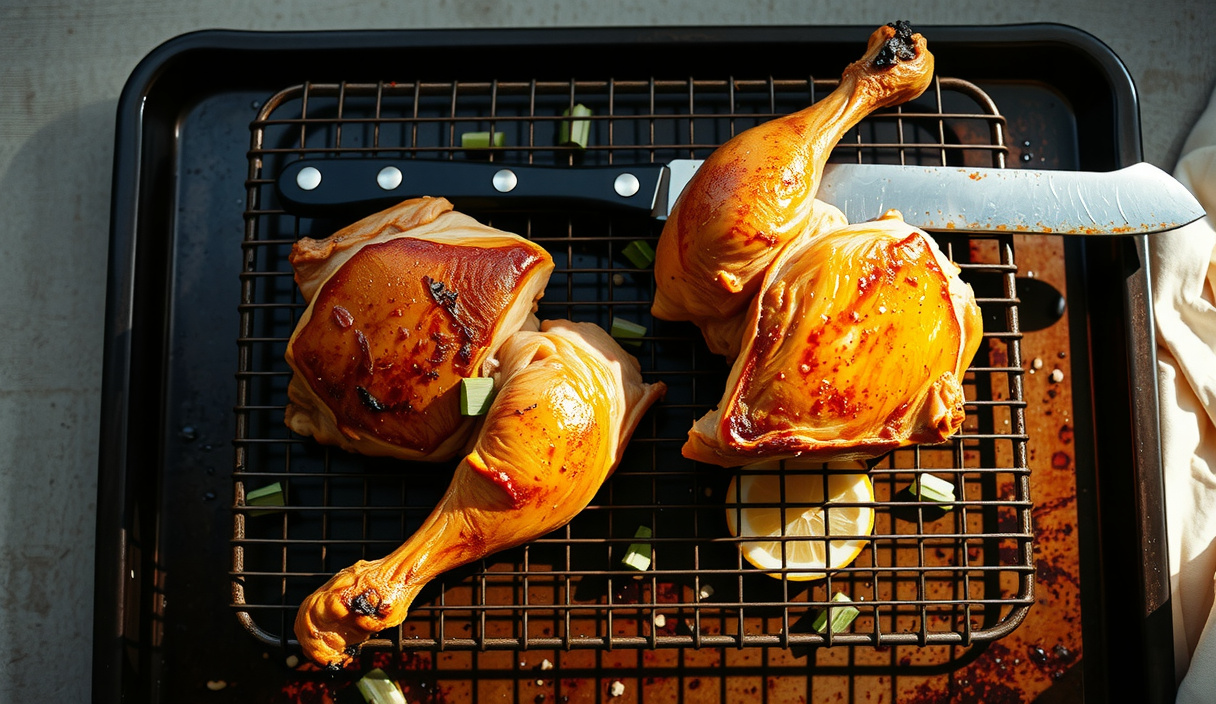
Low-Sodium Smoked Chicken Thighs

Bone-in, skin-on chicken thighs marinated in full-fat buttermilk and smoked low-and-slow over apple or cherry wood to 175°F internal. A no-salt rub of smoked paprika, garlic, onion, oregano, lemon zest, and black pepper builds deep bark and aromatic complexity without a single gram of added sodium. Each thigh delivers under 280 mg of sodium — less than one-fifth of what a standard salt-brined smoked chicken delivers — with the same mahogany bark, rendered skin, and gelatin-rich bite.
Equipment
- 1 Offset, kettle, or pellet smoker Must hold 225°F–250°F at grate level with indirect heat zone
- 2–3 chunks Apple or cherry wood chunks or chips Fist-sized hardwood chunks preferred over chips for longer, cleaner smoke
- 1 Instant-read thermometer Probe at the thickest point of the thigh, avoiding the bone
- 1 Wire rack set over rimmed baking sheet For the air-dry pellicle step in the refrigerator
- 1 Large zip-lock bag or baking dish For buttermilk marinade; dish works better for even coverage of large batches
Ingredients
Buttermilk Marinade
- 2 cups full-fat buttermilk Do not substitute low-fat; the fat carries volatile aromatics into the skin
- 1 teaspoon black pepper, freshly ground
- 1 teaspoon garlic powder Single-ingredient, no added salt
- 1 teaspoon onion powder Single-ingredient, no added salt
No-Salt Herb Rub
- 2 teaspoons smoked paprika Spanish pimentón de la Vera preferred for pre-formed smoke phenolics
- 1 teaspoon garlic powder Single-ingredient, no added salt
- 1 teaspoon onion powder Single-ingredient, no added salt
- 1 teaspoon dried oregano
- 1 teaspoon black pepper, freshly ground
- 1 teaspoon lemon zest From approximately 1 medium lemon; zest finely with a microplane immediately before mixing
- 0.5 teaspoon cayenne pepper Optional; omit for strict heat-sensitive diets
Chicken
- 6 bone-in, skin-on chicken thighs 6–8 oz each; trim excess hanging skin flaps but keep the main skin cap intact
Finishing
- 1 lemon, cut into wedges For serving; squeeze at the table rather than during the cook
- 4 sprigs fresh thyme Optional garnish

Instructions
Marinade and Pellicle
- Combine the 2 cups full-fat buttermilk, 1 tsp black pepper, 1 tsp garlic powder, and 1 tsp onion powder in a large zip-lock bag or baking dish. Add the 6 bone-in, skin-on chicken thighs. Seal or cover and refrigerate for 4 to 8 hours. Do not exceed 12 hours — lactic acid continues to denature surface proteins and extended exposure produces a mushy texture.1 teaspoon black pepper, freshly ground, 1 teaspoon garlic powder, 1 teaspoon onion powder, 1 lemon, cut into wedges
- Remove thighs from the marinade and shake off excess. Pat each piece thoroughly dry with paper towels — top, bottom, and all sides. Place skin-side up on a wire rack set over a rimmed baking sheet. Refrigerate uncovered for 30 to 60 minutes. The surface will become tacky and slightly dry to the touch. This pellicle layer is critical for smoke adhesion.1 lemon, cut into wedges
Build the Rub
- While the thighs air-dry, combine the no-salt herb rub in a small bowl: 2 tsp smoked paprika, 1 tsp garlic powder, 1 tsp onion powder, 1 tsp dried oregano, 1 tsp black pepper, 1 tsp fresh lemon zest, and 0.5 tsp cayenne if using. Stir to combine. The lemon zest will clump slightly — this is normal and ensures concentrated citral deposits on the skin.2 teaspoons smoked paprika, 1 teaspoon garlic powder, 1 teaspoon onion powder, 1 teaspoon dried oregano, 1 teaspoon black pepper, freshly ground, 1 teaspoon lemon zest, 0.5 teaspoon cayenne pepper
- Immediately before the thighs go onto the smoker, dust the rub evenly over all surfaces of each thigh. Press gently with your palm to adhere. Do not rub vigorously — the goal is a uniform coating, not embedding the spices into the surface, which would disrupt the pellicle.2 teaspoons smoked paprika, 1 teaspoon garlic powder, 1 teaspoon onion powder, 1 teaspoon dried oregano, 1 teaspoon black pepper, freshly ground, 1 teaspoon lemon zest, 0.5 teaspoon cayenne pepper, 1 lemon, cut into wedges
Smoke
- Prepare your smoker for indirect heat at 225°F to 250°F at grate level. Add 2 to 3 fist-sized chunks of apple or cherry wood (or a small handful of chips in a foil pouch if using a gas grill). Allow the smoker to stabilize and produce thin, blue-white smoke — not thick, billowing white smoke, which indicates incomplete combustion and creosote formation.
- Place thighs skin-side up on the indirect zone of the grate, at least 1.5 inches apart. Insert your thermometer probe into the thickest piece. Close the lid. Maintain 225°F to 250°F for the first 2 hours without opening the lid — every lid lift drops the grate temperature by 25°F to 40°F and costs 10 to 15 minutes of recovery time.1 lemon, cut into wedges
- After 2 hours, check internal temperatures. If any thigh is below 145°F, close the lid and check again in 20 minutes. Expect a stall between 145°F and 150°F lasting 20 to 45 minutes — this is evaporative cooling and is entirely normal. Do not increase smoker temperature.1 lemon, cut into wedges
- Once the stall breaks and the internal temperature is climbing, flip the thighs skin-side down for the final 15 to 20 minutes to crisp the underside against the grate. Watch closely — the skin fat renders quickly and flare-ups are possible on charcoal setups. Pull from the heat when the thickest thigh registers 175°F internal.1 lemon, cut into wedges
Rest and Serve
- Transfer thighs to a clean cutting board or platter. Rest uncovered for 10 minutes. Do not tent with foil — trapped steam softens the bark you just spent three hours building.1 lemon, cut into wedges
- Serve with lemon wedges and fresh thyme sprigs if using. A squeeze of fresh lemon at the table adds brightness and acidity that amplifies the smoked paprika and oregano notes without any sodium contribution.4 sprigs fresh thyme
Notes
Why buttermilk instead of a salt brine? A standard 4% salt brine drives Na+ ions into the muscle via osmosis, contributing 400–700 mg of sodium per thigh. Buttermilk acidifies the surface (lactic acid, pH 4.4–4.6) without relying on ionic strength. The lactic acid partially denatures surface myosin filaments beginning around 50°F, and calcium ions in the dairy activate native calpain proteases, producing measurable tenderization. The absorbed sodium from buttermilk is estimated at 30–50 mg per thigh — roughly 90% less than a salt brine.
The 175°F target and collagen hydrolysis: Collagen shrinkage begins at 60°C (140°F), but actual hydrolysis into soluble gelatin follows first-order kinetics and accelerates significantly above 70°C (158°F). At 175°F internal, held even briefly, a meaningful fraction of the intramuscular collagen converts, basting the meat fibers in endogenous gelatin. This is why chicken thighs pulled at 175°F feel juicier than those pulled at 165°F despite losing more total moisture — the gelatin creates a perception of succulence that free water alone does not.
Why smoked Spanish paprika, not generic paprika? Spanish pimentón de la Vera is dried over oak fires. The drying process deposits guaiacol, syringol, and catechol esters directly into the cell walls of the pepper. When applied to the skin surface and heated, these pre-formed phenolics volatilize alongside the new Maillard products, creating a layered smoke character the smoker alone cannot replicate. Generic sweet paprika is air-dried and contributes color but no smoke phenolics.
Lemon zest volatile behavior: Limonene (the primary terpene in lemon zest) has a boiling point of 349°F — well above smoking temperatures. It does not flash off during the cook. Instead, it partitions into the skin fat, emerging during mastication as a retronasal aromatic. This is why the citrus note reads more as a lingering brightness than a sharp up-front hit.
Sodium math per serving: Full-fat buttermilk ~260 mg Na per cup. Two cups marinade = ~520 mg Na total in the bath. Estimated absorption across 6 thighs: ~180–300 mg total, or 30–50 mg per thigh. Rub spices (paprika, garlic powder, onion powder, oregano, pepper) contribute negligible sodium when purchased as single-ingredient, no-salt-added products. Finished dish estimate: 220–280 mg Na per thigh, well within a 600 mg per meal low-sodium target.
Nutrition
Calories: 310kcalCarbohydrates: 3gProtein: 28gFat: 20gSaturated Fat: 5.5gCholesterol: 145mgSodium: 255mgFiber: 0.5gSugar: 2g
Tried this recipe?Let us know how it was!