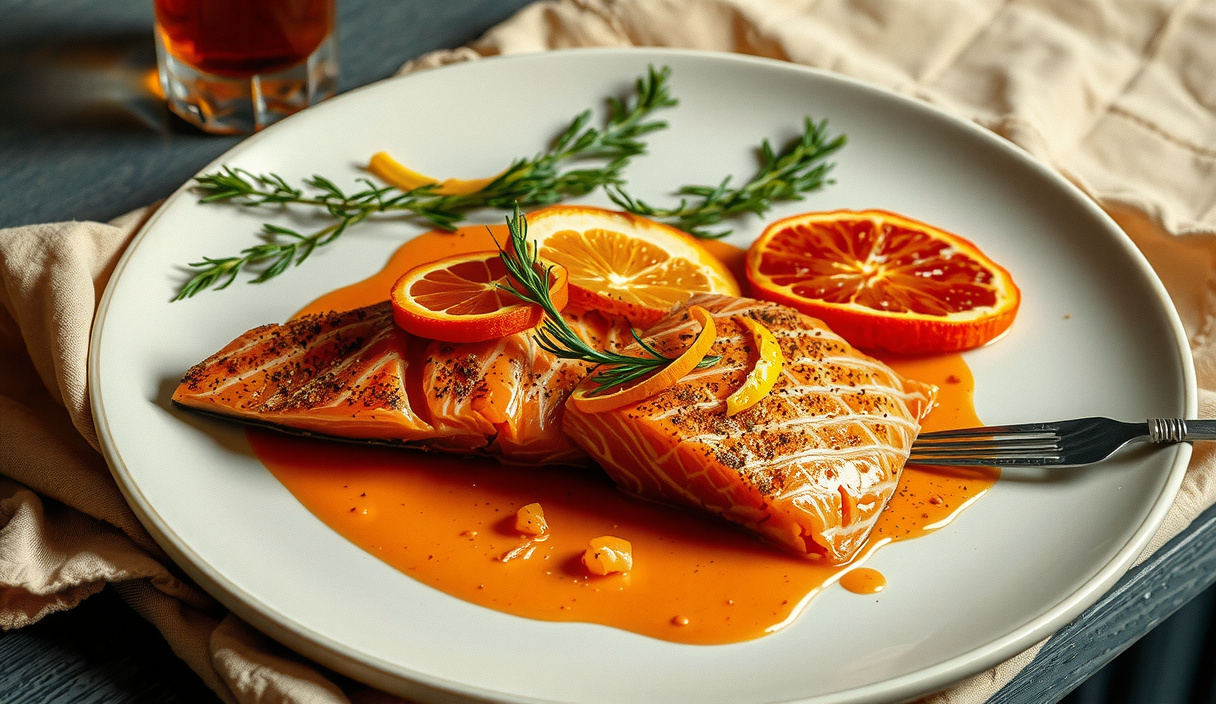
Low-Sodium Smoked Salmon with Dill-Citrus Cure

A half-salt cure at 1.5% w/w — precisely calculated by fillet weight — extended to 6 hours performs the same osmotic dewatering as a standard 3% cure at roughly half the sodium. Fresh dill, lemon and orange zest, and white pepper close the flavor gap by targeting olfactory and trigeminal receptor systems that salt was carrying. Smoked low and slow over alder wood to an internal temperature of exactly 140°F, this salmon is moist, deeply aromatic, and calibrated for anyone tracking dietary sodium without wanting to eat like they are.
Equipment
- 1 Offset smoker, kettle grill with indirect setup, or pellet smoker Must hold a stable 160–180°F (71–82°C) chamber temperature
- 1 Digital kitchen scale Gram precision required for the 1.5% cure calculation
- 1 Probe thermometer with continuous readout Pull at exactly 140°F (60°C) internal
- 1 Wire rack set inside a rimmed baking sheet For pellicle formation in the refrigerator
- 1 Microplane zester For zesting — pith-free zest only
- 2 to 3 cups Alder wood chunks or chips Apple wood is a solid alternative; avoid hickory and mesquite
Ingredients
Salmon
- 1.5 to 2 lbs center-cut skin-on salmon fillet Pin bones removed; weigh in grams before proceeding
Half-Salt Dill-Citrus Cure
- kosher salt (Diamond Crystal), measured by weight Calculate as 0.015 x fillet weight in grams — this is your exact NaCl dose
- 2 tsp granulated sugar Accelerates Maillard surface browning and offsets any perceptible bitterness at reduced salt levels
- 1 large lemon, zested Microplane only; avoid the white pith
- 1 medium navel orange, zested Adds limonene and linalool volatiles that read as brightness
- 3 tbsp fresh dill, finely chopped Carvone and myristicin compounds; add just before applying to the fish
- 0.5 tsp white pepper, finely ground Piperine activates TRPV1 receptors and extends palate finish without sodium
Finish (optional, at service)
- 1 tbsp fresh dill fronds Garnish
- 1 tsp lemon zest Bright aromatic finish just before serving

Instructions
Cure Preparation
- Weigh your salmon fillet in grams on a digital kitchen scale. Multiply that weight by 0.015 to get your exact kosher salt dose in grams. Write this number down. Measure out the salt precisely by weight — do not estimate by volume.
- In a small bowl, combine the weighed kosher salt, sugar, lemon zest, and orange zest. Using your fingertips, work the zest into the salt for about 30 seconds until the mixture is fragrant and slightly damp. Let it sit for 5 minutes — this blooming step releases essential oils from the flavedo cells directly into the salt crystals, improving aromatic transfer to the fish surface.2 tsp granulated sugar, 1 large lemon, zested, 1 medium navel orange, zested
- Add the finely chopped fresh dill and white pepper to the cure blend and stir to combine.3 tbsp fresh dill, finely chopped, 0.5 tsp white pepper, finely ground
Curing the Salmon
- Place the salmon fillet skin-side down on a large sheet of plastic wrap set inside a rimmed baking dish. Apply the entire cure blend evenly over the flesh side of the fillet, pressing gently to ensure full contact across the surface. Pay extra attention to the thicker end of the fillet — the thicker sections need full coverage to cure evenly.2 tsp granulated sugar, 1 large lemon, zested, 1 medium navel orange, zested, 3 tbsp fresh dill, finely chopped, 0.5 tsp white pepper, finely ground
- Wrap the fillet tightly in the plastic wrap and refrigerate for exactly 6 hours. Do not shorten this window — the reduced salt concentration requires the full time to drive equivalent osmotic dewatering and surface protein denaturation. Flip the wrapped fillet once at the 3-hour mark.
Pellicle Formation
- Unwrap the cured salmon and rinse it thoroughly under cold running water for 60 seconds, removing all surface cure. Pat completely dry with paper towels — every bit of surface moisture you remove now is moisture the pellicle does not have to expel.
- Place the rinsed, dried fillet skin-side down on a wire rack set over a rimmed baking sheet. Refrigerate uncovered for a minimum of 1 hour, ideally 2. The pellicle is ready when the surface of the fish is tacky and slightly shiny to the touch. This dried protein film is essential for smoke adhesion — do not skip this step.
Smoking
- Set up your smoker for indirect heat and preheat to a stable 160–180°F (71–82°C) chamber temperature. Add alder wood chunks or soaked chips to produce a thin, clean blue smoke. Avoid thick white billowing smoke, which deposits harsh creosote compounds on the pellicle.
- Place the salmon fillet skin-side down directly on the smoker grate. Insert a probe thermometer into the thickest part of the fillet, center-cut, keeping the probe tip away from the skin. Close the lid and smoke without opening for the first 45 minutes.
- Continue smoking until the internal temperature reads exactly 140°F (60°C). Total time will be approximately 90–120 minutes depending on fillet thickness and smoker consistency. Do not exceed 140°F — every degree above this threshold increases the risk of actin network collapse and permanent moisture loss. Remove the fillet from the smoker the moment the target temperature is reached.
Rest and Serve
- Rest the smoked salmon on its rack at room temperature for 15 minutes, then transfer to the refrigerator uncovered for at least 1 hour before slicing. This rest period allows internal moisture to redistribute and dramatically improves slice integrity.
- To serve, slice thin on a bias against the grain of the myomere layers using a long, sharp slicing knife. Garnish with fresh dill fronds and a light dusting of fresh lemon zest if desired. Store leftovers refrigerated at or below 38°F (3°C) and consume within 5 days.1 tbsp fresh dill fronds, 1 tsp lemon zest
Notes
Why 1.5% w/w and 6 hours instead of 3% and 2 hours? Osmotic dewatering is governed by the concentration gradient across the muscle cell membrane and the duration of exposure. At 3% NaCl, the gradient is steep — water migration is fast and aggressive. At 1.5%, the gradient is exactly half as steep, and the driving force is sustained over a longer contact window. After 6 hours at 1.5%, the total osmotic work performed on the fillet — measured by moisture loss percentage and pellicle formation quality — is functionally equivalent to a 2-to-3-hour 3% cure. The sodium delivered to the flesh, however, is roughly halved.
The actin collapse threshold at 74.4°C (166°F): Salmon myofibrillar tissue contains actin filaments that remain structurally intact up to approximately 74.4°C. Above this temperature, actin undergoes rapid denaturation. The actomyosin complex violently contracts both transversely and longitudinally, physically squeezing moisture out of the interstitial spaces in the muscle. This is irreversible — no amount of resting or saucing recovers expelled moisture. At our target of 140°F (60°C) internal, we are operating in the sarcoplasmic denaturation zone (which peaks around 67°C) while keeping the actin network intact. The result is a fully safe, fully set salmon that retains maximum water-holding capacity.
Pellicle physics: The pellicle is a dehydrated, cross-linked protein film formed when the surface proteins denature and partially aggregate after the rinse-and-dry stage. It is not cosmetic. Without a proper pellicle, smoke phenolics (primarily guaiacol and syringol) do not bond efficiently to the fish surface — they bead off or deposit unevenly. The pellicle also provides an additional antimicrobial barrier and structurally reinforces the surface against the thermal expansion that occurs during smoking. Two hours of uncovered refrigerator drying produces a reliably tacky, receptive surface.
Sodium estimate per serving: At 1.5% w/w NaCl on a 750g (1.65 lb) fillet, total applied sodium is approximately 4.35g NaCl, or 1,710 mg elemental sodium. Not all of this penetrates the flesh — some is rinsed away during the post-cure wash. Estimated retention is 40–60% of applied cure based on standard diffusion models for cold curing fish. Final sodium per 3-ounce (85g) serving is approximately 220–310 mg, compared to 600–900 mg for standard-cure smoked salmon of equivalent thickness.
Nutrition
Calories: 165kcalCarbohydrates: 1gProtein: 23gFat: 8gSaturated Fat: 1.5gCholesterol: 62mgSodium: 265mgSugar: 1g
Tried this recipe?Let us know how it was!