Memphis Dry-Rub Spare Ribs (3-2-1 Method)
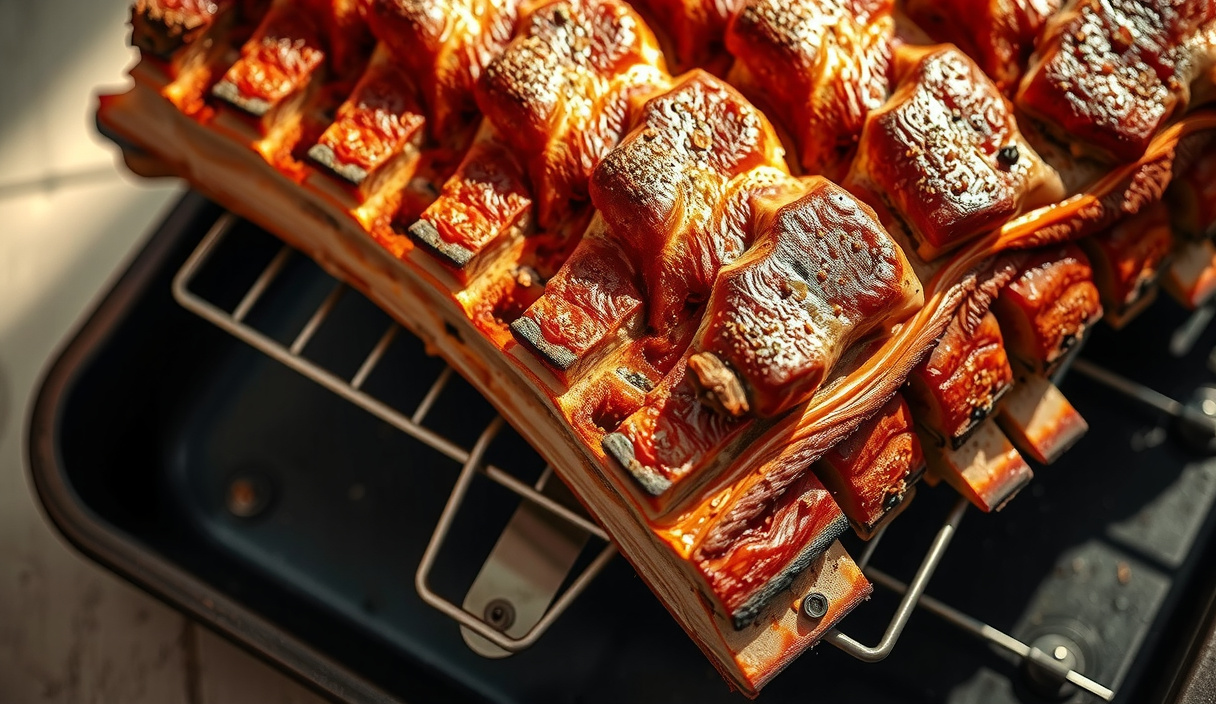
St. Louis-cut spare ribs coated in a smoked paprika, cumin, and brown sugar dry rub, then smoked low and slow over a hickory-apple blend using the 3-2-1 method. Phase one builds bark and smoke ring. Phase two (foil-wrapped) drives collagen-to-gelatin conversion. Phase three sets the bark to a lacquered, competition-style finish. Pulled at the bend test, never at falling-off-the-bone.
Equipment
- 1 Offset smoker or charcoal kettle with two-zone setup Must hold 225–250°F (107–121°C) at grate level for 6 hours
- 1 Leave-in digital probe thermometer Calibrated; read at grate level, not dome
- 1 roll Heavy-duty aluminum foil Used to wrap ribs tightly during phase two; double-layer for zero steam escape
- 1 Spray bottle For apple cider vinegar spritz during phase one
- 1 Boning knife For trimming membrane and any excess flap if full spares are used
- 6 oz Hickory wood chunks Chunks, not chips; 70% of total wood by weight
- 3 oz Apple wood chunks 30% of total wood by weight; moderates phenolic sharpness of hickory
Ingredients
Ribs
- 1 rack St. Louis-cut spare ribs About 3 to 3.5 lbs; membrane removed, excess hard fat trimmed
Dry Rub
- 3 tablespoons smoked paprika (pimentón de la vera) Sweet or bittersweet; do not substitute sweet paprika
- 2 tablespoons light brown sugar, packed Packed; contributes Maillard browning and bark depth
- 1 tablespoon kosher salt Diamond Crystal; if using Morton, reduce to 2 teaspoons
- 1 tablespoon ground cumin Freshly ground from whole seeds if possible for maximum volatility
- 2 teaspoons freshly ground black pepper Coarse grind
- 1 teaspoon garlic powder Not garlic salt
- 1 teaspoon onion powder
- 1 teaspoon dry mustard powder Colman's or equivalent; adds emulsified sulfur VOCs to the bark
- ½ teaspoon cayenne pepper Adjust to taste; this level registers as background warmth only
- ½ teaspoon dried thyme Optional but traditional in Memphis profiles
Spritz and Wrap
- ½ cup apple cider vinegar Mixed 1:1 with apple juice for the spritz bottle
- ½ cup unfiltered apple juice Mixed with vinegar for spritz
- 3 tablespoons apple juice Added inside the foil packet during the wrap phase to generate steam

Instructions
Prepare the Ribs and Rub
- Place the rack bone-side up on a cutting board. Slide a butter knife under the membrane (periosteum) at one end near a center bone. Grip the loosened edge with a paper towel and pull firmly in one motion to remove the entire membrane. Pat the rack dry on both sides with paper towels.
- Combine all dry rub ingredients in a small bowl: smoked paprika, brown sugar, kosher salt, cumin, black pepper, garlic powder, onion powder, dry mustard powder, cayenne, and thyme. Mix thoroughly. You need roughly 6 to 7 tablespoons total for one rack.2 tablespoons light brown sugar, packed, 1 tablespoon kosher salt, 1 tablespoon ground cumin, 2 teaspoons freshly ground black pepper, 1 teaspoon garlic powder, 1 teaspoon onion powder, 1 teaspoon dry mustard powder, 1/2 teaspoon cayenne pepper, 1/2 teaspoon dried thyme
- Apply the dry rub generously to the meat side, then the bone side, then the edges. Press it firmly into the surface with clean hands — you want adhesion, not a loose coating. Place the rack uncovered in the refrigerator for at least 1 hour, or up to 12 hours overnight. A surface pellicle will form, which aids bark adhesion and smoke absorption.2 tablespoons light brown sugar, packed, 1 tablespoon kosher salt, 1 tablespoon ground cumin, 2 teaspoons freshly ground black pepper, 1 teaspoon garlic powder, 1 teaspoon onion powder, 1 teaspoon dry mustard powder, 1/2 teaspoon cayenne pepper, 1/2 teaspoon dried thyme
Set Up the Smoker
- Light your charcoal or fire your offset 45 to 60 minutes before the ribs go on. Target a stable 225–250°F (107–121°C) at grate level. Verify with a calibrated probe at grate height — dome thermometers routinely read 15–30°F hotter than actual cooking temperature. Do not place the ribs until the temperature is stable and you have clean, thin, blue-gray smoke (not white billowing smoke, which indicates incomplete combustion and bitter creosote).
- Add the first wood addition: approximately 4 oz hickory chunks and 2 oz apple chunks placed directly on the coals or in the firebox. The smoke will be heaviest in the first 30 minutes — this is when the ribs absorb the most smoke, as cold protein surfaces are highly receptive. Prepare the spritz bottle by mixing apple cider vinegar and apple juice 1:1.1/2 cup apple cider vinegar, 1/2 cup unfiltered apple juice
Phase 1 — Unwrapped Smoke (3 Hours)
- Place the rack bone-side down on the grate over indirect heat. Insert a probe thermometer into the thickest part of the meat between two center bones, not touching bone. Close the lid. Do not open for the first 90 minutes. This phase is building the Maillard bark and establishing the smoke ring.
- At the 90-minute mark, open the smoker and quickly spritz both sides of the rack with the apple cider vinegar and apple juice mixture. Close immediately. Repeat the spritz every 45 to 60 minutes for the remainder of phase one. If the surface looks dry and the color is not deepening past pale orange, spritz more aggressively. Add a second wood addition (2 oz hickory, 1 oz apple) at the 2-hour mark if smoke production has dropped.1/2 cup apple cider vinegar, 1/2 cup unfiltered apple juice
- After a full 3 hours, pull the rack. The surface should be deep mahogany to reddish-brown with a defined dry bark. The internal temperature will likely be in the 155–170°F (68–77°C) range, possibly stalled. This is normal and expected. Do not wait for the stall to break — proceed to the foil wrap on schedule.
Phase 2 — Foil Wrap (2 Hours)
- Tear two large sheets of heavy-duty aluminum foil, each about twice the length of the rack. Lay one sheet flat and place the rack bone-side up on it. Pour 3 tablespoons of apple juice directly onto the bone side of the rack. Fold the foil up tightly around the rack, then wrap the second sheet around the entire package to create a double-layered, steam-tight seal. There should be no gaps — even a small opening will let steam escape and slow collagen hydrolysis significantly.3 tablespoons apple juice
- Return the foil-wrapped rack to the smoker at 225–250°F, bone-side down. Cook for exactly 2 hours. During this phase the internal temperature will climb steadily through the 180s and into the low 190s°F (82–91°C) as the trapped steam accelerates collagen-to-gelatin conversion. No spritzing or opening is needed.
Phase 3 — Bark Set (1 Hour)
- After 2 hours, carefully unwrap the foil. The rack will be visibly more pliable and the surface will appear steamed and softened. Discard the foil and collected juices (or save the juices — they are intensely flavored rendered collagen and can be added to a finishing sauce). Return the rack unwrapped, bone-side down to the smoker.
- Cook uncovered for 45 minutes to 1 hour. This phase re-dries the surface, concentrating the gelatin layer into a tacky, glossy bark. Check the bend test at the 45-minute mark: grip the rack with tongs at one end and lift — if it bends about 90 degrees with a visible crack forming in the bark before breaking, the ribs are done. If the rack droops more than 90 degrees with no resistance, it is past ideal but still excellent. If it is stiff and barely flexes, return to the smoker in 15-minute increments and re-test.
- Cross-check with the toothpick test: push a wooden toothpick between two center bones. It should slide in with zero resistance — like pushing into soft butter. Confirm the probe is reading 195–203°F (91–95°C) internal, understanding that the bend and toothpick tests override the thermometer as final arbiter.
Rest and Serve
- Remove the rack from the smoker and rest uncovered (or loosely tented in foil) on a cutting board for 15 to 30 minutes. This rest allows expelled moisture to redistribute through the muscle fibers. Do not skip it — cutting immediately will cause significant juice loss onto the board.
- Slice between each rib bone with a sharp slicing knife using a single smooth stroke. Each bone should separate cleanly, with the meat pulling away from the bone with a gentle tug — not zero tug (overcooked), and not a fight (undercooked). Serve immediately, bone-side down, with no sauce required. Memphis dry-rub ribs stand alone.
Notes
Why the stall happens: At approximately 160–170°F internal, surface evaporation absorbs thermal energy as fast as the smoker delivers it, anchoring the internal temperature for 45–90 minutes or more. This is the Maillard browning phase working in your favor on the exterior while the interior holds. The foil wrap bypasses the stall entirely on the back half of the cook by eliminating surface evaporation and converting the environment to a steam-assisted braise.
Why the bend test beats a target temperature: Collagen hydrolysis is a first-order kinetic process — it depends on both temperature and time together, not temperature alone. Two racks from different animals with different connective tissue loads will reach the same internal temperature at very different states of tenderness. The bend test measures the rheological outcome (how much collagen has actually converted to gelatin and weakened the interstitial structure) directly, making it a more accurate doneness signal than any temperature reading.
Smoke ring chemistry: The pink ring beneath the bark is not raw meat. It is carboxymyoglobin and nitrosomyoglobin — chemically stable pigments formed when carbon monoxide (CO) and nitrogen dioxide (NO₂) from combustion gases dissolve into the wet meat surface and bind with myoglobin. These complexes resist the normal thermal conversion to gray-tan hemichrome up to higher temperatures than oxymyoglobin does. A deep ring (¼ inch or more) indicates excellent fire management: clean combustion, sufficient surface moisture during the open phase, and consistent temperatures. It is aesthetically meaningful and a sign of technique, but it does not affect flavor.
Brown sugar concentration note: At 225–250°F grate temperature, the brown sugar in the rub does not caramelize in the traditional sense (caramelization of sucrose requires above 320°F / 160°C in isolation). Instead, the reducing monosaccharide fractions in brown sugar (from partial sucrose hydrolysis and added molasses) participate in the Maillard cascade with amino acids on the pork surface. This is why lower-sugar rubs produce lighter, less sweet bark at the same smoke temperatures — the Maillard reaction, not caramelization, is the dominant browning pathway here.
Nutrition
Calories: 720kcalCarbohydrates: 9gProtein: 54gFat: 51gSaturated Fat: 18gCholesterol: 210mgSodium: 890mgFiber: 1gSugar: 7g
Tried this recipe?Let us know how it was!