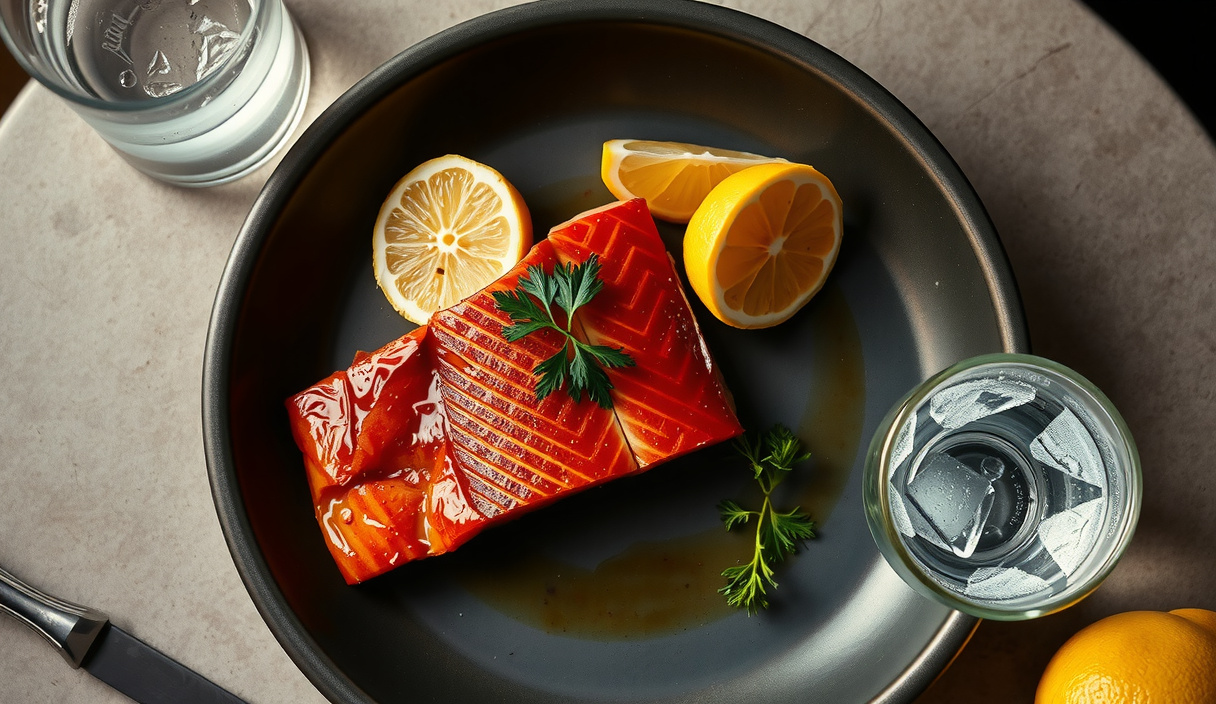
Pellet-Smoked King Salmon (Dry-Cured, Albumin-Free Method)

King salmon fillets dry-cured in a 3:1 salt-sugar mix for 4 hours, air-dried to a tacky pellicle, then smoked over alder pellets at 180°F to an internal temperature of 130°F. The cure pre-sets the albumin layer so the surface stays clean and lacquered throughout the cook — no white weeping, just deep smoke penetration and silky, fat-rich flesh.
Equipment
- 1 Pellet grill Capable of a stable 180°F setting; Super Smoke or low-smoke mode preferred. Alder, cherry, or apple pellets loaded.
- 1 Leave-in probe thermometer Wireless preferred; insert into the thickest point of the loin before the fillet goes on the grill.
- 1 Wire cooling rack For pellicle development; allows airflow under the fillet during the uncovered refrigerator rest.
- 1 Rimmed baking sheet Lined with plastic wrap for the cure stage; holds the fillet flat and contains moisture drawn out by the salt-sugar mixture.
- 1 Needle-nose pliers For pin bone removal prior to curing. Pull in the direction of each bone's natural angle.
- 1 Small desk fan (optional) Directed at the fillet during refrigerator air-dry; reduces pellicle development time from 90 minutes to approximately 45 minutes.
Ingredients
Salmon
- 2.5 lbs King salmon fillet, skin-on, pin bones removed Center-cut preferred; wild Alaskan Chinook or farm-raised New Zealand King both work. Avoid thin tail sections for this method.
Dry Cure
- 3 tablespoons Diamond Crystal kosher salt If using Morton's kosher salt, reduce to 2.5 tablespoons — Morton's has a higher bulk density and the ionic load will be greater by volume.
- 1 tablespoon granulated white sugar White sugar is used rather than brown to prevent hygroscopic molasses compounds from slowing pellicle formation.
- 1 teaspoon freshly cracked black pepper Optional; contributes piperine-forward aromatic complexity to the pellicle layer.
For Smoking
- 1 tablespoon neutral oil (avocado or refined sunflower) For oiling the grill grates to prevent sticking. Do not apply oil to the fillet — it will impede smoke adhesion to the pellicle.
- 2 cups alder, cherry, or apple wood pellets Loaded into the pellet hopper. Do not use hickory or mesquite at this temperature — they generate harsh phenolic compounds that overwhelm salmon fat.

Instructions
Cure the Salmon
- Remove any remaining pin bones from the salmon fillet using needle-nose pliers. Run your fingertip along the lateral line of the flesh side to locate them; pull each bone in the direction of its natural angle to avoid tearing the myotome structure.
- Combine the kosher salt, granulated white sugar, and cracked black pepper in a small bowl and mix thoroughly.1 tablespoon granulated white sugar, 1 teaspoon freshly cracked black pepper
- Line a rimmed baking sheet with plastic wrap. Lay the salmon fillet skin-side down. Apply the cure mixture evenly across the entire flesh side, pressing gently so it adheres. Do not apply cure to the skin. The cure layer should be even and approximately 1/8-inch thick — not packed on, not sparse.1 tablespoon granulated white sugar, 1 teaspoon freshly cracked black pepper
- Loosely cover the fillet with plastic wrap and refrigerate for exactly 4 hours. Do not exceed 5 hours for a 2.5-pound fillet — extended cure times increase ionic penetration depth, producing an uncomfortably salty interior and a firmer, more compressed texture than intended. Set a timer.
Rinse and Develop the Pellicle
- After 4 hours, remove the fillet from the refrigerator. Rinse thoroughly under cold running water, removing all visible cure residue from both the flesh and skin sides. Pat dry with paper towels — both sides, firmly.
- Place the fillet skin-side down on a wire rack set over a clean baking sheet. Refrigerate uncovered for a minimum of 45 minutes, ideally 90 minutes. If using a small desk fan, direct it at the flesh side of the fillet to accelerate surface drying. The fillet is ready when the surface feels distinctly tacky and slightly leathery to the touch — not wet, not shiny. A wet fillet cannot develop proper smoke adhesion and will weep albumin during the cook.
Smoke the Salmon
- Preheat your pellet grill loaded with alder, cherry, or apple pellets to 180°F. If your grill has a Super Smoke or low-smoke mode, activate it — these modes oscillate the auger to maximize smoke output at low temperatures. Allow the grill to reach and stabilize at 180°F for at least 15 minutes before the fillet goes on. Verify temperature with an independent grill thermometer if possible, as pellet grills frequently read 10–15°F warmer than actual grate-level temperature.2 cups alder, cherry, or apple wood pellets
- Oil the grill grates lightly with neutral oil using a folded paper towel held with tongs. Do not oil the fillet itself — surface oil impedes smoke compound adsorption to the pellicle.1 tablespoon neutral oil (avocado or refined sunflower)
- Place the fillet on the grill skin-side down. Insert the leave-in probe into the thickest point of the loin at a shallow angle, with the tip positioned at the geometric center of the muscle mass. Close the lid. Do not open the lid during the first 60 minutes of the cook.
- Smoke the fillet at 180°F until the internal temperature reaches 130°F at the thickest point of the loin. For a 2.5-pound center-cut King salmon fillet, this typically takes 90 to 120 minutes at 180°F ambient. Begin checking the probe reading at 75 minutes. Watch for the flesh-side color transition from translucent deep coral to opaque lighter pink progressing inward from the edges — when the center retains a slightly translucent, jewel-like quality and the probe reads 125–128°F, begin monitoring closely for carryover.
- Remove the fillet from the grill when the probe reads 128–130°F. Transfer to a cutting board or serving platter and rest uncovered for 5 to 10 minutes. Do not tent with foil — trapped steam will soften the pellicle and reintroduce surface moisture. The fillet is structurally stable and will not fall apart during the rest period.
- Serve directly from the skin — use a wide spatula to separate portions from the skin, which will adhere to the grate or platter. Alternatively, leave the skin on and serve in full for guests to peel away. The belly section will be more fully cooked and richly fatty; the loin section will be the textural centerpiece.
Notes
Why 3:1 salt-to-sugar by weight, not by volume? Volume measurements of kosher salt vary dramatically by brand — Diamond Crystal is significantly less dense than Morton's. By weight, a 3:1 ratio delivers a consistent ionic strength regardless of the salt brand in your pantry. The ionic strength of the brine that forms as the cure draws moisture from the fish dictates the depth and speed of myofibrillar denaturation in the surface layer. Too low, and the albumin is not fully displaced before smoking begins; too high, and the cured flesh becomes dense, rubbery, and unpleasantly salty at the surface.
The pellicle is a Maillard primer. The tacky surface film formed during the air-dry stage is a concentration of proteins and sugars drawn to the surface by osmotic action during the cure. When this layer contacts the warm, dry air of the smoker, it undergoes low-temperature Maillard condensation — Schiff base formation between the sugar carbonyl groups and available amino groups — generating the amber-mahogany color and the slightly caramelized top note of well-smoked salmon. Without it, the surface is pale, smoke adhesion is poor, and flavor is superficial.
Why 130°F and not 145°F (USDA target)? At a sustained smoker temperature of 180°F, the surface and sub-surface layers of the fillet reach and exceed 145°F well before the geometric center reads 130°F. The USDA 145°F target is a point-in-time instantaneous reading at the coldest point of the protein. In this cook, because the cook is extended over 90+ minutes at 180°F ambient, the integrated time-at-temperature across the entire fillet exceeds the equivalent pasteurization threshold for a 6-log reduction of Listeria and Salmonella even though the very center reads only 130°F at pull. Pulling at 130°F internal preserves the supra-threshold actin network and maintains maximum moisture retention. Cooking to 145°F internal will produce a fillet that is fully cooked but notably drier and more compressed — the actin denaturation zone has begun.
Albumin diagnostic: If white curd appears during the cook, it means either the pellicle was insufficient (wet surface) or the grill spiked above 200°F ambient. In the former case, the fix is procedural for the next cook. In the latter, you can reduce future spike risk by placing an oven-safe water pan on the grill grate beside the fillet — the latent heat of water evaporation buffers temperature fluctuations in the cooking chamber.
Nutrition
Calories: 310kcalCarbohydrates: 1gProtein: 38gFat: 16gSaturated Fat: 3.5gCholesterol: 95mgSodium: 480mgSugar: 1g
Tried this recipe?Let us know how it was!