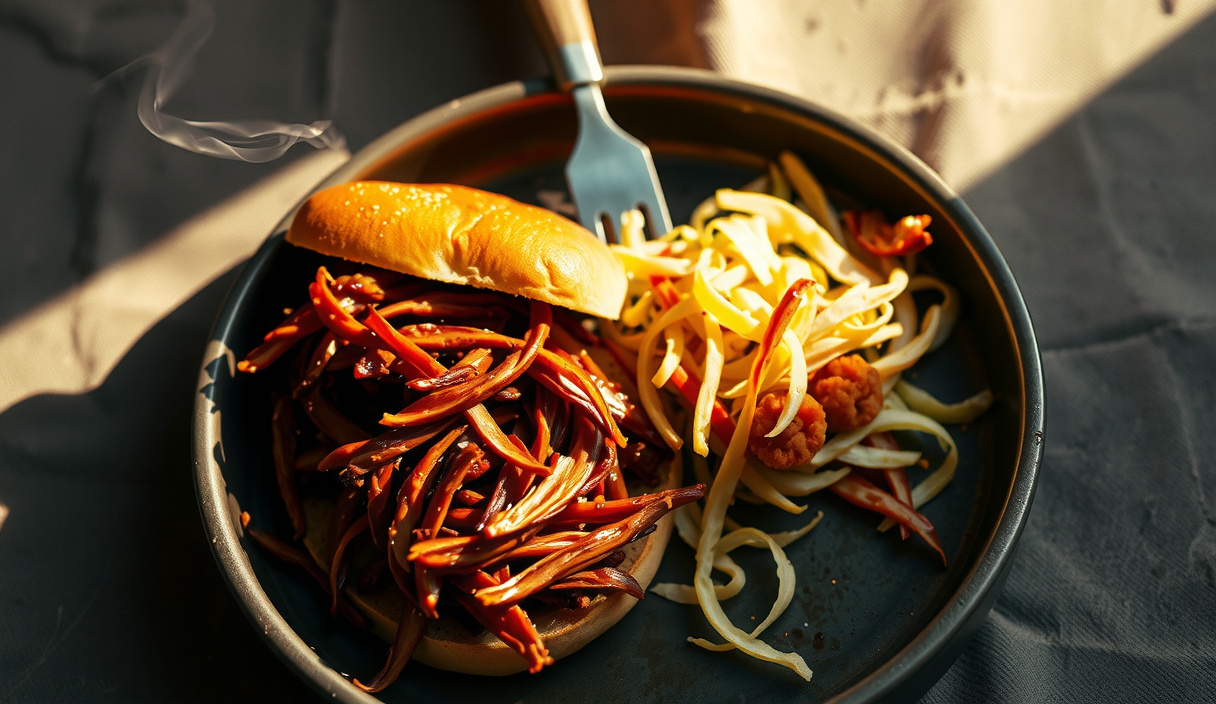
Plant-Based 'Pulled Pork' — Jackfruit + Soy Curls

Young green jackfruit smoked low-and-slow at 225°F, then braised with rehydrated soy curls in a tomato-vinegar BBQ sauce. The smoke phase deposits guaiacol and syringol deep into the fibrous jackfruit matrix while the acidic braise suppresses lipoxygenase-driven off-notes and softens the cell walls to shred-ready tenderness. The result is a structurally convincing, deeply smoky plant-based pulled pork with meaningful protein from whole-soybean soy curls.
Equipment
- 1 Smoker or kettle grill with indirect heat setup Target 225°F at grate level. A two-zone charcoal setup with apple or cherry wood chunks works equivalently to a pellet smoker.
- 2-3 Wood chunks (apple or cherry) For smoke flavor. Avoid mesquite — it over-dominates the delicate jackfruit matrix.
- 1 Large cast iron skillet or Dutch oven For the braise phase. Must be oven-safe to 300°F if finishing in the oven.
- 1 Wire rack set inside a rimmed baking sheet For drying jackfruit before seasoning and smoking.
- 2 Two forks For shredding. Pull apart at 130–140°F internal — not scalding hot.
- 1 Instant-read thermometer For monitoring both smoker grate temperature and braise temperature.
Ingredients
Jackfruit
- 2 cans (20 oz each) young green jackfruit in brine Drained, rinsed thoroughly, and patted completely dry. Do not use ripe jackfruit in syrup.
- 2 tbsp smoked paprika (pimentón de la Vera) Sweet or bittersweet variety. Check label for authentic oak-smoke processing.
- 1 tbsp ground cumin
- 1 tsp garlic powder
- 1 tsp onion powder
- 1 tsp fine sea salt
- ½ tsp black pepper, freshly ground
- ½ tsp cayenne pepper Adjust to heat preference.
- 1 tbsp neutral oil (avocado or sunflower) Helps dry rub adhere to jackfruit surface and promotes smoke adhesion.
Soy Curls
- 2 oz dry soy curls (Butler Foods or equivalent whole-soybean TVP) Approximately 2 loosely packed cups dry.
- 1 cup low-sodium vegetable broth Warm, 140–160°F. Used for rehydration.
- 1 tbsp apple cider vinegar Added to the rehydration liquid to suppress LOX-driven off-notes in soy matrix.
- ½ tsp smoked paprika Added to the rehydration liquid to pre-season soy curls.
Braising Sauce
- 1 cup crushed tomatoes Provides free glutamic acid (umami baseline) and pectin for natural sauce body.
- ½ cup low-sodium vegetable broth
- 3 tbsp apple cider vinegar Organic, unfiltered preferred. Primary acid for LOX suppression and flavor balance.
- 2 tbsp tomato paste Concentrated free glutamates and Maillard products. Stir into the sauce off the direct heat to avoid scorching.
- 2 tbsp molasses (unsulfured) Adds body, dark color, and a low-Maillard browning note. Omit for Carolina-style variation.
- 1 tbsp smoked paprika Reinforces the smoke signal with pyrazines and furanones from its own Maillard cascade.
- 1 tbsp soy sauce or tamari (gluten-free if needed) Delivers free glutamate and 5'-nucleotide synergy. Use coconut aminos for soy-free variation.
- 1 tsp ground cumin
- 1 tsp garlic powder
- ½ tsp onion powder
- ½ tsp black pepper
- ¼ tsp cayenne pepper
For Serving
- 6 hamburger buns or slider buns (use GF buns as needed)
- 1 cup coleslaw (store-bought or homemade) Optional but recommended — the acid and crunch contrast the rich, smoky braise.
- ¼ cup pickled red onion Optional. Adds bright acidity and color contrast.

Instructions
Prep: Jackfruit
- Drain and rinse the canned jackfruit thoroughly under cold running water. Using your hands, squeeze each piece firmly over the sink to expel as much brine and excess water as possible. Spread the pieces on a wire rack set inside a rimmed baking sheet. Pat dry with paper towels, then allow to air-dry at room temperature for 15 minutes. A completely dry surface is non-negotiable for smoke adhesion. Any residual moisture film will cause the phenolic smoke compounds to dissolve and evaporate rather than deposit on the matrix.
- While the jackfruit dries, combine the smoked paprika, cumin, garlic powder, onion powder, salt, black pepper, and cayenne in a small bowl to make the dry rub. Drizzle the oil over the dried jackfruit pieces and toss to coat evenly. Sprinkle the dry rub over the oiled jackfruit and toss again, pressing the spices into the surface so they adhere. Set aside.2 tbsp smoked paprika (pimentón de la Vera), 1 tbsp ground cumin, 1 tsp garlic powder, 1 tsp onion powder, 1 tsp fine sea salt, 1/2 tsp black pepper, freshly ground, 1/2 tsp cayenne pepper, 1 tbsp neutral oil (avocado or sunflower)
Rehydrate: Soy Curls
- In a medium bowl, combine the warm vegetable broth (140–160°F / 60–71°C — not boiling), apple cider vinegar, and smoked paprika for the soy curl rehydration liquid. Add the dry soy curls and stir to submerge. Allow to rehydrate for 15 minutes, stirring once halfway through. Do not use boiling liquid — temperatures above 170°F collapse the cellular matrix of the soy curls into a dense, rubbery mass. The acidic rehydration environment (target pH 4.5–5.0) actively denatures residual lipoxygenase in the soy matrix, suppressing hexanal and related aldehyde off-notes before any heat is applied.1 cup low-sodium vegetable broth, 1 tbsp apple cider vinegar, 1/2 tsp smoked paprika, 1 cup crushed tomatoes
- After 15 minutes, drain the rehydrated soy curls, reserving the rehydration liquid. Squeeze the soy curls firmly to remove excess liquid. Tear any large pieces into smaller, pulled-pork-scale shreds. Set aside. Reserve the rehydration liquid — it carries seasoning and will be incorporated into the braise.1 cup low-sodium vegetable broth
Smoke: Jackfruit
- Set up your smoker or grill for indirect cooking at 225°F (107°C) measured at the grate. Add 2–3 chunks of apple or cherry wood. Allow the smoke to establish and run clean (thin blue smoke, not thick white billowing smoke) before loading the jackfruit. Thick white smoke indicates incomplete combustion and will deposit acrid creosote rather than clean phenolic flavor compounds.
- Place the seasoned jackfruit pieces directly on the grate over the indirect zone in a single layer. Close the lid and smoke at 225°F (107°C) for 90 minutes, adding wood as needed to maintain visible smoke for at least the first 60 minutes. Do not open the lid during the first 45 minutes — every lid-lift drops the grate temperature by 30–50°F and disrupts the evaporative stall that concentrates the flavor-forming surface reactions. After 90 minutes, the jackfruit should be slightly dried on the exterior, deeply colored, and carry a pronounced smoky aroma. Remove from the smoker and set aside.
Build: Braising Sauce
- While the jackfruit smokes, combine all braising sauce ingredients — crushed tomatoes, vegetable broth, apple cider vinegar, tomato paste, molasses, smoked paprika, soy sauce, cumin, garlic powder, onion powder, black pepper, and cayenne — in a large Dutch oven or cast iron skillet. Whisk until the tomato paste and molasses are fully dissolved and homogeneous. The sauce should read pH 4.0–4.5 (test with a strip if you have one) — this acidic environment completes LOX denaturation and activates the pectin-release mechanism in the jackfruit during the braise.1/2 cup low-sodium vegetable broth, 3 tbsp apple cider vinegar, 2 tbsp tomato paste, 2 tbsp molasses (unsulfured), 1 tbsp smoked paprika, 1 tbsp soy sauce or tamari (gluten-free if needed), 1 tsp ground cumin, 1 tsp garlic powder, 1/2 tsp onion powder, 1/2 tsp black pepper, 1/4 tsp cayenne pepper, 6 hamburger buns or slider buns (use GF buns as needed)
Braise: Jackfruit + Soy Curls
- Add the smoked jackfruit pieces and the drained, shredded soy curls to the braising sauce. Add 1/4 cup of the reserved soy curl rehydration liquid to the pot. Stir gently to coat everything with the sauce. Bring to a gentle simmer over medium heat on the stovetop, then reduce heat to low. Cover and braise at a bare simmer — target 185–195°F (85–90°C) internal pot temperature — for 45–55 minutes, stirring every 15 minutes to prevent the bottom from scorching and to distribute the sauce evenly.1 cup low-sodium vegetable broth, 1/2 cup low-sodium vegetable broth, 3 tbsp apple cider vinegar
- After 45 minutes, check the jackfruit texture: it should pull apart easily under fork pressure into long, fibrous strands without resistance. If it still feels dense, continue braising in 10-minute increments. Do not allow the braise to exceed 205°F (96°C) — above this threshold, the cellulose walls of the jackfruit cells fully collapse and the strands disintegrate into paste rather than remaining shred-able. Remove the lid for the final 10 minutes of braising to allow the sauce to reduce and concentrate. The finished sauce should cling to the jackfruit strands rather than pool at the bottom of the pot.1 cup low-sodium vegetable broth
Shred and Serve
- Remove the pot from heat and allow to cool slightly until the mixture reaches 130–140°F (54–60°C) — warm to the touch but no longer scalding. Using two forks, shred the jackfruit pieces in the pot by pulling the strands apart against each other. The soy curls will integrate naturally with the jackfruit strands. Shredding at this temperature produces long, clean strands; shredding at scalding temperatures causes the strands to clump and steam-fuse before you can separate them.1 cup low-sodium vegetable broth
- Taste the finished pulled jackfruit. If you detect any residual grassy or green off-note (residual aldehyde), stir in 1 additional tablespoon of apple cider vinegar and toss over low heat for 3 minutes. Adjust salt if needed. Serve piled high on buns with coleslaw and pickled red onion.2 tbsp tomato paste, 1 cup coleslaw (store-bought or homemade), 1/4 cup pickled red onion
Notes
Why the stall happens — and why you want it: At 225°F grate temperature, the surface of the jackfruit hits the evaporative stall the same way a brisket does. Free water at the surface absorbs the latent heat of vaporization (approximately 2,260 J/g), anchoring the boundary-layer temperature near 212°F and actively preventing Maillard onset at the surface. This is actually what you want during the smoke phase — the extended low-surface-temperature window keeps the surface receptive to smoke compound deposition. The Maillard browning and bark development happen later in the braise where water activity drops as the sauce reduces.
Lipoxygenase (LOX) suppression — the mechanism: LOX is a non-heme iron enzyme that oxidizes polyunsaturated fatty acids (primarily linoleic acid in soybeans) into lipid hydroperoxides, which immediately cleave into volatile, odor-active aldehydes — predominantly hexanal and 2-pentylfuran. These are the 'beany' and 'grassy' notes characteristic of raw plant proteins. LOX has a pH optimum near 6.5–7.0 and is irreversibly denatured below pH 4.5. The acidic rehydration liquid (apple cider vinegar in broth, pH approximately 4.2) denatures the enzyme before any heat is applied. The braising sauce's pH (approximately 4.0–4.5 from tomato and vinegar) completes the job. Smoked paprika's pyrazines and furanones then layer over any remaining trace volatiles with a roasted, savory masking effect that exceeds what cumin or garlic alone can achieve.
Jackfruit pectin as a natural thickener: Young green jackfruit's cell walls are rich in pectin, particularly high-methoxyl pectin (HM pectin). As the braise temperature rises above 160°F (71°C) and the pH drops toward 4.0, the pectin in the cell walls begins to solubilize into the braising liquid. Over the 45–55 minute braise window, this released pectin increases the continuous-phase viscosity of the sauce significantly — equivalent to adding 0.5–0.8% w/w commercial pectin — providing natural cling and body without any starch or hydrocolloid addition. This is why the sauce thickens dramatically in the final 10 minutes when the lid is removed and free water evaporates: the pectin concentration in the remaining liquid increases rapidly toward its gelling threshold.
Umami stacking — tomato glutamate + soy sauce nucleotides: Free L-glutamic acid from the crushed tomatoes and tomato paste provides the baseline umami signal. The soy sauce contributes both additional glutamate and 5'-nucleotides (primarily IMP from the fermentation process). When glutamate and 5'-nucleotides are present simultaneously, their combined receptor activation of T1R1/T1R3 exceeds the simple sum of each alone — this is the synergistic umami effect that makes the braise taste 'meaty' despite containing no animal-derived compounds.
Nutrition
Calories: 285kcalCarbohydrates: 42gProtein: 14gFat: 6gSaturated Fat: 1gSodium: 680mgFiber: 7gSugar: 14g
Tried this recipe?Let us know how it was!