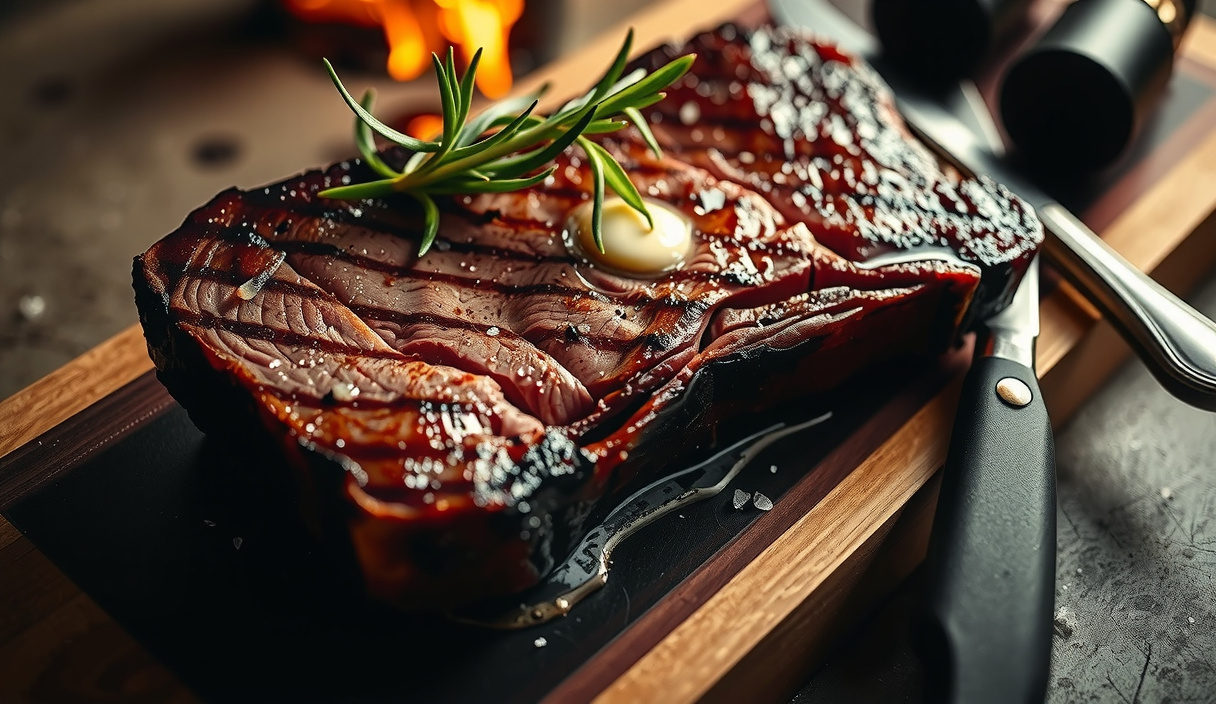
Reverse-Sear Ribeye on the Grill

A bone-in or boneless 2-inch ribeye is low-and-slow smoked on the cool side of a two-zone charcoal grill at 225°F until it hits 115°F internal, then transferred directly over a live coal bed for a 60-to-90-second-per-side Maillard blast. The result is edge-to-edge medium-rare pink encased in a dark, shatteringly crisp crust. Surface drying in the refrigerator for at least 4 hours before the cook is the single most important prep step — it drops surface water activity low enough that browning begins within seconds of grate contact rather than after a prolonged steam phase.
Equipment
- 1 Charcoal grill with lid (22-inch kettle or larger) Set up for two-zone indirect/direct cooking
- 1 Chimney starter For lighting a full load of lump charcoal
- 1 Leave-in dual-probe thermometer One probe at grate level in the indirect zone, one in the steak
- 1 Instant-read thermometer For precision reads during the sear phase
- 1 Wire rack set over a rimmed sheet pan For the refrigerator drying phase and the post-sear rest
- 1 pair Long tongs For flipping over high heat without disturbing the crust
Ingredients
The Steak
- 1 bone-in or boneless ribeye steak, 2 inches thick (approximately 28–34 oz) USDA Prime or high-Choice; heavy marbling in the cap and longissimus is critical
- 1 tsp Diamond Crystal kosher salt Per pound of steak weight; use 3/4 tsp per pound if salting 24 hours ahead
- 1 tsp coarsely cracked black pepper Use a mortar or coarse grind setting — fine pepper burns on the coals
Optional Compound Butter (Applied at Rest)
- 1 tbsp unsalted butter, softened
- 1 tsp fresh thyme leaves
- 1 small garlic clove, finely grated Optional; omit if you prefer unobstructed beef flavor
For the Grill
- 1 full chimney lump hardwood charcoal Approximately 5–6 quarts; split between a small indirect-zone bed and a full direct searing load
- 1 chunk post oak or apple wood Optional; for smoke during the indirect phase only

Instructions
Day Before or 4 Hours Ahead: Season and Dry
- Remove the ribeye from its packaging and pat completely dry on all surfaces with paper towels. Season all sides — including the fat cap and any exposed bone — generously with kosher salt and cracked black pepper. Place the steak on a wire rack set over a sheet pan.1 tsp Diamond Crystal kosher salt, 1 tsp coarsely cracked black pepper
- Refrigerate uncovered for a minimum of 4 hours, or up to 24 hours. Do not cover or tent the steak — the goal is active drying. The surface will develop a slightly tacky, darker appearance: this is the pellicle forming and is exactly what you want. It signals that surface water activity has dropped and the Maillard reaction will begin almost immediately on contact with the coals.
Fire Setup
- About 30 minutes before cooking, light roughly one-third of a chimney of charcoal and bank it to one side of the grill. Place a drip pan filled with a small amount of water on the opposite (cool) side. Position one leave-in probe at grate level on the cool side. Close the lid and adjust the vents until the cool-zone temperature stabilizes at 225°F. This may take 10 to 15 minutes of vent adjustment.1 small garlic clove, finely grated
- If using a wood chunk for smoke, place it directly on the lit coals now. It will begin producing smoke within 2 to 3 minutes.1 full chimney lump hardwood charcoal
Indirect Phase: Low and Slow to 115°F
- Remove the steak from the refrigerator. Pat all surfaces dry one final time with fresh paper towels to remove any surface condensation from the transfer. Insert the second leave-in probe into the geometric center of the thickest part of the steak, ensuring it is not touching bone or fat.
- Place the steak on the cool side of the grill, directly over the drip pan and away from any direct heat. Close the lid and do not open it unnecessarily. The steak will take approximately 45 to 60 minutes at 225°F to reach an internal temperature of 115°F. At 225°F, the thermal gradient across a 2-inch steak is very shallow — the interior and exterior are equilibrating slowly and evenly.
- While the steak is on the indirect zone, light a full chimney of lump charcoal. Allow it to fully ignite until the top coals are completely ashed over and glowing orange with no black spots. This searing load needs to be at maximum heat when the steak comes off the indirect zone.1 small garlic clove, finely grated
- When the steak's internal temperature reaches 115°F, remove it from the indirect zone and set it on a clean plate. Dump the fully lit chimney load of coals directly onto the grill, bank them to create a dense, intensely hot searing surface. Allow the grate to preheat directly over the coals for 2 minutes with the lid off.
Sear Phase: Maximum Maillard in Minimum Time
- Pat the steak surface dry one final time if any moisture has accumulated. Place the steak directly over the hot coals. You should hear an immediate, aggressive sizzle. Do not move the steak. Sear for exactly 60 to 90 seconds per side, flipping once with long tongs. Watch for the crust to develop a deep mahogany-brown color — not black. If you see significant flare-ups from dripping fat, shift the steak slightly to manage them without lifting it fully off the grate.
- After the second side is seared, stand the steak on its fat cap edge for 20 to 30 seconds to render and crisp the fat band. Use tongs to balance the steak on its edge — a pair of grill bricks or another steak can help stabilize it. Check the internal temperature with an instant-read thermometer: you are looking for 125 to 128°F for medium-rare. If below 120°F, add 20 more seconds per side. If already at 128°F or above, proceed immediately to rest.
Rest and Serve
- Transfer the steak to a clean wire rack over a sheet pan. Do not tent with foil — tenting traps steam and softens the crust. If using the optional compound butter, mix the softened butter with thyme leaves and grated garlic, and place a small knob on the top surface of the steak immediately. It will melt slowly as the steak rests.1 tbsp unsalted butter, softened, 1 tsp fresh thyme leaves
- Rest for 5 to 7 minutes. The internal temperature will continue rising to approximately 130 to 133°F — a perfect medium-rare. Slice against the grain or serve whole. Season the cut surface with a small additional pinch of flake salt if desired, and serve immediately.1 tsp Diamond Crystal kosher salt
Notes
Why dry the surface in the fridge? Water activity at the steak's surface sits near 0.99 when the steak comes out of the package. The Maillard reaction requires surface temperatures well above 140°C (284°F) to proceed meaningfully, but as long as free moisture is present, evaporative cooling holds the boundary layer near 100°C. Four hours of uncovered refrigeration drops surface water activity toward 0.85 or below — the optimal band for Maillard kinetics — so browning begins within the first few seconds of grate contact rather than after a prolonged steam phase. This is the single highest-leverage step in the entire recipe.
The 115°F pull temperature explained: Myosin, the most heat-labile structural protein in beef muscle, begins denaturing between 39°C and 58°C (102–136°F). Actin, the other major structural protein, collapses between 74–78°C (165–172°F) and is the mechanism behind chalky, dry beef. Pulling at 115°F keeps the entire interior safely within the myosin denaturation window while remaining far from the actin destruction threshold. The 60-to-90-second sear raises the surface and near-surface temperatures dramatically but does not have time to drive the interior above 130°F if executed correctly.
Why a two-zone fire? The two-zone setup separates convective heat transfer (indirect zone, ~225°F ambient air) from conductive and radiant heat transfer (direct zone, grate at 700°F+). The indirect phase uses gentle convective air movement to equilibrate the interior temperature slowly without triggering Maillard browning — the surface stays below 100°F until the steak hits the coals. This thermal separation is impossible on a single-zone fire at any reasonable temperature.
Charcoal quantity matters: A full chimney of fully lit lump charcoal generates approximately 700 to 900°F at the grate surface. This is the minimum threshold to produce a deep Maillard crust in under 90 seconds per side. Insufficient charcoal produces surface temperatures of 400 to 500°F, which requires 3 to 5 minutes of contact to develop comparable color — enough time for the heat to penetrate deep into the interior and push it past medium. Load the chimney full and let it fully ash before dumping.
Nutrition
Calories: 920kcalCarbohydrates: 0.5gProtein: 72gFat: 70gSaturated Fat: 28gCholesterol: 210mgSodium: 980mg
Tried this recipe?Let us know how it was!