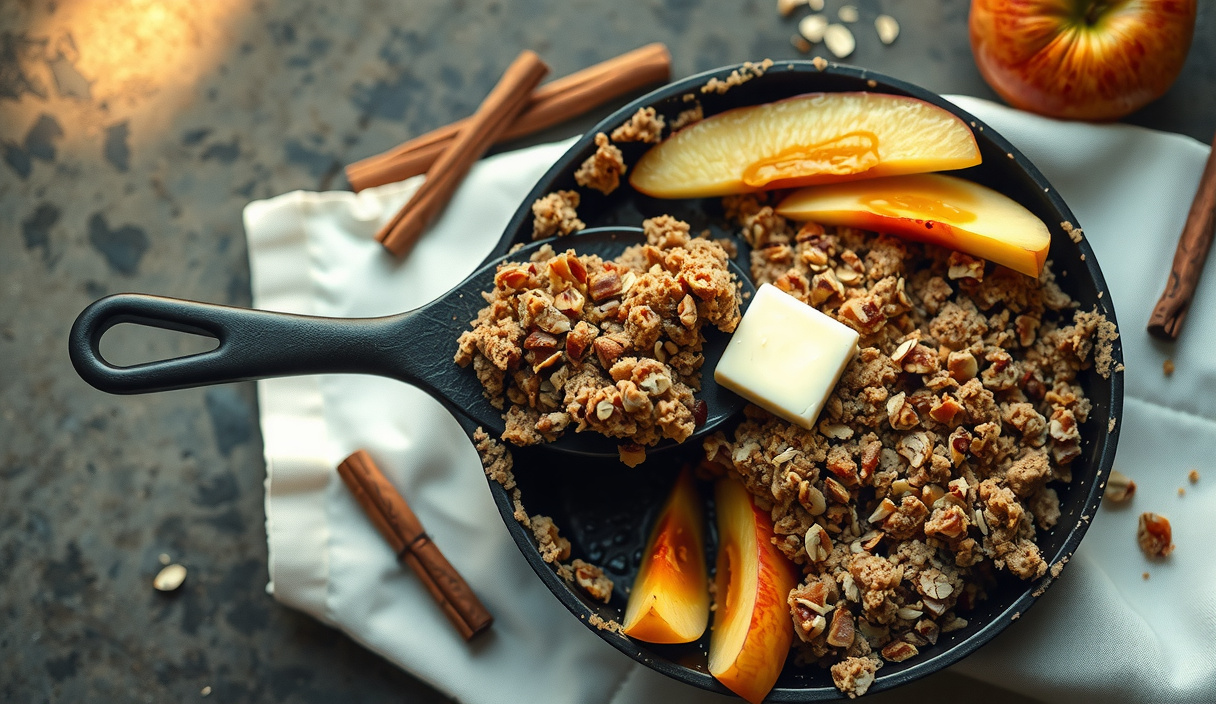
Smoked Apple Crisp — Skillet-Baked

A 10-inch cast-iron skillet of Granny Smith and Honeycrisp apples finished with an oat-butter-brown-sugar crumble inside a 350°F smoker over apple or cherry wood. The fruit layer reaches the 180°F pectin-depolymerization threshold in roughly 20 to 25 minutes; the crumble crisps via fat-render Maillard and absorbs smoke phenolics directly into the rendered butter matrix. Serve warm with vanilla ice cream or crème fraîche.
Equipment
- 1 10-inch cast-iron skillet Pre-heat on the smoker grate for 10 minutes before adding the filling
- 1 Offset smoker or pellet grill Calibrated to 350°F at grate level with a grate-mounted thermometer
- 2 to 3 small chunks Apple wood or cherry wood chunks Fruitwood only — hickory and mesquite are too aggressive for dessert applications
- 1 Instant-read or probe thermometer For monitoring apple filling internal temperature; pull at 185 to 190°F
- 1 Grate-level thermometer Dome thermometers on smokers often read 20 to 40°F high; measure where the skillet sits
- 1 Pastry cutter or two forks For cutting cold butter into the crumble dry ingredients
- 1 set Heavy silicone handle cover and oven mitt Cast-iron handle can exceed 400°F after 40 minutes of radiant exposure
Ingredients
Apple Filling
- 3 medium Granny Smith apples Peeled, cored, sliced 1/4 inch thick; approximately 1 lb prepared weight
- 2 medium Honeycrisp apples Peeled, cored, sliced 1/4 inch thick; approximately 10 oz prepared weight
- ⅓ cup light brown sugar Packed
- 2 tablespoons cornstarch
- 1 tablespoon fresh lemon juice
- 1 teaspoon ground cinnamon
- ¼ teaspoon ground nutmeg Freshly grated preferred
- ¼ teaspoon fine kosher salt
- 1 teaspoon pure vanilla extract
Oat Crumble Topping
- 1 cup old-fashioned rolled oats Not instant oats; the larger surface area of rolled oats maximizes Maillard browning
- ¾ cup all-purpose flour
- ½ cup light brown sugar Packed; provides reducing sugars for Maillard cascade and molasses-derived umami depth
- ¼ cup granulated sugar
- ½ teaspoon ground cinnamon
- ¼ teaspoon fine kosher salt
- 8 tablespoons unsalted butter Cold, cut into 1/2-inch cubes; do not use softened or melted — cold fat is essential for discrete crumble structure
For Serving
- Vanilla ice cream or crème fraîche Optional but highly recommended; the cold dairy fat against the warm filling creates a temperature-driven flavor release

Instructions
Prepare the Smoker and Skillet
- Set up your smoker for indirect heat and bring it to a stable 350°F at grate level using a grate-mounted thermometer — not the dome gauge. Add 2 to 3 small chunks of apple wood or cherry wood to the fire. Wait for clean, thin blue smoke before proceeding. White or billowing smoke indicates incomplete combustion and will deposit bitter creosote on the crumble.
- Place the empty 10-inch cast-iron skillet on the grate over the indirect zone. Allow it to pre-heat for 10 minutes. This creates the high-temperature contact surface that initiates caramelization of the Honeycrisp sugars at the bottom of the filling from the moment the apples hit the pan.
Make the Crumble Topping
- In a large bowl, combine the rolled oats, all-purpose flour, 1/2 cup light brown sugar, granulated sugar, 1/2 teaspoon cinnamon, and 1/4 teaspoon kosher salt. Whisk briefly to distribute evenly.1 cup old-fashioned rolled oats, 3/4 cup all-purpose flour, 1/2 cup light brown sugar, 1/4 cup granulated sugar, 1/2 teaspoon ground cinnamon, 1/4 teaspoon fine kosher salt
- Add the cold butter cubes to the dry ingredients. Using a pastry cutter or your fingertips, work the butter into the mixture until it resembles coarse, uneven crumbs — the largest pieces should be the size of small peas and the smallest should be sandy. Discrete fat pockets are essential: they melt individually in the smoker, creating the irregular craggy texture that catches and holds the smoke phenolics. Refrigerate the crumble while you prepare the filling.8 tablespoons unsalted butter
Prepare the Apple Filling
- Peel, core, and slice the Granny Smith apples and Honeycrisp apples to a uniform 1/4-inch thickness. Consistent thickness is critical — thicker slices will not reach the 180°F pectin-depolymerization threshold within the 40-minute cook window and will retain a waxy, under-softened texture.2 medium Honeycrisp apples
- In a large bowl, toss the sliced apples with 1/3 cup light brown sugar, cornstarch, lemon juice, 1 teaspoon cinnamon, nutmeg, 1/4 teaspoon salt, and vanilla extract. Toss until the apples are evenly coated and the cornstarch is fully incorporated with no dry white pockets visible. The cornstarch will gelatinize as the filling heats, binding the pectin-rich juices released during depolymerization into a cohesive sauce rather than a watery pool.1/3 cup light brown sugar, 2 tablespoons cornstarch, 1 tablespoon fresh lemon juice, 1 teaspoon ground cinnamon, 1/4 teaspoon ground nutmeg, 1/4 teaspoon fine kosher salt, 1 teaspoon pure vanilla extract
Assemble and Smoke
- Using a heavy silicone handle cover and oven mitt, carefully remove the pre-heated skillet from the smoker. Working quickly, transfer the apple filling into the hot skillet and spread into an even layer. You should hear an immediate sizzle as the apple sugars contact the hot cast iron — this is the caramelization reaction initiating at the bottom crust.2 medium Honeycrisp apples, 1/3 cup light brown sugar, 2 tablespoons cornstarch, 1 tablespoon fresh lemon juice, 1 teaspoon ground cinnamon, 1/4 teaspoon ground nutmeg, 1/4 teaspoon fine kosher salt, 1 teaspoon pure vanilla extract
- Remove the crumble from the refrigerator and scatter it evenly over the apple filling in an even layer, covering the fruit to the edges of the skillet. Do not press the crumble down — loose, airy distribution maximizes the surface area exposed to smoke and heat.1 cup old-fashioned rolled oats, 3/4 cup all-purpose flour, 1/2 cup light brown sugar, 1/4 cup granulated sugar, 1/2 teaspoon ground cinnamon, 1/4 teaspoon fine kosher salt, 8 tablespoons unsalted butter
- Return the skillet to the smoker over the indirect zone. Close the lid and cook at 350°F for 35 to 40 minutes. At the 30-minute mark, check the crumble color: it should be transitioning to deep amber. If the crumble peaks are already deeply browned, tent loosely with foil for the remaining time to prevent the oats from entering the bitter charring zone above approximately 360°F surface temperature.
- The crisp is done when the crumble is deep amber and set across the entire surface, the edges of the filling are bubbling actively around the crumble border, and a probe thermometer inserted into the center of the filling reads 185 to 190°F. The filling internal temperature is the definitive doneness signal — visual cues on the crumble can be reached 5 to 8 minutes earlier than full pectin depolymerization in the filling center.
Rest and Serve
- Remove the skillet from the smoker using the silicone handle cover and oven mitt — the handle will be extremely hot. Place on a heavy trivet or folded towel and allow the crisp to rest for 15 minutes before serving. At 185 to 190°F the filling is fully liquid; as it drops below 150°F, the cornstarch-thickened pectin gel re-sets into a scoopable, cohesive filling. Do not skip this step.
- Serve directly from the skillet with a large spoon, scooping deep to capture both the crisped crumble layer and the jammy apple filling below. Serve immediately with vanilla ice cream or crème fraîche alongside. The thermal contrast between the warm filling and cold dairy accelerates the release of volatile smoke phenolics — the crisp will smell most intensely of wood smoke in the first 30 seconds after the cold dairy hits the surface.Vanilla ice cream or crème fraîche
Notes
Why the apple blend matters: Granny Smith apples have a native pH of approximately 3.2 to 3.5 and a higher total pectin content than most eating apples. At this pH, the polygalacturonic acid chains in the pectin gel more firmly upon cooling, providing structural identity to the filling even after the 180°F depolymerization window. Honeycrisp contributes fructose and glucose — both highly reactive reducing sugars — that drive Maillard browning at the fruit-skillet contact zone where temperatures approach 280 to 300°F on pre-heated cast iron. Neither variety alone produces both effects.
Why 1/4-inch slices are mandatory: Apple cell walls contain pectin in two forms: a soluble pectin fraction that breaks down rapidly above 180°F, and a hemicellulose-cellulose fraction that does not. Slices thicker than 3/8 inch require substantially longer to drive the core temperature through the full pectin-depolymerization window within the 40-minute cook time. The result is a filling with a softened exterior and a waxy, under-cooked interior — the same failure mode seen in overly thick potato slices in gratins.
Smoke phenolic uptake: The guaiacol and syringol deposited by fruitwood smoke are highly lipophilic compounds — they partition preferentially into the rendered butter matrix of the crumble rather than into the high-water-activity apple filling. This means the smoke character is concentrated in the crumble layer, not the fruit, which is the correct sensory architecture: smoke as a spice note in the topping, pure fruit in the filling. Avoid mesquite or hickory, which generate high concentrations of heavy creosote fractions that overwhelm the dessert register at these phenolic exposure levels.
Cornstarch gelatinization: Cornstarch begins to gelatinize at approximately 144 to 162°F and reaches maximum viscosity around 195°F before thinning on extended cooking. In this application, the filling temperature stabilizes at 185 to 190°F — right at peak cornstarch gel strength. Pulling at this temperature produces a filling that is cohesive but not gluey. Cooking past 200°F internal causes over-gelatinization followed by thinning as amylose chains over-hydrate and partially dissolve back into the liquid phase.
Pre-heating the skillet: The thermal mass of a cold 10-inch cast-iron skillet is approximately 4 to 5 pounds. Placed cold into a 350°F smoker, it takes 15 to 20 minutes to reach equilibrium temperature — during which time the filling is sitting on a warming but not hot surface. Pre-heating for 10 minutes eliminates this lag and ensures the caramelization reaction at the fruit-iron interface begins from the first moment of contact, producing the jam layer at the bottom of the filling that distinguishes a properly executed skillet crisp from a baked-dish version.
Nutrition
Calories: 385kcalCarbohydrates: 58gProtein: 4gFat: 16gSaturated Fat: 9gCholesterol: 38mgSodium: 145mgFiber: 4gSugar: 38g
Tried this recipe?Let us know how it was!