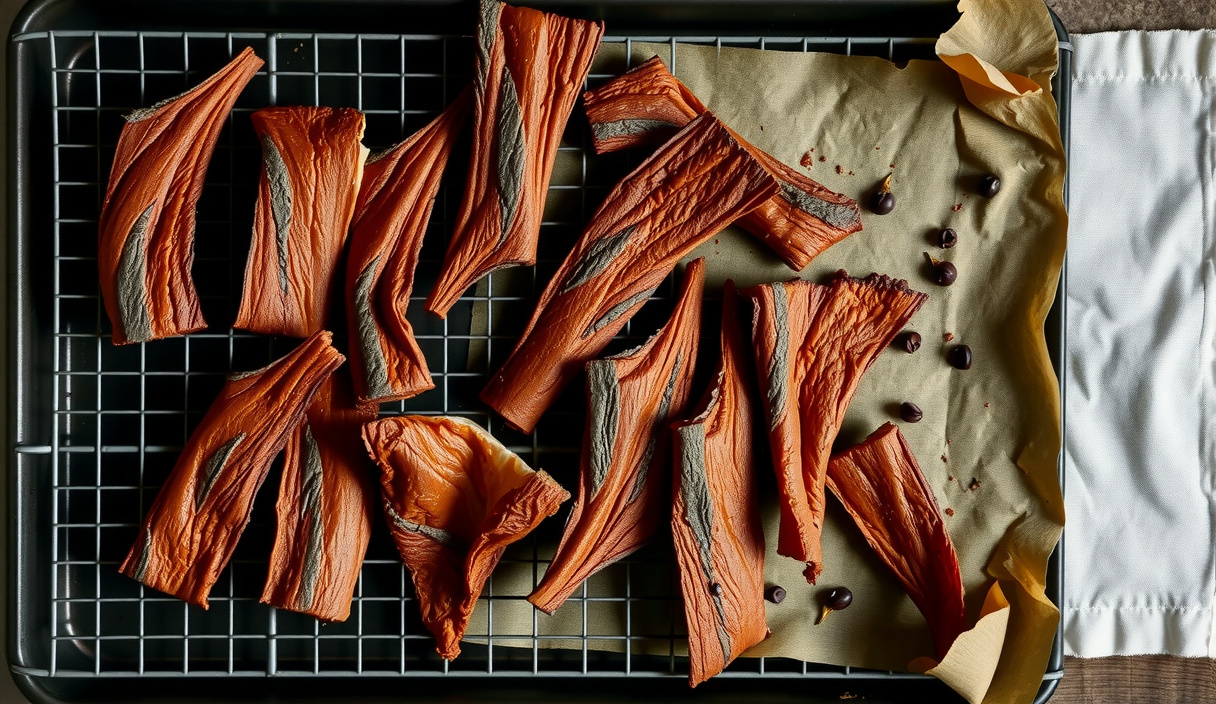
Smoked Beef Jerky — Lean Round

Top round sliced against the grain, marinated 8 to 24 hours in a soy-Worcestershire-brown sugar brine, then low-temp smoked at 165°F for 4 to 6 hours until the bend test confirms water activity at or below 0.85. Classic snap, deep Maillard crust, and a continuous hickory smoke signal — engineered to be shelf-stable from the first batch.
Equipment
- 1 Pellet grill or digital electric smoker Must hold 165°F with active convective airflow for 6+ hours
- 2 Wire smoking racks or grates Strips must lie flat with no overlap
- 1 Sharp boning or slicing knife Or a deli slicer for consistent 1/4-inch cuts
- 1 Large zip-lock bags or non-reactive container For marinating
- 1 Instant-read thermometer To verify smoker ambient and strip internal temperature
- several Paper towels For patting strips dry before smoking
Ingredients
Beef
- 2 lb top round or eye of round, trimmed of all fat and silverskin Partially freeze 45-60 minutes for easier uniform slicing
Marinade
- 60 ml soy sauce Regular-sodium; tamari for gluten-free
- 30 ml Worcestershire sauce
- 30 ml water
- 2 tablespoons dark brown sugar, packed Light brown sugar works; dark gives deeper caramel notes
- 1 teaspoon coarse black pepper, freshly ground
- 1 teaspoon garlic powder
- 1 teaspoon onion powder
- ½ teaspoon smoked paprika Adds a phenolic depth note
- ¼ teaspoon red pepper flakes Optional; omit for mild
- ¼ teaspoon Prague Powder No. 1 (curing salt) Optional but recommended for long-smoke safety margin and color; 1/4 tsp per 5 lb meat

Instructions
Slice the Beef
- Wrap the trimmed top round tightly in plastic wrap and place in the freezer for 45 to 60 minutes — you want the exterior firm but the core not yet frozen solid. This firms the muscle fibers and makes consistent 1/4-inch slices significantly easier.
- Remove from the freezer and slice against the grain at a consistent 1/4 inch (6 mm). Hold the knife at a slight 10-degree bias angle to widen each strip without going thicker. Aim for strips 4 to 6 inches long. Discard any remaining silverskin or connective tissue pockets — they will not tenderize during drying.
Make the Marinade and Marinate
- In a mixing bowl, whisk together the soy sauce, Worcestershire sauce, water, brown sugar, black pepper, garlic powder, onion powder, smoked paprika, red pepper flakes (if using), and Prague Powder No. 1 (if using) until the sugar is fully dissolved. Taste — it should be aggressively salty-savory with a distinct sweet undertone.30 ml Worcestershire sauce, 30 ml water, 2 tablespoons dark brown sugar, packed, 1 teaspoon coarse black pepper, freshly ground, 1 teaspoon garlic powder, 1 teaspoon onion powder, 1/2 teaspoon smoked paprika, 1/4 teaspoon red pepper flakes, 1/4 teaspoon Prague Powder No. 1 (curing salt)
- Add the beef slices to a large zip-lock bag or non-reactive container. Pour the marinade over the meat, massage to coat every surface, press out excess air, and seal. Refrigerate for a minimum of 8 hours and up to 24 hours. Longer marination intensifies flavor and deepens the osmotic pre-treatment — the ionic load of the soy sauce will visibly firm and slightly darken the exterior of the strips by the 12-hour mark.30 ml Worcestershire sauce, 30 ml water, 2 tablespoons dark brown sugar, packed, 1 teaspoon coarse black pepper, freshly ground, 1 teaspoon garlic powder, 1 teaspoon onion powder, 1/2 teaspoon smoked paprika, 1/4 teaspoon red pepper flakes, 1/4 teaspoon Prague Powder No. 1 (curing salt)
Set Up the Smoker
- Preheat your smoker to 165°F with the vents fully open to maximize convective airflow. Load hickory or cherry wood — enough for a moderate, consistent smoke for the first 2 hours. Do not use a water pan: you need the environment dry to drive surface desiccation and allow Maillard browning to initiate.
Dry and Load the Strips
- Remove the strips from the marinade and lay them flat on paper towels. Press a second layer of paper towels firmly on top and blot dry — remove as much surface moisture as possible. This step is critical: surface moisture creates an evaporative cooling layer that delays browning and adds 30 to 60 minutes of unnecessary drying time.
- Arrange the strips directly on the smoker grates in a single layer with at least 1/2 inch of clearance between every strip. No overlapping. Every surface must have exposure to moving air and smoke. If you are using two racks, rotate them top-to-bottom at the 2-hour mark.
Smoke and Monitor
- Smoke at 165°F for 4 to 6 hours without opening the lid unnecessarily. The first 30 to 45 minutes accomplish two things simultaneously: the strips reach internal temperature equilibrium with the smoker environment (achieving USDA-compliant pathogen lethality for whole-muscle beef), and the surface desiccates enough for Maillard browning to begin. You will see the exterior transition from a wet, crimson color to a dark mahogany within the first hour.
- At the 4-hour mark, begin performing the bend test every 30 minutes. Pull a representative strip, let it cool on the counter for exactly 2 minutes (it will feel softer hot than at equilibrium), then bend it 90 degrees at its midpoint. Target result: the strip flexes and cracks open at the apex but does not fully snap in two — a fibrous hinge of a few threads remains. A strip that folds without cracking needs more time. A strip that snaps cleanly in two with no hinge has been over-dried but is still edible — adjust time down on your next batch.
Cool and Store
- When the bend test confirms doneness, remove all strips and spread them in a single layer on a wire cooling rack at room temperature. Do not pile or stack. Allow to cool completely — a minimum of 1 hour. Strips continue to lose a small amount of surface moisture as they cool, which firms the texture slightly.
- Once fully cooled and at room temperature, transfer to vacuum-seal bags or zip-lock bags with excess air pressed out. At aw 0.85, the jerky is shelf-stable at room temperature for up to 2 weeks if sealed properly. Vacuum-sealed and refrigerated, quality holds for 3 months. Vacuum-sealed and frozen, 12 months with no meaningful quality loss.
Notes
Why 165°F smoker temperature? USDA guidelines for whole-muscle jerky require either (a) heating the meat to 160°F internal before dehydrating, or (b) post-dehydration oven treatment at 275°F for 10 minutes. Setting the smoker ambient to 165°F from the start satisfies approach (a): thin strips at 1/4 inch reach internal equilibrium with the chamber within 30 to 45 minutes, achieving the required lethality against Salmonella and E. coli O157:H7 without a separate oven step. Ground-meat jerky requires the post-dehydration oven flash regardless of smoker temperature.
Water activity (aw) as the real endpoint: The USDA shelf-stable threshold for jerky is aw 0.85 or below. At this water activity, free water is thermodynamically insufficient to support bacterial growth. The bend test (crack at 90 degrees with fibrous hinge) corresponds reliably to aw in the 0.80–0.87 range for beef jerky at these thickness and marinade parameters. A bench-top water activity meter will confirm precisely; expect a reading of 0.82–0.85 on properly finished strips.
Maillard kinetics at low temperature: Maillard browning requires a water activity between 0.5 and 0.7 at the reaction surface and temperatures above approximately 140°F to proceed at meaningful rates. Starting the smoker dry at 165°F accelerates surface desiccation, pushing the boundary-layer aw into the optimal browning window within the first 30 to 45 minutes. The reducing sugars from brown sugar (fructose and glucose after partial sucrose hydrolysis in the acidic marinade) react with free amino groups — primarily lysine side chains in the myofibrillar proteins — to generate melanoidins (color) and the pyrazine and furan VOCs responsible for roasted, nutty aroma.
Prague Powder No. 1 note: Sodium nitrite at 156 ppm (the concentration delivered by 1/4 teaspoon of Prague Powder No. 1 per 5 lb of meat) provides a meaningful safety margin against Clostridium botulinum in the anaerobic micro-environments that can form between strips during the first stage of smoking, before free water activity has dropped sufficiently. It also produces the characteristic pink-red myoglobin retention (nitrosomyoglobin) that gives commercial jerky its vivid color. It is optional in this recipe because the 165°F smoker temperature and 1/4-inch strip thickness provide strong primary safety controls — but recommended for any batch intended for extended storage or gifting.
Nutrition
Calories: 138kcalCarbohydrates: 5gProtein: 22gFat: 3gSaturated Fat: 1gCholesterol: 55mgSodium: 620mgSugar: 4g
Tried this recipe?Let us know how it was!