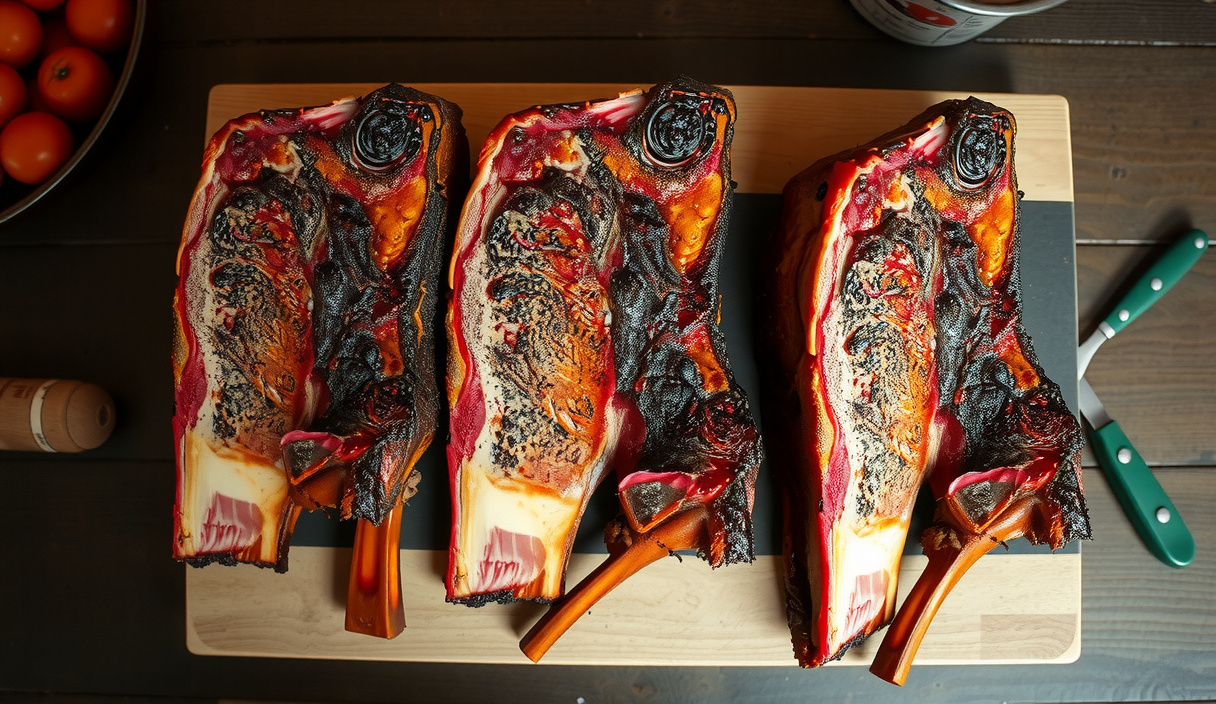
Smoked Beef Ribs — Dino Bones
Beef plate ribs — 123A cut, three bones per rack — slow-smoked at 250°F over post-oak for 8 to 10 hours until probe-tender at 203°F internal. A 50/50 salt-and-pepper crust builds a deep, lacquered bark while the intramuscular collagen fully converts to gelatin, producing ribs that are simultaneously bark-brittle on the outside and fall-apart unctuous within.
Equipment
- 1 Offset smoker, ceramic kamado, or kettle grill with indirect setup Capable of holding a steady 250°F for 10+ hours. A water pan in the cook chamber helps stabilize temperature and add humidity.
- 8–12 pieces Post-oak split logs or chunks Split logs for offset firebox; fist-sized chunks for kamado or kettle. Avoid green wood — season at least 6 months.
- 1 Leave-in probe thermometer Set probe into the thickest meat section between bones, not touching bone or fat pocket.
- 1 Instant-read thermometer For final probe-tenderness check across multiple sites on the slab.
- 1 Wire cooling rack set inside rimmed sheet pan For resting the ribs with airflow underneath.
- 1 Dry insulated cooler (empty, no ice) For the mandatory 45–60 minute post-cook rest. Pre-warm the cooler interior by pouring in hot water, dumping it, and drying before use.
- 1 Long slicing knife (12-inch or longer) For slicing between bones cleanly. A boning knife for any membrane trimming.
Ingredients
The Ribs
- 1 rack beef plate ribs (123A cut, 3 bones) 9–12 lbs raw weight. USDA Choice minimum; Prime or American Wagyu preferred. Fat cap trimmed to ¼–½ inch maximum. Membrane removed from bone side.
Salt-and-Pepper Rub
- 3 tablespoons coarse kosher salt Diamond Crystal brand by weight if scaling. Do not use table salt — the fine grind will over-salt the surface.
- 3 tablespoons coarse black pepper, 16-mesh grind The 16-mesh grind is specific — coarser than standard ground pepper, finer than cracked peppercorns. Tellicherry black pepper preferred for aromatic complexity.
Optional Binder
- 1 tablespoon yellow mustard or Worcestershire sauce Applied as a thin, even slick to help rub adhesion only. Contributes no perceptible flavor after 8 hours of smoke.

Instructions
Day-Of Prep (60–75 min before lighting fire)
- Remove the beef plate rib slab from refrigerator packaging. Pat completely dry with paper towels — surface moisture suppresses early bark formation. Lay meat-side up on a clean surface.
- Flip the slab bone-side up. Locate the thin, papery membrane (the periosteum) running across the bones. Work a butter knife or the handle of a spoon under one edge to lift it, grip with a paper towel, and peel it off in one sheet. Leaving it on creates a chewy barrier that blocks smoke penetration from the bone side.
- Trim the fat cap to a uniform ¼ to ½ inch thickness across the top. Any cap thicker than ½ inch insulates the meat too aggressively and can prevent full collagen hydrolysis in a reasonable cook window. Score the remaining fat cap in a crosshatch pattern (cuts every inch, ¼ inch deep) to help it render evenly.
- In a small bowl, combine the kosher salt and 16-mesh black pepper. Mix thoroughly — the 50/50 ratio by volume is the target. If you want to verify by weight, use equal grams of each.3 tablespoons coarse black pepper, 16-mesh grind
- If using a binder, brush or rub a thin, uniform slick of yellow mustard or Worcestershire sauce over all surfaces of the slab — meat, fat cap, sides, and bone side. The layer should be barely visible, not thick. Apply the salt-and-pepper rub immediately: season all surfaces generously and evenly, pressing lightly to adhere. Do not rub it in aggressively — let it sit on the surface where it will form bark. Allow the seasoned slab to rest uncovered at room temperature for 60 minutes before the cook begins.3 tablespoons coarse black pepper, 16-mesh grind, 1 tablespoon yellow mustard or Worcestershire sauce
Fire and Smoke Setup
- Light your smoker and establish a stable 250°F cooking temperature before the meat goes on. For an offset, build a base coal bed using a chimney of hardwood lump charcoal, then feed post-oak splits every 45–60 minutes to maintain temperature and smoke production. For a kamado or kettle, use lump charcoal with 4–6 large post-oak chunks buried in the coal bed. A water pan in the cook chamber is highly recommended — it raises humidity, which increases smoke adhesion to the surface and buffers temperature swings. Stable temperature is more important than maximum temperature: 245°F to 255°F is the acceptable band.
The Cook (8–10 hours)
- Place the slab fat-cap-side up on the grate in the indirect zone. Insert the leave-in probe into the thickest section of meat between the first and second rib bone, angled to avoid touching bone or fat. Close the lid. Do not open the lid for at least 3 hours.
- Hours 1–3 (Smoke Absorption and Bark Formation): Maintain 250°F. The meat surface will transition from raw pink to a deep mahogany as Maillard browning and smoke deposition build the bark layer. Smoke ring formation (carboxymyoglobin) is occurring in the outer ½ inch of meat. Internal temperature will climb steadily toward 150°F–160°F during this phase.
- Hours 3–6 (The Stall — 160°F to 170°F internal): Expect the internal temperature to plateau — this is the stall. Surface evaporation is absorbing energy as fast as the pit delivers it. The probe may read within a 5-degree range for 1–3 hours. This is normal and not a sign of a problem. Maintain 250°F. Do not wrap. The bark is hardening and the fat cap is beginning to render. Continue adding fuel as needed to hold temperature.
- Hours 6–10 (Collagen Hydrolysis and Final Climb — 170°F to 203°F+ internal): Once the stall breaks, internal temperature will resume climbing at roughly 1°F–2°F per 10 minutes. Collagen is actively hydrolyzing into gelatin throughout this phase. The bark will develop a lacquered, slightly tacky exterior. Begin checking probe tenderness at 195°F internal: insert your instant-read probe into the thickest meat section perpendicular to the grain. There should be noticeable but diminishing resistance. At 200°F–205°F, the probe should slide through with essentially zero resistance — like inserting it into room-temperature butter. That is your pull signal.
Rest and Serve
- Remove the slab from the cooker and place it on a wire rack set over a sheet pan. Allow it to air-rest for 10 minutes to stop surface steaming, then transfer to a pre-warmed dry cooler. Close the cooler and rest for a minimum of 45 minutes, maximum 90 minutes. Do not cut earlier — the gelatin matrix needs time to reabsorb into the muscle fibers. Internal temperature will hold above 160°F for the full rest window, well within food safety parameters.
- Transfer the rested slab to a cutting board. Using a long slicing knife, cut straight down between each bone to separate individual rib portions. Do not saw through bone — the cuts should fall naturally between rib bones. Each portion is one bone with its attached meat slab. Serve immediately, bone-in, with the bark side facing up.
Notes
Why the stall happens — and why you must not fight it: At 160°F–170°F internal, surface evaporation removes latent heat at exactly the rate the 250°F pit is delivering it. The physics are straightforward: water's latent heat of vaporization (~2,260 J/g) is enormous relative to the pit's conductive and convective heat-transfer rate into the large cold mass of the slab. The meat's internal temperature cannot rise until the surface moisture supply diminishes. Wrapping in foil eliminates this evaporation, ending the stall, but it also traps steam that softens the bark irreversibly. For plate ribs with their inherent fat content, the stall is survivable naked — and the bark reward is worth every minute.
Collagen hydrolysis kinetics: The intercostal connective tissue of beef plate ribs is dominated by Type I collagen, which undergoes thermally driven triple-helix unwinding beginning around 155°F–165°F internal. Hydrolysis to soluble gelatin accelerates sharply above 175°F via first-order kinetics governed by the Arrhenius equation — meaning each 18°F increase roughly doubles the hydrolysis rate. At 250°F ambient and 203°F internal sustained for 30–45 minutes, essentially all accessible collagen converts. The result is a self-generated gelatin matrix that keeps the meat moist and produces that characteristic unctuous mouthfeel without any added liquid.
Post-oak smoke chemistry: Post-oak combustion at 250°F–300°F produces a phenolic VOC mixture dominated by guaiacol (smoky, woody), 4-methylguaiacol (spicy, smoky), and syringol (sweet-smoke). These compounds deposit on the condensation layer at the meat surface — which is cooler than the surrounding smoke — and react with surface proteins and myoglobin. The pink smoke ring is carboxymyoglobin formed when CO and NO from incomplete combustion bind to heme iron, stabilizing the red pigment. It penetrates approximately ¼–½ inch from the surface and is a visual indicator of smoke absorption, not a doneness indicator.
Fat cap rendering kinetics: Beef subcutaneous fat begins softening around 100°F and transitions from β-prime crystal to fully liquid between 130°F and 150°F lipid temperature. At 250°F ambient with the fat cap up, surface fat liquefies within the first two hours and flows continuously over the bark surface throughout the cook, self-basting and contributing to the glossy lacquered appearance. This rendering process is why you must score the fat cap — it allows the liquid fat pathways to distribute evenly rather than channeling off the sides.
Serving temperature: Pull from the cooler and serve promptly. Gelatin gels below approximately 95°F (35°C physiological range) — a rested slab sitting too long at room temperature will start to firm as the gelatin matrix sets. Serve hot.
Nutrition
Calories: 980kcalCarbohydrates: 2gProtein: 68gFat: 78gSaturated Fat: 32gCholesterol: 265mgSodium: 1420mgFiber: 0.5g
Tried this recipe?Let us know how it was!