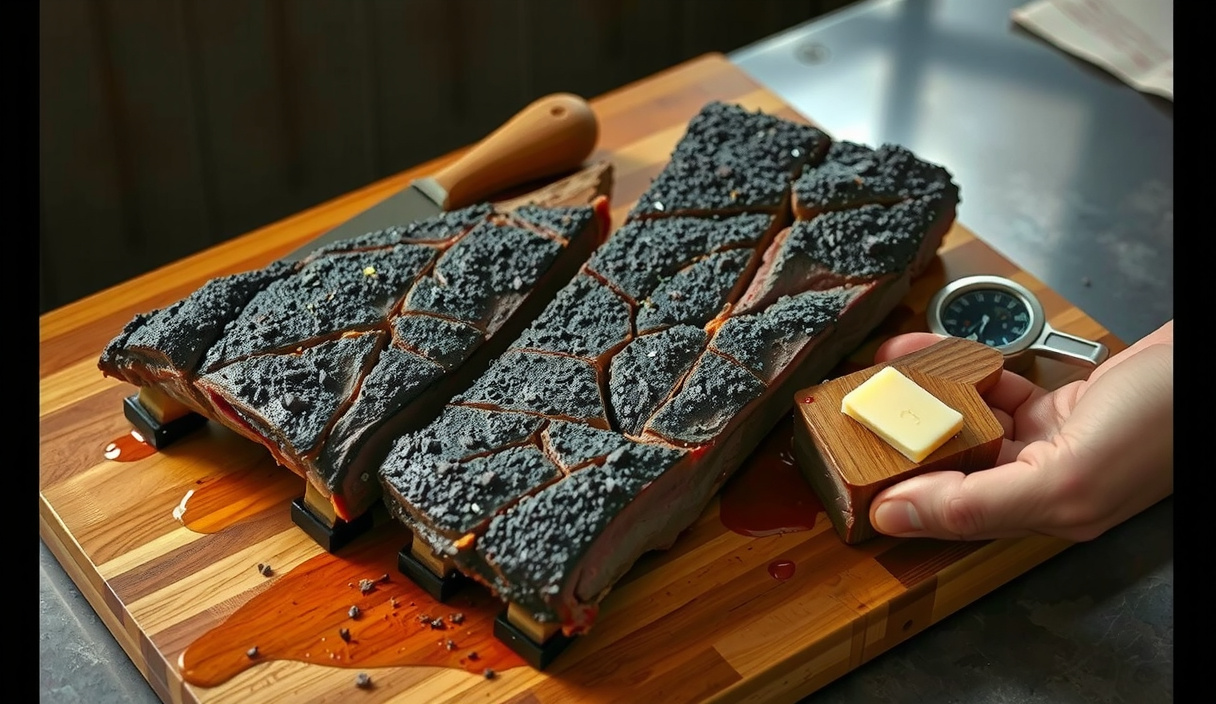
Smoked Beef Short Ribs

Bone-in beef short ribs smoked low and slow at 250°F with nothing but coarse salt and black pepper, cooked until the internal temperature reaches 203–207°F and a probe slides through the meat with zero resistance. The extended thermal exposure converts the dense collagen network into soluble gelatin, producing a self-basting, pull-apart interior beneath a deep mahogany bark built by hours of Maillard chemistry. This is the definitive Texas-style smoked short rib — no wrap, no sauce, no shortcuts.
Equipment
- 1 Offset smoker, kettle grill, pellet grill, or ceramic cooker Must hold a stable 250°F indirect heat with good airflow. Pellet grills should be set to high-smoke mode.
- 1 Dual-probe leave-in digital thermometer One probe for meat internal temperature, one at grate level. Lid thermometers are unreliable — grate-level reading is the only one that matters.
- 2-3 fist-sized chunks Post oak, hickory, or pecan wood chunks For offset cookers; 1-2 for pellet grills. The goal is thin blue smoke throughout, not white billowing smoke.
- 1 Water pan Placed in the cook chamber to buffer temperature swings and maintain surface humidity during bark formation.
- 1 Cutting board Large and sturdy — plate short ribs are substantial slabs.
- 1 sheet Heavy-duty aluminum foil or unwaxed butcher paper For resting only. Not used during the cook.
Ingredients
The Ribs
- 4-5 lbs bone-in beef short ribs Plate short ribs (NAMP 123A, 3-4 bone slab) or chuck short ribs. Look for heavy marbling. Ask your butcher for a full slab, not individual English-cut pieces. Trim any silverskin membrane from the bone-side if still attached.
The Rub
- 2 tablespoons coarse kosher salt Diamond Crystal preferred. Do not use fine salt — coarse grind controls penetration rate and bark texture.
- 2 tablespoons coarse black pepper 16-mesh grind preferred, or crack whole peppercorns coarsely. Pre-ground fine pepper will not contribute bark texture.

Instructions
Prep
- Remove the short ribs from refrigeration 30 to 45 minutes before cooking to allow the surface temperature to rise slightly, which improves smoke adhesion in the early cook window. Pat all surfaces completely dry with paper towels — surface moisture delays bark formation by extending the evaporative cooling phase before the Maillard cascade can initiate.
- Combine the coarse kosher salt and coarse black pepper in a small bowl at a 1:1 ratio by volume. Apply a generous, even coat to all surfaces of the ribs — top, bottom, sides, and exposed bone ends. Press the rub firmly into the surface so it adheres. Do not be timid: this is the only seasoning layer the meat will receive, and a good coat is required to build a substantial bark.2 tablespoons coarse black pepper
- For best results, allow the seasoned ribs to rest uncovered in the refrigerator overnight (8–12 hours) or at minimum 45 minutes at room temperature. The surface moisture will redissolve the salt, and osmotic pressure will begin drawing it into the meat. This is not optional brining — it is surface chemistry that improves bark adhesion and seasoning depth.2 tablespoons coarse black pepper
Fire the Smoker
- Bring your smoker to a stable 250°F at grate level before the meat goes on. This is the critical setup step. Rushing the preheat and placing meat on an unstable fire is the most common source of temperature spike failures. For offset smokers, establish your coal bed, add 1–2 wood splits, and confirm temperature stability for at least 15 minutes before loading. Add 2–3 fist-sized wood chunks to an offset or kettle; 1–2 for a pellet grill on high-smoke mode. Place a water pan in the cook chamber if your setup allows.
The Smoke
- Place the short ribs bone-side down on the grate over indirect heat. The bone acts as a thermal insulator, protecting the meat from direct radiant heat below. Insert your leave-in probe thermometer into the thickest part of the meat, positioned away from bone by at least half an inch. Confirm grate-level temperature is reading 250°F before closing the lid.
- Maintain 250°F throughout the cook. For the first 3 hours, do not open the lid. The smoke ring is forming during this window and lid lifts drop chamber temperature and humidity. The fire needs small, consistent fuel additions to maintain temperature stability — resist the urge to overfuel.
- Expect the stall to hit between 155°F and 175°F internal, typically around hours 3–4. The temperature will stop climbing and may hold for 1–3 hours. This is surface evaporation absorbing heat as fast as the smoker delivers it. Do not wrap. Do not increase the temperature. This is where the bark is being built and the collagen hydrolysis kinetics are accumulating time at temperature. The stall will break on its own when the surface moisture drops sufficiently.
- At approximately 5–6 hours, internal temperature should begin climbing past the stall toward 190°F. Begin checking the probe-slide test: insert a metal skewer or the thermometer probe tip into the thickest part of the meat. At 200°F internal, begin testing every 15–20 minutes. The ribs are done when the probe slides in with zero resistance — like pushing into warm butter. This typically occurs between 203°F and 207°F internal, but texture is the authority, not temperature. Total cook time is typically 6–7.5 hours at 250°F.
Rest and Serve
- Remove the ribs from the smoker when the probe-slide test confirms doneness. Rest uncovered on a cutting board for 15 minutes to allow the surface temperature to drop slightly and some steam to escape, preventing bark softening. Then tent loosely with foil and rest an additional 30 to 45 minutes. During this window, carryover conduction continues working through the interior, and muscle fibers reabsorb a fraction of expelled juices as tension releases. Cutting immediately results in significant juice loss on the board.
- To serve, slice between the bones to separate individual ribs. Each bone is its own serving. The meat should pull cleanly from the bone with gentle hand pressure, and the cross-section should show a distinct smoke ring, a mahogany bark layer, and an interior that glistens from the gelatin matrix. Serve immediately.
Notes
Why 250°F and not hotter? The collagen-to-gelatin conversion is a first-order kinetic reaction — it depends on both temperature and time. At 250°F cook temperature, the meat interior reaches 160°F (where hydrolysis begins accelerating) slowly enough that the process accumulates significant time at temperature. Cooking at 300°F+ drives the interior to the target temperature faster but shortchanges the hydrolysis integral, producing a result that reads done on a thermometer but is structurally still tough. Short ribs need time at temperature, not just temperature.
The stall is physics, not failure. When internal temperature parks between 155°F and 175°F for hours, it is because surface evaporation is absorbing latent heat at approximately the same rate the smoker delivers thermal energy. The surface is anchored near 212°F by the phase change of water. This extended evaporative window is precisely what drives the Maillard cascade on the surface — amino groups reacting with carbonyl compounds in the meat’s exudate at water activity values (aw) below 0.70, generating hundreds of aroma-active heterocyclic compounds. Wrapping to power through the stall truncates this reaction. In this cook, we never wrap.
Smoke ring science: The pink smoke ring beneath the bark is formed by nitric oxide (NO) and carbon monoxide (CO) from wood combustion reacting with myoglobin to form stable carboxymyoglobin and nitrosomyoglobin complexes. This reaction only occurs efficiently when the meat surface is moist and the internal temperature is below 140°F. Smoke ring depth is set in the first 2–3 hours of the cook. A clean-burning, oxygen-rich fire (thin blue smoke) maximizes NO and CO delivery. White, billowing smoke is oxygen-starved combustion producing creosote — it deposits bitter phenolic compounds on the meat surface rather than building smoke-ring precursors.
Collagen concentration in short ribs: Beef plate short ribs contain substantially more connective tissue than most other primal cuts, which is why they are unforgiving at high heat and transcendent at low-and-slow. The gelatin generated during the cook stays internal, re-lubricating the protein matrix and contributing the characteristic glossy, unctuous mouthfeel. A good gelatin set in the drippings (which will gel solid in the refrigerator) is direct evidence of successful collagen hydrolysis.
Nutrition
Calories: 780kcalCarbohydrates: 1gProtein: 52gFat: 63gSaturated Fat: 27gCholesterol: 195mgSodium: 820mg
Tried this recipe?Let us know how it was!