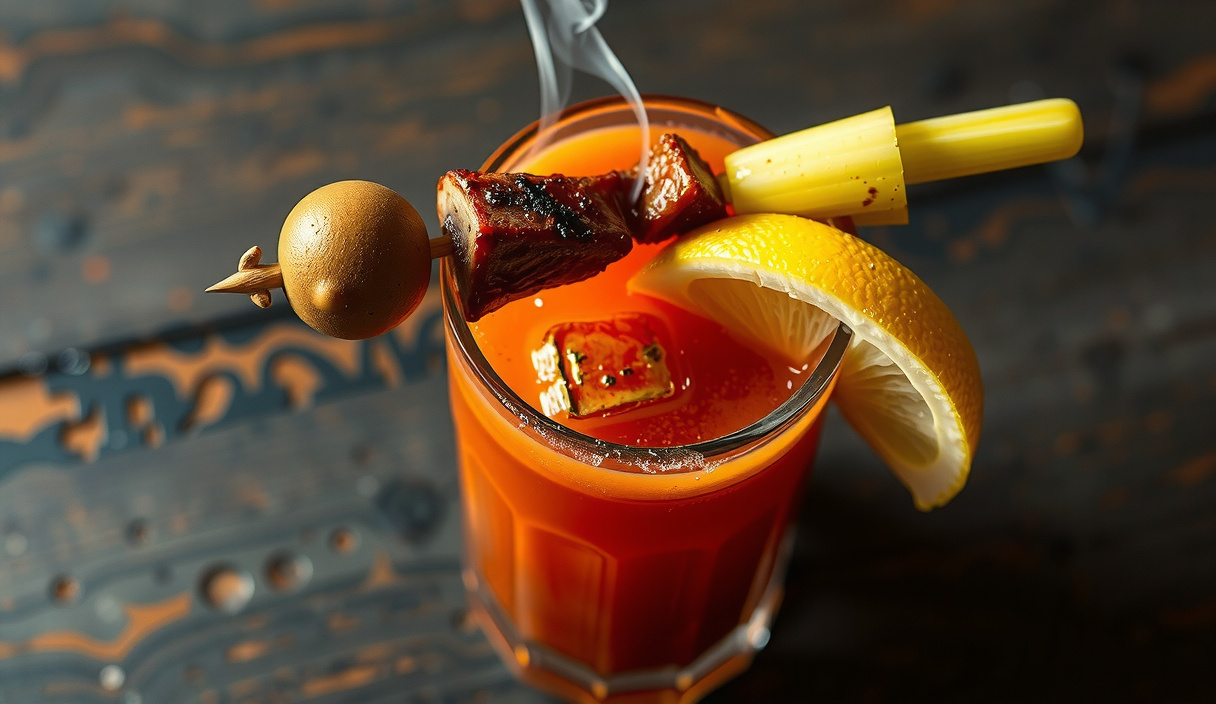
Smoked Bloody Mary with Brisket Burnt-End Skewer

A precisely built brunch cocktail that layers cold-smoked tomato juice, fresh horseradish, Worcestershire, and lemon over ice, then tops it with a brisket burnt-end skewer, smoked olive, and pickled okra. Every garnish earns its place by actively improving the drink.
Equipment
- 1 Pint glass or highball glass (16 oz) Chilled if possible
- 1 Handheld smoke infuser or cold-smoke setup For cold-smoking the tomato juice; cherry or applewood chips recommended
- 1 Bar spoon
- 1 Jigger or measuring cups
- 1 Fine-mesh sieve For straining fresh horseradish if desired
- 2 Wooden cocktail skewers (6-inch)
- 1 Shallow plate for rim mixture
Ingredients
Smoked Rim
- 1 tbsp coarse kosher salt
- 1 tsp smoked paprika
- 0.5 tsp coarsely cracked black pepper
- 0.5 wedge lemon For wetting the glass rim
Cold-Smoked Tomato Juice Base
- 4 oz tomato juice Low-sodium preferred; or fresh-juiced and strained San Marzano tomatoes
- 1 tsp cherry or applewood chips For cold-smoking; smoke below 85°F
Cocktail Build
- 1.5 oz vodka Neutral, unflavored 80-proof; chilled
- 0.5 oz fresh lemon juice Squeezed immediately before building
- 1 tsp fresh horseradish Grated immediately before use; adjust to heat preference
- 0.5 tsp Worcestershire sauce Full-sodium, original formulation
- 0.25 tsp hot sauce Tabasco or Crystal; adjust to taste
- 0.125 tsp celery salt
- 3 cracks black pepper Freshly cracked
Garnish
- 2 pieces brisket burnt ends Point-cut, caramelized, bark re-formed; firm enough to skewer
- 1 piece smoked olive Green or Castelvetrano; smoked in a smoker or with a smoke infuser
- 1 spear pickled okra Store-bought or homemade; adds vinegar brightness and crunch
- 1 wedge lemon For garnish
- 3 pieces large-format ice cubes 2-inch cubes preferred for slow melt rate

Instructions
Cold-Smoke the Tomato Juice (Do This the Night Before)
- Pour the tomato juice into a sealed container or covered pitcher with enough headspace for smoke to accumulate. Using a handheld smoke infuser loaded with cherry or applewood chips, inject cold smoke into the container. Seal immediately and let the smoke contact the juice for 10 to 15 minutes at ambient temperature — the juice surface temperature should remain below 85°F throughout. Do not heat the juice.1.5 oz vodka, 0.5 oz fresh lemon juice
- After the smoke contact period, refrigerate the smoked juice uncovered for 30 minutes to allow volatile surface compounds to dissipate, then cover and refrigerate for a minimum of 8 hours (overnight is ideal). The phenolic compounds need time to equilibrate through the full volume of juice. Juice used immediately will taste sharp and unintegrated.1.5 oz vodka
Prep the Rim and Glass
- Combine the coarse kosher salt, smoked paprika, and cracked black pepper on a shallow plate. Stir to distribute evenly. Run a lemon wedge around the outer lip of a pint or highball glass, wetting only the outermost half-inch of the rim. Roll the moistened rim lightly through the spice-salt mixture, applying even pressure to build a thin, consistent layer. Shake off any excess.1 tsp smoked paprika, 0.5 tsp coarsely cracked black pepper, 0.5 wedge lemon
- Fill the rimmed glass with large-format ice cubes. Cold glass and slow-melting ice are non-negotiable — a warm Bloody Mary degrades the aromatic profile and turns the horseradish harsh.
Build the Cocktail
- Add the chilled vodka directly over the ice, followed by the cold-smoked tomato juice, fresh lemon juice, fresh-grated horseradish, Worcestershire sauce, hot sauce, celery salt, and cracked black pepper. Do not pre-mix the spice components — add them individually so you can taste and adjust before the final stir.1 tsp fresh horseradish, 1.5 oz vodka, 0.5 tsp Worcestershire sauce, 0.25 tsp hot sauce, 0.125 tsp celery salt, 3 cracks black pepper, 2 pieces brisket burnt ends, 1 piece smoked olive
- Using a bar spoon, stir the drink five to six times with a gentle, sweeping motion from the bottom of the glass upward. The goal is to integrate the components and chill the liquid further without over-aerating the tomato juice. Taste through the straw. Adjust horseradish, hot sauce, or lemon to your preference before adding garnish.0.25 tsp hot sauce, 3 cracks black pepper, 0.5 tsp Worcestershire sauce
Assemble and Add the Garnish
- Thread two brisket burnt ends and one smoked olive onto a 6-inch cocktail skewer, alternating for visual balance. Leave enough skewer handle exposed for easy gripping above the rim of the glass.1 spear pickled okra, 1 wedge lemon
- Lay the pickled okra spear against the inside of the glass, angled outward. Place the lemon wedge on the rim. Rest the burnt-end skewer across the top of the glass so it sits partly submerged in the drink. Allow the skewer to rest in the drink for 45 to 60 seconds before serving or drinking. This is the fat-migration window — bark compounds and rendered beef fat will begin dissolving into the liquid, enriching each subsequent sip.3 pieces large-format ice cubes, 1 spear pickled okra, 1 wedge lemon
Notes
Why cold-smoke, not hot-smoke, the juice? Hot-smoking tomato juice (above 140°F) would drive off its most volatile aroma compounds — including the cis-3-hexenal that gives fresh tomato its characteristic brightness — and would begin cooking the juice, introducing stewed, caramelized notes that compete with the Bloody Mary spice profile. Cold-smoking below 85°F deposits phenolic smoke compounds (guaiacol, syringol, 4-methylguaiacol) into the aqueous phase without thermally degrading the base. These phenolics have odor-activity values at concentrations as low as 3 parts per billion in water, meaning a small deposited amount produces a pronounced perceptible effect.
Why does the horseradish need to be fresh? Allyl isothiocyanate (AITC), the active heat compound in horseradish, forms enzymatically when the cell walls of the root are ruptured — the enzyme myrosinase converts sinigrin into AITC upon mechanical damage. AITC is volatile and oxidizes rapidly in air. At room temperature, grated horseradish loses approximately half its AITC potency within 30 minutes of grating. Jarred horseradish has been stabilized with vinegar, which arrests the enzymatic reaction early and significantly reduces final AITC concentration. Fresh-grated, used immediately, delivers the sharpest, most nasal-clearing heat.
The Worcestershire umami mechanism: Worcestershire contains fermented anchovies (free glutamate source) and tamarind (organic acid and nucleotide source). The combination of free L-glutamic acid and 5'-ribonucleotides (specifically IMP from the anchovy) produces a synergistic umami response at the T1R1/T1R3 receptor that is 7 to 8 times more intense than glutamate alone. This is why Worcestershire adds perceived depth far beyond what its volume suggests.
Large-format ice science: A 2-inch ice cube has approximately 8 times the volume and 4 times the surface-area-to-volume ratio advantage of standard crescent ice, melting at a fraction of the rate. This is a surface-area dilution problem — more ice surface means faster heat exchange and faster melt. Large-format ice keeps the drink at its target temperature (around 38°F) without the progressive dilution that standard ice causes within the 10-minute brunch service window.
Nutrition
Calories: 185kcalCarbohydrates: 8.5gProtein: 9gFat: 5gSaturated Fat: 1.8gCholesterol: 22mgSodium: 920mgFiber: 1.2gSugar: 5.5g
Tried this recipe?Let us know how it was!