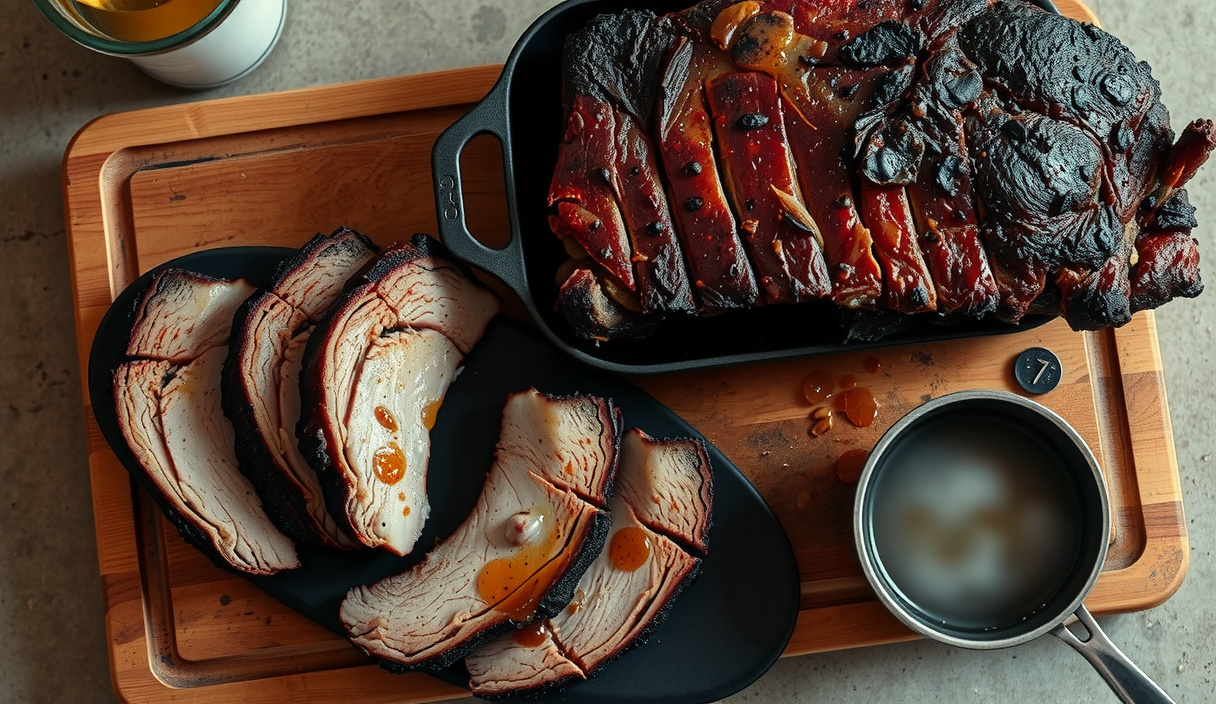
Smoked Brisket with Bone-Broth Glaze

A whole packer brisket smoked over post oak at 250°F for 10-12 hours, then finished in the final hour with a bone-broth reduction glaze concentrated to over 10% w/w gelatin. The glaze adheres to the set bark via collagen tackiness, amplifying savory depth without sweetness. Rest minimum 60 minutes before slicing the flat and point separately against the grain.
Equipment
- 1 Offset smoker or ceramic kamado Calibrated to hold 250°F chamber temperature at grate level. A kettle with snake method works with close monitoring.
- 1 Wireless dual-probe digital thermometer One probe for meat internal temp (flat), one for chamber air temp at grate level. Non-negotiable for stall management.
- 6-8 chunks Post oak wood chunks or splits Post oak or red oak. Avoid mesquite for cooks longer than 4 hours—phenol accumulation turns bitter.
- 1 Heavy-bottomed 3-quart saucier or saucepan For the broth reduction. Stainless steel or enameled cast iron—avoid reactive aluminum for a 6-hour reduction.
- 1 Silicone basting brush For glaze application. Heat-resistant to 400°F.
- 1 Dry cooler or insulated bag For the mandatory rest. Pre-warm with hot water, dump, then dry before adding the wrapped brisket.
- 1 Sharp slicing knife (12-inch) A long, thin blade allows clean, single-stroke slices at 1/4-inch thickness without tearing the bark.
- 2 large sheets Pink butcher paper For resting. Uncoated kraft paper allows some steam escape while retaining heat—superior to foil for bark preservation.
Ingredients
Brisket
- 1 whole packer brisket, USDA Choice or Prime (12-16 lb) Flat and point intact. Fat cap trimmed to 1/4 inch—do not trim to bare meat.
Texas Rub
- ¼ cup coarse kosher salt (Diamond Crystal) Coarse grind only—fine salt will over-penetrate and create a saline crust rather than a bark-forming surface layer.
- ¼ cup coarse-ground black pepper (16-mesh) 16-mesh grind is the Central Texas standard. Fine black pepper produces a muddy paste rather than a gritty, textural bark.
- 1 tablespoon granulated garlic Optional but adds Maillard-active amino acid precursors to the surface layer.
Bone-Broth Glaze
- 4 quarts high-quality beef bone broth Must gel firmly in the refrigerator. Commercial carton broth that stays liquid when cold will not produce an effective glaze—it lacks the collagen density required.
- 1 tablespoon apple cider vinegar Added at the start of reduction only. The mild acidity assists collagen hydrolysis and brightens the finished glaze without making it taste acidic.
- 1 teaspoon fine sea salt Adjust to taste only at the very end of reduction—the broth will concentrate salt proportionally. Taste before adding.

Instructions
Start the Bone-Broth Reduction (6 Hours Before Serving)
- Pour all 4 quarts of beef bone broth into a heavy-bottomed 3-quart saucier. Add the apple cider vinegar. Bring to a bare simmer over medium heat, then reduce heat to low—target 185°F liquid temperature, visible as a slow, lazy bubble every 3-4 seconds. Do not boil aggressively. A rolling boil will emulsify fat into the reduction, producing a cloudy, greasy glaze instead of a clear, tacky one.1 tablespoon granulated garlic, 4 quarts high-quality beef bone broth
- Maintain the bare simmer for 5.5 to 6 hours, stirring occasionally. The reduction is complete when the volume has dropped to approximately 1 cup (250ml) and the liquid coats the back of a spoon in a thick, glossy layer. When a small amount is refrigerated for 5 minutes it should set to a firm, sliceable gel—this confirms gelatin concentration above 10% w/w. Season with fine sea salt only at this final stage. Keep warm on the lowest heat setting until glazing time.1 tablespoon apple cider vinegar
Prepare and Season the Brisket
- Remove the brisket from refrigerator 30 minutes before seasoning—not to “bring it to room temperature” (a cut this large will not meaningfully equalize in 30 minutes) but to allow the surface to dry slightly, which helps the rub adhere. Trim the fat cap to a consistent 1/4-inch layer across the flat. Remove any hard, waxy fat deposits (gray-white, not cream-colored) which will not render and create greasy pockets.
- Combine the coarse kosher salt, 16-mesh black pepper, and granulated garlic in a small bowl. Apply the rub generously to all surfaces of the brisket—fat cap, lean sides, and the underside. Press the rub firmly into the meat surface. The coverage should be dense enough that you cannot easily see the raw meat through the rub on the lean surfaces. Do not apply the rub more than 45 minutes before smoking—the salt will pull surface moisture if left too long, creating a wet slurry rather than a dry bark-forming layer.1/4 cup coarse-ground black pepper (16-mesh), 1 tablespoon granulated garlic
Set Up the Smoker
- Fire your offset smoker, kamado, or kettle grill to a stable 250°F at grate level. For an offset, establish a clean, thin blue smoke before placing the brisket—thick white billowing smoke indicates incomplete combustion and will impart a harsh, acrid flavor. For a kamado, pre-soak 2-3 post oak chunks for 20 minutes and nestle them among the lump charcoal. Insert your chamber probe at grate level near the cooking area. Stabilize the temperature for at least 20 minutes before the brisket goes on.
Smoke the Brisket
- Place the brisket fat-cap down (or fat-cap up, depending on your heat source—fat cap faces the dominant heat source to act as a thermal shield). Insert the meat probe into the thickest part of the flat, avoiding the fat seam. Close the lid. Resist the urge to open it frequently—every lid lift drops the chamber temperature 25-40°F and adds 10-15 minutes to the cook. Add wood chunks or splits as needed to maintain thin blue smoke throughout.
- Monitor the internal temperature of the flat. Between 160°F and 170°F internal, the brisket will enter the stall—evaporative surface cooling absorbs energy as fast as the smoker delivers it, holding the temperature flat for 1-4 hours. This is not a failure state. The collagen hydrolysis continues during the stall; Maillard bark development continues at the surface. Maintain your smoker temperature and wait it out. The stall resolves when surface moisture has decreased enough that evaporative cooling can no longer keep pace with heat input.
- After 8-9 hours, when the bark is set hard (firm to the touch, not yielding or spongy under finger pressure), dark mahogany in color, and the internal temperature of the flat is above 175°F, begin the glaze phase. Check the flat’s surface with a finger—it should feel dry and almost crisp. If it still yields like soft rubber, wait another 30-45 minutes.
Apply the Bone-Broth Glaze
- Using a silicone brush, apply a thin, even coat of the warm bone-broth reduction across all exposed bark surfaces. The glaze will initially liquify on contact with the hot bark surface, then re-gel as the surface cools slightly between applications. Apply 3 coats total at 20-minute intervals over the final 60 minutes of the cook. Each coat builds on the last, creating a glossy, layered lacquer.4 quarts high-quality beef bone broth
- Continue smoking until the flat reads 200-203°F internal and the probe slides through the thickest part of the flat with zero resistance—like inserting it into soft butter. This is the definitive doneness signal, not temperature alone. A brisket that resists the probe at 203°F needs more time; one that gives at 198°F is ready. Pull the brisket and apply one final glaze coat immediately.
Rest and Slice
- Wrap the glazed brisket tightly in two layers of pink butcher paper. Place it in a pre-warmed dry cooler (pre-warmed by rinsing with hot water and drying). Close the cooler and rest for a minimum of 60 minutes—up to 3 hours is acceptable and will not harm the brisket. The internal temperature will drop only 10-15°F in this window. The rest allows the gelatin-rich juices that have been expelled from the muscle during the cook to be reabsorbed into the protein matrix as temperature gradients equalize.
- Unwrap the brisket and separate the point from the flat at the fat seam using a sharp boning or slicing knife. Identify the grain direction on the flat—it runs lengthwise down the muscle. Slice the flat against the grain at 1/4-inch thickness. The point’s grain runs at roughly a 90-degree angle to the flat’s—identify it separately and slice accordingly. Arrange on a cutting board or butcher paper. If desired, brush one final warm coat of any remaining bone-broth glaze over the sliced meat immediately before serving.
Notes
Why the stall happens: At 160-170°F internal, the brisket surface is wet enough that evaporative cooling absorbs incoming energy as fast as the smoker delivers it, holding the temperature in a temporary equilibrium. This is identical in mechanism to a swamp cooler—the latent heat of vaporization of water (540 cal/g) is a massive energy sink. The stall breaks naturally once surface moisture drops below the threshold at which evaporative cooling can compensate for heat input. Wrapping in butcher paper (the Texas crutch) traps humidity in a microclimate around the meat, reducing the evaporation rate and shortening the stall by 30-60 minutes at the cost of modest bark softening.
Collagen hydrolysis kinetics: Collagen-to-gelatin conversion is a first-order kinetic reaction driven by time and temperature. The reaction rate increases exponentially above 55°C (131°F) and accelerates dramatically above 70°C (158°F). Extended time in the 160-190°F internal range—which a brisket spends for many hours—converts the dense Type I collagen cross-links of the connective tissue into soluble gelatin. The mechanical result is that tough, rubbery connective tissue becomes gelatin that coats and lubricates the muscle fibers, producing the probe-slides-in-like-butter texture that signals doneness.
The 10% w/w gelatin threshold in the glaze: Standard bone broth runs 1-3% w/w gelatin. At this concentration, the liquid is pourable and Newtonian in flow behavior. As concentration increases toward 5-8%, the liquid becomes pseudoplastic—it flows easily under shear (brushing) but recovers viscosity at rest. Above 10% w/w, the gelatin network is dense enough to form a true viscoelastic gel at room temperature. On the hot bark surface (175-200°F), this gel melts and flows into the porous bark micro-structure, then re-sets as the surface cools. Three applications build a layered film that is tacky, glossy, and mechanically bonded to the bark rather than merely coating it. This is the same physical principle as a pharmaceutical controlled-release coating—mechanical adhesion via gelatin tackiness, not chemical bonding.
Maillard onset on bark: The Maillard reaction cascade initiates at the surface when local temperature exceeds 140°C (284°F) with water activity (aᵂ) in the 0.5-0.7 range. On a brisket surface at 250°F ambient with the fat cap as a thermal buffer, surface temperature runs approximately 180-220°F—slightly below the classical Maillard onset temperature. However, the prolonged exposure (10-12 hours) combined with the low aᵂ achievable via salt-assisted desiccation means cumulative Maillard product accumulation is substantial. The coarse black pepper in the rub contributes piperine and associated carbonyl compounds that participate directly in the browning cascade, deepening bark color beyond what salt alone achieves.
Nutrition
Calories: 610kcalCarbohydrates: 2gProtein: 62gFat: 38gSaturated Fat: 14gCholesterol: 195mgSodium: 820mg
Tried this recipe?Let us know how it was!