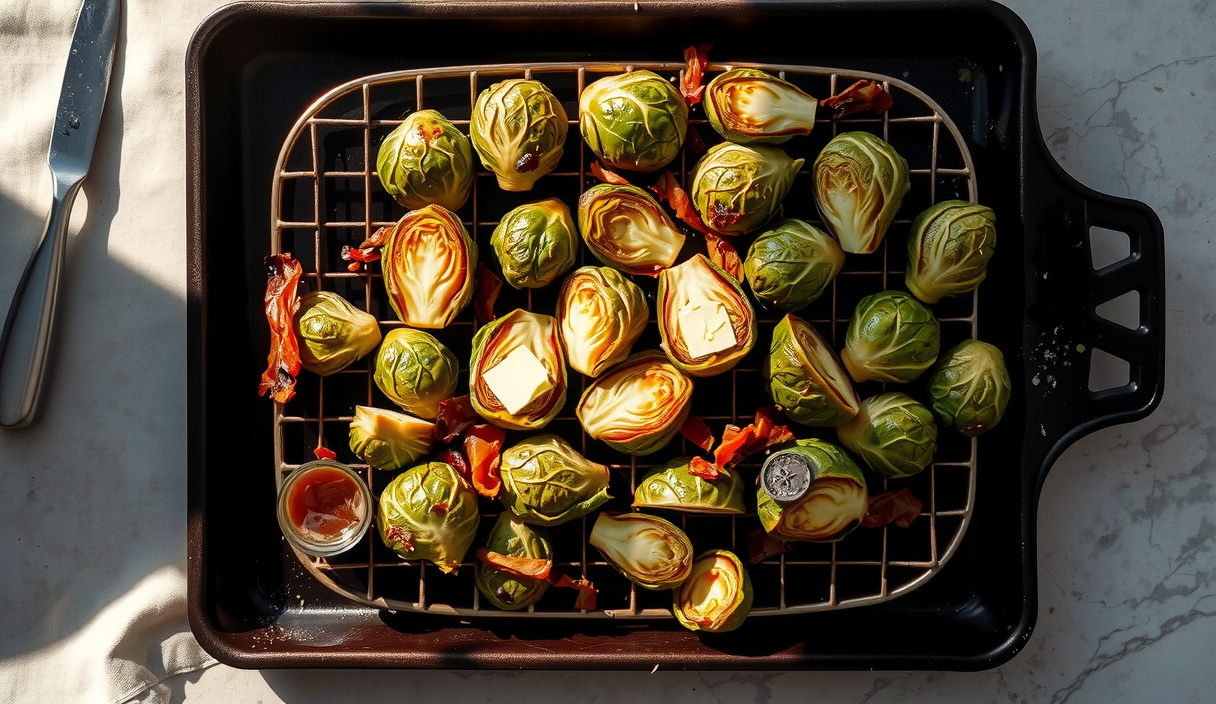
Smoked Brussels Sprouts with Bacon and Maple-Dijon Glaze

Halved Brussels sprouts tossed in rendered bacon fat and cold-smoked at 350°F for 30 minutes to build deep smoke penetration, then blasted at 425°F to char the cut faces via aggressive Maillard browning. A Maple-Dijon glaze is applied off-heat so the reducing sugars caramelize against residual surface heat rather than pyrolyzing over a live flame. Finished with crispy bacon lardons for texture and salt contrast.
Equipment
- 1 Smoker or indirect-setup charcoal or pellet grill Capable of holding 350°F and ramping to 425°F
- 1 Probe thermometer For accurate grate temperature; factory dials are often unreliable by 25 to 50°F
- 1 Cast-iron skillet or oven-safe pan For rendering bacon fat
- 1 Large mixing bowl For fat-tossing and glazing off-heat
- 1 Sheet pan or grill basket Optional: use a grill basket for easy flipping of small sprouts
- 1 to 2 Cherry or apple wood chunks or chips One small chunk or a small handful of chips; avoid hickory or mesquite
Ingredients
Sprouts and fat
- 2 lbs Brussels sprouts Trimmed and halved through the core; target 1 to 1.5 inch diameter for uniform cooking
- 4 strips thick-cut bacon Rendered for the fat; lardons reserved for garnish
- 3 tablespoons rendered bacon fat From the strips above; substitute 1.5 tbsp unsalted butter plus 1.5 tbsp avocado oil if needed
- 0.5 teaspoon kosher salt Applied after glazing; not before smoking
- 0.25 teaspoon black pepper Freshly cracked
Maple-Dijon glaze
- 3 tablespoons pure maple syrup Grade A dark or Grade B for deeper flavor; avoid pancake syrup
- 1 tablespoon Dijon mustard Smooth Dijon; the mucilage proteins act as a natural emulsifier binding the glaze
- 1 teaspoon apple cider vinegar Adjust to taste; this is the brightness lever against the maple sweetness
- 1 pinch red pepper flakes Optional; adds slow-building heat contrast

Instructions
Prep and render bacon
- Render the bacon strips in a cast-iron skillet over medium-low heat until the fat is fully liquefied and the lardons are crispy, approximately 8 to 10 minutes. Remove the lardons to a paper-towel-lined plate and reserve. Strain the rendered fat through a fine mesh strainer into a small bowl and allow it to cool for 2 minutes. You need approximately 3 tablespoons of clarified fat.4 strips thick-cut bacon, 3 tablespoons rendered bacon fat
- Trim the stem end of each Brussels sprout and halve through the core. Pat the cut surfaces dry aggressively with paper towels — this is not optional. Any surface moisture delays Maillard browning onset by 4 to 6 minutes and creates steam that softens the interior before the exterior can char.
- In the large mixing bowl, toss the halved sprouts with the warm rendered bacon fat until every cut surface is evenly coated. Do not season with salt yet — salt draws cellular moisture to the surface via osmosis and counteracts the drying step you just completed.3 tablespoons rendered bacon fat
Low-smoke phase
- Prepare your smoker or grill for indirect heat at a stable 350°F (177°C). Verify the temperature with a probe thermometer at grate level — not the factory lid dial. Add one small chunk of cherry or apple wood, or a small foil packet of soaked chips, to the heat source.
- Arrange the fat-coated Brussels sprouts cut-side down on the grate in a single layer with visible space between each sprout. Crowding traps steam between sprouts and prevents the surface desiccation required for browning. Close the lid. Smoke at 350°F for 30 minutes without opening the lid. During this phase, smoke is penetrating the cut face and building the aromatic base while the surface water activity drops toward the Maillard-active zone.3 tablespoons rendered bacon fat
High-heat char phase
- After 30 minutes, ramp the smoker or grill to 425°F (218°C). On a pellet grill, simply increase the setpoint. On a charcoal setup, open the vents fully and, if needed, move the sprouts over the direct-heat zone. Continue cooking for 10 to 15 minutes, checking at the 10-minute mark. The cut faces should show deep, dark mahogany char with caramelized edges. The outer leaves will be crispy and slightly blackened at the tips — this is correct. Remove any sprouts under 1 inch in diameter 3 to 4 minutes earlier, as they char faster than larger ones.
Glaze and finish
- While the sprouts are in the char phase, whisk together the maple syrup, Dijon mustard, apple cider vinegar, and red pepper flakes (if using) in the large mixing bowl until fully emulsified. The Dijon's mustard mucilage proteins will bind the fat-soluble maple compounds and vinegar into a stable, cohesive glaze.3 tablespoons pure maple syrup, 1 tablespoon Dijon mustard, 1 teaspoon apple cider vinegar, 1 pinch red pepper flakes
- Pull the sprouts from the heat and let them rest off the grate for 60 seconds — long enough to drop from active pyrolysis temperature but not long enough to cool below 150°F where caramelization stalls. Transfer to the mixing bowl with the glaze and toss vigorously. The glaze should sizzle and thicken on contact with the hot sprout surfaces. This is the caramelization event: the reducing sugars in the maple syrup reacting with the residual surface heat to build lacquered, glossy color without the bitterness of live-fire pyrolysis.3 tablespoons pure maple syrup, 1 tablespoon Dijon mustard, 1 teaspoon apple cider vinegar
- Season with kosher salt and freshly cracked black pepper immediately after glazing. Taste and adjust the vinegar level. Transfer to a serving platter and scatter the reserved crispy bacon lardons over the top. Serve immediately.0.5 teaspoon kosher salt, 0.25 teaspoon black pepper, 4 strips thick-cut bacon
Notes
Why the two-stage temperature protocol works: At 350°F (177°C) with indirect heat, the surface water activity of the fat-coated sprout drops from approximately 0.95 toward the 0.50 to 0.70 range where Maillard browning becomes kinetically favorable. Smoke compounds — primarily guaiacol, syringol, and their derivatives — deposit on and dissolve into the bacon fat layer during this phase, building a flavor reservoir. At 425°F (218°C), the surface temperature surpasses the dehydration threshold and the Maillard cascade accelerates rapidly via Schiff base formation between free amino groups in the sprout proteins and the carbonyl groups in the fat-carried reducing sugars.
Why the glaze goes on off-heat: Maple syrup contains approximately 60 to 65% sucrose plus free glucose and fructose. At grate temperatures above 400°F, these reducing monosaccharides cross into pyrolysis within 60 to 90 seconds, generating acrid, carbonaceous melanoidin compounds. By applying the glaze at residual surface temperatures of 150 to 180°F, caramelization proceeds without pyrolysis. The Dijon provides mustard mucilage proteins — natural amphiphilic polymers — that stabilize the maple-fat interface, producing a cohesive lacquered coat rather than a greasy, separated drizzle.
The sulfur chemistry of Brassicas under dry heat: Glucosinolates in Brussels sprouts hydrolyze when cell walls rupture. Under wet heat, this yields volatile hydrogen sulfide — the stereotypically unpleasant smell of boiled cabbage. Under dry convective heat with low water activity, the same precursors follow a different reaction pathway, integrating into roasted thiazole, pyrazine, and furan structures that are perceived as nutty, caramelized, and savory rather than sulfurous. Drying the cut surface before cooking and maintaining a dry cooking environment are therefore not just texture decisions — they are flavor decisions at the molecular level.
Wood selection note: Mild fruit woods (cherry, apple) donate primarily methoxyphenol compounds (guaiacol family) that integrate well with brassica flavor chemistry. Heavy woods like hickory donate significantly more of the stronger phenolic compounds (4-methylguaiacol, creosol) that can amplify perceived bitterness in high-glucosinolate vegetables. Use one small chunk — this is a 45-minute cook, not a long brisket smoke. Over-smoking brassicas at higher wood loads risks pushing past pleasant to acrid.
Nutrition
Calories: 210kcalCarbohydrates: 18gProtein: 8gFat: 13gSaturated Fat: 4.5gCholesterol: 18mgSodium: 420mgFiber: 5gSugar: 10g
Tried this recipe?Let us know how it was!