Smoked Chicken Lollipops
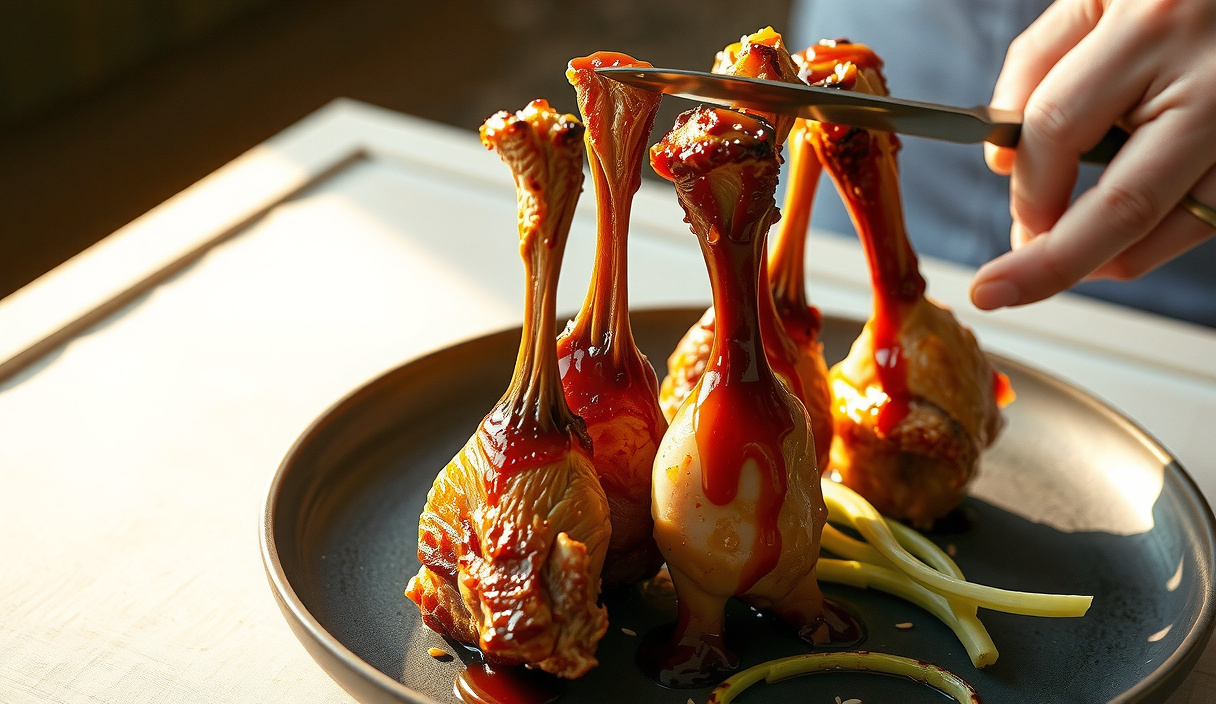
French-cut drumsticks smoked low and slow at 250°F, then finished with a honey-bourbon glaze at 325°F for a deep mahogany lacquer. The exposed bone accelerates heat transfer — rotation and precise thermometer use are the keys to juicy, even results every time.
Equipment
- 1 Smoker (offset, pellet, or kettle) Capable of holding a stable 250°F with a water pan
- 1 Boning knife Thin, stiff, and sharp — essential for a clean cartilage score
- 1 Instant-read thermometer Probe the thickest part of the meat cylinder, never near the bone
- 1 Wire cooling rack For rub-rest in the refrigerator and for resting after the cook
- 1 Small saucepan For reducing the glaze to a spoon-coating consistency
- 1 Basting brush Silicone preferred for high-heat glaze application
- 12 squares (3-inch) Aluminum foil To wrap bone tips and moderate conductive heat at the exposed shaft
- 3 to 4 Cherry or apple wood chunks Fist-sized chunks; soak is unnecessary for offset/kettle, not recommended for pellet
Ingredients
Drumsticks
- 6 chicken drumsticks 4 to 5 oz each, uniform size; fresh preferred over frozen
Dry Rub
- 2 tbsp brown sugar Packed; provides Maillard precursors and bark development
- 1 tbsp smoked paprika
- 1 tsp garlic powder
- 1 tsp onion powder
- 1 tsp kosher salt
- ½ tsp black pepper Freshly ground
- ½ tsp cayenne pepper Reduce to 1/4 tsp for mild heat
- ½ tsp dried thyme
Honey-Bourbon Glaze
- 3 tbsp honey Provides fructose and glucose for Maillard browning; do not substitute pure sucrose syrup
- 2 tbsp bourbon
- 2 tbsp ketchup
- 1 tbsp apple cider vinegar
- 1 tbsp Worcestershire sauce Use a certified gluten-free brand if needed
- 1 tbsp unsalted butter Adds gloss and fat-phase aroma carry
- 1 tsp hot sauce Such as Crystal or Frank's
- ¼ tsp garlic powder

Instructions
French the Drumsticks
- Stand a drumstick upright on a cutting board with the knuckle end facing up. Using the tip of your boning knife, score a clean circle through the skin and cartilage ring approximately 1 inch above the knuckle joint. Apply firm, controlled pressure — you are cutting through cartilage, not hacking through bone.
- Once the cartilage ring is fully scored, grip the skin and meat below the score line with a paper towel for traction. Push the meat upward firmly toward the meaty end of the drumstick, inverting it into a compact cylinder. Scrape the exposed bone clean of any tendons, cartilage fragments, or skin with the back of your knife blade. The finished lollipop should have a clean, exposed 2-inch bone handle and a tight meat cylinder at the top.
- Wrap each exposed bone tip tightly in a small square of aluminum foil. This is heat management, not aesthetics — the foil moderates conductive energy input through the exposed bone shaft during the smoke phase.
Apply the Rub and Rest
- Combine all dry rub ingredients in a small bowl and whisk until evenly blended.1 tbsp smoked paprika, 1 tsp garlic powder, 1 tsp onion powder, 1 tsp kosher salt, 1/2 tsp black pepper, 1/2 tsp cayenne pepper, 1/2 tsp dried thyme
- Pat each lollipop completely dry with paper towels on all surfaces. Place on a wire rack set over a sheet pan. Season generously with the dry rub, pressing it firmly onto all surfaces of the meat cylinder. Do not season the foil-wrapped bone.1 tbsp smoked paprika, 1 tsp garlic powder, 1 tsp onion powder, 1 tsp kosher salt, 1/2 tsp black pepper, 1/2 tsp cayenne pepper, 1/2 tsp dried thyme
- Return the rack, uncovered, to the refrigerator for at least 1 hour and up to 24 hours. The cold, circulating air will dehydrate the surface slightly, forming a tacky pellicle that dramatically improves smoke adhesion and bark development.
Make the Glaze
- Combine honey, bourbon, ketchup, apple cider vinegar, Worcestershire sauce, butter, hot sauce, and garlic powder in a small saucepan over medium heat. Stir constantly and bring to a gentle simmer. Reduce heat to low and cook for 3 to 4 minutes, stirring frequently, until the glaze thickens to a consistency that coats the back of a spoon and holds a line when you draw your finger through it. Remove from heat. The glaze can be made up to 3 days ahead and refrigerated; rewarm gently before using.3 tbsp honey, 2 tbsp bourbon, 2 tbsp ketchup, 1 tbsp apple cider vinegar, 1 tbsp Worcestershire sauce, 1 tbsp unsalted butter, 1 tsp hot sauce, 1/4 tsp garlic powder
Smoke
- Fire your smoker to a stable 250°F. Place a water pan in the chamber if your smoker allows it. Add cherry or apple wood chunks to achieve a clean, thin blue smoke — not thick white billowing smoke, which carries acrid compounds that will dominate the flavor.
- Stand the lollipops upright on the grate with the meat cylinder up and the foil-wrapped bone resting through the grate, or lay them on their sides if standing is not feasible on your cooker. Either orientation works — upright is preferred for even convective exposure around the cylinder. Leave at least 1 inch between each lollipop for airflow.
- Smoke at 250°F for 60 to 70 minutes. At the 60-minute mark, probe the thickest part of each meat cylinder, keeping the thermometer well away from bone. Rotate each lollipop 180 degrees on the grate at this point regardless of temperature — this corrects for hot spots and addresses the thermal asymmetry created by the exposed bone shaft. Continue cooking until the thickest meat reads 140°F to 145°F internal, which is your signal to begin the glaze phase.
Glaze and Finish
- When internal temperature reaches 140°F to 145°F, open any vents, add a small amount of additional fuel, or adjust your smoker to spike the pit temperature to 325°F. This temperature jump drops the water activity at the surface and allows the reducing sugars in the glaze to Maillard-brown rather than steam.
- Once the pit stabilizes at 325°F, brush each lollipop generously with the first coat of glaze. Close the lid and cook for 5 minutes.3 tbsp honey, 2 tbsp bourbon, 2 tbsp ketchup, 1 tbsp apple cider vinegar, 1 tbsp Worcestershire sauce, 1 tbsp unsalted butter, 1 tsp hot sauce, 1/4 tsp garlic powder
- Apply the second coat of glaze and cook for another 4 to 5 minutes, watching closely. The glaze should set into a deep mahogany lacquer. Do not walk away at this stage — sugar burns quickly at 325°F.3 tbsp honey, 2 tbsp bourbon, 2 tbsp ketchup, 1 tbsp apple cider vinegar, 1 tbsp Worcestershire sauce, 1 tbsp unsalted butter, 1 tsp hot sauce, 1/4 tsp garlic powder
- Pull each lollipop when the thickest meat reads 160°F internal. Transfer to the wire rack and rest uncovered for 5 to 7 minutes. Carryover heat will bring the internal temperature to 163°F to 165°F. Remove or replace the foil bone caps with fresh foil if presenting whole. Serve immediately.
Notes
Why 250°F for smoke and 325°F for the glaze? The smoke phase runs below aggressive Maillard thresholds intentionally. At 250°F, surface water activity stays high, which suppresses the amino-carbonyl browning cascade but allows nitrogen dioxide from the combustion gases to penetrate the muscle and form the smoke ring — a reaction that essentially stops once surface protein denatures above 140°F. The temperature spike to 325°F for the glaze phase rapidly drops surface water activity, creating the conditions for Maillard onset. Honey and brown sugar both contain free reducing monosaccharides (fructose and glucose) that participate in this browning cascade at lower activation energies than sucrose, which is why glaze chemistry matters: a pure sucrose glaze browns poorly in this short window without first hydrolyzing.
The bone conduction problem: Exposed bone conducts thermal energy approximately 25 to 35 times more efficiently than hydrated muscle tissue. Bone-adjacent meat can overshoot target temperature by 10°F to 15°F while the dense outer cylinder is still catching up. Foil on the bone tip moderates radiative input; rotation at the halfway mark corrects for directional asymmetry. Always probe the geometric center of the meat mass — bone proximity gives falsely elevated readings.
Pellicle formation: The 1-hour minimum refrigerator rest after applying the rub is not optional flavor-rest time. The cold, dry air partially dehydrates the surface, forming a tacky protein layer (the pellicle) identical in mechanism to what is formed before cold-smoking fish. Smoke binds to this layer far more effectively than to a wet surface. A 24-hour rest produces a noticeably deeper smoke ring and more cohesive bark.
Safe internal temperature: 165°F is the USDA minimum for poultry, corresponding to a 7-log reduction in Salmonella. Pulling at 160°F and resting 5 minutes achieves the equivalent lethality through sustained temperature exposure — the same pasteurization math used in sous-vide protocols. Do not skip the rest.
Nutrition
Calories: 310kcalCarbohydrates: 14gProtein: 28gFat: 14gSaturated Fat: 4gCholesterol: 145mgSodium: 520mgSugar: 12g
Tried this recipe?Let us know how it was!