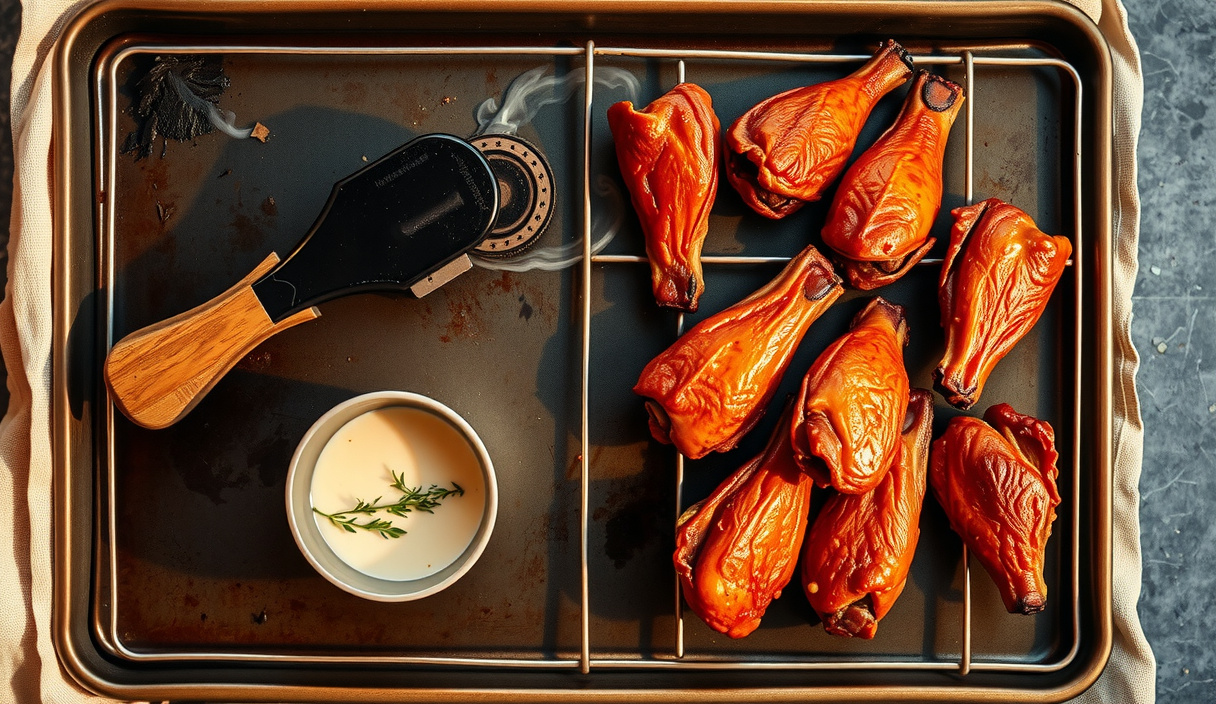
Smoked Chicken Wings With Crackling-Crisp Skin

A baking-powder alkaline dry brine restructures chicken skin at the molecular level before the wings ever see smoke. Two hours on the smoker at 250°F builds deep color and renders the subcutaneous fat; a 90-second blast at 450°F shatters the skin into a cracker-thin crust that holds up bite after bite. No deep-fryer. No flour. Just chemistry and fire.
Equipment
- 1 Offset smoker or kettle grill with indirect zone Needs to hold a stable 245–255°F ambient temperature
- 1 Instant-read thermometer Calibrated; used to pull wings at exactly 165°F
- 1 Wire rack set over a rimmed baking sheet Essential for airflow on all surfaces during the overnight fridge rest
- 2 Cherry or apple wood chunks 2 fist-sized chunks; not chips — slower smolder, no refueling needed
- 1 High-heat grill or large cast-iron skillet Must reach 450°F for the finish sear; preheat at least 10 minutes
- 1 Large mixing bowl For tossing wings with the dry brine mixture
Ingredients
Wings and Dry Brine
- 3 lbs chicken wings Split into flats and drums, tips removed; patted completely dry with paper towels
- 1 tbsp kosher salt Diamond Crystal preferred; if using Morton, reduce to 2 teaspoons
- 1 tsp aluminum-free baking powder Raises skin pH to ~8.5 for Maillard acceleration and peptide bond weakening
- 1 tsp freshly cracked black pepper
- 1 tsp garlic powder
- 1 tsp smoked paprika Adds a second layer of smoke-adjacent color and VOC complexity
- 0.5 tsp onion powder
- 0.25 tsp cayenne pepper Optional; adjust to heat preference
For Serving (Optional)
- 4 tbsp unsalted butter For a classic Buffalo-style toss
- 0.33 cup Louisiana-style hot sauce Such as Frank's RedHot; whisk into melted butter off heat

Instructions
Dry Brine and Rest
- Pat the chicken wings completely dry with paper towels on all surfaces. Any surface moisture will dilute the dry brine and slow the pH shift in the skin.
- In a large bowl, whisk together the kosher salt, baking powder, black pepper, garlic powder, smoked paprika, onion powder, and cayenne (if using) until evenly combined.1 tbsp kosher salt, 1 tsp aluminum-free baking powder, 1 tsp freshly cracked black pepper, 1 tsp garlic powder, 1 tsp smoked paprika, 0.5 tsp onion powder, 0.25 tsp cayenne pepper
- Add the wings to the bowl and toss aggressively until every surface is coated with the dry brine mixture. The coating should feel uniformly chalky — no bare patches of skin.1 tbsp kosher salt, 1 tsp aluminum-free baking powder, 1 tsp freshly cracked black pepper, 1 tsp garlic powder, 1 tsp smoked paprika, 0.5 tsp onion powder, 0.25 tsp cayenne pepper
- Arrange the wings in a single layer on a wire rack set over a rimmed baking sheet, skin side up. Do not stack them. Refrigerate uncovered for a minimum of 8 hours, ideally 12 to 24 hours. The refrigerator's low-humidity airflow is doing critical drying work here — covering the wings traps moisture and defeats the process.
Smoke
- Remove the wings from the refrigerator 20 minutes before smoking. Set up your smoker or kettle grill for indirect cooking and preheat to a stable 250°F ambient temperature. Add 2 fist-sized chunks of cherry or apple wood directly to the coals or firebox.
- Place the wings on the smoker grate, skin side up, with at least 1 inch of space between each wing for airflow. Close the lid. Smoke at 250°F until the thickest part of the largest drumette reads 165°F internal on an instant-read thermometer — approximately 90 to 120 minutes depending on wing size and smoker calibration. Do not open the lid for the first 45 minutes.
- When the wings hit 165°F, transfer them to the wire rack on the baking sheet. The skin should look dry and matte with a deep amber color. If any spots look glossy or wet, they need more time on the smoker. Rest the wings on the rack while you prepare the sear.
High-Heat Sear
- Preheat a grill or cast-iron skillet to 450°F minimum — this takes at least 10 full minutes on high heat. You need genuine high-energy radiation and conduction at the surface, not just ambient hot air. A drop of water flicked onto the grate or pan should vaporize instantly with an aggressive sizzle.
- Place the wings skin side down on the hot grate or skillet. Do not move them. Sear for 60 to 90 seconds. The skin will appear to stick initially — this is the proteins at the contact surface bonding to the metal. Let them release naturally; pulling early tears the skin. Flip and sear the other side for 60 seconds.
- Transfer the seared wings to a clean serving platter or bowl immediately. The skin should be deep mahogany brown, blistered in spots, and audibly crunchy when you press it with a finger.
Sauce and Serve (Optional)
- If saucing: melt the unsalted butter in a small saucepan over medium heat. Remove from heat and whisk in the hot sauce until fully emulsified. Transfer the seared wings to a large bowl, pour the sauce over, and toss immediately. Serve within 4 minutes — sauce is hygroscopic and will begin softening the crust within 5 to 8 minutes at room temperature. For maximum crunch, serve the sauce on the side.4 tbsp unsalted butter, 0.33 cup Louisiana-style hot sauce
- If serving plain: season with a light pinch of flaky sea salt immediately off the sear and serve at once. The contrast between the smoky, shatteringly crisp skin and the juicy interior is the entire point — do not let them sit.
Notes
Why baking powder creates crispy skin: Baking powder contains sodium bicarbonate, which raises the skin's surface pH from a neutral ~5.8 toward 8.0–9.0. This alkaline shift accelerates hydrolysis of peptide bonds in the outermost keratin layer, physically thinning the skin matrix and creating a porous structure that expels moisture faster and browns at lower temperatures. The Maillard reaction — the amino-carbonyl condensation cascade responsible for roasted flavor and color — accelerates significantly above pH 7.0. Use aluminum-free baking powder at 0.5% w/w to total weight to avoid metallic off-notes from sodium aluminum sulfate.
The stall and why it does not apply here: The classic barbecue stall occurs on large cuts (brisket, pork shoulder) when surface evaporation absorbs heat as fast as the smoker delivers it, anchoring internal temperature around 155–165°F for hours. On wings, the surface-area-to-mass ratio is so high and the pre-dried skin so desiccated that evaporative cooling is minimal. Wings typically pass through 165°F without stalling. If your wings plateau, it is almost always a thermometer placement issue — probe the thickest part of the drum, not adjacent to bone.
Collagen hydrolysis window: The wing joint softens because the collagen in the cartilage begins hydrolysis above 160°F. At 250°F ambient and a 90-to-120-minute cook, the joint collagen converts to gelatin, making the flat pull cleanly off the bone. This is the same first-order kinetic pathway as long-braised cuts — just compressed by higher temperature.
Fat rendering between the skin and meat: Subcutaneous fat renders progressively between 130°F and 160°F internal. The 250°F smoke phase is intentionally long enough to complete this rendering before the skin is set by the 450°F sear. If fat has not fully rendered before the sear, it gets trapped under the skin as a greasy, chewy layer. The overnight dry brine rest begins this process by desiccating the skin surface and improving thermal conductivity into the fat layer.
Aroma chemistry of cherry and apple wood: Fruit woods produce smoke rich in syringol, guaiacol, and 4-methylsyringol — phenolic compounds that partition into the surface fat of the wing, providing the characteristic sweet-smoke aromatic profile. These lipophilic VOCs have very low vapor pressure at room temperature, meaning the smoke flavor is released slowly during eating via retronasal olfaction rather than as a sharp upfront hit. Hickory and mesquite produce higher concentrations of catechol and creosote at the smoke densities needed for a short wing cook, which is why they can taste acrid here.
Nutrition
Calories: 410kcalCarbohydrates: 1.5gProtein: 34gFat: 29gSaturated Fat: 8gCholesterol: 145mgSodium: 820mgFiber: 0.5gSugar: 0.5g
Tried this recipe?Let us know how it was!