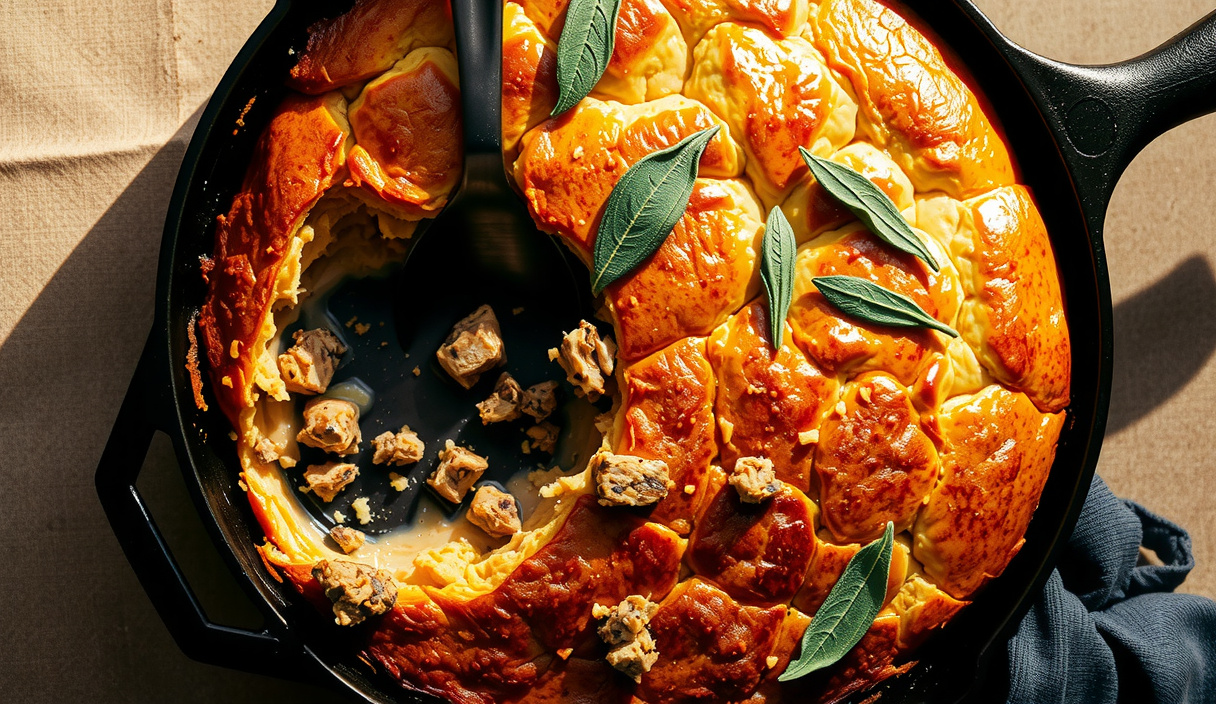
Smoked Cornbread Dressing with Sausage and Sage

Day-old cornbread cubes soaked in a savory chicken broth binder with crumbled Italian sausage, fresh sage, celery, and onion, then smoked low and slow at 275°F until the interior sets to a custardy richness and the top crust crackles with hardwood-smoke perfume. The smoker's dry convective airflow does the textural work no oven can match.
Equipment
- 1 Smoker (offset, pellet, or kettle-grill indirect setup) Must hold a stable 275°F. Apple or cherry wood chunks or pellets recommended.
- 1 12-inch cast-iron skillet or 9x13-inch aluminum roasting pan Cast iron produces a more aggressively crisped bottom; aluminum is easier to handle on grate.
- 1 Large (12-inch) skillet for sausage and aromatics
- 1 Instant-read thermometer Essential. Doneness is temperature-driven: 160°F internal, not visual cues.
- 1 Large mixing bowl At least 5-quart capacity to fold dressing without compressing the cubes.
Ingredients
Cornbread base
- 8 cups day-old Southern-style cornbread Cut into 1-inch cubes, spread on a sheet pan, and left uncovered at room temperature 8 to 24 hours (overnight preferred). No added sugar varieties hold up best.
Sausage and aromatics
- 1 lb Italian sausage (mild or hot) Casings removed; break into irregular crumbles for maximum browning surface.
- 4 tablespoons unsalted butter
- 3 stalks celery Medium dice, approximately 1 cup.
- 1 large yellow onion Medium dice, approximately 1.5 cups.
- 4 cloves garlic Minced fine.
- 3 tablespoons fresh sage leaves Chiffonade or rough chop. Dried sage works at 1 tablespoon — multiply dried by 3x for fresh equivalency, not 1:1.
- 1 teaspoon fresh thyme leaves Stripped from stems.
- 0.5 teaspoon black pepper Freshly cracked.
- 0.5 teaspoon kosher salt Adjust at the end — sausage and broth both carry sodium.
Binder and liquid
- 2.5 cups chicken stock or broth Brought to a simmer before use. Hot broth ensures even absorption into the retrograded starch.
- 2 large eggs Lightly beaten. Provides the heat-set custard binder: ovalbumin sets at approximately 144°F-160°F (62-71°C).
Finishing
- 2 tablespoons unsalted butter Cut into small pieces and dotted across the top of the dressing just before it goes on the smoker. Melts and bastes the surface crust.

Instructions
Day before: Stale the cornbread
- Cut the cornbread into 1-inch cubes. Spread in a single layer on one or two rimmed sheet pans. Leave uncovered at room temperature for 8 to 24 hours. The surface should feel dry to the touch and the cubes should hold their shape when lightly squeezed. This overnight staling allows amylose retrogradation to crystallize the starch network, giving the cubes the structural rigidity they need to absorb broth without collapsing.
Day of: Build the sausage and aromatic base
- Set a large skillet over medium-high heat. Add the Italian sausage, breaking it into irregular crumbles with a wooden spoon. Cook, stirring occasionally, until deeply browned on the exterior — about 6 to 8 minutes. You want genuine browning (Maillard), not just grey cooking. Do not crowd the pan; use batches if needed. Remove the sausage to a large mixing bowl, leaving the rendered fat in the skillet.
- Add the butter to the rendered sausage fat in the skillet. Once melted, add the celery and onion. Cook over medium heat, stirring occasionally, until the onion is translucent and beginning to soften — 6 to 8 minutes. Add the garlic and cook 1 minute more until fragrant.4 tablespoons unsalted butter, 3 stalks celery, 1 large yellow onion
- Add the sage and thyme to the skillet and stir for 30 seconds to bloom the herbs in the fat. Deglaze the skillet with a splash (about 1/4 cup) of the measured chicken stock, scraping up all browned bits from the bottom of the pan. Those fond deposits are concentrated Maillard products that belong in the final dressing. Remove from heat.4 cloves garlic, 3 tablespoons fresh sage leaves, 2 large eggs
Assemble the dressing
- Add the day-old cornbread cubes to the large mixing bowl with the browned sausage. Pour the skillet contents (aromatics, deglazed fond, all fat) over the cornbread and sausage. Season with black pepper and salt and fold gently once or twice to distribute the aromatics without breaking the cubes.1 teaspoon fresh thyme leaves, 0.5 teaspoon black pepper
- In a separate bowl or measuring cup, whisk together the hot chicken stock and beaten eggs. The stock must be hot — not boiling — so it starts activating the binder immediately and penetrates the starch matrix evenly. Pour the egg-stock mixture over the cornbread mixture. Fold very gently two or three times until the liquid is absorbed. Rest for exactly 5 minutes — no longer. The cubes should look moistened and cohesive but not waterlogged or mushy.2 large eggs, 2 tablespoons unsalted butter
- Grease the cast-iron skillet or roasting pan generously with butter or reserved sausage drippings. Transfer the dressing mixture into the pan, pressing lightly into an even layer. Dot the surface with the small pieces of finishing butter.
Smoke the dressing
- Prepare the smoker for indirect cooking and bring it to a stable 275°F (135°C). Use apple or cherry wood — 2 to 3 chunks for an offset, a full hopper load of apple pellets for a pellet smoker. Temperature stability is more important than precise wood type. Do not use hickory or mesquite here; they will overwhelm the sage-sausage profile.
- Place the dressing uncovered directly on the smoker grate. Smoke at a locked 275°F for 55 to 65 minutes, checking the internal temperature starting at the 50-minute mark. The top crust will develop a deep golden-brown, crackling surface from the low-humidity airflow well before the interior is fully set — this is expected. Do not pull early based on the crust color alone.
- The dressing is done when an instant-read thermometer inserted into the geometric center reads 160°F (71°C). At this temperature, ovalbumin is fully denatured and the egg-broth binder has set into a firm custard throughout the matrix. Remove from the smoker and rest uncovered for 10 minutes before serving. The interior binder continues to firm as it cools slightly, making clean portions much easier to cut and serve.
Notes
Why day-old cornbread matters — amylose retrogradation: Freshly baked cornbread contains fully gelatinized, highly mobile starch chains. Overnight at room temperature, the linear amylose fraction re-crystallizes into ordered double-helix structures via hydrogen bonding. This retrograded starch absorbs hot broth slowly and selectively, maintaining the cube's geometric integrity. Skip this step and you get a wet, homogenous paste instead of a dressing with distinct, custardy interior bites.
The 275°F smoker advantage — evaporative surface desiccation: At 275°F (135°C), convective airflow inside the smoker carries water vapor away from the dressing surface far more efficiently than the still, humid air inside a standard oven. As the surface water activity drops, the localized surface temperature climbs well above the boiling point of water, enabling Maillard browning (onset requires surface temperatures above approximately 140°C / 284°F at low water activity). The result is a shatteringly crisp top crust layered with pyrazine, furan, and aldehyde volatiles from the Maillard cascade, plus phenolic smoke compounds from the hardwood — a flavor complexity ceiling no oven can reach.
Egg-binder set temperature: The beaten eggs mixed into the hot stock function as a heat-set custard binder. Ovalbumin (the primary egg white protein) denatures and begins to aggregate between approximately 144°F and 160°F (62–71°C). Pulling the dressing at 160°F internal ensures the binder is fully set throughout, converting the loose, soaked matrix into a cohesive, sliceable structure. Below 140°F, the center will remain wet and loose.
Fat as aromatic solvent: Lipophilic volatile organic compounds from fresh sage (camphor, eucalyptol, alpha-thujone) and onion (sulfur-driven allicin transformation products) partition strongly into the rendered sausage fat and butter. Blooming these aromatics in hot fat concentrates them in the lipid phase, distributing them uniformly through the dressing matrix rather than allowing them to escape as steam during cooking. This is why the deglaze step matters: every droplet of fat-soluble aroma stays in the dish.
Nutrition
Calories: 420kcalCarbohydrates: 34gProtein: 18gFat: 24gSaturated Fat: 9gCholesterol: 110mgSodium: 780mgFiber: 2gSugar: 5g
Tried this recipe?Let us know how it was!