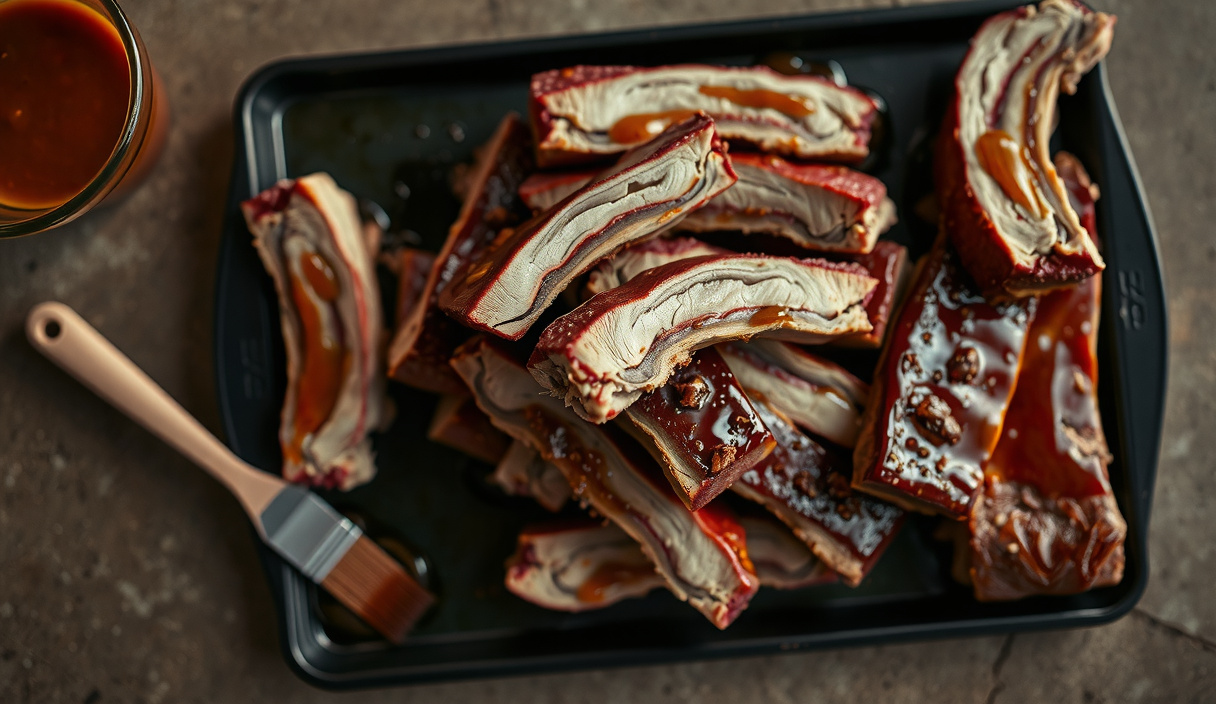
Smoked Country-Style Pork Ribs
Blade-end country-style pork ribs smoke at 225°F to build a Maillard crust and smoke ring, then braise sealed in a foil pan with BBQ sauce and apple juice until the internal temperature hits 195°F — the threshold where collagen fully hydrolyzes into self-basting gelatin. A quick open-lid caramelization step at the end sets the glaze and deepens the color. Pull-apart tender, smoky, and rich without a twelve-hour commitment.
Equipment
- 1 Smoker or kettle grill Set up for indirect heat, 225°F with apple or cherry wood chunks
- 1 Two-probe digital thermometer One probe at grate level, one for internal meat temperature — non-negotiable for hitting the 170°F smoke pull and 195°F braise finish
- 1 Disposable aluminum half-sheet foil pan Deep-sided, large enough to hold ribs in a single layer with at least 1 inch of liquid
- 1 roll Heavy-duty aluminum foil For sealing the foil pan airtight during the braise
- 1 Wire cooling rack For resting the ribs after the caramelization step
- 1 Basting brush
Ingredients
Ribs
- 4 lbs blade-end country-style pork ribs Bone-in or boneless; look specifically for the blade end — darker meat with visible fat striations, not the leaner center-cut loin version
Dry Brine
- 2 tsp kosher salt Diamond Crystal; if using Morton's, reduce to 1.25 tsp — its denser crystal structure delivers more sodium by volume
Dry Rub
- 2 tbsp brown sugar Packed; provides reducing sugars for Maillard crust development and caramel depth
- 1 tbsp smoked paprika
- 1 tsp garlic powder
- 1 tsp onion powder
- 1 tsp black pepper Freshly ground
- 1 tsp dry mustard powder Colman's or equivalent; amplifies the sulfurous umami baseline
- 0.5 tsp cayenne pepper Adjust up or down for heat preference
- 0.5 tsp celery salt
Braise Liquid
- 1 cup BBQ sauce Tomato-based; use your preferred brand — the pectin and soluble solids in the sauce act as a viscous moisture barrier around the meat during the braise
- 0.5 cup apple juice Unfiltered preferred; pH 3.5 to 4.0 contributes mild acid hydrolysis of collagen and fructose for finishing caramelization
- 2 tbsp apple cider vinegar Balances sweetness and adds brightness to the braise liquid
- 1 tbsp Worcestershire sauce
Finishing Glaze
- 0.5 cup BBQ sauce Same sauce used in the braise; applied during the open-lid caramelization step

Instructions
Dry Brine
- Pat the country-style pork ribs dry with paper towels. Sprinkle kosher salt evenly over all surfaces — approximately 0.5 tsp per pound of meat. Place on a wire rack set over a rimmed sheet pan, uncovered, and refrigerate for 12 to 24 hours. The salt will initially draw surface moisture out through osmosis, then migrate back into the muscle, denaturing a portion of the myosin and restructuring the water-holding matrix. The surface will appear slightly dry and tacky after brining — this is correct and promotes crust formation.
Apply Rub and Prep Smoker
- Combine brown sugar, smoked paprika, garlic powder, onion powder, black pepper, dry mustard powder, cayenne pepper, and celery salt in a small bowl. Mix thoroughly. Apply the rub generously to all surfaces of the ribs, pressing firmly so it adheres to the tacky brined exterior. Let the ribs rest at room temperature for 30 minutes while the smoker comes up to temperature. This brief equilibration allows the rub to begin drawing surface moisture, forming a paste that will set into bark.1 tbsp smoked paprika, 1 tsp garlic powder, 1 tsp onion powder, 1 tsp black pepper, 1 tsp dry mustard powder, 0.5 tsp cayenne pepper, 0.5 tsp celery salt
- Set up your smoker for indirect heat at 225°F. Add two to three chunks of apple or cherry wood — not chips — to the coals or wood box. Allow the smoker to stabilize at temperature before loading the ribs. Verify temperature with your ambient grate-level probe, not the lid thermometer, which typically reads 15°F to 25°F higher than actual grate temperature.
Smoke Phase
- Place the ribs on the smoker grate in a single layer, with at least 1 inch of clearance between pieces for even smoke and convective heat circulation. Insert the meat probe into the thickest section of the largest rib, parallel to the bone if bone-in, positioned away from any fat pockets. Smoke at 225°F with the lid closed for approximately 2 hours, until the internal temperature reads 170°F. Do not open the lid during the first 90 minutes — every lid-lift drops smoker temperature 25°F to 40°F and releases accumulated smoke. Expect a stall around 155°F to 165°F as surface evaporative cooling temporarily absorbs energy as fast as the smoker delivers it; hold temperature and wait it out.
Build Braise Liquid
- While the ribs smoke, combine BBQ sauce, apple juice, apple cider vinegar, and Worcestershire sauce in a bowl and whisk to combine. The mixture should be pourable but viscous — the tomato pectin and soluble solids in the sauce provide yield stress that will slow moisture migration from the meat surface during the sealed braise. Pour the braise liquid into the disposable foil pan and set aside.1 cup BBQ sauce, 0.5 cup apple juice, 2 tbsp apple cider vinegar, 1 tbsp Worcestershire sauce
Braise Phase
- When the ribs reach 170°F internal, transfer them directly from the smoker into the foil pan containing the braise liquid. Arrange in a single layer, meat-side down if possible. The ribs should be at least half-submerged — add a splash of additional apple juice if the liquid level is low. Seal the pan tightly with two layers of heavy-duty aluminum foil, crimping the edges firmly so no steam can escape. Return the sealed pan to the smoker and re-insert the meat probe through the foil into the thickest rib section.1 cup BBQ sauce, 0.5 cup apple juice, 2 tbsp apple cider vinegar, 1 tbsp Worcestershire sauce
- Continue cooking at 225°F, sealed, until the internal temperature reaches 195°F. This will take approximately 60 to 90 minutes depending on rib thickness and smoker consistency. At 195°F, the collagen hydrolysis is complete — the connective tissue has fully converted to soluble gelatin that coats each muscle fiber. Check the liquid level once at the 45-minute mark by carefully lifting one corner of the foil. If liquid is below half an inch, add a quarter cup of apple juice before resealing.
Caramelization and Rest
- When the ribs hit 195°F, carefully remove the foil pan from the smoker. Open the foil away from you — the steam is extremely hot. Transfer the ribs from the braise liquid to the smoker grate, or to a grill running at 225°F to 250°F. Using a basting brush, apply a generous coat of BBQ sauce to all exposed surfaces. Cook open for 2 to 3 minutes per side, brushing with additional sauce once per side, until the glaze is set and visibly caramelized. The reducing sugars in the sauce and the residual apple juice fructose on the surface will brown rapidly — watch closely and do not walk away.0.5 cup BBQ sauce
- Transfer the glazed ribs to a wire rack. Rest for 10 minutes uncovered — do not tent with foil, which would trap steam and soften the crust you just built. During the rest, the gelatin in the muscle transitions from a fully fluid state back to a cohesive gel phase, the surface moisture redistributes into the fiber structure, and the glaze firms from sticky to a set lacquered finish. Slice or pull to serve.
Notes
Why 225°F and not higher? At 225°F, the rate of internal temperature rise is slow enough that the surface Maillard reaction and smoke deposition can run to completion before the internal muscle hits the actin-denaturation danger zone of 166°F to 172°F. Higher smoker temperatures — 275°F or above — drive internal temperature up too quickly relative to crust formation, leaving less margin before the transition to the braise must occur. The slower approach also extends the time spent in the 140°F to 160°F range, where initial collagen shrinkage begins and the muscle starts expelling bound water. More time in that window means less total water to make up during the braise phase.
The stall is physics, not a problem: Between approximately 155°F and 165°F internal, surface evaporation absorbs energy as fast as the smoker delivers it — the evaporative cooling rate matches the heat-transfer rate. Internal temperature plateaus, sometimes for 30 to 45 minutes. This is normal and expected. The stall is where the bark is forming and the smoke ring is deepening. Do not raise smoker temperature to push through it; the stall resolves itself once surface moisture is sufficiently reduced and the evaporation rate drops below the heat-transfer rate.
Collagen hydrolysis kinetics: Collagen begins shrinking at 140°F and the hydrolysis rate increases exponentially above 176°F. At 195°F with the closed foil pan maintaining a moist environment, the first-order conversion of triple-helix collagen to soluble gelatin runs essentially to completion within 30 to 45 minutes of holding at that temperature. The gelatin produced — roughly 2% to 4% of the liquid phase by the end of the braise — is sufficient to create a self-basting layer around every muscle fiber. This is why 195°F ribs feel silky rather than simply cooked: the gelatin physically lubricates the protein matrix in a way that no amount of added sauce can replicate from the outside.
Why apple juice? Apple juice at pH 3.5 to 4.0 does three things in this recipe: (1) It provides mild acid catalysis of collagen peptide bonds, slightly accelerating hydrolysis rate compared to a neutral pH braise liquid. (2) Its fructose and glucose content — roughly 10 to 12 grams per 100 mL — participates in surface Maillard reactions during the final open-lid caramelization step, contributing to glaze color and flavor depth without requiring additional sugar. (3) Its aromatic volatile esters — primarily ethyl butanoate and hexyl acetate — partition into the fat phase of the braised meat and contribute to the fruity, complex aroma that distinguishes a braise-finished rib from a purely dry-smoked one.
Nutrition
Calories: 480kcalCarbohydrates: 22gProtein: 38gFat: 26gSaturated Fat: 9gCholesterol: 130mgSodium: 820mgFiber: 0.5gSugar: 18g
Tried this recipe?Let us know how it was!