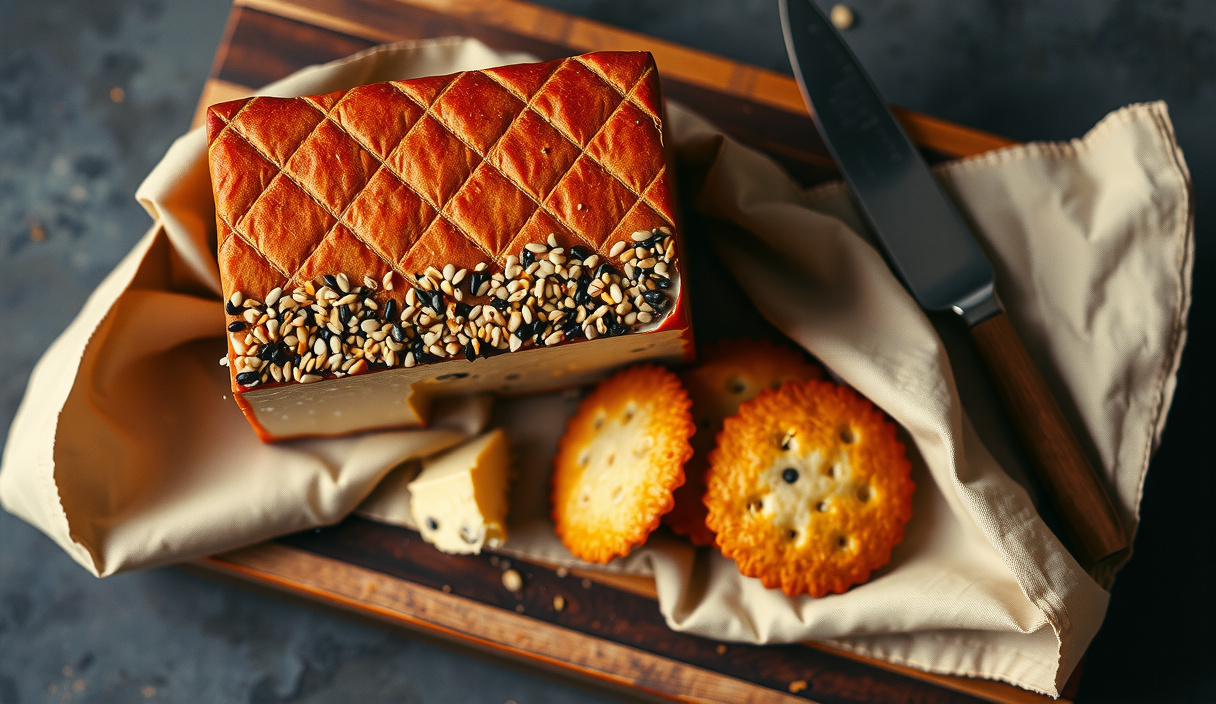
Smoked Cream Cheese with Everything-Bagel Crust

An 8oz block of cold cream cheese, scored in a deep crosshatch, coated in everything-bagel seasoning, and smoked low-and-slow at 225°F for 90 minutes. Casein proteins firm the block without melting it, while the high-surface-moisture dairy matrix absorbs smoke phenolics through dual fat-soluble and water-soluble pathways. The result is a deeply flavored, mahogany-crusted appetizer that takes 5 minutes of prep and runs completely unattended on the smoker. Serve hot with crackers, sliced vegetables, or toasted crostini.
Equipment
- 1 Pellet grill or offset smoker Set up for indirect heat at 225°F with a water pan if available. Hickory or cherry wood recommended.
- 1 Instant-read thermometer To verify internal temp of cream cheese reaches 130–140°F by the end of the cook.
- 1 Paring knife For scoring the crosshatch pattern 1/4 inch deep across top and sides of the block.
- 1 Pastry brush For applying the oil coat evenly before seasoning.
- 1 Small sheet pan or cast iron skillet Optional — use to catch any edge drips from the block and for easier transport from smoker to table.
Ingredients
- 8 oz block cream cheese Full-fat, straight from the refrigerator — cold is critical. Do not use whipped or reduced-fat cream cheese.
- 1 tablespoon olive oil or avocado oil Just enough to coat the surface thinly and improve seasoning adhesion.
- 3 tablespoons everything-bagel seasoning Look for a blend with visible dried garlic and onion flakes — these are the Maillard contributors that develop roasted depth under smoke heat.
- 1 teaspoon flaked sea salt Optional — only if your everything-bagel blend is low on salt.
For serving
- crackers Buttery or plain crackers work best — avoid heavily seasoned ones that compete with the everything-bagel crust.
- sliced cucumbers Cool, high-moisture vehicle that contrasts nicely with the warm, intense crust.
- sliced baguette or crostini Optional — toast lightly before serving.
- everything-bagel seasoning A small pinch over the top at the table reinforces the aroma right before first bite.

Instructions
Prep
- Fire up your smoker and bring it to a stable 225°F using indirect heat. Add your wood — hickory for assertive smoke depth, cherry for a slightly sweeter, fruitier profile. Allow the smoker to run for at least 15 minutes until you see thin blue smoke rather than heavy white smoke. Do not load the cream cheese until the smoke is clean.
- While the smoker comes to temp, unwrap the cold cream cheese block and place it on a small cutting board. Using a sharp paring knife, score a crosshatch pattern across the top and all four sides, cutting approximately 1/4 inch deep and spacing cuts about 3/4 inch apart. This increases surface area and dramatically improves both smoke penetration and seasoning adhesion. Don't skip this step.8 oz block cream cheese
- Using a pastry brush, apply a thin, even coat of olive oil or avocado oil across the entire surface of the scored block — top, bottom, and all four sides. The oil acts as an adhesive for the seasoning and helps drive the surface toward Maillard browning conditions faster by reducing immediate evaporative cooling.1 tablespoon olive oil or avocado oil
- Pour the everything-bagel seasoning onto a small plate and press all six sides of the oiled block firmly into the seasoning, ensuring full, even coverage — especially packed into the scored grooves where smoke will concentrate. Add the optional flaked sea salt if your blend is light on salt. The scored grooves should be visibly packed with seasoning.3 tablespoons everything-bagel seasoning, 1 teaspoon flaked sea salt
Smoke
- Place the seasoned cream cheese block directly on the smoker grate over indirect heat, or set it on a small cast iron skillet or foil-lined sheet pan for easier handling. Close the lid and smoke at 225°F for 90 minutes, undisturbed. Resist opening the lid — every lid lift drops chamber temperature and risks a temperature spike on recovery that could push the block past the safe casein-stability window.8 oz block cream cheese
- At the 60-minute mark, the block should show a visible amber-to-mahogany color developing on the scored ridges. If the block is still pale, your smoke temperature is running low or your smoke is too thin — check your firebox and add a small chunk of wood if needed. By 90 minutes, the ridges should be deep mahogany and the seasoning should look toasted and fragrant. Use an instant-read thermometer to verify internal temperature reaches 130–140°F. If it hasn't reached 130°F, give it another 10–15 minutes.
Serve
- Transfer the block to a serving board while still hot from the smoker. Arrange crackers, sliced cucumbers, and any other dippers around it. Optionally, scatter a pinch of fresh everything-bagel seasoning directly over the top at the table — the heat of the block will immediately volatilize the dried aromatics, amplifying the scent right at the moment of first bite.crackers, sliced cucumbers, sliced baguette or crostini, everything-bagel seasoning
- To serve, drag a cracker or cucumber slice straight through the scored crust, scooping the warm, silky interior with the toasted crust shattering over it. The block will hold its shape for 20–30 minutes at room temperature before the interior begins to firm back up as the fat phase re-crystallizes. Serve immediately and eat while warm.
Notes
Why the casein network doesn't melt at 225°F: Cream cheese is an oil-in-water emulsion stabilized by casein micelles — phosphoprotein clusters that are among the most thermally stable proteins in food. Unlike whey proteins (which denature sharply at 140–167°F and form irreversible aggregates), casein micelles respond to heat by progressive compaction and increased association rather than unfolding and aggregating. At an internal temperature of 100–150°F — which is precisely what a cold cream cheese block achieves sitting in a 225°F smoker — the casein network tightens and stabilizes, firming the block without causing the catastrophic emulsion inversion that produces melting and oil separation. This is why cream cheese is one of the only dairy products you can smoke without it turning into a puddle.
Dual-pathway smoke deposition on dairy: Smoke compounds exist in two phases — water-soluble phenolics (guaiacol, syringol, 4-methylguaiacol) and fat-soluble heavier aromatics. Cream cheese's high surface moisture (water activity ~0.98 at the start of the cook) makes it extraordinarily receptive to the water-soluble phenolics, which absorb deeply and rapidly. As the surface dries and water activity drops through the cook, lipophilic smoke compounds partition simultaneously into the exposed fat phase. This dual mechanism is why smoked cream cheese develops such a complex, layered smoke character — both the bright, sharp phenolic notes and the deep, resinous bass notes are captured.
Maillard onset in the everything-bagel crust: The dried garlic and onion flakes in the seasoning contain reducing sugars (primarily fructose and glucose) and free amino acids (glutamic acid, cysteine). At the surface temperatures the crust particles achieve through radiant heat, Maillard cascade chemistry proceeds through Schiff base formation, Amadori rearrangement, and Strecker degradation, generating pyrazines (roasted, nutty), furanones (caramel), and sulfur-containing heterocycles (roasted allium depth). This is why the everything-bagel crust smells significantly more complex after 90 minutes of smoking than a raw blend does — the smoke heat is running live flavor chemistry on the seasoning surface the entire time.
Wood selection and phenolic load: Hickory combustion produces a high phenolic yield dominated by guaiacol and syringol — the classic BBQ smoke signature. Cherry produces lower total phenolics but a higher proportion of fruit-ester volatiles and a deeper red pigmentation from anthocyanin combustion products. Mesquite burns at higher internal temperatures, generating heavier creosote-class compounds that are overpowering on a neutral dairy canvas. Match wood intensity to the intended serving context: hickory for savory, assertive applications; cherry for a lighter, sweeter profile that pairs with fruit-forward accompaniments like honey or fig jam.
Nutrition
Calories: 102kcalCarbohydrates: 1.5gProtein: 2gFat: 10gSaturated Fat: 6gCholesterol: 32mgSodium: 210mgFiber: 0.2gSugar: 0.8g
Tried this recipe?Let us know how it was!