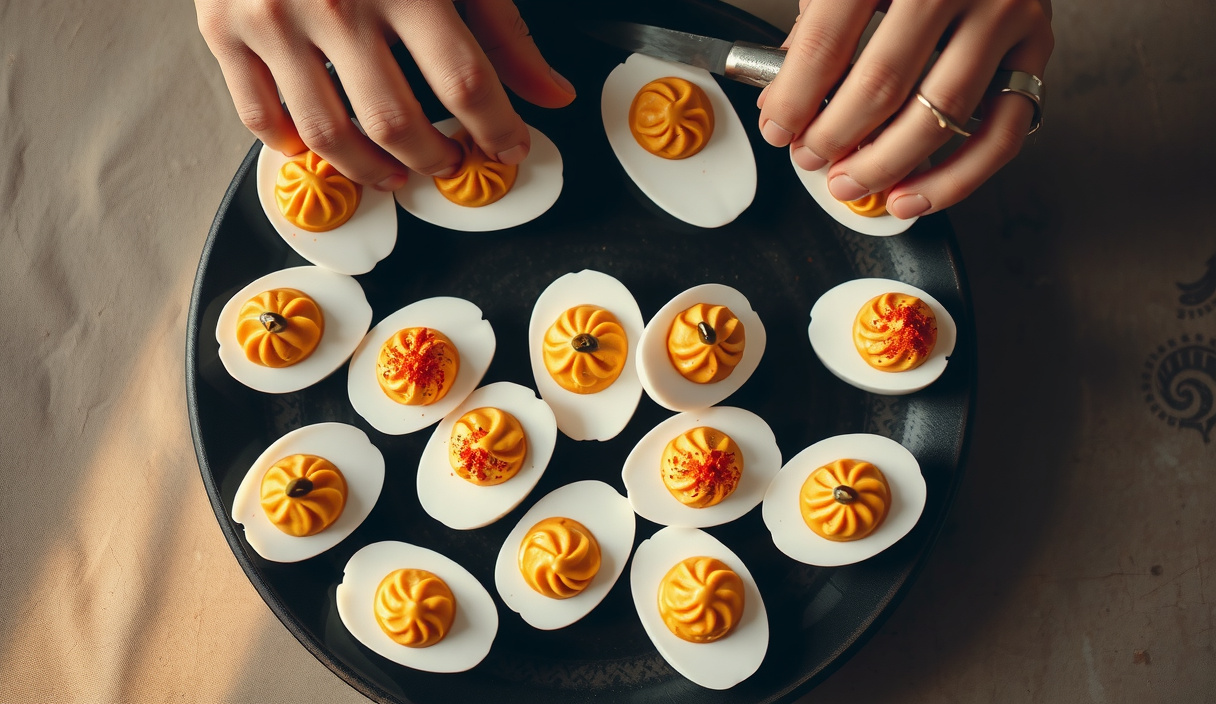
Smoked Deviled Eggs — The Cold-Smoke Yolk Method

Whole eggs cold-smoked at 90°F for 90 minutes over applewood absorb phenolic smoke compounds through the shell's natural pores, producing whites with a delicate amber blush and yolks perfumed with genuine campfire depth. The yolk filling — a stabilized emulsion of mayo, Dijon, smoked paprika, and a precise acid correction — is piped back into the whites for a party appetizer with layers of smoke that no surface-smoked egg can replicate.
Equipment
- 1 Smoker or covered grill with cold-smoke setup Maintain 85 to 100°F at grate level. A maze pellet smoker, tube smoker, or a kettle with minimal charcoal all work.
- 2 handfuls Applewood chips or chunks Fruitwood preferred. Cherry or pecan are excellent alternatives.
- 1 Probe thermometer Clip to the grate near the eggs. Non-negotiable for temperature control.
- 1 Medium saucepan
- 1 Large bowl with ice water Prepare before the eggs finish boiling.
- 1 Piping bag fitted with a 1M star tip A large zip-lock bag with the corner cut works as a substitute.
- 1 Wire cooling rack For drying eggs before smoking.
Ingredients
Eggs
- 6 large eggs At least 7 to 10 days old for easy peeling. Refrigerator-cold is fine going into the smoker.
Yolk Filling
- 3 tablespoons full-fat mayonnaise Duke's or Hellmann's. Do not use reduced-fat.
- 1 teaspoon Dijon mustard
- 1 teaspoon smoked paprika Pimentón de la Vera bittersweet (agridulce) preferred.
- 1 teaspoon apple cider vinegar Start with 1/2 teaspoon and adjust to taste after seasoning.
- ¼ teaspoon kosher salt Season to taste last, after all other ingredients are incorporated.
- ⅛ teaspoon freshly ground black pepper
- ¼ teaspoon hot sauce Optional. Crystal or Texas Pete works well without overwhelming the smoke.
Garnish
- smoked paprika A light dusting over each finished egg.
- 6 small fronds fresh dill Optional. One small frond per egg half.
- flaky sea salt Optional finish. One small crystal per egg.

Instructions
Cold Smoke the Whole Eggs
- Set up your smoker or covered grill for cold smoking. Load the smoke generator with applewood chips or chunks and ignite. Allow the chamber to stabilize between 85°F and 95°F at grate level before placing the eggs. Clip your probe thermometer to the grate near where the eggs will sit and monitor it throughout the smoke.
- Remove the eggs from the refrigerator and pat each one completely dry with paper towels. Place them directly on the grate — upright in an egg carton tray or lying flat, both work. Do not crowd them; leave at least 1 inch of airspace around each egg for smoke circulation.
- Close the lid and cold smoke the eggs for 90 minutes, maintaining the chamber between 85°F and 100°F the entire time. If the temperature climbs above 100°F, crack a vent or place a small pan of ice inside the chamber away from the smoke source. After 90 minutes, remove the eggs. The shells will show a very faint tan tinge and smell distinctly smoky.
Hard Boil and Peel
- Prepare a large bowl of ice water. Bring a medium saucepan of water to a full rolling boil. Using a slotted spoon, gently lower the smoked eggs into the boiling water one at a time. Boil for exactly 11 minutes for a fully set but not over-cooked yolk.
- Immediately transfer the eggs to the ice water bath and let them sit for at least 10 minutes. This halts carryover cooking and prevents the gray-green ferrous sulfide ring from forming around the yolk. Peel under cold running water — the shells should slide off cleanly. Pat the peeled whites dry and refrigerate them on a plate while you make the filling.
Make the Yolk Filling
- Halve each peeled egg lengthwise with a thin, sharp knife. Pop the yolks into a medium bowl. Set the whites hollow-side up on a serving platter or sheet pan.
- Mash the yolks with a fork until no large lumps remain — the finer the texture, the smoother the piped result. Add the mayonnaise and Dijon mustard. Mix vigorously until completely smooth and glossy.1 teaspoon Dijon mustard
- Add the smoked paprika, half of the apple cider vinegar, the black pepper, and hot sauce if using. Stir to fully incorporate. Taste the filling: it should be rich, smoky from both the shell-penetrated yolks and the paprika, with a bright acidic edge. Add more vinegar in 1/4-teaspoon increments as needed. Season with kosher salt last — taste carefully, as the Dijon and paprika both carry salt.1 teaspoon smoked paprika, 1 teaspoon apple cider vinegar, 1/4 teaspoon kosher salt, 1/8 teaspoon freshly ground black pepper, 1/4 teaspoon hot sauce
- Transfer the filling to a piping bag fitted with a 1M star tip. Refrigerate the bag flat for 10 minutes if the filling has become warm from handling — cold filling holds its piped shape far better.1 teaspoon Dijon mustard, 1 teaspoon smoked paprika, 1 teaspoon apple cider vinegar, 1/4 teaspoon kosher salt, 1/8 teaspoon freshly ground black pepper, 1/4 teaspoon hot sauce
Pipe and Garnish
- Pipe the filling into each white half in a single continuous spiral motion, applying even pressure from the shoulder rather than the hand. Start at the outer edge of the hollow and spiral inward and upward to create a domed rosette that rises just above the rim of the white.1 teaspoon Dijon mustard, 1 teaspoon smoked paprika, 1 teaspoon apple cider vinegar, 1/4 teaspoon kosher salt, 1/8 teaspoon freshly ground black pepper, 1/4 teaspoon hot sauce
- Dust each finished egg lightly with smoked paprika from a height of about 12 inches for an even, fine coat. Add a small dill frond and a single crystal of flaky sea salt to each if using. Serve immediately or refrigerate on the platter until ready — do not leave at room temperature for more than 2 hours total.smoked paprika, 6 small fronds fresh dill, flaky sea salt
Notes
Why cold smoking works through the shell: Eggshells contain 7,000 to 17,000 natural pores whose biological purpose is gas exchange for the developing embryo. At 90°F, small phenolic smoke molecules — guaiacol, syringol, 4-methylguaiacol — and their water-vapor carrier migrate inward through these pores and through the keratin-collagen shell membranes into the albumen and yolk. The 90°F target is critical: below this the smoke smolders inconsistently; above 100°F the albumen begins to contract and expel moisture outward, reversing the pressure gradient and sharply reducing phenolic absorption. At 130°F and above, significant myosin denaturation begins and you are cooking, not cold-smoking.
The 90-minute rule: At 60 minutes smoke penetration is subtle; at 90 minutes it is distinct and well-integrated; at 120 minutes the whites begin to accumulate phenolics at the membrane surface that read as bitter. 90 minutes is the inflection point where benefit and risk are optimally balanced.
Why older eggs peel cleanly: Freshly laid egg albumen has a pH around 7.6. As the egg ages, CO2 outgasses through the pores, raising albumen pH toward 9.2. This higher pH reduces the electrostatic bond between the albumen and the inner shell membrane, allowing the cooked white to release cleanly in one piece. A fresh egg boiled hard will almost always tear.
Mayonnaise as a fat-phase flavor buffer: The lipid phase in full-fat mayonnaise is the primary solvent for all lipophilic aroma compounds — smoke phenolics, paprika carotenoid esters, and mustard volatiles. These molecules partition strongly into fat, suppressing their vapor pressure and creating a slow, time-delayed release on the palate rather than an immediate spike and fade. Reduced-fat mayo has a much smaller lipid phase and simply cannot hold the same aromatic load — hence the specific instruction to use full-fat only.
Food safety note: Smoked deviled eggs are a reduced-oxygen, high-protein product. Keep refrigerated below 40°F until 5 minutes before service. Discard any eggs left at room temperature for more than 2 hours total (1 hour if ambient temperature exceeds 90°F).
Nutrition
Calories: 78kcalCarbohydrates: 0.5gProtein: 4gFat: 7gSaturated Fat: 1.5gCholesterol: 98mgSodium: 115mgSugar: 0.2g
Tried this recipe?Let us know how it was!