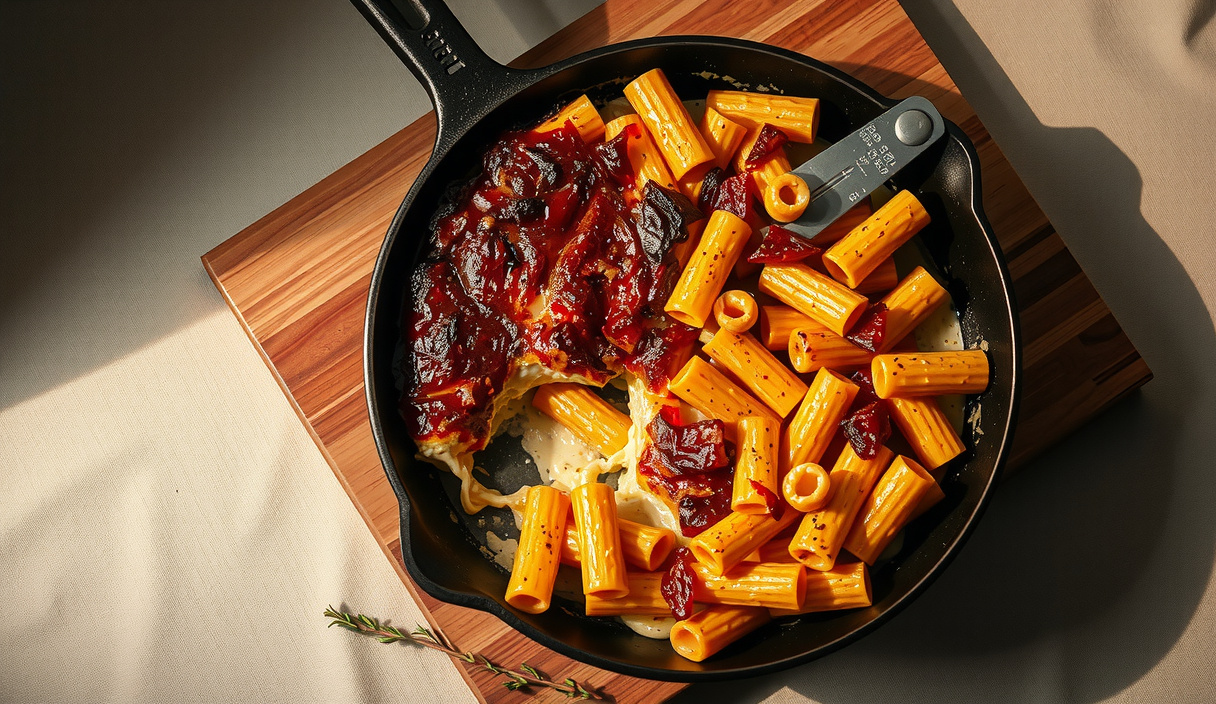
Smoked Mac & Cheese — Three-Cheese Béchamel

A sodium-citrate-stabilized three-cheese béchamel (sharp cheddar, gruyère, parmesan) coats cavatappi pasta and goes into a 275°F smoker for 60 minutes, developing a Maillard-browned, smoke-kissed crust while the interior stays impossibly creamy. This is the version where food physics and fire finally work together.
Equipment
- 1 12-inch cast iron skillet or 4-quart enameled Dutch oven Must be stovetop-safe and smoker-safe. No plastic handles.
- 1 Smoker (offset, kettle, kamado, or pellet) Set up for indirect heat at 275°F. Use apple or cherry wood chunks or chips.
- 1 Large pot for boiling pasta
- 1 Kitchen scale Required for accurate sodium citrate measurement at 4% w/w.
- 1 Whisk
- 1 Instant-read thermometer To verify internal casserole temperature of 185–190°F.
- 1 Box grater For block cheese — do not use pre-shredded.
Ingredients
Pasta
- 1 lb cavatappi pasta Or cellentani, ridged elbow, or rigatoni
- 1 tbsp kosher salt For pasta water
Three-Cheese Sodium Citrate Béchamel
- 3 cups whole milk 720g; cold from refrigerator
- 29 g food-grade sodium citrate Trisodium citrate dihydrate; 4% of 720g milk = 28.8g, rounded to 29g. Approx 2 tbsp but weigh for accuracy.
- 3 tbsp unsalted butter
- 3 tbsp all-purpose flour
- 1 cup heavy cream
- 8 oz sharp aged cheddar 18-month or older; shredded from block, not pre-shredded
- 6 oz gruyère Shredded from block; cave-aged preferred
- 3 oz Parmigiano-Reggiano Finely grated
- 1 tsp dry mustard powder
- 1 tsp smoked paprika
- ½ tsp garlic powder
- ¼ tsp white pepper Freshly ground
- ½ tsp kosher salt Adjust to taste; sodium citrate contributes saltiness
Topping
- ½ cup panko breadcrumbs
- 2 tbsp unsalted butter Melted
- 2 tbsp Parmigiano-Reggiano Finely grated, for topping
- ½ tsp smoked paprika For topping color

Instructions
Prep & Fire
- Fire your smoker and bring it to a stable 275°F using indirect heat. Add 2–3 apple or cherry wood chunks (or a generous handful of soaked chips if using a kettle). Allow the smoke to run clean — white billowing smoke indicates incomplete combustion and will make food taste acrid. You want thin blue smoke before food goes on.
- Bring a large pot of water to a rolling boil. Add 1 tablespoon kosher salt. Cook the cavatappi for exactly 2 minutes less than the package minimum time — it should be firmly undercooked with a distinct white center when you bite through. Drain and toss with a light drizzle of neutral oil to prevent sticking. Set aside.1 tbsp kosher salt
Build the Sodium Citrate Béchamel
- In your cast iron skillet or Dutch oven, whisk the 29g sodium citrate into the 3 cups cold whole milk until fully dissolved. This is easier in cold liquid — do not skip this step or add it to hot milk.29 g food-grade sodium citrate, 3 cups whole milk
- Over medium heat, warm the milk-sodium citrate mixture, stirring occasionally, until it reaches 140°F (just below a simmer). Do not boil. Meanwhile, in a separate small saucepan, melt 3 tablespoons butter over medium heat. Whisk in 3 tablespoons all-purpose flour and cook, stirring constantly, for 90 seconds until the roux smells nutty and the raw flour aroma dissipates. This activates the starch's thickening potential.3 tbsp unsalted butter, 3 tbsp all-purpose flour
- Gradually whisk the hot roux into the warm sodium citrate milk, adding it in a thin stream while whisking constantly. Add the 1 cup heavy cream. Raise heat to medium-high and cook, whisking continuously, until the sauce thickens and coats the back of a spoon — about 5–7 minutes. It will reach approximately 190°F. Remove from heat.1 cup heavy cream
- Add the dry mustard powder, smoked paprika, garlic powder, white pepper, and kosher salt to the hot béchamel. Whisk to combine.1/4 tsp white pepper, 1/2 tsp kosher salt, 1/2 cup panko breadcrumbs, 2 tbsp unsalted butter, 2 tbsp Parmigiano-Reggiano
- Remove the pan from heat entirely. Add the shredded cheddar, gruyère, and Parmigiano-Reggiano in three separate additions, stirring vigorously with a silicone spatula after each until fully melted and incorporated before adding the next. The residual heat (around 170–180°F) plus the sodium citrate emulsion will produce a perfectly smooth, glossy sauce. If the cheese is not melting fully, briefly return the pan to the lowest possible heat for 30-second intervals — do not boil.8 oz sharp aged cheddar, 6 oz gruyère, 3 oz Parmigiano-Reggiano
Assemble
- Add the drained, undercooked cavatappi to the cheese sauce in the skillet. Fold gently with a spatula until every piece of pasta is thoroughly coated. The mixture will look slightly looser than you expect — this is correct. It will tighten significantly during the smoke.
- In a small bowl, combine the panko breadcrumbs, melted butter, 2 tablespoons Parmigiano-Reggiano, and 1/2 teaspoon smoked paprika. Toss until the crumbs are evenly coated. Scatter the topping mixture evenly over the surface of the pasta.1/2 tsp smoked paprika
Smoke
- Transfer the uncovered skillet directly to the smoker grate over indirect heat. Close the lid. Smoke at 275°F for 60 minutes, without opening the lid for the first 45 minutes. After 45 minutes, check the surface — it should be deeply golden with some darker browned spots. If it looks pale, verify your chamber temperature with a grate-level thermometer.
- At the 60-minute mark, verify the internal temperature at the center of the casserole with your instant-read thermometer. You are targeting 185–190°F. If it has not reached 180°F yet, continue smoking in 10-minute increments. Once the target temp is hit and the surface is golden-brown with visible smoke-deposit color, pull the skillet from the smoker.
Rest & Serve
- Allow the mac and cheese to rest uncovered for 10 minutes on a heatproof surface. This rest is not optional — the starch network needs time to firm from fluid to spoonable. Serve directly from the skillet. The bottom crust that has formed against the cast iron is a prize — make sure it gets distributed across portions.
Notes
Why sodium citrate works (and why 4% matters): Sodium citrate (Na₃C₆H₅O₇) is a chelating agent — it binds the calcium ions that normally cross-link casein proteins in aged cheese. Without those calcium bridges, the casein chains stay dispersed rather than aggregating into rubbery clumps when heated. The fat phase remains emulsified in the continuous water phase, producing a sauce that is physically incapable of breaking in the normal way. At 4% w/w of the milk mass, you achieve full chelation of the available calcium without over-salting the sauce (sodium citrate contributes a mild, faintly salty-sour flavor). Going below 3% risks incomplete emulsification in high-fat aged cheeses; going above 5% produces a noticeably soapy finish.
The stall in the casserole: Just as a brisket stalls around 160–170°F due to evaporative cooling, a dense mac and cheese casserole will hold its core temperature steady for 15–20 minutes during the smoke as surface moisture evaporates. Do not raise your smoker temperature in response — just wait it out. The internal temperature will eventually climb as the surface moisture decreases. This is why internal temp verification matters more than clock time.
Wood selection and smoke dosage: Phenolic compounds deposited from wood smoke — primarily guaiacol and syringol from hardwoods — are highly soluble in fat. The butter and cheese fat in this dish acts as a smoke trap: it absorbs and concentrates these phenolics, intensifying the smoke flavor beyond what a lean protein would pick up in the same timeframe. This is why fruit woods with lower phenolic density (apple, cherry) work better here than heavy hardwoods. With hickory or mesquite, you risk overwhelming the dairy register entirely.
Cheese selection matters at the molecular level: Aged cheddar contributes high levels of free amino acids (particularly glutamic acid) from proteolysis during aging — this is what delivers the deep savory baseline. Gruyère's characteristic nuttiness comes from its higher propionate content, produced by Propionibacterium during its longer maturation. Parmigiano-Reggiano provides glutamate density and sharp crystalline tyrosine nodes that dissolve slowly in the sauce. Together they generate a layered umami architecture that no single cheese can replicate.
Nutrition
Calories: 610kcalCarbohydrates: 52gProtein: 28gFat: 32gSaturated Fat: 18gCholesterol: 95mgSodium: 820mgFiber: 2gSugar: 6g
Tried this recipe?Let us know how it was!