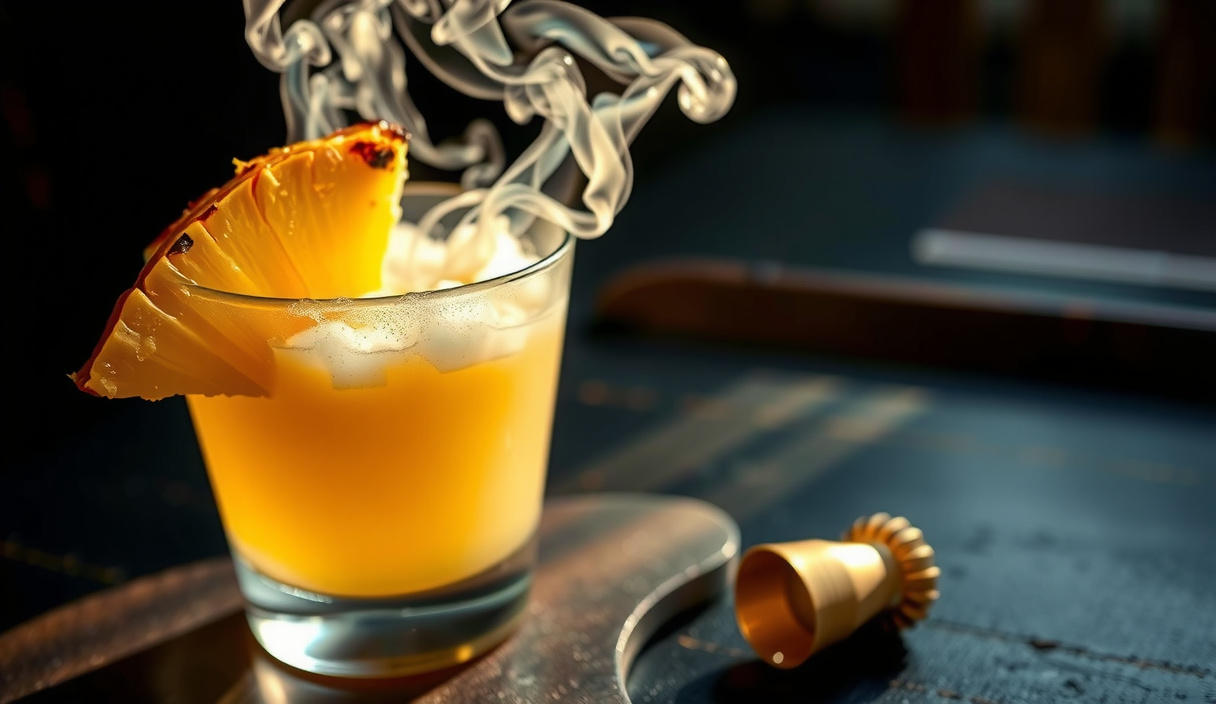
Smoked Pineapple Daiquiri

Pineapple wedges cold-smoked at 225°F absorb guaiacol and syringol phenols from applewood, which bind to the fruit's reducing sugars and survive pressing. The resulting juice shakes into a daiquiri that is simultaneously tropical, tart, and layered with a clean campfire finish that no extract or garnish trick can replicate.
Equipment
- 1 Smoker or kettle grill set up for indirect heat Target 225°F at grate level. Use an ambient probe thermometer, not the lid gauge.
- 1 cup Applewood or cherrywood chips Soak in water for 20 minutes before use so chips smolder rather than flare.
- 1 Juicer or blender plus fine-mesh strainer A centrifugal juicer gives the cleanest, lowest-fiber result. A blender plus straining through cheesecloth works equally well.
- 1 Cocktail shaker A two-piece tin shaker (Boston shaker) chills faster than a three-piece cobbler.
- 1 Hawthorne strainer
- 1 Fine-mesh conical strainer Double-straining removes ice chips and pineapple fiber for a crystal-clear pour.
- 1 Chilled coupe glass Store in the freezer for at least 20 minutes before service.
Ingredients
Smoked Pineapple Juice
- 1 small fresh pineapple About 3 lb whole. Cut into 1-inch-thick spears with skin on to protect flesh from direct radiant heat.
Cocktail
- 2 oz white rum Choose a clean, lightly filtered white rum with pronounced ethyl ester brightness. Avoid aged or spiced rum for the base build.
- 1.5 oz smoked pineapple juice Freshly pressed, fine-strained, and chilled to 34°F before use.
- 0.75 oz fresh lime juice Squeezed to order. Approximately 1 medium lime. Do not use bottled.
- 0.5 oz simple syrup 1:1 ratio, white sugar to water. Adjust up or down by 0.25 oz depending on the natural sweetness of your pineapple.
- 1 cup ice Large, hard cubes preferred. Cloudy or cracked ice melts too fast and over-dilutes before the target temperature is reached.
Garnish
- 1 small wedge smoked pineapple Reserve one smoked spear before juicing. Cut a thin wedge and nick the skin to balance on the coupe rim.

Instructions
Smoke the Pineapple
- Set up your smoker or kettle grill for indirect heat. Bring the grate temperature to a steady 225°F using an ambient probe thermometer placed at grate level. Add the soaked applewood or cherrywood chips directly over your heat source.
- Cut the pineapple into 1-inch-thick spears, leaving the skin on. The skin acts as a thermal buffer, slowing internal cooking while the flesh surface absorbs smoke compounds.
- Arrange the pineapple spears on the grate over the indirect-heat zone (not directly above the coals or burner). Close the lid. Smoke at 225°F for exactly 30 minutes. Do not lift the lid during this window — each opening drops chamber temperature by 25–40°F and disrupts the convective smoke flow that drives phenol deposition onto the fruit surface.
- Remove the pineapple from the smoker. The surface should be lightly golden with visible condensation of smoke compounds — not charred, not dried out. Allow to cool at room temperature for 10 minutes, then transfer to the refrigerator uncovered for at least 15 minutes before juicing. Cold fruit presses more efficiently and the chilled juice is ready for the shaker faster.
Press and Strain the Juice
- Remove and discard the pineapple skin. Feed the smoked flesh through a centrifugal juicer or blend with 2 tablespoons of cold water and press through a fine-mesh strainer lined with cheesecloth, pressing firmly to extract all liquid. You should yield approximately 4–6 oz of juice from a 3-pound pineapple.
- Transfer the pressed juice to a sealed container and refrigerate at 34°F for a minimum of 60 minutes before use. Chilled juice is essential for reaching the target final cocktail temperature (28–32°F in the glass) without over-diluting on ice.
Build and Shake the Cocktail
- Add the white rum, smoked pineapple juice, fresh lime juice, and simple syrup to the large tin of your cocktail shaker.1.5 oz smoked pineapple juice, 0.75 oz fresh lime juice, 0.5 oz simple syrup
- Fill the shaker two-thirds full with ice. Seal and shake hard for 12–15 seconds. You should feel the outside of the tin become painfully cold and begin to frost — this confirms the internal temperature has dropped below 32°F and sufficient dilution (approximately 20–25% by volume) has occurred.1 cup ice
- Double-strain through the Hawthorne strainer and a fine-mesh conical strainer simultaneously into your chilled coupe glass. The double-strain removes ice shards and any residual pineapple fiber, producing a clear, silky pour.
- Garnish with a thin smoked pineapple wedge balanced on the rim. Serve immediately.1 small wedge smoked pineapple
Notes
Why 225°F and not hotter? Above 230°F, the pineapple surface temperature climbs past the point where evaporative cooling can moderate it, accelerating water loss. As free moisture drops, concentration of bitter chlorogenic-type phenols at the surface rises disproportionately relative to the desirable guaiacol and syringol fraction. The 225°F ceiling keeps the guaiacol-to-bitter-phenol ratio in the range that tastes like campfire rather than ashtray.
Why do phenols survive juicing? Guaiacol (log P ≈ 1.06) and syringol (log P ≈ 1.32) are moderately hydrophilic, distributing readily into pineapple's aqueous sugar matrix. The reducing sugars — primarily glucose and fructose — form reversible hemiacetal complexes with carbonyl-bearing smoke volatiles, physically trapping them in solution. Water activity of the pressed juice (aw ≈ 0.99) provides sufficient molecular mobility to maintain these complexes while preventing rapid evaporative loss at refrigeration temperatures.
The bromelain factor: Pineapple juice contains bromelain, a sulfhydryl protease. At cocktail concentrations and refrigerated storage pH (~3.8–4.2), bromelain activity is low enough that it does not meaningfully break down proteins in the drink itself, but it does contribute to the fine foam stability generated during vigorous shaking by modifying surface-active peptide structures. This is the same mechanism behind pineapple juice's use as a foam builder in classic tiki cocktails.
Acidity and retronasal phenol release: The lime juice targets a final cocktail pH of approximately 2.3–2.5. At this acidity, salivary protein binding of hydrophobic phenols is partially suppressed, increasing the free concentration of guaiacol in saliva during swallowing. More free guaiacol reaches the olfactory epithelium via the retronasal passage on swallow, amplifying the perceived smoke character without any additional smoke input. This is why the smoke hits harder on the finish than on the initial nose.
Nutrition
Calories: 195kcalCarbohydrates: 16gProtein: 0.4gFat: 0.1gSodium: 5mgFiber: 0.2gSugar: 14g
Tried this recipe?Let us know how it was!