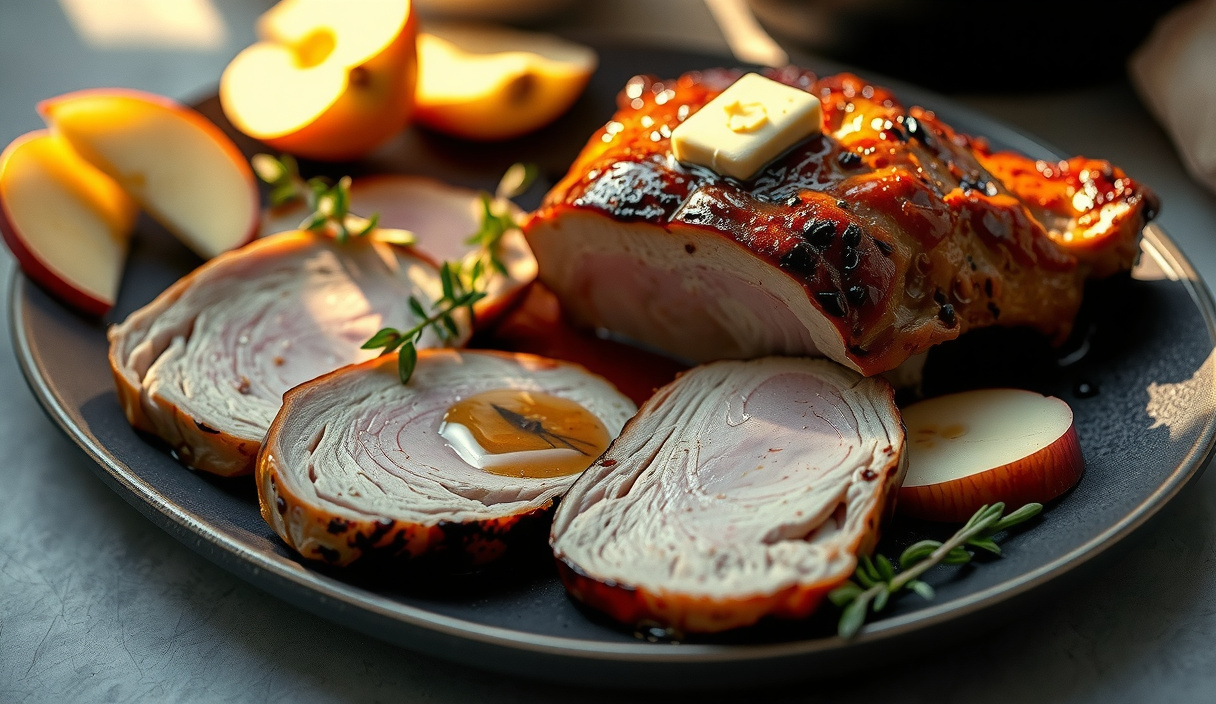
Smoked Pork Tenderloin with Apple-Cider Glaze

A 250°F low-and-slow smoke brings a silver-skin-free pork tenderloin to a precise 140°F internal — landing squarely in the myosin-denatured, actin-intact window for maximum juiciness — then a 4:1-reduced apple cider glaze goes on in the final ten minutes for a lacquered, Maillard-browned crust with deep caramel-fruit complexity. Sixty minutes total, zero guesswork if you have a thermometer.
Equipment
- 1 Smoker (offset, pellet, kettle, or vertical) Calibrated to hold a stable 250°F (121°C) chamber temperature
- 1 Instant-read thermometer Insert into the geometric center of the thickest part of the tenderloin
- 1 Small saucepan For reducing the apple cider glaze on the stovetop
- 1 Wire rack For resting the finished tenderloin to preserve bark integrity
- 1 Silicone basting brush For applying the glaze in thin, even coats
- 2 Apple or cherry wood chunks or chips Chunks preferred for a pellet or offset smoker; chips in a foil pouch for a kettle grill
Ingredients
Pork
- 1 pork tenderloin (1 to 1.25 lb / 450–570 g), silver skin removed A single tenderloin as sold in most grocery stores; trim any visible fat and peel off the silver skin before proceeding
- 1 tsp kosher salt Diamond Crystal; use 3/4 tsp if Morton
- ½ tsp freshly ground black pepper
- ½ tsp smoked paprika Optional; adds a phenolic aromatic baseline if wood smoke alone is subtle
- ½ tsp garlic powder
- ½ tsp onion powder
- 1 tbsp neutral oil (avocado or canola) Acts as a binder for the dry rub and helps initiate surface browning
Apple-Cider Glaze
- 2 cups fresh unfiltered apple cider Not sparkling cider or cider vinegar; look for unfiltered, fresh-pressed juice at 10–11 °Brix for the best aromatic payload after reduction
- 1 tbsp apple cider vinegar Adds malic-acid brightness and keeps the glaze from tasting flat once concentrated
- 1 tbsp whole-grain Dijon mustard Provides emulsifying mucilage and a subtle piquancy that balances the sweetness
- ¼ tsp kosher salt
- ¼ tsp freshly ground black pepper
- 1 pinch cayenne pepper Optional; a small amount of capsaicin activates TRPV1 receptors and sharpens the perception of sweetness

Instructions
Prepare the Tenderloin
- Pat the pork tenderloin completely dry with paper towels. Locate the silver skin — the iridescent, pearlescent membrane running along one side — and slide a thin boning or paring knife under it. Hold it taut with a paper towel for grip and peel it off in one continuous strip. Discard.
- In a small bowl, combine the kosher salt, black pepper, smoked paprika, garlic powder, and onion powder. Coat the tenderloin evenly with the neutral oil, then apply the dry rub on all sides, pressing gently to adhere. Allow to rest uncovered at room temperature for 20 to 30 minutes while the smoker preheats. If time permits, dry-brine overnight in the refrigerator uncovered — the surface will desiccate slightly, which accelerates Maillard browning on the smoker.1 tsp kosher salt, 1/2 tsp freshly ground black pepper, 1/2 tsp smoked paprika, 1/2 tsp garlic powder, 1/2 tsp onion powder, 1 tbsp neutral oil (avocado or canola)
Reduce the Apple-Cider Glaze
- Combine the apple cider, apple cider vinegar, whole-grain Dijon mustard, salt, pepper, and cayenne (if using) in a small saucepan. Stir to combine. Set over medium-low heat and bring to a steady, gentle simmer — do not boil aggressively, as a rapid boil drives off desirable aromatic esters faster than it concentrates sugars.2 cups fresh unfiltered apple cider, 1 tbsp apple cider vinegar, 1 tbsp whole-grain Dijon mustard, 1/4 tsp kosher salt, 1/4 tsp freshly ground black pepper, 1 pinch cayenne pepper
- Simmer uncovered, stirring occasionally, until the liquid reduces to approximately 1/2 cup (one-quarter of the original volume) — roughly 20 to 25 minutes. The glaze is ready when it coats the back of a spoon and a line drawn through it holds its shape for two to three seconds. Remove from heat and set aside. The glaze will thicken slightly as it cools.2 cups fresh unfiltered apple cider, 1 tbsp apple cider vinegar
Smoke the Tenderloin
- Set up your smoker for indirect cooking and stabilize the chamber temperature at 250°F (121°C). Add apple or cherry wood chunks — two small chunks for a long cook smoker, or a foil packet of soaked chips positioned over a coal snake for a kettle. You want a thin, pale blue smoke; thick white billowing smoke indicates incomplete combustion and will produce acrid, bitter flavors on a lean cut.
- Place the seasoned tenderloin on the grate away from any direct heat source. Insert the probe of your instant-read thermometer into the thickest geometric center of the meat, avoiding the narrow tapered end. Close the lid and smoke undisturbed.
- Monitor the internal temperature every 10 minutes starting at the 40-minute mark. The tenderloin will typically reach 125–130°F (52–54°C) internal in 45 to 50 minutes at a stable 250°F chamber, then climb the final 10–15°F over the next 10 to 15 minutes as the thermal gradient equalizes. Total cook time is approximately 55 to 65 minutes depending on the exact weight and ambient conditions.
- When the internal temperature reaches 130°F (54°C), begin warming the cider glaze over low heat on the stovetop until it is fluid and brushable (approximately 130–140°F itself — warm enough to flow, concentrated enough to cling).2 cups fresh unfiltered apple cider, 1 tbsp apple cider vinegar, 1 tbsp whole-grain Dijon mustard
- When the internal temperature reaches 135°F (57°C), brush a thin, even coat of the cider glaze over all surfaces of the tenderloin using the silicone basting brush. Close the lid and allow it to set for 3 minutes. Apply a second thin coat and allow it to caramelize for an additional 3 to 4 minutes.2 cups fresh unfiltered apple cider, 1 tbsp apple cider vinegar, 1 tbsp whole-grain Dijon mustard, 1/4 tsp kosher salt, 1/4 tsp freshly ground black pepper, 1 pinch cayenne pepper
- Pull the tenderloin when the internal temperature reads 140°F (60°C). Carry-over heat during the rest period will bring the center to the USDA-recommended 145°F (63°C). Transfer immediately to a wire rack. Do not tent with foil — foil trapping steam will soften the lacquered glaze crust you just built.
Rest and Serve
- Rest the tenderloin on the wire rack for 5 minutes. This allows the thermal gradient to equalize across the cross-section and permits the intracellular pressure to redistribute, reducing juice loss on cutting. The internal temperature will rise to approximately 145°F (63°C) during this window.
- Transfer to a cutting board and slice on a 45-degree bias against the grain into medallions approximately 3/4 inch thick. The grain runs longitudinally through the tenderloin; cutting at an angle shortens the visible muscle fiber length in each slice. Serve immediately with any remaining warmed cider glaze as a dipping sauce alongside.
Notes
Why 250°F specifically: At this chamber temperature, the thermal gradient between the surface and the geometric center of a 1.25 lb tenderloin is shallow enough that the exterior does not overshoot the actin-denaturation danger zone (74°C / 165°F) while the center finishes. At 325°F or higher, the surface reaches actin collapse well before the center hits 140°F, producing a thick gray band of overcooked outer meat. The 250°F window is the engineering sweet spot for this diameter of muscle.
The protein denaturation sequence in this cook: Myosin denatures between 39°C and 58°C (102–136°F); sarcoplasmic proteins follow through 67°C (153°F); actin does not fully collapse until 74–78°C (165–172°F). By pulling at 140°F (60°C), you are landing in the zone where myosin has formed a gelled network — providing structure — but actin is still largely intact and has not expelled its bound water. This is the physiological basis for the "pink but safe" pork that the USDA now endorses.
The 4:1 cider reduction math: Fresh apple cider runs approximately 10–11 °Brix (grams of dissolved sugar per 100 g solution). Reducing two cups (approximately 480 mL) to one-half cup (120 mL) concentrates dissolved solids by roughly 4x, pushing °Brix above 40. This does three things simultaneously: (1) raises the boiling point of the glaze above water (enabling higher-temperature browning on contact with the meat surface), (2) lowers water activity below 0.85 in the glaze itself so it clings rather than running off, and (3) concentrates malic acid, esters, and volatile phenolics into a smaller liquid volume for more intense flavor per gram of applied glaze.
Glaze timing matters: Applying glaze earlier than 10 minutes before pull causes the sugars to carbonize rather than caramelize — they burn. The short, two-coat application window keeps surface temperature high enough for rapid Maillard chemistry but short enough to prevent pyrolysis of the melanoidins that makes a crust bitter rather than complex.
Silver skin science: Silver skin is predominantly type I collagen in a highly cross-linked, tendon-like arrangement. At 140°F internal, you have not come anywhere near the sustained temperature (above 160–170°F for extended periods) required to hydrolyze those cross-links into gelatin. Leaving silver skin on means it simply contracts, buckles the tenderloin, and presents as a rubbery, leathery band on the finished plate. Remove it before cooking.
Nutrition
Calories: 220kcalCarbohydrates: 18gProtein: 29gFat: 5gSaturated Fat: 1.5gCholesterol: 85mgSodium: 520mgSugar: 16g
Tried this recipe?Let us know how it was!