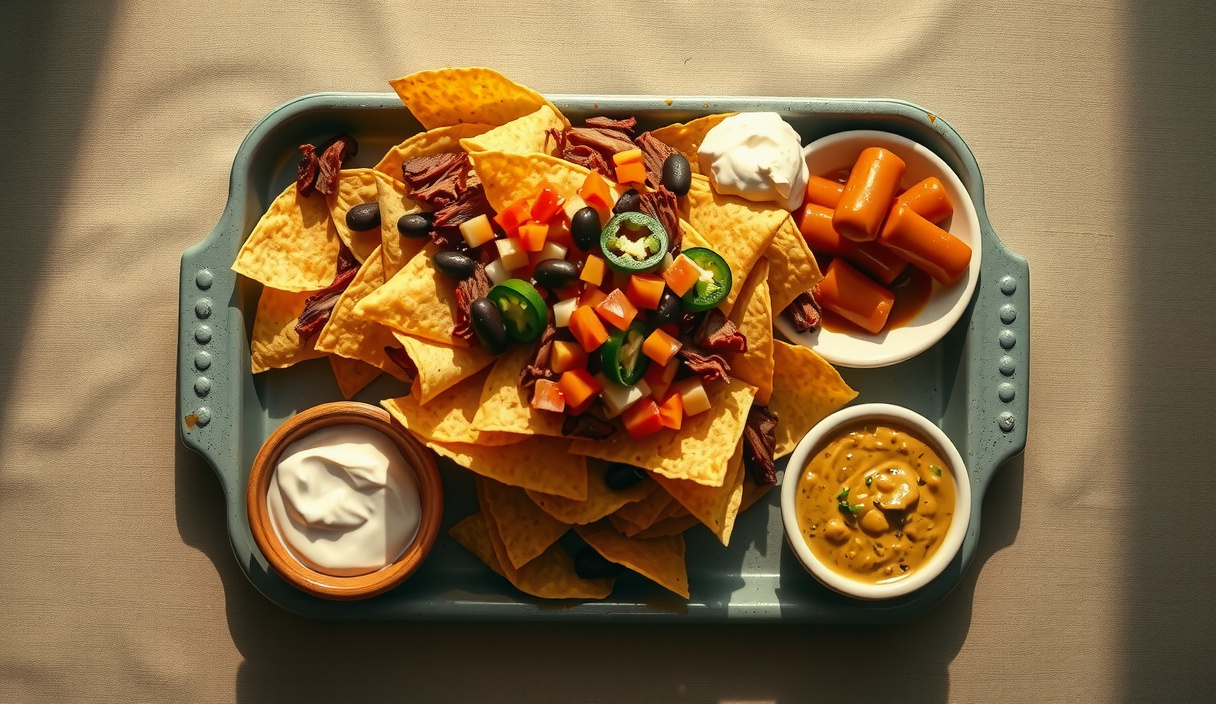
Smoked Pulled Pork Nachos
Tortilla chips loaded with smoky pulled pork, pepper jack, sharp cheddar, black beans, and jalapeños — built in a foil pan and finished on the smoker at 350°F for 12 to 15 minutes. The smoker's dry convective airflow keeps chips crispy while the cheese melts into every crevice. Cold toppings go on at the table. This is the nacho that makes the oven version obsolete.
Equipment
- 1 Pellet smoker or offset smoker Must reach and hold a stable 350°F
- 1 Half-size disposable aluminum foil pan (9x13 inch) Use two pans nested together for added rigidity
- 1 Box grater For freshly shredding block cheese
- 1 Colander For draining pulled pork and black beans
- 1 Sheet pan For surface-drying the pulled pork before building
- 1 Instant-read thermometer Optional but useful for confirming smoker temp stability
Ingredients
The Build
- 12 oz restaurant-style thick-cut tortilla chips About 3/4 of a standard 16 oz bag; avoid thin or baked chips
- 2 cups smoked pulled pork Drained and surface-dried; warm but not saucy
- 6 oz pepper jack cheese Freshly shredded from block; not pre-shredded
- 4 oz sharp cheddar cheese Freshly shredded from block
- 1 can (15 oz) black beans Drained, rinsed, and patted dry with paper towels
- 2 fresh jalapeños Thinly sliced into rounds; seeds in for heat, seeds out for mild
- 1 teaspoon kosher salt For seasoning the pork layer if needed
- 1 tablespoon your house BBQ rub Optional; dust lightly over the top cheese layer before smoking
Cold Finish Toppings (add after smoking)
- ½ cup sour cream Served in dollops or drizzled; do not add before smoking
- 1 cup fresh pico de gallo Store-bought or homemade; drain excess liquid before serving
- 1 ripe avocado Sliced or roughly mashed; add right before serving to prevent oxidation
- ¼ cup fresh cilantro leaves Rough-torn; omit if cilantro-averse
- 2 tablespoons pickled jalapeño slices Optional; adds bright acid contrast to the smoky base
- 2 tablespoons hot sauce Served on the side for individual heat adjustment

Instructions
Prep
- Fire up your smoker and bring it to a stable 350°F. Give it at least 15 minutes at target temperature before loading the nachos. Uneven temperature at the start is the primary cause of patchy cheese melt.
- Drain the pulled pork through a colander for 5 minutes. Spread it on a sheet pan and warm at 300°F in a conventional oven — or microwave in 60-second bursts — until the pork is warm and surface-dry. You want a texture like good carnitas, not braised meat swimming in liquid. Taste and season with kosher salt if needed.2 cups smoked pulled pork, 1 teaspoon kosher salt
- Drain the black beans in a colander, rinse under cold water, then spread on paper towels and press dry. This takes 30 seconds and eliminates free water from your chip layer.1 can (15 oz) black beans
- Freshly shred the pepper jack and sharp cheddar from block using a box grater. Toss them together in a bowl. Pre-shredded cheese is coated in anti-caking starch that interferes with a clean casein melt — use block cheese.6 oz pepper jack cheese, 4 oz sharp cheddar cheese
Build the Nachos
- Lay the first tier: spread roughly half the tortilla chips in a single, mostly flat layer across the bottom of your foil pan. Overlapping is fine — gaps are not. Every chip should be touching its neighbor.
- Scatter half the pulled pork over the first chip tier, distributing it as evenly as possible so every section of the pan has pork coverage. Follow immediately with half the black beans and half the sliced fresh jalapeños.2 cups smoked pulled pork, 1 can (15 oz) black beans, 2 fresh jalapeños
- Apply half the shredded cheese blend over the first tier, covering the pork and beans. The cheese acts as a structural binder — don't be stingy at this stage. Every exposed chip should have cheese on or near it.6 oz pepper jack cheese, 4 oz sharp cheddar cheese
- Build the second tier: add the remaining chips over the first tier, then top with the remaining pulled pork, remaining black beans, remaining jalapeños, and the remaining cheese blend. If using BBQ rub, dust it lightly over the top cheese layer now.2 cups smoked pulled pork, 1 can (15 oz) black beans, 2 fresh jalapeños, 6 oz pepper jack cheese, 4 oz sharp cheddar cheese, 1 tablespoon your house BBQ rub
Smoke
- Place the foil pan directly on the smoker grate. Do not cover the pan — a foil tent traps steam and defeats the physics of using a smoker for this application. Cook uncovered at 350°F.
- At the 7-minute mark, rotate the pan 180 degrees to account for hot spots, particularly if you are on an offset smoker where the firebox end runs hotter.
- Pull the nachos at 12 to 15 minutes, when the cheese is fully melted and bubbling and the chip edges visible at the perimeter are showing the faintest golden color. Do not wait for deep browning — the melt window closes at around 18 minutes when chip sogginess begins regardless of airflow.
Finish and Serve
- Immediately add the cold toppings directly to the hot nachos: dollop the sour cream, spoon the pico de gallo over the surface, fan the sliced avocado across the top, and scatter the cilantro leaves and pickled jalapeño slices. The thermal contrast between hot cheese and cold toppings is intentional and correct.1/2 cup sour cream, 1 cup fresh pico de gallo, 1 ripe avocado, 1/4 cup fresh cilantro leaves, 2 tablespoons pickled jalapeño slices
- Serve the pan at the table immediately with hot sauce on the side. Call everyone before the pan comes off the smoker — the service window is 8 minutes before chip integrity begins to decline. Nachos do not hold and there is no engineering fix for that reality.2 tablespoons hot sauce
Notes
Why the smoker beats the oven: A sealed oven at 350°F traps the water vapor driven off by melting cheese and warming pork. That vapor equilibrates throughout the cavity and condenses on cooler surfaces — namely the chips below the cheese layer — plasticizing the amorphous corn starch network and driving the chip below its glass-transition temperature into a rubbery, soggy state. The smoker's open combustion airflow continuously vents that vapor, keeping the relative humidity inside the cooking environment low enough that evaporation dominates over condensation at the chip surface. Same temperature, fundamentally different moisture dynamics.
The chip glass-transition window: Tortilla chips are a low-moisture rigid solid (water activity aw < 0.3) held in a glassy starch state. Introducing free water — from wet pork, undrained beans, or oven steam — plasticizes the starch network and drops its glass-transition temperature below ambient. Once that threshold is crossed, the chip converts from rigid to rubbery and cannot be reversed by further heat. The window at 350°F on a smoker is approximately 10 to 18 minutes before plasticization becomes irreversible. Build dry, smoke fast, serve immediately.
Cheese melt physics: Pepper jack enters viscous casein flow between 130°F and 150°F (54–66°C). Pre-shredded cheese coated in potato starch or cellulose raises the effective melt temperature and produces a grainier melt with less flow. Block-shredded cheese melts cleanly because the casein micelles are free to relax and interpenetrate across the chip surface without interference from anti-caking agents. The shred size also matters: a coarse shred (large holes on a box grater) melts more evenly and with more surface contact than a fine shred, which can clump.
Pulled pork bark and VOC reactivation: Smoked bark contains melanoidins and Maillard products — heat-stable, aromatic compounds formed during the original smoke cook above 280°F (138°C). At 350°F on the nacho smoker, these compounds are thermally reactivated, releasing pyrazines, furanones, and sulfurous volatiles that define smoke-meat character. This is why nachos made with freshly smoked pork taste categorically more complex than those made with oven-roasted pork — the bark's aromatic payload is real and measurable.
Nutrition
Calories: 520kcalCarbohydrates: 42gProtein: 28gFat: 26gSaturated Fat: 11gCholesterol: 75mgSodium: 890mgFiber: 6gSugar: 3g
Tried this recipe?Let us know how it was!