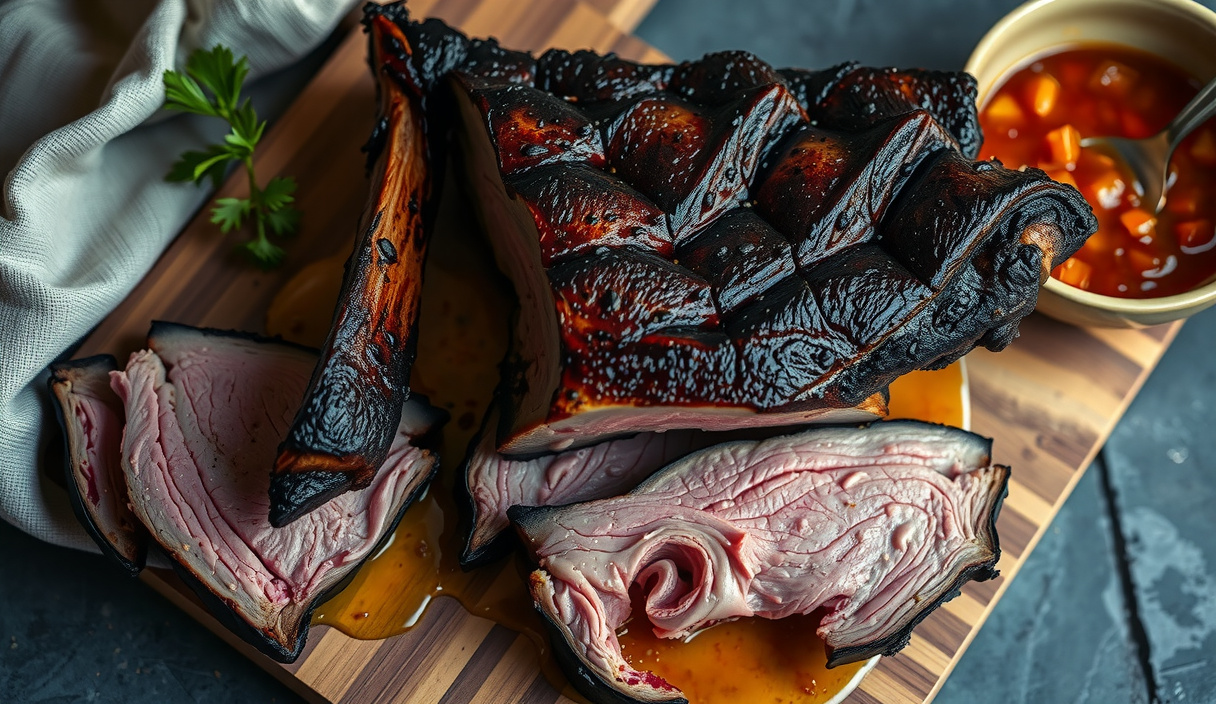
Smoked Tri-Tip — Santa Maria Style

The Central California benchmark: a garlic-salt-pepper rubbed tri-tip smoked low-and-slow over red oak to 125°F internal, then seared hard directly over live coals for a blistered, VOC-rich crust. Reverse sear precision plus two-direction grain slicing delivers maximum tenderness from this uniquely structured cut.
Equipment
- 1 Offset smoker or kettle grill with two-zone setup Any configuration delivering indirect 225°F smoke and a subsequent direct high-heat sear zone
- 3-4 pieces Red oak splits or large chunks Logs or large chunks only — pellets and chips do not sustain the coal bed quality needed for the sear
- 1 Instant-read thermometer Pull the probe before the sear phase to protect the sensor from direct coal heat
- 1 Wire cooling rack For resting the roast after the sear — preserves crust integrity versus resting flat
- 1 Sharp slicing knife A long, thin-bladed slicer makes clean perpendicular cuts across the changing grain direction
- 1 Chimney starter Build the sear coal bed in the chimney during the final 30 minutes of the smoke phase
Ingredients
The Roast
- 1 tri-tip roast, USDA Choice or Prime, fat cap trimmed to 1/4 inch 2.5 to 3 lbs is the target weight — large enough for smoke ring development, small enough for fast searing
Santa Maria Rub
- 1 tbsp coarse garlic salt Lawry's or a homemade blend of 3 parts fine sea salt to 1 part garlic powder; avoid anti-caking agents
- 1 tbsp freshly cracked black pepper Crack coarse — pre-ground loses its volatile piperine punch before it hits the crust
- 1 tsp kosher salt Supplements the garlic salt for deeper ion penetration during the rub rest
- 1 tsp dried oregano Optional but traditional — adds dried-herb top notes that echo classic Santa Maria seasoning
- ½ tsp onion powder
Finishing
- 1 tbsp neutral oil Applied just before the sear to promote uniform crust contact and prevent sticking on the grate

Instructions
Rub and Rest
- Combine the garlic salt, cracked black pepper, kosher salt, dried oregano, and onion powder in a small bowl. Pat the tri-tip completely dry with paper towels on all sides — moisture on the surface will dissolve the rub and slow pellicle formation.1 tbsp freshly cracked black pepper, 1 tsp kosher salt, 1 tsp dried oregano
- Apply the rub generously to all surfaces of the roast, pressing it firmly into the meat. Do not be timid — this is a thick cut and the exterior crust needs aggressive seasoning to carry flavor all the way through. Set the roast on a wire rack over a sheet pan and rest at room temperature for 45 to 60 minutes. During this window, osmotic pressure draws surface moisture out and then re-absorbs it carrying dissolved salt deeper into the muscle tissue, improving seasoning depth and forming the dry pellicle that will support bark development.1 tbsp freshly cracked black pepper, 1 tsp kosher salt, 1 tsp dried oregano
Build the Smoker
- Set up your smoker or grill for two-zone indirect cooking. Target a steady 225°F in the indirect cooking chamber. Add 2 to 3 red oak chunks or a split log to your fire management system. Allow the smoke to transition from heavy white to thin blue-gray before placing the meat — white billowing smoke carries acrid, incomplete-combustion compounds that will make your crust taste bitter. Thin blue smoke is what carries the guaiacol and syringol volatiles that define Santa Maria flavor.
Smoke Phase
- Place the tri-tip fat-cap up on the indirect side of the grill. Insert a probe thermometer into the thickest part of the roast, avoiding bone and fat pockets. Close the lid and maintain 225°F. Leave it alone — resist the urge to open the lid repeatedly. Smoke penetration is a diffusion process; interrupting the thermal environment slows it.
- Approximately 25 to 30 minutes before you expect the roast to hit 125°F internal (typically 60 to 90 minutes total cook time depending on roast size and smoker efficiency), load your chimney starter with red oak lump charcoal or red oak hardwood. Get it fully lit and ashed over — you need a screaming-hot, 600°F-plus coal bed ready the moment the thermometer reads 125°F. Waiting to build coals after pulling the roast costs you heat and texture.
- When the internal temperature reaches 125°F, pull the roast from the smoker. Pat the surface completely dry with paper towels — any free moisture is the enemy of the Maillard reaction. Brush or rub lightly with neutral oil to promote even grate contact during the sear.1/2 tsp onion powder
Sear Over Red Oak Coals
- Dump the fully ashed red oak coals into the direct-heat zone of your grill and spread them into an even bed. Lower the grate to its closest position to the coals if your setup allows. The goal is intense radiant and conductive heat — you should not be able to hold your hand at grate level for more than 2 seconds.
- Place the tri-tip directly over the coal bed. Do not walk away. Sear for 2 to 3 minutes per side, rotating once if needed to avoid localized flare-up charring. You are building a deeply browned, crackling crust — not burning the exterior. Listen for an aggressive sizzle and watch for the smoke and char lines that signal active Maillard chemistry. Total sear time is 4 to 6 minutes. The internal temperature will climb 5°F to 8°F during this phase from carryover and direct heat, landing at a target finished internal of 130°F to 133°F.
Rest and Slice
- Transfer the seared tri-tip to a wire rack (not flat on a cutting board) and rest for 10 to 15 minutes. Resting flat traps steam under the roast and softens the crust. The rack allows airflow on all sides and preserves bark texture while the internal thermal gradient equalizes across the roast.
- Two-direction slicing is mandatory on tri-tip. Before cutting, examine the roast. At the wide, fan-shaped end the muscle fibers run roughly lengthwise. At the narrow, pointed end the fibers shift direction by approximately 90 degrees. Identify where the grain changes — usually about two-thirds of the way along the roast. Separate the roast into two sections at this transition point. Slice each section thinly (about 1/4 inch) and perpendicular to its own fiber direction. This shortens the myofibrillar bundles mechanically, converting what would be tough, chewy meat into tender, yielding slices. Serve immediately.
Notes
Why 225°F and not higher? At 225°F, the heat flux into the roast is slow enough that the thermal gradient between the surface and the center remains gentle — you get edge-to-edge even doneness with a relatively thin overcooked gray band at the exterior. Cooking at 275°F or 300°F speeds the cook but widens that gray band dramatically, sacrificing the rosy interior that makes this cut worth eating.
The stall does not apply here. Unlike collagen-heavy cuts (brisket, pork shoulder), tri-tip has minimal connective tissue. It will not plateau at 160°F to 170°F from evaporative cooling the way collagen-rich cuts do. Temperature rise is steady and predictable — plan for roughly 30 to 45 minutes per pound at 225°F as a rough guide, but always cook to internal temperature, not time.
Smoke ring chemistry: The pink smoke ring beneath the bark is caused by carbon monoxide and nitric oxide from wood combustion binding to myoglobin in the meat surface, stabilizing its pink color even after proteins have denatured. It is a visual indicator of low-temperature smoking and clean smoke exposure — not a direct flavor compound, but a reliable proxy for technique. No smoke ring means either too-hot cooking or inadequate clean smoke time.
Grain direction science: The tensor fasciae latae muscle of the tri-tip has an anisotropic fiber orientation — meaning the muscle fibers do not all run in one direction. Cutting perpendicular to the fibers shortens the myofibrillar bundles in the bite, reducing the shear force required for mastication by a measurable factor. Cutting parallel to the fibers leaves those bundles long, requiring significantly more chewing force regardless of internal temperature or rest time.
Nutrition
Calories: 310kcalCarbohydrates: 1gProtein: 38gFat: 16gSaturated Fat: 6gCholesterol: 115mgSodium: 620mg
Tried this recipe?Let us know how it was!