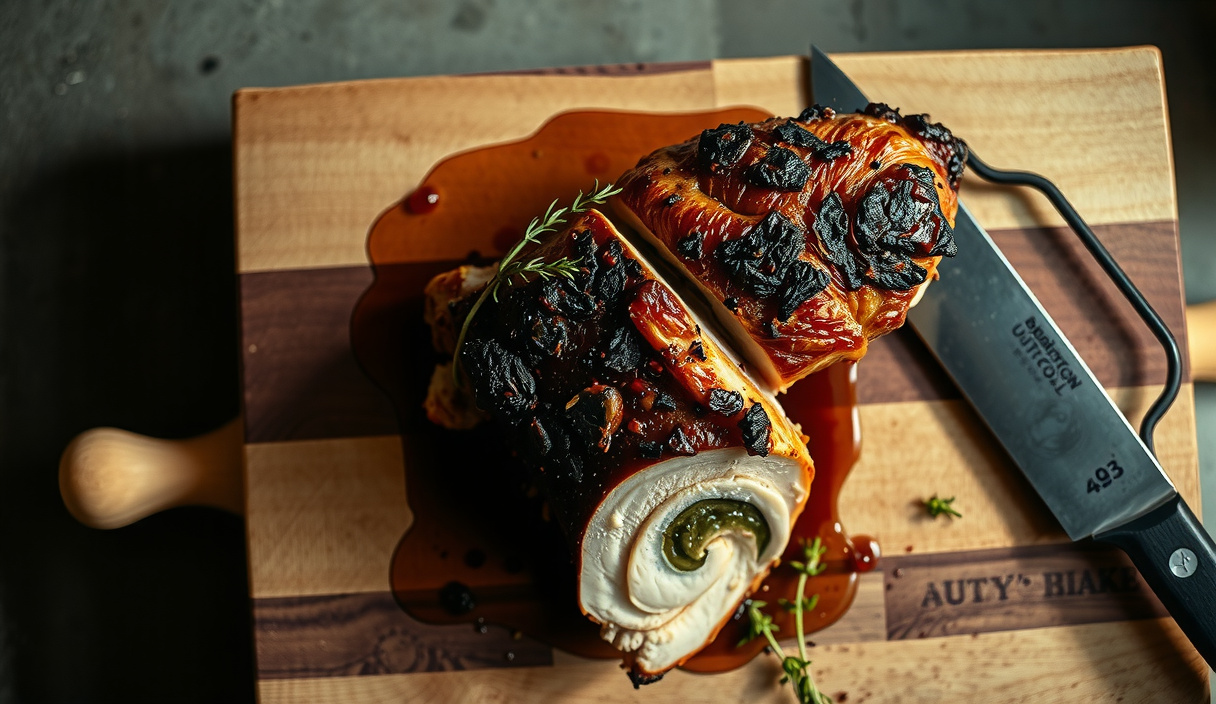
Sous Vide Smoked Chicken Breast

A two-stage technique that decouples pasteurization from surface cooking: a 145°F sous vide bath for 90 minutes locks in moisture and achieves full food safety, then a 350°F smoker finish for 12–15 minutes builds real bark, smoke ring, and crackling skin. The result is the juiciest smoked chicken breast achievable without any compromise on safety or flavor.
Equipment
- 1 Immersion circulator (sous vide) Must hold 145.0°F ±0.5°F. Verify against a calibrated instant-read thermometer before the cook.
- 1 Large pot or cambro container Minimum 8-quart capacity to allow full water circulation around the bags.
- 1 Vacuum sealer or 1-gallon zipper-lock bags Vacuum seal preferred. Zipper bags work via water-displacement method — submerge until just the zipper is above water, then seal.
- 1 Smoker or kettle grill (indirect setup) Pellet grill at 350°F with apple or cherry pellets is ideal. Kettle charcoal with a fruitwood chunk over 2-zone indirect heat also works.
- 1 Instant-read thermometer Required to confirm the bath temperature and to pull the breast at 150°F during the smoker finish.
- 1 Wire rack over sheet pan For air-drying the breast after the bath. Elevating the breast ensures airflow under the skin.
Ingredients
Chicken
- 4 bone-in, skin-on chicken breast halves 10–12 oz each. Uniform size matters for even bath equilibration. Boneless skinless works — see Variations section.
Dry Brine
- 1 tbsp kosher salt (Diamond Crystal) If using Morton kosher salt, reduce to 2 teaspoons — it is roughly 1.5x denser than Diamond Crystal.
- 1 tsp black pepper, coarsely ground
BBQ Rub (apply before smoker)
- 1 tbsp smoked paprika
- 1 tsp garlic powder
- 1 tsp onion powder
- 1 tsp brown sugar Adds reducing sugars that accelerate Maillard browning and caramelization on the smoker surface.
- 0.5 tsp cayenne pepper Optional. Reduce or omit for a milder profile.
- 0.5 tsp kosher salt
- 1 tsp neutral oil (avocado or refined coconut) Binds the rub to the skin and helps droplet formation for Maillard onset under convective heat.
Wood Smoke
- 2 oz apple or cherry wood chunks (or pellets) Fruitwoods are low-phenol and complement chicken without turning acrid at short exposure times. Avoid mesquite.

Instructions
Dry Brine
- Pat the chicken breast halves completely dry with paper towels. Combine the kosher salt and coarsely ground black pepper, then season all surfaces of each breast evenly, including under the skin flap if accessible. Place on a wire rack set over a sheet pan, uncovered, and refrigerate for a minimum of 4 hours and ideally overnight (12–16 hours). The salt will first draw surface moisture out, then dissolve and redistribute back into the muscle, raising intracellular ionic strength and improving water-holding capacity during the bath.1 tsp black pepper, coarsely ground
Sous Vide Bath
- Set the immersion circulator to 145.0°F (62.8°C) and allow the bath to come fully to temperature. Verify with a calibrated instant-read thermometer — do not load the chicken until the water is stable at the target.
- Place each breast half in an individual vacuum bag or in a 1-gallon zipper-lock bag using the water-displacement method. Do not crowd multiple large breasts into a single bag — water circulation must contact all surfaces. Seal the bags, removing as much air as possible.
- Submerge the sealed bags in the preheated bath. The bags must be fully submerged; clip to the side of the vessel if needed. Cook at 145°F for 90 minutes. Do not open or disturb the bags during the cook. At 90 minutes the chicken is fully pasteurized and the core is in equilibrium with the bath temperature.
- If finishing immediately: Proceed to the next step. If finishing within 48 hours: Transfer sealed bags to an ice water bath for 15 minutes to chill the core below 40°F, then refrigerate. Remove from the refrigerator 20 minutes before the smoker step.
Pre-Smoke Prep
- Preheat your smoker or indirect grill to a stable 350°F. Add the apple or cherry wood chunks or pellets now so they are smoldering and producing thin blue smoke by the time the chicken goes on. Avoid thick white smoke — it deposits acrid creosote.2 oz apple or cherry wood chunks (or pellets)
- Remove the chicken from the bags and pat every surface thoroughly dry with paper towels — skin-side in particular must be as dry as possible. Wet skin steams instead of crisping. For extra bark development, rest uncovered on the wire rack for 15–30 minutes at room temperature after patting dry.
- Combine all BBQ rub ingredients in a small bowl: smoked paprika, garlic powder, onion powder, brown sugar, cayenne, and salt. Brush or rub the neutral oil lightly over the skin surface, then apply the rub evenly to all sides, pressing gently to adhere. The oil acts as a binder and helps the rub form a continuous reactive surface on the smoker.1 tbsp smoked paprika, 1 tsp garlic powder, 1 tsp onion powder, 1 tsp brown sugar, 0.5 tsp cayenne pepper, 0.5 tsp kosher salt, 1 tsp neutral oil (avocado or refined coconut)
Smoker Finish
- Place the breasts skin-side up on the smoker grate over indirect heat. Close the lid and cook at 350°F for 12–15 minutes. Do not flip — skin-side up keeps the fat rendering down through the meat and prevents the crust from sticking to the grate.2 oz apple or cherry wood chunks (or pellets)
- Begin probing at the 10-minute mark. Insert an instant-read thermometer into the thickest part of the breast, avoiding the bone. Pull the chicken when the internal temperature reads 148–150°F. The breast is already pasteurized; you are chasing texture, not safety. Above 155°F the actin network begins to stress; above 160°F you have undone the moisture work the bath achieved.
- Transfer the finished breasts to a cutting board and rest loosely tented with foil for 3–5 minutes. The bark will firm slightly as the surface temperature equilibrates. You should see a visible pink smoke ring just below the skin — this is myoglobin reacting with nitric oxide from the wood combustion, a sign of genuine smoke penetration.
- Slice against the grain at a 45-degree bias, cutting perpendicular to the long axis of the muscle fibers. Serve immediately. The cross-section should show the smoke ring at the perimeter, a uniformly pale-pink silky interior — not white, not chalky, not grey — and a dry, crackling bark on the skin.
Notes
Why 145°F is safe: Pathogen lethality in poultry is a time-temperature relationship, not a single magic number. The FDA validated pasteurization tables show that 145°F held for 8.4 minutes achieves a 7-log (99.99999%) reduction in Salmonella — identical lethality to an instantaneous 165°F reading. Ninety minutes at 145°F is roughly 640x the required exposure time. The meat will be slightly pink and feel silky — that is correct texture, not undercooking.
Actin vs. myosin denaturation windows: Myosin, the primary structural protein in chicken breast, denatures between approximately 104°F and 140°F. At 145°F it is completely unfolded and has formed the coagulated gel structure we call cooked chicken. Actin does not denature until 154–165°F. When actin goes, the actomyosin complex contracts violently in both lateral and longitudinal axes, expelling intracellular water and collapsing water-holding capacity by 25–35%. The bath holds the core permanently below this threshold. The smoker finish adds only 5–7°F to the core over 12–15 minutes — not enough to push through the actin window.
Maillard onset on the smoker: The Maillard cascade requires that local water activity at the reactive surface drop below approximately 0.70 before browning can outpace evaporative cooling. At 350°F with low humidity (typical of a smoker environment), the dry-brined, paper-towel-dried skin surface reaches this water activity threshold within 3–5 minutes of exposure. From that point, the amino acids (primarily lysine side chains) and reducing sugars (brown sugar in the rub, plus glucose and fructose from the meat itself) react to form Schiff bases, progressing through Amadori rearrangement and Strecker degradation to yield the melanoidin pigments and pyrazine/furanone volatile pool that defines BBQ bark.
Smoke ring formation: The pink smoke ring visible at the perimeter of the sliced breast is not raw meat — it is a stable pink pigment formed when nitric oxide (NO) and carbon monoxide (CO) from wood combustion diffuse into the meat surface and bind to myoglobin, forming nitrosomyoglobin (pink) and carboxymyoglobin (also pink-red). This reaction occurs before the myoglobin denatures to grey hemichrome. A genuine smoke ring is evidence that gaseous combustion products penetrated the surface — it is an authentic smoke marker, not cosmetic.
Dry brine ionic strength effect: Kosher salt in the dry brine dissolves in the surface moisture it draws out, then migrates back into the muscle as a saline solution over the brine window. The elevated intracellular ionic strength (I) modestly denatures a thin outer layer of structural protein, which physically seals the surface against moisture egress during the bath. It also expands the protein network spacing, allowing more water to be retained within the myofibrillar lattice — the same mechanism exploited in commercial wet-injected turkey.
Nutrition
Calories: 310kcalCarbohydrates: 3gProtein: 48gFat: 11gSaturated Fat: 3gCholesterol: 145mgSodium: 680mgFiber: 0.5gSugar: 1.5g
Tried this recipe?Let us know how it was!