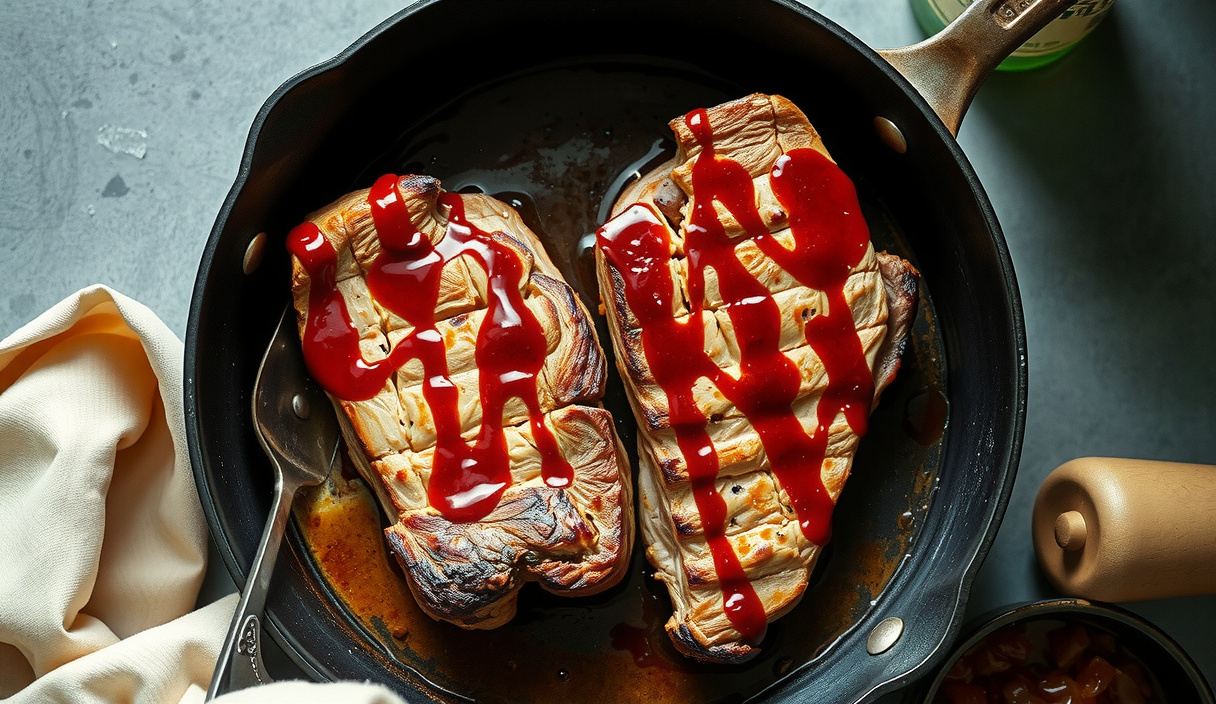
St. Louis Pork Steaks

Pork shoulder steaks grilled over direct heat for Maillard crust, then braised in beer and Maull's BBQ sauce until internal temperature reaches 195°F — the sweet spot where collagen converts fully to gelatin and the connective tissue of the shoulder transforms from tough to luxuriously sticky and tender. A final open-grill glaze phase lacquers the sauce into a tight, caramelized bark. This is the grill-to-braise method that made St. Louis pork steaks a regional institution.
Equipment
- 1 Charcoal or gas grill Set up for direct high heat; charcoal preferred for maximum surface temperature and drier heat environment.
- 1 Half-size steam-table foil pan Approximately 12 x 10 inches. Must be deep enough to hold steaks and braising liquid without overflowing.
- 1 roll Heavy-duty aluminum foil For sealing the foil pan during the braise phase. Double-crimp the edges to prevent steam loss.
- 1 Instant-read thermometer Non-negotiable for verifying 195°F internal temperature in the coolest zone of each steak.
- 1 pair Tongs
- 1 Wire rack and sheet pan For the pre-grill dry brine rest in the refrigerator.
Ingredients
Pork Steaks
- 4 bone-in pork shoulder steaks, 3/4-inch thick Approximately 10 to 14 oz each. Cut from the Boston butt cross-section. Ask your butcher if not pre-packaged.
- 1 tbsp kosher salt For dry brining. Diamond Crystal preferred; reduce by one-third if using Morton.
- 1 tsp coarse black pepper
- 1 tsp garlic powder
- 1 tsp smoked paprika
Braising Liquid
- 12 oz lager or amber ale One standard can or bottle. Avoid IPAs and dark stouts. Budweiser is the authentic St. Louis choice.
- 1 cup Maull's Original BBQ sauce Or substitute any tomato-forward, tangy barbecue sauce with low-to-moderate sweetness.
- 2 tbsp apple cider vinegar Reinforces the acid environment (target pH 3.8 to 4.2) that accelerates collagen hydrolysis.
- 1 tbsp Worcestershire sauce
- 1 tsp onion powder
Finishing Glaze
- ½ cup Maull's Original BBQ sauce Applied directly to steaks during the open glaze phase. Additional sauce for serving on the side.

Instructions
Prep and Dry Brine
- Pat the pork steaks completely dry on both sides with paper towels. Combine the kosher salt, black pepper, garlic powder, and smoked paprika in a small bowl and mix well.1 tbsp kosher salt, 1 tsp coarse black pepper, 1 tsp garlic powder, 1 tsp smoked paprika
- Season the steaks generously on all surfaces with the dry rub. Place on a wire rack set over a sheet pan and refrigerate uncovered for at least 30 minutes, or up to 4 hours. The dry brine draws surface moisture outward and then reabsorbs it as a seasoned brine. The uncovered refrigeration desiccates the surface — lower surface water activity is essential for rapid Maillard browning onset when the steaks hit the grill.1 tbsp kosher salt, 1 tsp coarse black pepper, 1 tsp garlic powder, 1 tsp smoked paprika
Build the Grill and Braise
- While the steaks rest, mix the braising liquid: combine the beer, 1 cup Maull's BBQ sauce, apple cider vinegar, Worcestershire sauce, and onion powder in the foil steam-table pan. Whisk until the sauce is evenly incorporated into the beer. Set aside.12 oz lager or amber ale, 1 cup Maull's Original BBQ sauce, 2 tbsp apple cider vinegar, 1 tbsp Worcestershire sauce, 1 tsp onion powder
- Set up your grill for direct high heat — charcoal banked to a single even layer, or gas burners on high. Target grate temperature of 450°F to 500°F. Allow at least 10 minutes of preheating with the lid closed so the grates accumulate maximum thermal mass for a hard sear.
Grill Phase: Building the Maillard Crust
- Remove steaks from the refrigerator. Their surface should be visibly dry — no glistening moisture. Place the steaks directly over the hottest zone of the grill in a single layer with at least 1 inch of space between each steak to prevent steam buildup between them.
- Grill without moving for 4 to 5 minutes. You are driving surface temperature above 280°F and driving off the final boundary-layer moisture so the Maillard cascade can ignite. Resist the urge to flip early — the steak will release naturally from the grate when sufficient crust has formed. Flip once and grill the second side for 4 to 5 minutes. Target strong grill marks and a deep, mahogany-brown color across at least 70 percent of each surface. Some flare-ups from rendering fat are normal and desirable for smoky char notes.
- Transfer the grilled steaks immediately into the foil pan containing the braising liquid, arranging them in a single layer. They should be partially submerged — braising liquid should come roughly halfway up the sides of the steaks. If stacking is necessary for very large steaks, alternate the orientation so the thicker parts of one steak rest over the thinner parts of the steak below.12 oz lager or amber ale, 1 cup Maull's Original BBQ sauce, 2 tbsp apple cider vinegar, 1 tbsp Worcestershire sauce, 1 tsp onion powder
Braise Phase: Collagen Conversion
- Seal the foil pan tightly with a double layer of heavy-duty aluminum foil, crimping the edges firmly to prevent steam escape. A tight seal maintains internal steam pressure and keeps the effective braising temperature at or above 212°F — critical for the rate of collagen hydrolysis.
- Place the sealed foil pan on the grill over indirect heat (move coals to one side for charcoal, or turn off the burner directly beneath the pan for gas). Close the grill lid. Maintain an ambient grill temperature of 325°F to 375°F. Braise for 60 to 75 minutes.
- After 60 minutes, carefully open one corner of the foil — steam will escape aggressively, so use tongs and keep your hands clear. Insert your instant-read thermometer into the thickest part of one steak, away from the bone. Target 195°F internal temperature. At 195°F, collagen hydrolysis is well advanced and the gelatin released from the connective tissue has had sufficient time to re-infiltrate the muscle bundles. Below 185°F the steaks will still be chewy; above 205°F the gelatin matrix begins to break down and the meat turns mushy. Check at least two steaks per pan. Re-seal and continue braising in 10-minute increments if the target has not been reached.
Open Glaze Phase: Rebuilding the Bark
- Once the steaks reach 195°F internal, remove the foil from the pan completely and discard it. Using tongs, transfer the steaks from the braising liquid back onto the grill grates over direct medium-high heat. Brush the top surface of each steak generously with the finishing glaze Maull's sauce.1/2 cup Maull's Original BBQ sauce
- Grill open and uncovered for 4 to 5 minutes per side, brushing additional sauce each time you flip. The braising liquid that has soaked into the surface of the steaks contains dissolved gelatin, malt sugars, and Maull's reducing sugars. As surface moisture evaporates under the direct heat, the concentration of these compounds skyrockets, triggering a secondary Maillard and caramelization event that produces the glossy, tightly lacquered bark that defines a proper St. Louis pork steak. Watch carefully — the sugars will go from deep amber to burnt in under 60 seconds if heat is excessive. Pull any steaks that start to blacken aggressively.1/2 cup Maull's Original BBQ sauce
Rest and Serve
- Transfer the glazed steaks to a cutting board or platter. Rest uncovered for 5 minutes. During this rest, the thermally driven pressure gradient inside the steak equalizes, allowing the gelatin-rich braising liquid that has infiltrated the muscle matrix to redistribute evenly. Serve whole — these are traditionally eaten on the bone — with additional warm Maull's sauce on the side.1/2 cup Maull's Original BBQ sauce
Notes
Why 195°F and not 145°F (USDA safe)? Pork is microbiologically safe at 145°F internal. But pork shoulder contains dense collagen networks that are structurally intact and mechanically tough at that temperature. Collagen hydrolysis into soluble gelatin follows first-order kinetics: the rate roughly doubles for every 18°F increase above the onset threshold of approximately 160°F. At 195°F, the conversion proceeds rapidly enough that 15 to 20 minutes of hold time at temperature fully dissolves the intramuscular connective tissue, converting it from tough chewy fibers into the sticky, lubricating gelatin that makes braised shoulder legendary. This is the same thermodynamic logic that governs pulled pork, beef brisket, and any other collagen-rich braise.
The stall does not apply here — and here is why: Low-and-slow smoking exhibits a classic evaporative stall at approximately 160°F to 170°F internal, where surface evaporation absorbs energy as fast as the smoker delivers it, pinning the meat's temperature for hours. In a sealed foil braise, the interior of the pan is already at or above 100% relative humidity — there is nowhere for surface moisture to evaporate to. The stall mechanism is neutralized. The braising liquid conducts heat directly to the meat surface, and the sealed steam environment maintains internal temperature, driving through the stall zone in a fraction of the time a smoker would require.
Beer pH and collagen hydrolysis: Standard American lagers have a pH of approximately 4.0 to 4.4. Adding apple cider vinegar drops the braising liquid pH to approximately 3.8 to 4.2. Mildly acidic environments destabilize the hydrogen bonding that maintains tropocollagen triple-helix integrity, reducing the activation energy barrier for hydrolytic cleavage. The practical result: braising in acidic liquid at 195°F converts collagen to gelatin measurably faster than a neutral or alkaline braise at the same temperature.
Surface water activity and Maillard onset: The Maillard reaction requires surface temperature above approximately 280°F and water activity (Aw) below 0.7 at the meat surface. Wet meat surfaces are anchored at 212°F (100°C) by the latent heat of vaporization — until the boundary-layer moisture evaporates completely, the surface temperature cannot climb further. Drying the steaks in the refrigerator before grilling dramatically reduces this evaporative delay. The dry brine step contributes as well: osmotic pull draws moisture out of the surface layers, which then reabsorbs, lowering the free water fraction slightly and accelerating the surface drying process on the grill.
Nutrition
Calories: 620kcalCarbohydrates: 22gProtein: 52gFat: 34gSaturated Fat: 12gCholesterol: 175mgSodium: 1180mgFiber: 0.5gSugar: 16g
Tried this recipe?Let us know how it was!