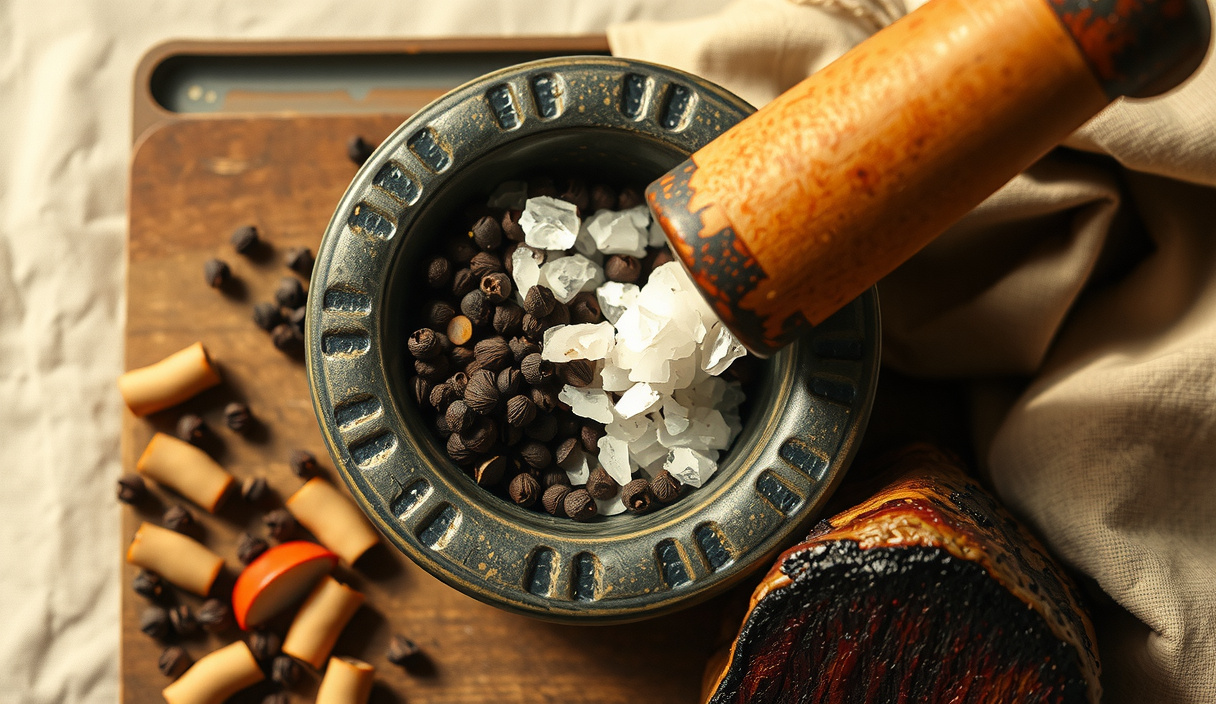
Texas-Style Beef Rub: 50/50 Salt and Pepper

The canonical Central Texas brisket rub — equal parts kosher salt and 16-mesh coarse black pepper by weight. No fillers, no sugar, no garlic powder. This two-ingredient formula drives osmotic surface protein denaturation, anchors a three-dimensional pepper scaffold, and produces the deep mahogany bark that defines elite Texas BBQ. Scale the batch to match your cut; the ratio never changes.
Equipment
- 1 Kitchen scale Required — measuring by volume introduces unacceptable variance with different salt crystal geometries
- 1 Wide-mouth jar or shaker For mixing and applying; a large-hole shaker delivers an even, dispersed coat from 12 to 18 inches above the meat
- 1 Mixing bowl Medium size, for combining the two ingredients before transferring to shaker
Ingredients
- 56 g Diamond Crystal kosher salt 2 oz by weight; do not substitute table salt or Morton Kosher without adjusting — Morton is approximately 1.5x denser and saltier by volume
- 56 g 16-mesh coarse black pepper 2 oz by weight; source from a restaurant supply or labeled spice vendor — standard supermarket coarse grind is inconsistent and often too fine

Instructions
- Weigh out 56 g (2 oz) of Diamond Crystal kosher salt and 56 g (2 oz) of 16-mesh coarse black pepper on a kitchen scale. Combine in a mixing bowl and stir with a spoon until fully distributed. The blend should appear evenly speckled with no visible clustering of either component.56 g Diamond Crystal kosher salt, 56 g 16-mesh coarse black pepper
- Transfer the blended rub to a wide-mouth shaker or jar. Shake once to confirm even distribution before use.56 g Diamond Crystal kosher salt, 56 g 16-mesh coarse black pepper
- To apply: remove your brisket (or other beef cut) from refrigeration. The cold, slightly tacky surface provides natural adhesion — no binder is needed. Hold the shaker 12 to 18 inches above the surface and apply an even coat to all exposed meat surfaces at a rate of approximately 1/2 teaspoon of rub per pound of trimmed meat. Do not coat the fat cap heavily — a light dusting is sufficient as the fat cap contributes little to bark formation on the meat-side crust.56 g Diamond Crystal kosher salt, 56 g 16-mesh coarse black pepper
- After applying, press the rub lightly with an open palm — do not rub or massage — to physically seat the 16-mesh pepper particles into the wet protein surface. Heavy rubbing fractures the larger pepper fragments into fine dust that will scorch during the cook.56 g Diamond Crystal kosher salt, 56 g 16-mesh coarse black pepper
- Allow the rub to set on the meat uncovered at room temperature for 45 minutes, or refrigerate uncovered for up to 2 hours before cooking. This rest period allows the osmotic cycle to draw surface moisture out and pull brine back into the myofibrillar matrix, maximizing salt penetration and surface protein reorganization before the meat hits the smoker.56 g Diamond Crystal kosher salt, 56 g 16-mesh coarse black pepper
Notes
Why 16-mesh specifically: Pepper particle size is a mechanical engineering variable, not just a flavor preference. At 16-mesh (approximately 1.0 to 1.4 mm diameter), each fragment is large enough to physically embed into the moist protein surface of raw beef and interlock with adjacent particles, forming a three-dimensional scaffold that holds the bark matrix together across 12 to 16 hours of smoke exposure. Finer grinds — below approximately 20-mesh — do not embed; they coat the surface and burn during high-radiant-heat phases of the cook, producing acrid, bitter aldehyde and ketone off-notes rather than the deep, resinous piperine signature of authentic Texas bark. Coarser grinds — above approximately 8-mesh — do not adhere consistently and fall off during repositioning. The 16-mesh specification is the geometric adhesion optimum.
Sodium chloride and myofibrillar protein denaturation: Salt's role in bark formation begins long before the brisket enters the smoker. Sodium chloride disrupts the electrostatic bonds in myosin and actin filament networks, partially reorganizing the surface protein matrix into a more porous, adhesive structure. This controlled pre-denaturation creates a high-surface-area substrate that bonds more effectively with the polymerizing Maillard products produced during the bark-formation phase. The Maillard cascade on the brisket surface requires local surface temperatures above approximately 280°F (138°C) — conditions reached during the post-stall phase when the surface moisture burden finally drops enough for the boundary layer to exceed 212°F (100°C). Salt has primed that surface hours in advance.
Yield and scaling: This batch (112 g / 4 oz total) covers approximately 8 pounds of trimmed brisket at the standard application rate of 1/2 teaspoon per pound. To scale up, maintain the 1:1 weight ratio exactly. Store unused blended rub in a sealed airtight jar away from light and heat; use within 2 weeks for maximum aromatic potency as piperine and terpene volatiles in the cracked pepper degrade with extended storage and air exposure. Do not pre-blend large quantities for long-term storage.
Nutrition
Carbohydrates: 0.5gProtein: 0.1gFat: 0.1gSodium: 2360mgFiber: 0.2g
Tried this recipe?Let us know how it was!