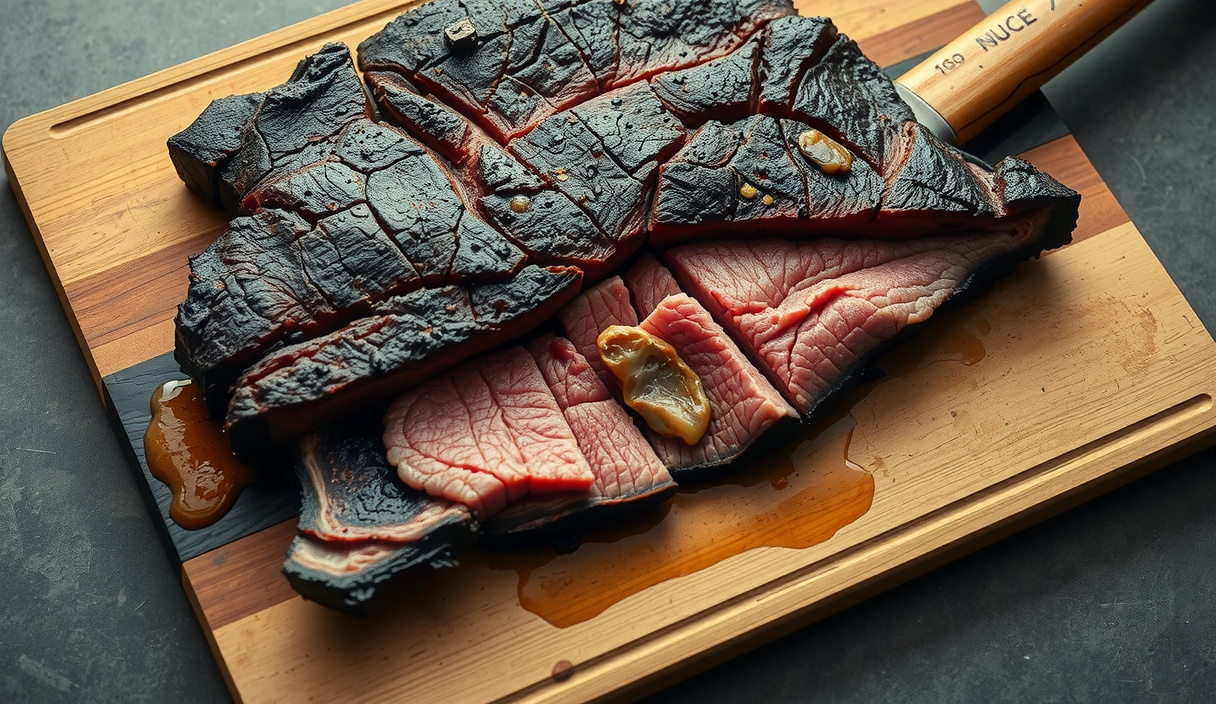
Tomahawk Ribeye — Reverse Sear

A 2.5-inch bone-in tomahawk ribeye cooked low-and-slow at 225°F until 115°F internal, then seared at 600°F for a shattering Maillard crust and a perfect medium-rare edge to edge. The femur bone acts as a cold sink — bone positioning during both phases is the controlling variable most home cooks miss.
Equipment
- 1 Wire rack set inside a rimmed half-sheet baking pan Elevates the steak so air circulates beneath it during the oven phase — prevents the bottom side from steaming.
- 1 Leave-in probe thermometer Position the probe in the geometric center of the eye, not near the bone or in a fat pocket. ThermoWorks ChefAlarm or equivalent.
- 1 12-inch cast-iron skillet Must be preheated a full 10 minutes over maximum gas heat before the steak touches it. Alternatively, a charcoal grill set up with the grate 2 inches above glowing coals.
- 1 Instant-read thermometer Optional but useful for confirming final internal temp after the sear.
- 1 Boning knife For slicing cleanly along the rib bone for tableside presentation.
Ingredients
- 1 tomahawk ribeye, approximately 2.5 inches thick and 2.5 to 3.5 lbs Bone-in, with the rib bone frenched. Have your butcher confirm thickness — thickness controls oven time, weight does not.
- 1 teaspoon per pound of meat Diamond Crystal kosher salt For the dry brine. If using Morton kosher salt, use half the volume — Morton is roughly twice as dense. Do not use table salt.
- 1 teaspoon coarsely ground black pepper Apply immediately before the sear, not during the dry-brine phase — pepper burns at high sear temperatures if applied too early.
- 1 tablespoon avocado oil or refined beef tallow Smoke point above 500°F. Added to the pan immediately before the steak, not during the preheat.
Optional Compound Butter (for resting phase)
- 4 tablespoons unsalted butter, softened to room temperature
- 2 cloves fresh garlic, minced
- 1 tablespoon fresh thyme leaves
- 1 tablespoon fresh rosemary, finely chopped
- 1 pinch flaky sea salt Maldon or similar.

Instructions
Dry Brine (24 Hours or 45 Minutes Ahead)
- Pat the tomahawk completely dry with paper towels on all surfaces including around the bone. Season generously on all sides with kosher salt at a rate of 1 teaspoon Diamond Crystal per pound of meat — roughly 2.5 to 3.5 teaspoons total for a standard tomahawk. Stand the steak upright on the wire rack set over a rimmed baking sheet so all surfaces are exposed to air.For best results, refrigerate uncovered for 24 hours. The salt draws surface moisture out via osmosis, then the moisture fully reabsorbs into the meat over the next 12 to 18 hours, carrying dissolved salt deep into the myofibrillar water phase. This raises the ionic strength of the muscle tissue and measurably increases water-holding capacity in the cooked steak. If you are short on time, salt at least 45 minutes ahead — the worst window is 5 to 40 minutes after salting, when surface moisture has been drawn out but not yet reabsorbed.1 tomahawk ribeye, approximately 2.5 inches thick and 2.5 to 3.5 lbs, 1 teaspoon per pound of meat Diamond Crystal kosher salt
Optional: Make Compound Butter
- Combine softened butter with minced garlic, thyme, rosemary, and flaky sea salt. Mix thoroughly, roll tightly in plastic wrap into a log shape, and refrigerate until firm. This can be made up to 5 days ahead. Slice a half-inch round when ready to use.4 tablespoons unsalted butter, softened to room temperature, 2 cloves fresh garlic, minced, 1 tablespoon fresh thyme leaves, 1 tablespoon fresh rosemary, finely chopped, 1 pinch flaky sea salt
The Low-Temperature Oven Phase
- Preheat your oven to 225°F. Allow at least 20 minutes for the oven to fully stabilize at temperature — home ovens cycle and overshoot on initial heat-up. A pizza stone or baking steel on a lower rack helps buffer temperature swings if you have one.
- Remove the steak from the refrigerator. Insert your probe thermometer into the geometric center of the ribeye eye — not adjacent to the bone, not into a thick fat seam. The probe tip should be equidistant from all surfaces of the eye muscle. Position the steak on the wire rack with the bone pointing away from the oven's rear heating element or dominant heat source. This is critical: the bone conducts heat slowly and will lag 10°F to 15°F behind the eye muscle during the oven phase. Pointing the bone toward the heat source does not compensate — it creates an uneven cook on the bone-side lobe that persists through the sear.1 tomahawk ribeye, approximately 2.5 inches thick and 2.5 to 3.5 lbs
- Slide the baking sheet into the oven. For a 2.5-inch tomahawk, expect 90 to 110 minutes to reach 115°F internal. Monitor the probe thermometer continuously. Do not open the oven repeatedly — every opening drops the oven temperature by 25°F to 40°F and adds time. Begin checking the probe display at the 80-minute mark. Pull the steak from the oven when the probe reads exactly 115°F.1 tomahawk ribeye, approximately 2.5 inches thick and 2.5 to 3.5 lbs
Prepare for the Sear
- While the steak is in the final 20 minutes of the oven phase, place your cast-iron skillet over the largest burner on your gas range at maximum heat. Allow it to preheat for a full 10 minutes. The pan is ready when a drop of water vaporizes instantly on contact and the surface reads 580°F to 650°F on an infrared thermometer. If using a charcoal grill, light a full chimney of hardwood lump charcoal and allow it to ash over completely, then dump it and position the grate 2 inches above the coals.
- When the steak reaches 115°F and comes out of the oven, pat every surface completely dry with fresh paper towels including the sides and around the bone. Any visible moisture on the surface will create an evaporative cooling buffer that delays Maillard browning by 30 to 60 seconds — enough time for the sear to drive the core temperature past your target. Season with coarsely ground black pepper on all surfaces now. Do not apply pepper earlier in the process as it will char on a 600°F surface if pre-applied during dry brining.1 tomahawk ribeye, approximately 2.5 inches thick and 2.5 to 3.5 lbs, 1 teaspoon coarsely ground black pepper
The High-Temperature Sear
- Add avocado oil or tallow to the screaming-hot cast-iron skillet. It should shimmer and begin to smoke within 5 seconds. Allow it to heat for 10 seconds after adding, then immediately lay the steak flat — eye side down — with the bone angled away from the hottest part of the burner. Press gently on the steak with a spatula or your palm (through a towel) to ensure maximum surface contact with the metal. Do not move the steak.1 tomahawk ribeye, approximately 2.5 inches thick and 2.5 to 3.5 lbs, 1 tablespoon avocado oil or refined beef tallow
- Sear for 60 to 90 seconds on the first side until a deep mahogany crust forms — you will see it creeping up the sides of the steak. Flip once. Sear the second side for 60 to 90 seconds. Using tongs, hold the steak vertically and sear all four sides (edges including the fat cap) for 20 to 30 seconds each. This renders the fat cap and seals the crust on surfaces that would otherwise remain pale. The total active sear time should not exceed 4 minutes — if you need more time than this to develop the crust, your pan was not hot enough at the start.1 tomahawk ribeye, approximately 2.5 inches thick and 2.5 to 3.5 lbs
- Transfer the steak immediately to a clean wire rack set over a cutting board. Do not place it directly on the cutting board — elevating it prevents the crust from steaming and softening on the underside. If using compound butter, place one slice on top of the steak now — the residual crust heat will melt it over the rest period without cooking the butter past its smoke point.1 tomahawk ribeye, approximately 2.5 inches thick and 2.5 to 3.5 lbs, 4 tablespoons unsalted butter, softened to room temperature, 2 cloves fresh garlic, minced, 1 tablespoon fresh thyme leaves, 1 tablespoon fresh rosemary, finely chopped, 1 pinch flaky sea salt
Rest and Serve
- Rest the steak for a minimum of 10 minutes, uncovered. Tenting with foil traps steam and softens the crust you just worked to build — do not tent. During rest, conduction equalizes the steep thermal gradient between the seared exterior and the core. The carryover during this phase is minimal compared to the sear but real — expect the core to rise approximately 3°F to 5°F during the rest.
- To serve: using a boning knife, slice cleanly along the rib bone to free the eye from the bone in one intact piece. Then slice the eye against the grain into half-inch planks. Re-plate the bone alongside the sliced meat for presentation. Finish with a pinch of flaky sea salt over the cut surfaces if desired. The internal temperature at service for a properly executed reverse sear targeting 115°F pull should read 128°F to 132°F — the heart of medium-rare.1 tomahawk ribeye, approximately 2.5 inches thick and 2.5 to 3.5 lbs, 1 teaspoon per pound of meat Diamond Crystal kosher salt
Notes
Why the bone is a cold sink: The femur has a specific heat capacity roughly 40% lower than lean muscle, but its thermal conductivity is dramatically lower than surrounding fat and myofibrillar protein. Heat absorbed by the bone disperses slowly into the meat around it. The result during the oven phase: the meat immediately adjacent to the bone runs 10°F to 15°F cooler than the geometric center of the eye. Always keep the bone away from the dominant heat source — both in the oven and on the sear surface — to prevent a cool, undercooked stripe in the bone-adjacent lobe.
Why 225°F and the Maillard cascade: Maillard browning — amino-carbonyl condensation reactions yielding hundreds of VOCs and dark melanoidin pigments — requires surface temperature above 280°F (138°C) and, critically, low surface water activity. The 225°F oven phase progressively desiccates the steak surface over 90 to 110 minutes, dropping the boundary-layer water activity substantially. When the dry surface contacts a 600°F pan, there is no evaporative cooling to fight — surface temperature spikes past Maillard onset almost immediately. Compare this to searing a cold, wet steak from raw: evaporative cooling anchors the surface near 212°F for the first 60 to 90 seconds, forcing a longer total sear time that drives excessive heat into the interior.
The 115°F pull temperature and carryover math: A 60-second sear per side on a 600°F surface deposits significant heat into the outer 3mm of the steak and generates measurable carryover into the near-surface zone. Expect a net temperature rise of 12°F to 15°F between the oven pull point and the post-rest final reading. Pulling at 115°F targets a final eating temperature of 128°F to 132°F — medium-rare. Pulling at 120°F risks finishing at 133°F to 137°F — medium.
Dry-brine ionic strength effect: Salt dissolved in the myofibrillar water phase raises the ionic strength of the muscle tissue. Elevated ionic strength modulates the electrostatic interactions between actin and myosin filaments, reducing the degree of contraction during cooking and measurably increasing the water-holding capacity of the cooked meat. This is the physical mechanism behind the improved juiciness of a brined versus an unsalted steak — not simply surface seasoning.
Marbling and fat rendering: Ribeye intramuscular fat begins rendering at approximately 100°F for the lowest-melting triacylglycerols. The 115°F oven phase mobilizes this fat partially before the sear — the high-heat sear then drives the surface fat through the β-prime crystal melting range, releasing liquid fat into the crust. This self-basting mechanism produces the lacquered, high-gloss crust characteristic of a well-executed ribeye sear without requiring butter in the pan during the main sear phase.
Nutrition
Calories: 820kcalProtein: 72gFat: 58gSaturated Fat: 24gCholesterol: 215mgSodium: 980mg
Tried this recipe?Let us know how it was!