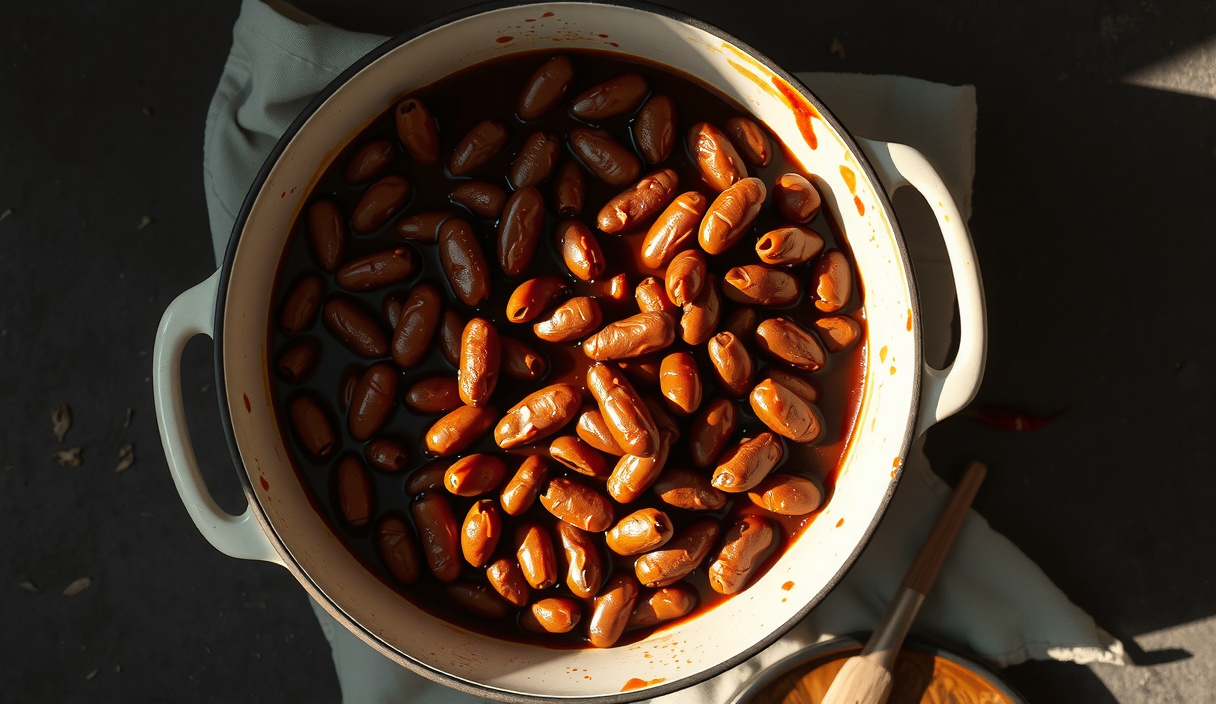
Vegan BBQ Beans — Smoked Pinto

Pinto beans braised low and slow in a molasses-ACV barbecue sauce, with real smoker time layering guaiacol and syringol phenolics into the fat phase. Smoked paprika and nutritional yeast build the savory-smoke axis that bacon traditionally occupies — no animal products, no shortcuts, no compromise on depth.
Equipment
- 1 Smoker or covered kettle grill Target 250–275°F ambient with apple, hickory, or oak wood chunks
- 1 Enameled cast iron Dutch oven 5–6 quart capacity; enameled interior protects against ACV reactivity with bare iron
- 1 Colander
- 1 Large mixing bowl For overnight bean soak
- 1 Instant-read thermometer Optional but useful for monitoring smoker ambient temp
Ingredients
Beans
- 1 lb dried pinto beans Picked over and rinsed; soaked overnight in salted water (1 tbsp kosher salt per quart)
- 1 tbsp kosher salt For the soak brine — not added to the final dish
Aromatic Base
- 2 tbsp extra-virgin olive oil
- 1 medium yellow onion Diced fine, approximately 1 1/2 cups
- 6 cloves garlic Minced
Sauce
- ½ cup blackstrap molasses Blackstrap preferred for its lower sugar content and deeper bitter-iron edge; regular unsulfured molasses produces a sweeter, milder result
- ¼ cup ketchup Check label for vegan compliance — most are
- 3 tbsp apple cider vinegar Raw or filtered; adds acetic acid backbone that brightens molasses sweetness and preserves pectin gelling
- 2 tbsp yellow mustard Standard prepared mustard; its mucilage proteins contribute secondary emulsification
- 2 tbsp nutritional yeast Deactivated Saccharomyces cerevisiae; contributes free glutamates and 5'-nucleotide precursors for umami synergy
- 2 tbsp smoked paprika Spanish pimentón de la vera preferred; provides carotenoid color and phenolic smoke character
- 1 tsp chipotle powder Optional; increases heat and deepens smoke dimension
- 1 tbsp soy sauce Or tamari for gluten-free; adds sodium and additional glutamate load
- 1 tbsp brown sugar Packed; provides additional reducing sugars for Maillard surface development during smoker exposure
- 1 tsp black pepper Freshly ground
- 1 tsp kosher salt Plus more to taste at finish
- 3 cups vegetable broth Low-sodium preferred; or water
- 1 tsp liquid smoke Added strictly off-heat at the end; hickory or mesquite; do not cook with it

Instructions
Soak the Beans
- Place the dried pinto beans in a large bowl. Add enough cold water to cover by at least 3 inches and stir in 1 tbsp kosher salt. The salt brine — approximately 1% ionic strength — keeps the pectin chains in the seed coat more intact during cooking, resulting in beans that hold their shape through the long braise without blowing out. Soak at room temperature for 8–12 hours or overnight. Drain and rinse thoroughly before using.1 tbsp kosher salt
Build the Aromatic Base
- Set your Dutch oven over medium heat on the stovetop. Add the olive oil and heat until it shimmers — approximately 180–200°F surface temperature, well below the smoke point. Add the diced onion and cook, stirring occasionally, for 8–10 minutes until deeply softened and beginning to show golden edges. The caramelization here contributes reducing sugars and Strecker degradation products that build baseline sweetness and aromatic complexity.2 tbsp extra-virgin olive oil, 1 medium yellow onion
- Add the minced garlic and cook for 90 seconds, stirring constantly. Garlic burns rapidly above 250°F due to its high reducing-sugar content; pull it from heat the moment it turns pale gold and fragrant. Remove from heat.6 cloves garlic
Assemble the Pot
- Add the drained, soaked beans directly to the Dutch oven with the softened aromatics. Pour in the molasses, ketchup, apple cider vinegar, yellow mustard, nutritional yeast, smoked paprika, chipotle powder (if using), soy sauce, brown sugar, black pepper, and 1 tsp kosher salt. Stir to combine, making sure the molasses is fully incorporated — it tends to sink and pool at the bottom.1/2 cup blackstrap molasses, 1/4 cup ketchup, 3 tbsp apple cider vinegar, 2 tbsp yellow mustard, 2 tbsp nutritional yeast, 2 tbsp smoked paprika, 1 tsp chipotle powder, 1 tbsp soy sauce, 1 tbsp brown sugar, 1 tsp black pepper, 1 tsp kosher salt
- Pour in the vegetable broth. The liquid level should come to approximately 1/2 inch above the top of the beans — the beans will absorb a significant volume during the first 90 minutes of cooking. Stir once more to integrate. Taste the raw braising liquid; it should be aggressively seasoned and slightly sharp — it will mellow and deepen dramatically during the cook.3 cups vegetable broth
Fire Up the Smoker
- Prepare your smoker for indirect cooking at 250–275°F. Add apple, hickory, or oak wood chunks to generate active smoke — approximately one fist-sized chunk at the start, with a second added at the 60-minute mark. These wood species produce phenolic compounds (guaiacol, syringol) in the 250–350 ppm range that adsorb onto the fat phase of your sauce, creating genuine smoke complexity. Avoid mesquite for this application — its higher combustion temperature produces excess creosote that turns bitter on long cooks.
- Place the uncovered Dutch oven in the smoker. Let it ride uncovered for the first 30 minutes so the exposed sauce surface picks up direct smoke contact. Then lid the Dutch oven and continue cooking for 90 minutes, maintaining smoker temp at 250–275°F. At the 90-minute mark, check the liquid level — if it has dropped below the top of the beans, add hot water in 1/4 cup increments to bring it back just even with the bean surface.
- Remove the lid and continue smoking for a final 45–60 minutes until the sauce has reduced to a thick, lacquer-like consistency that coats a spoon heavily and the beans are completely tender — no chalky bite at the center. The uncovered final stage drives evaporative concentration of the pectin-molasses matrix, building body and intensifying flavor through Maillard-driven melanoidin formation at the exposed sauce surface. Total smoker time: approximately 2.5–3 hours.
Finish and Rest
- Remove the Dutch oven from the smoker and set on a heat-safe surface. Stir in the liquid smoke off-heat — this is critical. The top-note phenolics in liquid smoke (responsible for the campfire, fresh-smoke aroma) volatilize rapidly above 150°F, so adding off-heat preserves them. Start with 3/4 tsp, stir, and taste. Add the remaining 1/4 tsp if you want a more pronounced smoke signal.1 tsp liquid smoke
- Taste for balance: the sauce should read smoky, sweet, tangy, and savory in that order. If it tastes flat or one-dimensionally sweet, add 1 tsp ACV. If the acid is sharp and dominant, add 1 tsp molasses. Adjust salt. Let the pot rest uncovered for 15 minutes before serving — the sauce will continue to tighten as the temperature drops from approximately 200°F to 160°F, improving the coating and presentation of each bean.
Notes
Why do pinto beans self-thicken the sauce? Pinto beans carry a meaningful endogenous pectin load in their seed coat — primarily polygalacturonic acid chains. As the beans cook past 180°F internal, the middle lamella undergoes partial beta-elimination degradation, releasing soluble pectin polymers into the braising liquid. These polymers physically restrict free-water mobility (acting as a weak hydrogel), building sauce viscosity without any added starch. The lower the pH of the braising liquid (here, driven by the ACV to approximately pH 3.8–4.2), the more stable this pectin network is — which is why the ACV is not optional.
Why does the sauce need to be uncovered for the final stage? Covered braising prevents evaporative reduction. The sauce needs to lose water to concentrate the pectin-molasses-melanoidin matrix. Opening the lid drops the water activity of the surface and allows the Maillard reaction to proceed on the exposed sauce — creating the glossy, mahogany crust you see on competition beans. If your sauce is still thin at the end of the cook, add 20 uncovered minutes at 275°F.
Liquid smoke dose precision: Liquid smoke is a condensate of wood combustion phenolics — guaiacol, syringol, eugenol — identical to what adsorbs onto food during conventional smoking. At 1 tsp for 6–8 servings, the contribution sits in the perceptible but background range, augmenting and integrating with the actual smoker phenolics rather than dominating. Double the dose and it crosses from smoke to chemical. Always add off-heat and taste incrementally.
Nutritional yeast as umami driver: Nutritional yeast provides free L-glutamic acid alongside nucleotide precursors (hypoxanthine, guanine derivatives). Free glutamate alone activates T1R1/T1R3 umami receptors at roughly 30 mM threshold. When paired with 5'-nucleotides, the activation threshold drops by a factor of 8–10 via allosteric synergy — the same mechanism that makes dashi (kombu glutamate + katsuobushi IMP) taste exponentially more savory than either component alone. Two tablespoons here is not optional garnish; it is load-bearing flavor infrastructure.
No smoker? Oven method: Bake covered at 325°F for 2 hours, then uncovered for 30–45 minutes. Increase liquid smoke to 1 1/2 tsp and add a pinch extra smoked paprika stirred in at the end. The beans will be very good — just without the multilayer phenolic depth that actual combustion delivers.
Nutrition
Calories: 310kcalCarbohydrates: 54gProtein: 14gFat: 5gSaturated Fat: 0.7gSodium: 520mgFiber: 13gSugar: 16g
Tried this recipe?Let us know how it was!