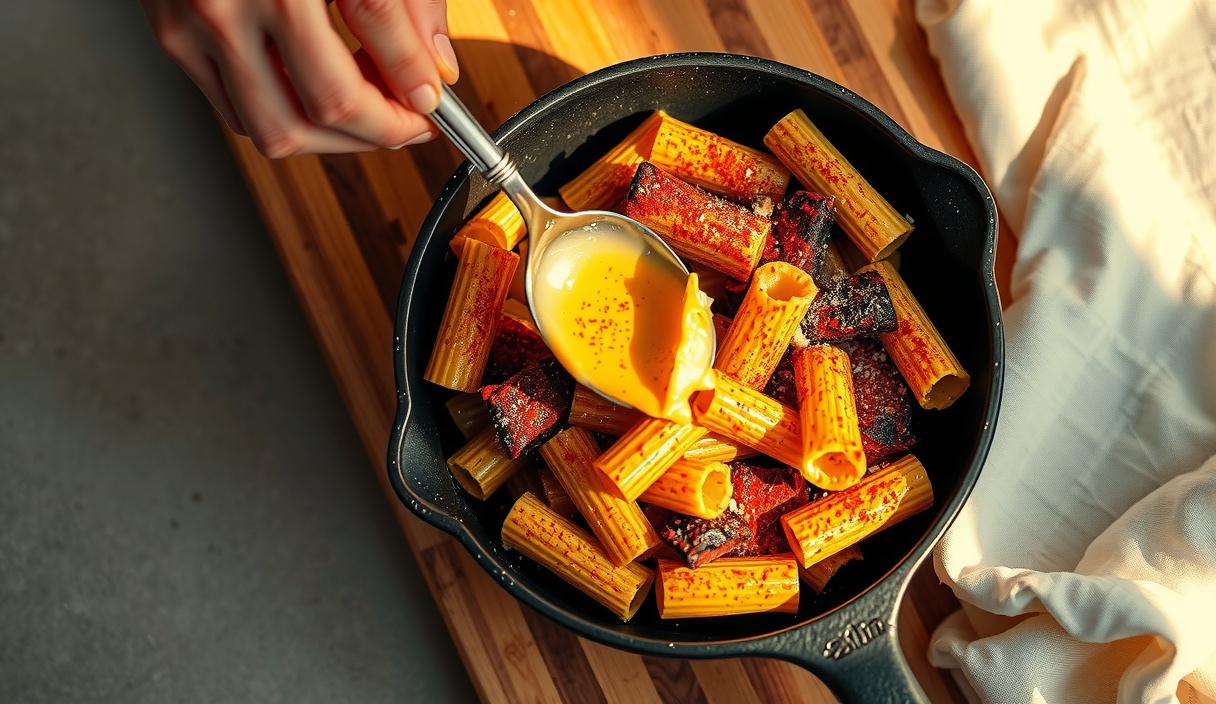
Vegan Smoked Mac & Cheese — Cashew Smoke Sauce

A plant-based mac and cheese built on a stable cashew-protein-fat emulsion locked with 0.2% xanthan gum, seasoned with kala namak sulfur compounds for cheese-funk, white miso for fermented umami, and nutritional yeast for glutamate depth. The assembled dish finishes 30 minutes on the smoker at 250°F, where oak phenolics deposit on the viscous sauce surface and partition into the cashew fat phase for sustained, wood-fired aromatic resonance. Where Flavor Meets the Flame.
Equipment
- 1 High-speed blender Must run at maximum speed for 90 seconds; standard blenders at low speed will leave coarse fat aggregates
- 1 Smoker or kettle grill Set up for indirect heat at 250°F grate-level; use oak wood chunks
- 1 Grate-level probe thermometer Lid thermometers read 25–50°F high; measure at the cooking grate
- 1 12-inch cast iron skillet or heavy-gauge foil pan Needs to sit flat on grates and retain heat to prevent bottom-layer emulsion chill
- 1 Large pot For boiling pasta
- 1 Kitchen scale Required for precise xanthan gum measurement at 0.2% w/w
Ingredients
Cashew Smoke Sauce
- 300 g raw whole cashews Soaked 8 hours or overnight in cold water, then drained and rinsed; or cover with boiling water 45 minutes minimum
- 400 g warm filtered water 130°F (54°C) — warm temperature reduces lipid phase viscosity during blending for better emulsification
- 0.8 g xanthan gum Exactly 0.2% of the 400g water by weight; measure on a kitchen scale — a scant 1/4 tsp. Disperse in the cold water before adding cashews.
- 4 tbsp nutritional yeast Deactivated, B12-fortified; provides free glutamic acid for umami saturation
- 1.5 tbsp white shiro miso Do not substitute red or brown miso; white miso keeps pH above 4.8 and color light
- 2 tbsp fresh lemon juice Add after emulsion is stable and xanthan fully hydrated to avoid protein flocculation
- 3 cloves garlic Roughly chopped; added to blender raw for allicin pungency
- 1 tsp kala namak (black salt) Start at 3/4 tsp, taste after blending, and adjust; highly potent sulfur compounds — smell of hard-boiled egg is intentional
- 0.5 tsp smoked paprika Adds lipophilic carotenoid color compounds and a secondary smoky baseline before the smoker
- 0.5 tsp ground turmeric Color only — mimics the yellow hue of aged cheddar
- 0.25 tsp fine sea salt Adjust after final taste; kala namak carries its own salinity
- 0.25 tsp dry mustard powder Mustard mucilage proteins provide secondary emulsification support at the oil-water interface
Pasta and Assembly
- 450 g elbow macaroni Standard semolina or certified GF brown rice pasta; cook to 90% done (slight starchy center) — it continues hydrating in the smoker
- 1 tbsp kosher salt For the pasta boiling water
- 2 tbsp reserved pasta cooking water The starchy water helps bind sauce to pasta; reserve before draining
Smoke Setup
- 2 chunks oak wood chunks Fist-sized; chunks sustain smoke output without temperature spikes. Apple or cherry acceptable; avoid hickory for this profile.

Instructions
Soak Cashews
- Place raw cashews in a bowl and cover with cold filtered water by at least 2 inches. Soak for 8 hours or overnight at room temperature. For a fast soak, cover with just-boiled water and soak for 45 minutes. Drain and rinse thoroughly under cold running water until water runs clear.
Prepare the Emulsion Base
- Whisk the xanthan gum into 200g of the warm water (130°F) in a small container and let it hydrate for 2 minutes. It will become slightly viscous. This pre-hydration prevents lumping when added to the blender.0.8 g xanthan gum, 400 g warm filtered water
- Add the drained soaked cashews, xanthan slurry, and remaining 200g warm water to the blender jar. Do not add lemon juice yet. Blend on maximum speed for 90 seconds continuously. The sauce should be completely smooth, opaque, and coat a spoon — no visible granules. If your blender labors or the sauce is still grainy at 90 seconds, blend an additional 30 seconds.400 g warm filtered water, 0.8 g xanthan gum
- Add the nutritional yeast, white miso, garlic, kala namak, smoked paprika, turmeric, sea salt, and dry mustard powder to the blender. Blend on high for an additional 30 seconds until fully incorporated. Taste for salt and sulfur depth from the kala namak — it should smell and taste distinctly egg-like and sharp.4 tbsp nutritional yeast, 1.5 tbsp white shiro miso, 3 cloves garlic, 1 tsp kala namak (black salt), 0.5 tsp smoked paprika, 0.5 tsp ground turmeric, 0.25 tsp fine sea salt, 0.25 tsp dry mustard powder
- Now add the lemon juice. Blend on medium for 15 seconds only. Taste immediately. The sauce should have bright acid lift without turning sour. Adjust: add more kala namak for sulfur depth, more nutritional yeast for umami, more lemon for sharpness. The emulsion is now set — do not re-blend aggressively after this point.2 tbsp fresh lemon juice
Cook the Pasta
- Bring a large pot of water to a rolling boil. Add kosher salt. Cook elbow macaroni to 90% done — roughly 1.5 minutes less than the package's minimum al dente time. The pasta should have a visible, small starchy core when you bite through a piece. Before draining, reserve 2 tablespoons of pasta cooking water in a small cup.1 tbsp kosher salt, 450 g elbow macaroni, 2 tbsp reserved pasta cooking water
- Drain the pasta and return it to the pot immediately. Pour the cashew sauce over the hot pasta and stir to coat completely. Add the reserved pasta water and stir again — the starch helps bind the sauce to the pasta surface. Transfer the dressed pasta to your cast iron skillet or foil pan, spreading it into an even layer.450 g elbow macaroni, 2 tbsp reserved pasta cooking water
Smoke
- Set up your smoker or kettle grill for indirect heat at 250°F measured at the cooking grate (not the lid thermometer). Add oak wood chunks to produce clean, thin blue smoke. Allow the smoke to establish for 5 to 10 minutes before loading the food — heavy white smoke means the wood is still off-gassing harsh compounds.2 chunks oak wood chunks
- Place the skillet or pan on the indirect-heat side of the grates. Close the lid. Do not stir, do not open, do not adjust for 30 minutes. The phenolic smoke compounds are depositing on the sauce surface continuously — every opening interrupts this process and loses heat. Monitor grate temperature every 10 minutes through a vent probe. Maintain 250°F ± 15°F.
- At 30 minutes, pull the pan. The surface will show a slightly darker, tacky-looking skin — that is the smoke film layered over the emulsion. Stir the entire dish once from bottom to top to distribute the smoke-concentrated surface layer throughout. Taste for seasoning — add a pinch of sea salt or a few drops of lemon juice if needed. Serve immediately from the pan.
Notes
Why xanthan gum at exactly 0.2% w/w? Xanthan is a bacterial-fermented polysaccharide that behaves as a rigid, rod-like polymer in solution. At 0.2% of the aqueous phase weight, it crosses the critical overlap concentration (c*), creating a pseudoplastic network — highly viscous at rest to arrest fat droplet collision and Stokes'-Law-driven separation, but thinning rapidly under the shear stress of mastication so flavor releases cleanly. Below 0.15%, the network is too weak to survive 250°F convective heat for 30 minutes. Above 0.5%, you get gummy, slimy mouthfeel. Measure precisely.
The kala namak chemistry: Kala namak is mined evaporite salt rich in iron sulfide (FeS), hydrogen sulfide (H₂S), and sulfur dioxide (SO₂). When dissolved in warm water, it releases volatile sulfur species into the headspace and the liquid phase. These compounds activate the same olfactory receptors (OR51E1 and related sulfur-sensing ORs) stimulated by thiols, disulfides, and mercaptans in aged dairy cheese. The mechanism is identical — the molecule class, not the source, determines the sensory perception. Traditional stocks and lab digests; kala namak and aged gruyere: same pathway.
Smoke deposition physics: Oak smoke phenolics (guaiacol, syringol, 4-methylguaiacol) are semi-volatile, lipophilic compounds. Their vapor-condensed phase partition coefficient (K_aw) strongly favors the lipid phase at 250°F. The cashew fat droplets at the sauce surface act as active phenolic sinks — each droplet absorbs smoke aromatics preferentially, creating a reservoir that releases during eating as fat melts at body temperature (37°C). This is why smoke finish on a fat-based sauce is so much more effective than smoke finish on a lean broth: the fat holds the smoke, then releases it slowly as you chew.
Pasta absorption in the smoker: Partially cooked elbow macaroni at 90% doneness retains significant water absorption capacity in its still-gelatinizing starch core. During the 30-minute smoke hold, residual steam and the sauce's aqueous phase continue to hydrate the pasta until starch gelatinization completes at approximately 195°F internal temperature. This is why pulling pasta al dente (fully done) before the smoker will produce overcooked, mushy pasta in the final dish.
Nutrition
Calories: 480kcalCarbohydrates: 62gProtein: 16gFat: 18gSaturated Fat: 3.5gSodium: 620mgFiber: 4gSugar: 4g
Tried this recipe?Let us know how it was!