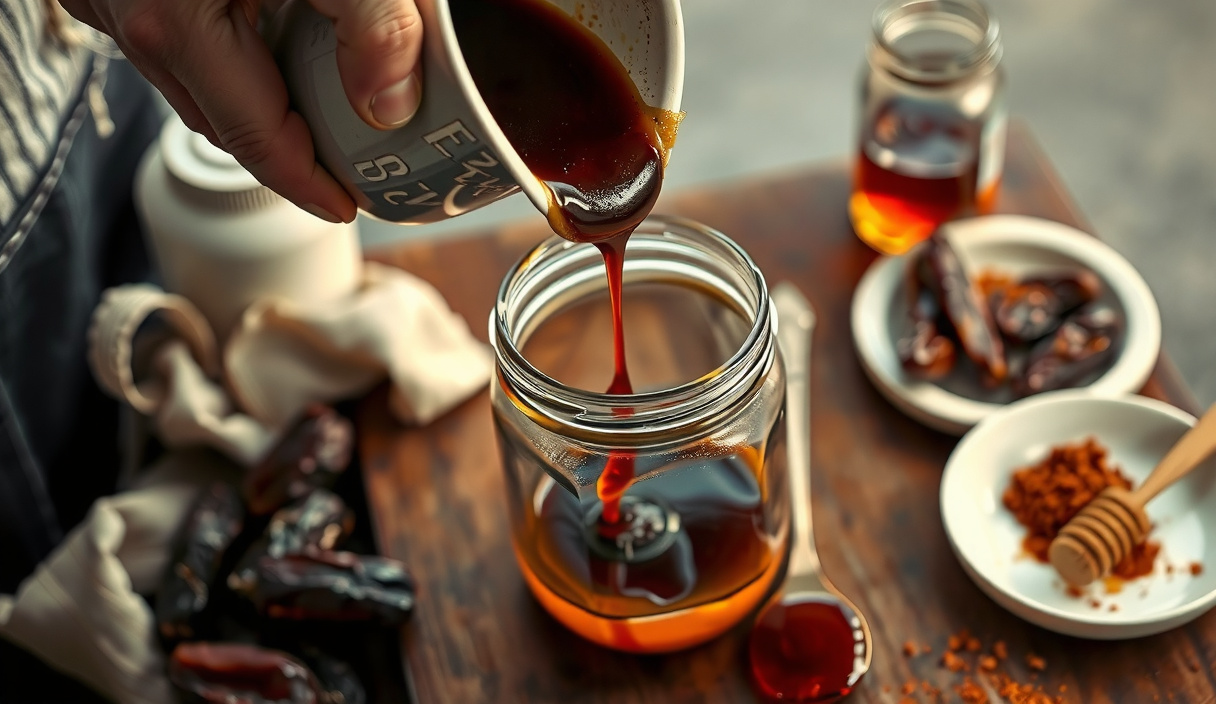
Whole-Food BBQ Sauce — No Refined Sugar

A deeply flavored, whole-food BBQ sauce built on Medjool date paste, double-concentrated tomato paste, apple cider vinegar, tamari, and smoked paprika. The date paste replaces refined sugar while simultaneously contributing a pseudoplastic fiber-viscosity network — no gums, no modified starches, no industrial additives. Reduces to a glossy, spoon-coating glaze with genuine smoke complexity and a long umami finish.
Equipment
- 1 High-speed blender Vitamix or equivalent — required to fully disperse date fiber matrix into a smooth colloidal paste
- 1 Medium saucepan (3-quart) Straight-sided preferred for even heat distribution and accurate thermometer readings
- 1 Instant-read thermometer To confirm the 210–220°F reduction target — do not skip
- 1 Silicone spatula For scraping the blender completely and stirring the reduction
- 1 Fine-mesh strainer (optional) Pass sauce through if a restaurant-smooth texture is desired; not required for home use
Ingredients
Date Paste
- 12 large Medjool dates, pitted About 200g / 7 oz by weight; choose soft, moist dates — hard or crystallized dates will not blend smooth
- 6 tablespoons warm water (160°F) Used to soak and then blend the dates — do not discard; the soaking liquid carries soluble fiber and sugars
Sauce Base
- 6 tablespoons double-concentrated tomato paste About 90g; tube or can — provides pectin-rich solids and deep umami base
- 3 tablespoons apple cider vinegar, raw unfiltered With the mother preferred; provides acetic acid for pH balance and Maillard substrate liberation
- 2 tablespoons tamari (certified gluten-free) Check label — must contain no wheat and no added sugar for strict whole-food compliance
- 1 tablespoon smoked paprika Spanish pimentón de la vera preferred; provides authentic smoke phenolics — guaiacol and syringol
- 1 teaspoon dry mustard powder Provides allyl isothiocyanate — a mild trigeminal activator that sharpens the vinegar note
- 1 teaspoon garlic powder Not fresh garlic — powder distributes evenly through the reduction without burning
- 1 teaspoon onion powder
- ½ teaspoon ground black pepper, coarsely ground
- ¼ teaspoon cayenne pepper Optional — adjust to taste; even a small amount sharpens perception of smokiness
- ¾ cup water Used to thin the sauce to correct working viscosity before reduction; filtered preferred
Finishing
- Kosher salt, to taste Add only after final reduction — tamari already contributes significant sodium

Instructions
Make the Date Paste
- Place the pitted Medjool dates in a small bowl and cover with the warm water (160°F). Let soak for 15 minutes — the dates will soften and absorb most of the liquid. Do not discard the soaking water.6 tablespoons warm water (160°F)
- Transfer the soaked dates and all remaining soaking liquid to a high-speed blender. Blend on high for 45 to 60 seconds until completely smooth, stopping once to scrape down the sides. The paste should be silky with no visible fiber strands. If any grainy texture remains, blend for an additional 30 seconds. Set aside in the blender jar.6 tablespoons warm water (160°F)
Build the Sauce
- Add the tomato paste, apple cider vinegar, tamari, smoked paprika, dry mustard powder, garlic powder, onion powder, black pepper, cayenne pepper (if using), and water to the blender with the date paste. Blend on medium for 20 seconds until fully integrated. The sauce will look thin — this is correct before reduction.6 tablespoons double-concentrated tomato paste, 3 tablespoons apple cider vinegar, raw unfiltered, 2 tablespoons tamari (certified gluten-free), 1 tablespoon smoked paprika, 1 teaspoon dry mustard powder, 1 teaspoon garlic powder, 1 teaspoon onion powder, 1/2 teaspoon ground black pepper, coarsely ground, 1/4 teaspoon cayenne pepper, 3/4 cup water
- Pour the blended sauce into a medium saucepan. Set over medium heat. Bring to a gentle simmer — small bubbles forming at the edges, not a rolling boil. This should take 4 to 5 minutes. Stir constantly during this phase; the high sugar and solids content means the bottom of the pan will scorch if left unattended.
Reduce
- Reduce heat to medium-low. Simmer uncovered, stirring every 2 to 3 minutes, for 18 to 22 minutes total. The sauce is ready when it reads 210–220°F on an instant-read thermometer and coats the back of a spoon with a film that does not run when you drag a clean finger across it. The surface will shift from a dull, opaque rust to a glossy mahogany — that visual cue confirms sufficient Maillard product formation.Watch the final 5 minutes carefully. Reduction accelerates as water evaporates. If the sauce begins to spit or the bottom catches, reduce heat immediately and stir more aggressively.
Rest and Season
- Remove the saucepan from heat. Let the sauce rest uncovered for 10 minutes — this volatile bloom step is not optional. The smoked paprika phenolics redistribute during this window and the sauce will smell dramatically more complex than it did on the burner.
- Taste. Add kosher salt only now — the tamari already provides significant sodium, and reduction concentrates it further. If the sauce tastes flat, add a second teaspoon of ACV. If it tastes sharp, add 1 tablespoon warm water and stir. Sauce should taste smoky-sweet upfront, with a vinegar tang in the mid-palate and a long savory finish from the tamari.Kosher salt, to taste
Store or Apply
- Transfer to a glass jar or airtight container. Refrigerate for up to 14 days. For BBQ application: brush onto proteins in the last 15 to 20 minutes of cooking at grate temperatures of 275–300°F. Date-derived fructose caramelizes and scorches at lower surface temperatures than sucrose — do not apply to high-direct-heat zones above 350°F or the sauce will char bitter.
Notes
Why date paste instead of brown sugar or maple syrup: Medjool dates carry roughly 66% total sugars by weight, but the fiber matrix — primarily soluble beta-glucan analogs and pectin-adjacent polysaccharides — remains intact after blending. This fiber forms a non-Newtonian pseudoplastic dispersion in the aqueous phase: viscosity drops under shear (brush application, mastication) but recovers at rest, keeping the sauce clingy without any added gum or modified starch. The power-law flow behavior index (n) of a 15% w/w date fiber reduction runs approximately 0.45–0.55 — in the same functional band as xanthan-stabilized commercial sauces.
Maillard kinetics with date fructose: Fructose is a more reactive Maillard partner than sucrose because it presents a free open-chain aldehyde carbonyl without requiring acid hydrolysis first. At 210–220°F surface temperatures, the sauce generates early Amadori products and furanone-class aroma compounds (caramel, dark fruit, mild toffee) characteristic of well-developed BBQ sauce complexity. Reduction above 225°F risks fructose pyrolysis — the transition from flavor to char — which is why the temperature window is hard-coded into this recipe.
Tamari as umami chassis: Tamari provides free L-glutamic acid concentrations of approximately 1,200–1,500 mg per 100 mL. Glutamate activates the T1R1/T1R3 heterodimeric receptor complex at concentrations as low as 0.5 mM, synergistically amplifying all other flavor compounds in the sauce — extending smoke perception, deepening sweetness complexity, and lowering the overall detection threshold of minor aromatic volatiles from smoked paprika. The result is a sauce that tastes more layered than its short ingredient list suggests.
Application temperature warning: This sauce contains high fructose and glucose concentrations (from dates) rather than sucrose. Fructose caramelizes at approximately 230°F vs. sucrose at 320°F. At grate temperatures above 350°F, date-sweetened sauces will scorch to a bitter, acrid char within 3 to 4 minutes. Apply exclusively in the final low-and-slow window of your cook — this is a glaze, not a mop.
Nutrition
Calories: 52kcalCarbohydrates: 12.5gProtein: 0.8gFat: 0.2gSodium: 185mgFiber: 1.2gSugar: 10.3g
Tried this recipe?Let us know how it was!