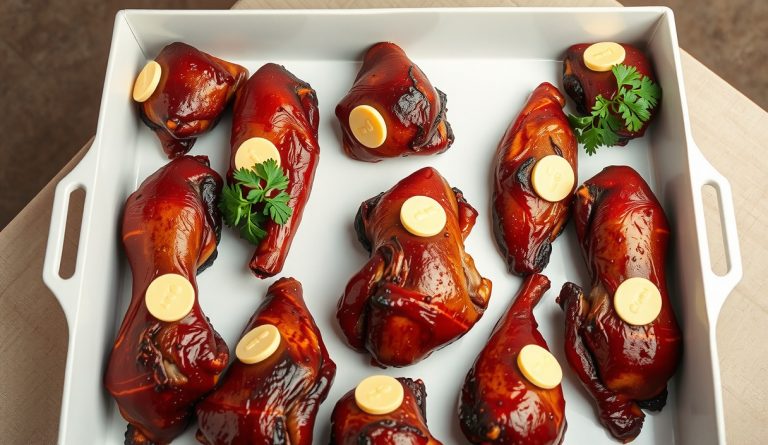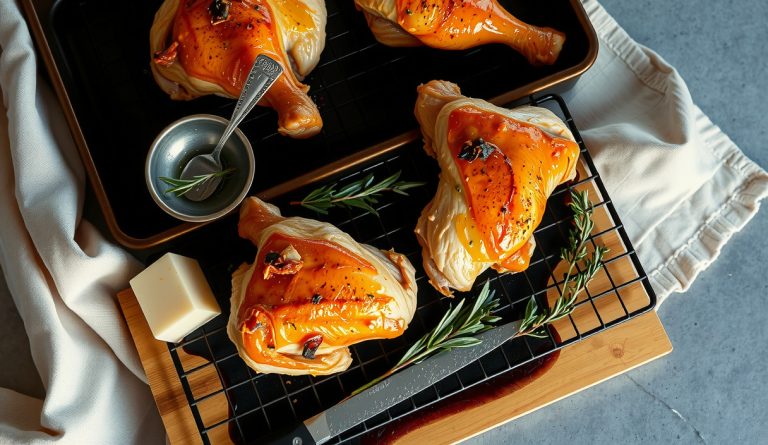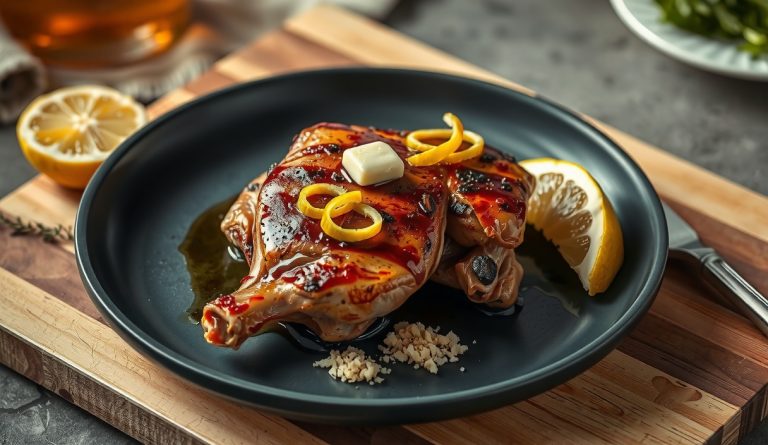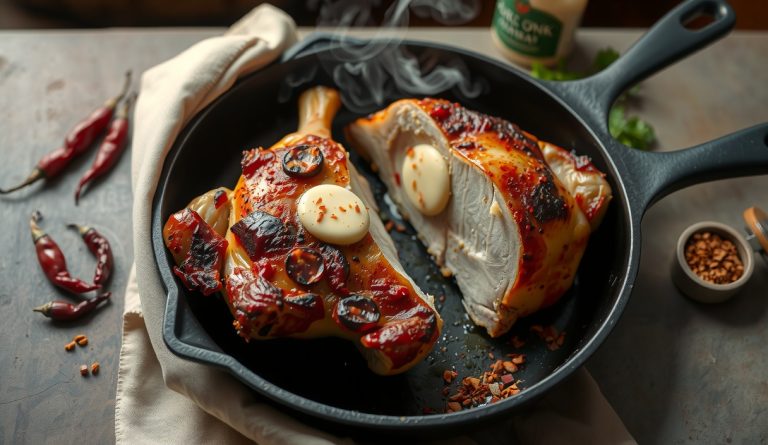
Keto Smoked Chicken Thighs with Garlic-Herb Compound Butter
Equipment
- 1 Smoker or kettle grill with indirect-heat setup Must hold a stable 250–275°F and ramp to 400°F for the sear finish
- 2–3 chunks Cherry or apple wood chunks Do not use wood chips — chunks provide sustained smoke without flaring
- 1 Instant-read thermometer Target 175°F at deepest point of thigh muscle, not touching bone
- 1 Wire rack set over a sheet pan For the overnight dry-brine step — airflow on all sides is essential
Ingredients
Chicken
- 4 bone-in, skin-on chicken thighs Approximately 2.5 to 3 lbs total — trim excess overhanging fat but leave the main skin cap intact
Sugar-Free Dry Rub
- 1 tbsp granular erythritol Granular only — powdered dissolves too quickly and muddies the bark
- 2 tsp smoked paprika Spanish pimentón de la Vera preferred for its Maillard-reactive pentose sugar content
- 1 tsp kosher salt
- 1 tsp garlic powder
- 0.5 tsp onion powder
- 0.5 tsp dried thyme
- 0.5 tsp dried rosemary Finely crushed between fingers before adding to improve bark adhesion
- 0.25 tsp black pepper, coarse ground
- 0.25 tsp cayenne pepper Optional — omit for a mild profile
Garlic-Herb Compound Butter
- 4 tbsp unsalted European-style butter 82–84% fat content; softened to room temperature
- 3 cloves garlic Minced to a paste using the side of a knife with a pinch of salt
- 1 tbsp fresh thyme leaves Stripped from stems; substitute 1 tsp dried if fresh unavailable
- 1 tbsp fresh rosemary Finely minced; woody stems discarded
- 0.5 tsp kosher salt
- 0.25 tsp black pepper
- 0.5 tsp lemon zest Optional but recommended — adds brightness without adding water or carbs

Instructions
Make the Compound Butter
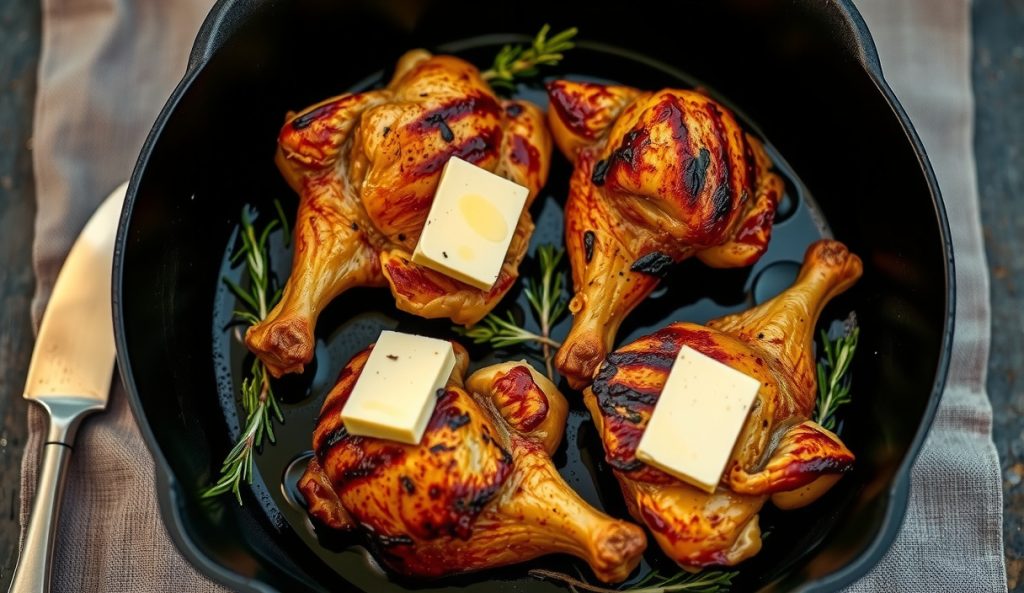
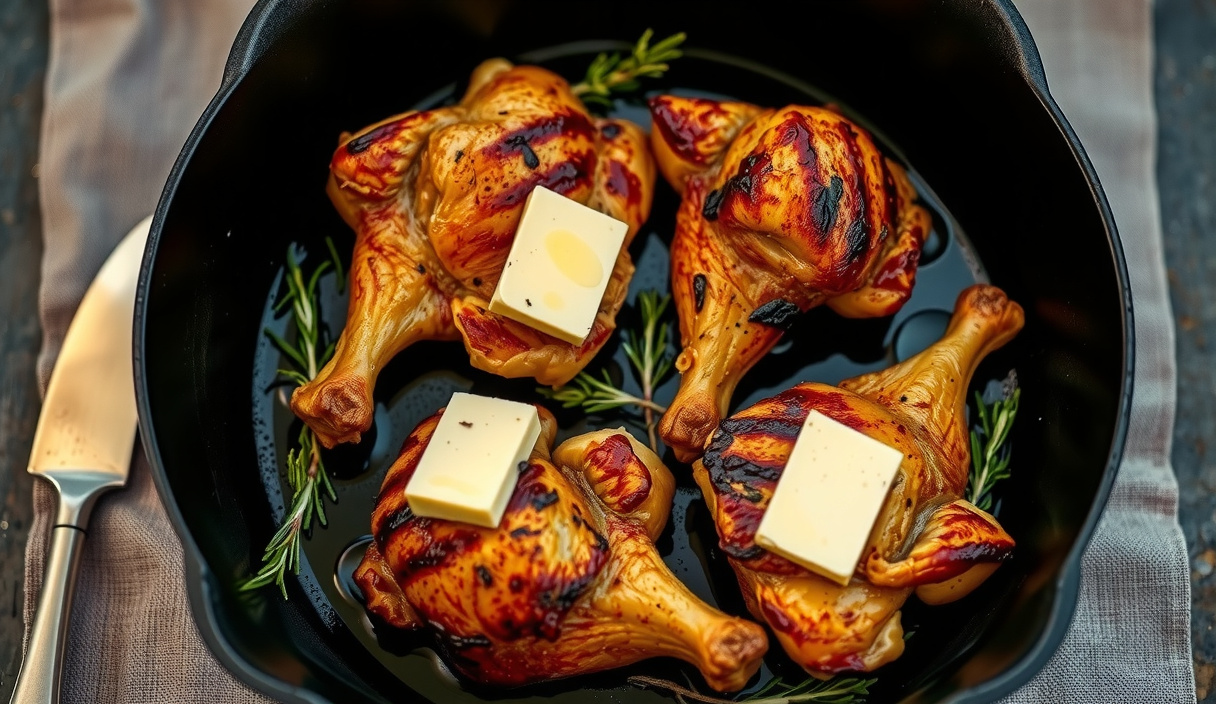
- Combine the softened butter, minced garlic paste, thyme, rosemary, salt, pepper, and lemon zest (if using) in a small bowl. Mix vigorously with a fork until the aromatics are fully incorporated and the butter is homogeneous. Taste and adjust salt. Transfer to a small piece of plastic wrap, shape into a rough log, and refrigerate until firm — at least 30 minutes. The butter must be fully softened when you mix it — cold butter will not incorporate the herbs evenly, leaving pockets rather than a uniform aromatic matrix.3 cloves garlic, 1 tbsp fresh thyme leaves, 1 tbsp fresh rosemary, 0.5 tsp kosher salt, 0.25 tsp black pepper, 0.5 tsp lemon zest
Apply Rub and Dry Brine
- Combine all dry rub ingredients in a small bowl and mix until the erythritol and spices are evenly distributed. Pat the chicken thighs completely dry with paper towels — any surface moisture will impede bark formation by raising the boundary-layer water activity above the Maillard-optimal range.2 tsp smoked paprika, 1 tsp kosher salt, 1 tsp garlic powder, 0.5 tsp onion powder, 0.5 tsp dried thyme, 0.5 tsp dried rosemary, 0.25 tsp black pepper, coarse ground, 0.25 tsp cayenne pepper
- Using your fingers, carefully loosen the skin from the flesh of each thigh, working from the thick end inward without tearing. Push approximately 1 tablespoon of compound butter under the skin of each thigh and press from the outside to spread it into an even layer across the muscle. Work quickly — the heat of your hands will soften the butter fast. If the butter becomes too soft, return it to the refrigerator for 10 minutes before continuing.3 cloves garlic
- Apply a generous, even coat of the dry rub to all surfaces of each thigh — including the underside and any exposed meat at the edges. Place the thighs skin-side up on a wire rack set over a sheet pan. Refrigerate uncovered for a minimum of 8 hours and up to 24 hours. This dry-brine rest solubilizes the surface proteins, draws and redistributes moisture via osmosis, and critically drops the skin’s surface water activity — the key setup for clean bark formation and skin crispness on the smoker.2 tsp smoked paprika, 1 tsp kosher salt, 1 tsp garlic powder, 0.5 tsp onion powder, 0.5 tsp dried thyme, 0.5 tsp dried rosemary, 0.25 tsp black pepper, coarse ground, 0.25 tsp cayenne pepper
Fire Up and Smoke
- Remove the thighs from the refrigerator 30 minutes before cooking to temper slightly. Prepare your smoker for indirect cooking at 250–275°F. Add 2 to 3 chunks of cherry or apple wood to the coals or wood box — this is the full wood addition for the cook. Do not add more wood mid-cook. Excess smoke on poultry generates bitter creosote compounds that the limited connective tissue mass of chicken cannot absorb and buffer the way brisket does.
- Place the thighs skin-side up on the smoker grate over indirect heat, maintaining at least 1 inch of airspace between each piece for even convective flow. Close the lid and smoke at 250–275°F until the internal temperature reaches 165°F at the deepest point of the thigh muscle, measured away from the bone. This typically takes 2 to 2.5 hours depending on thigh size and smoker consistency. Resist opening the lid repeatedly — each opening drops pit temperature by 25–50°F and extends the cook unpredictably.
- If your smoker is capable of high heat, ramp the temperature to 400°F now. If using a kettle or offset, open the vents fully and add fresh coals to boost heat. Cook skin-side up for an additional 8–12 minutes, until the skin is deep mahogany, visibly bubbled, and audibly crackling. Monitor the internal temperature closely — you are targeting 175°F final internal. The skin-side-up orientation during the high-heat finish allows the fat to render upward through the skin rather than pooling on the grate beneath, driving crispness from within.
Rest and Serve
- Remove the thighs from the smoker when the internal temperature reads 175°F. Transfer to a clean cutting board or platter and tent loosely with foil — do not seal tightly, as trapped steam will reverse the skin crispness achieved in the last 10 minutes of cooking. Rest for 10 minutes. During this window the temperature gradient within the thigh equalizes and the muscle fibers relax, reducing juice loss at the cut. Serve immediately after the rest.
Notes
Nutrition
Bone-in, skin-on chicken thighs are the ideal cut for the smoker — not because they are forgiving (though they are), but because the architecture of the thigh is genuinely engineered for it. A thick cap of subcutaneous fat sits between skin and muscle. When you push compound butter into that cavity before the bird ever sees smoke, you create a self-basting lipid reservoir. As the thigh climbs toward its finish temperature, that butter slowly renders, continuously bathing the myofibrillar tissue in an aromatic fat phase. The result is the kind of moisture and flavor persistence that a boneless breast cannot touch.
The rub is the other half of the equation. Traditional BBQ rubs lean on brown sugar for two reasons — sweetness and Maillard browning. Brown sugar is a reducing-sugar bomb that kicks the amino-carbonyl cascade into overdrive, delivering the dark, complex bark we love. On a keto protocol, brown sugar is off the table. But the Maillard reaction does not care about your macro goals; it cares about free amino groups and reducing carbonyls at the right temperature and water activity. That is exactly what this recipe exploits.
Why do keto smoked chicken thighs work? The science
Keto smoked chicken thighs achieve moisture and bark without sugar because the compound butter supplies the lipid lubrication and the smoked paprika supplies the Maillard reactants — erythritol never needs to brown. Chicken thigh muscle is dominated by myosin and actin filaments. Myosin begins to denature between 130°F and 140°F, transitioning the texture from raw to tender. Actin collapses violently past 176°F — that contraction is the precise mechanism behind dry, stringy poultry. This recipe intentionally targets a 175°F internal finish temperature: the actin network is fully denatured and water-holding capacity has dropped dramatically, but the lipid phase introduced by the compound butter provides the lubrication that masks the moisture loss.
The subcutaneous fat cap reaches full render well before 175°F, shrinking and tightening the skin. Cranking the smoker to 400°F for the final 10 minutes drives surface temperature above 300°F — the practical onset for rapid Maillard-driven browning — completing the skin crackle without overcooking the muscle below.
The erythritol in the rub is doing real chemical work, though not in the way you might expect. Erythritol (a four-carbon polyol) is classified as a non-reducing sugar alcohol — in its pure crystalline state it will not participate in the Maillard cascade. However, smoked paprika is loaded with free amino acids and pentose sugars (including ribose and arabinose) that are extraordinarily reactive Maillard substrates. At pit temperatures between 250°F and 275°F, with water activity at the rub surface between 0.5 and 0.7 — the known optimal range for Maillard kinetics — these native paprika reactants drive the color and flavor cascade. The erythritol contributes osmotic bulk and a very mild endothermic cooling effect on the palate (its heat of solution is approximately -42.9 cal/g), which actually sharpens perception of herb and garlic volatiles. Net glycemic impact: effectively zero. Erythritol is absorbed and excreted intact without insulin response.
The compound butter deserves a note on volatility and fat partitioning. Garlic’s primary aroma compounds — diallyl disulfide and allicin degradation products — are highly lipophilic. Their vapor-condensed phase partition coefficients favor sequestration in the fat phase at rest. When the butter melts under the skin during smoking, those aromatic molecules are distributed throughout the lipid matrix surrounding the meat. Upon eating, the fat melts at body temperature, and the volatiles are released in a sustained, time-delayed burst directly into the retronasal olfactory pathway. Fresh thyme and rosemary provide terpene-rich top notes — linalool, carvacrol, borneol — that are similarly held in the butter’s lipid phase, creating a layered aromatic release sequence that a water-based marinade simply cannot replicate.
What equipment and ingredients do I need?
- Smoker setup: Any offset, kettle, or pellet smoker capable of holding 250–275°F works here. A pellet grill that can ramp to 400°F for the sear finish is ideal. If using a kettle, set up a two-zone fire and use the indirect side for the smoke phase.
- Wood choice: Cherry or apple wood. Both burn mild and slightly sweet, which pairs cleanly with poultry and does not overpower the herb butter. Hickory is acceptable but reduce usage to one small chunk — it reads as acrid against the delicate thyme notes at full dose.
- Erythritol: Use granular, not powdered. Powdered erythritol has a faster dissolution rate that causes it to weep and muddy the rub surface before bark sets. Granular stays put.
- Smoked paprika: The Maillard workhorse of this rub. Select a high-quality Spanish pimentón de la Vera (smoked over oak) — the elevated free amino acid and pentose sugar content from the smoking process makes it dramatically more reactive than generic smoked paprika.
- Butter: Use European-style (82–84% fat) unsalted butter. The higher fat percentage means less water in the compound butter, which translates to less steam under the skin during the smoke phase and crisper results.
- Instant-read thermometer: Non-negotiable. Target 175°F at the deepest point of the thigh muscle, away from the bone. The bone conducts heat and will read high.
Keto Smoked Chicken Thighs with Garlic-Herb Compound Butter
Equipment
- 1 Smoker or kettle grill with indirect-heat setup Must hold a stable 250–275°F and ramp to 400°F for the sear finish
- 2–3 chunks Cherry or apple wood chunks Do not use wood chips — chunks provide sustained smoke without flaring
- 1 Instant-read thermometer Target 175°F at deepest point of thigh muscle, not touching bone
- 1 Wire rack set over a sheet pan For the overnight dry-brine step — airflow on all sides is essential
Ingredients
Chicken
- 4 bone-in, skin-on chicken thighs Approximately 2.5 to 3 lbs total — trim excess overhanging fat but leave the main skin cap intact
Sugar-Free Dry Rub
- 1 tbsp granular erythritol Granular only — powdered dissolves too quickly and muddies the bark
- 2 tsp smoked paprika Spanish pimentón de la Vera preferred for its Maillard-reactive pentose sugar content
- 1 tsp kosher salt
- 1 tsp garlic powder
- 0.5 tsp onion powder
- 0.5 tsp dried thyme
- 0.5 tsp dried rosemary Finely crushed between fingers before adding to improve bark adhesion
- 0.25 tsp black pepper, coarse ground
- 0.25 tsp cayenne pepper Optional — omit for a mild profile
Garlic-Herb Compound Butter
- 4 tbsp unsalted European-style butter 82–84% fat content; softened to room temperature
- 3 cloves garlic Minced to a paste using the side of a knife with a pinch of salt
- 1 tbsp fresh thyme leaves Stripped from stems; substitute 1 tsp dried if fresh unavailable
- 1 tbsp fresh rosemary Finely minced; woody stems discarded
- 0.5 tsp kosher salt
- 0.25 tsp black pepper
- 0.5 tsp lemon zest Optional but recommended — adds brightness without adding water or carbs
Instructions
Make the Compound Butter
- Combine the softened butter, minced garlic paste, thyme, rosemary, salt, pepper, and lemon zest (if using) in a small bowl. Mix vigorously with a fork until the aromatics are fully incorporated and the butter is homogeneous. Taste and adjust salt. Transfer to a small piece of plastic wrap, shape into a rough log, and refrigerate until firm — at least 30 minutes. The butter must be fully softened when you mix it — cold butter will not incorporate the herbs evenly, leaving pockets rather than a uniform aromatic matrix.3 cloves garlic, 1 tbsp fresh thyme leaves, 1 tbsp fresh rosemary, 0.5 tsp kosher salt, 0.25 tsp black pepper, 0.5 tsp lemon zest
Apply Rub and Dry Brine
- Combine all dry rub ingredients in a small bowl and mix until the erythritol and spices are evenly distributed. Pat the chicken thighs completely dry with paper towels — any surface moisture will impede bark formation by raising the boundary-layer water activity above the Maillard-optimal range.2 tsp smoked paprika, 1 tsp kosher salt, 1 tsp garlic powder, 0.5 tsp onion powder, 0.5 tsp dried thyme, 0.5 tsp dried rosemary, 0.25 tsp black pepper, coarse ground, 0.25 tsp cayenne pepper
- Using your fingers, carefully loosen the skin from the flesh of each thigh, working from the thick end inward without tearing. Push approximately 1 tablespoon of compound butter under the skin of each thigh and press from the outside to spread it into an even layer across the muscle. Work quickly — the heat of your hands will soften the butter fast. If the butter becomes too soft, return it to the refrigerator for 10 minutes before continuing.3 cloves garlic
- Apply a generous, even coat of the dry rub to all surfaces of each thigh — including the underside and any exposed meat at the edges. Place the thighs skin-side up on a wire rack set over a sheet pan. Refrigerate uncovered for a minimum of 8 hours and up to 24 hours. This dry-brine rest solubilizes the surface proteins, draws and redistributes moisture via osmosis, and critically drops the skin’s surface water activity — the key setup for clean bark formation and skin crispness on the smoker.2 tsp smoked paprika, 1 tsp kosher salt, 1 tsp garlic powder, 0.5 tsp onion powder, 0.5 tsp dried thyme, 0.5 tsp dried rosemary, 0.25 tsp black pepper, coarse ground, 0.25 tsp cayenne pepper
Fire Up and Smoke
- Remove the thighs from the refrigerator 30 minutes before cooking to temper slightly. Prepare your smoker for indirect cooking at 250–275°F. Add 2 to 3 chunks of cherry or apple wood to the coals or wood box — this is the full wood addition for the cook. Do not add more wood mid-cook. Excess smoke on poultry generates bitter creosote compounds that the limited connective tissue mass of chicken cannot absorb and buffer the way brisket does.
- Place the thighs skin-side up on the smoker grate over indirect heat, maintaining at least 1 inch of airspace between each piece for even convective flow. Close the lid and smoke at 250–275°F until the internal temperature reaches 165°F at the deepest point of the thigh muscle, measured away from the bone. This typically takes 2 to 2.5 hours depending on thigh size and smoker consistency. Resist opening the lid repeatedly — each opening drops pit temperature by 25–50°F and extends the cook unpredictably.
- If your smoker is capable of high heat, ramp the temperature to 400°F now. If using a kettle or offset, open the vents fully and add fresh coals to boost heat. Cook skin-side up for an additional 8–12 minutes, until the skin is deep mahogany, visibly bubbled, and audibly crackling. Monitor the internal temperature closely — you are targeting 175°F final internal. The skin-side-up orientation during the high-heat finish allows the fat to render upward through the skin rather than pooling on the grate beneath, driving crispness from within.
Rest and Serve
- Remove the thighs from the smoker when the internal temperature reads 175°F. Transfer to a clean cutting board or platter and tent loosely with foil — do not seal tightly, as trapped steam will reverse the skin crispness achieved in the last 10 minutes of cooking. Rest for 10 minutes. During this window the temperature gradient within the thigh equalizes and the muscle fibers relax, reducing juice loss at the cut. Serve immediately after the rest.
Notes
Nutrition
How do I nail it every time? Tips and technique
- Dry the skin 24 hours out. Pat the thighs completely dry, apply the rub, and rest uncovered on a wire rack in the refrigerator overnight. This drops the surface water activity well below 0.8, which is the threshold above which evaporative cooling delays Maillard onset on the skin during the smoke phase. Wet skin steams before it crisps.
- Do not skip the butter-under-skin step. It feels fussy. It is not optional. The compound butter is the entire moisture insurance policy for the protein matrix once actin denatures past 165°F. Skipping it produces good smoked chicken; doing it produces exceptional smoked chicken.
- Watch for the stall. Chicken thighs rarely stall as dramatically as brisket, but the internal temperature may plateau around 155–160°F as surface evaporation temporarily matches heat input. Hold your pit temperature and do not open the lid. The stall typically resolves within 15–20 minutes.
- The 400°F finish is structural, not cosmetic. At the end of the smoke phase the skin is tacky and leathery, not crispy. The high-heat finish rapidly drives off remaining surface moisture and pushes the skin fat into a full render, creating the bubble-and-crackle texture that defines great smoked poultry skin. Without this step you have good bark but soft skin.
- Rest before cutting. A 10-minute rest allows the temperature gradient within the thigh to equalize and residual muscle contraction to relax, reducing juice loss at the cut by a measurable amount. Tent loosely — a tight tent traps steam and softens the skin you just worked to crisp.
- Do not go past 175°F internal. On keto, the fat content of the compound butter partially compensates for moisture loss, but there is a hard limit. Past 180°F the muscle tissue is irreparably fibrous regardless of the lipid buffer.
What variations can I make to this recipe?
Spicy-Cajun version: Replace thyme and rosemary in both the rub and compound butter with 1 tsp cayenne, 1 tsp dried oregano, and 0.5 tsp white pepper. Add 0.25 tsp celery salt to the rub. The capsaicin activates TRPV1 receptors, creating a heat-forward profile that contrasts well against the fat richness of the butter. Keep the erythritol-paprika base — the Maillard mechanism is identical.
Lemon-herb with asiago compound butter: Add 2 teaspoons of finely grated lemon zest (not juice — the water disrupts bark formation) and 2 tablespoons of finely grated asiago cheese to the compound butter. Lemon zest’s limonene content is highly lipophilic and integrates beautifully into the fat matrix. The aged cheese introduces free glutamates that synergistically amplify the savory depth of the smoked protein. Carb count remains under 2g net per serving.
Scaling for a competition cook: This recipe scales linearly to as many thighs as your smoker rack will allow without crowding — maintain 1 inch of airspace between pieces to ensure even convective smoke flow. The compound butter recipe scales 1:1 by weight of butter per thigh. For a large batch, prepare the compound butter as a log, refrigerate until firm, and slice coins directly under the skin rather than using softened butter, which is harder to handle at volume.
Dairy-free swap: Replace European butter with an equal mass of refined coconut oil blended with 1 tablespoon of extra virgin olive oil. The coconut oil provides the saturated fat structure (melting point approximately 76°F, so it will remain semi-solid during the rubbing step if your kitchen is cool) and the olive oil contributes monounsaturated aroma compounds. Increase garlic and herb quantities by 25% to compensate for the absence of butter’s dairy-forward flavor notes. Still fully keto-compliant.
Frequently asked questions
Can I use boneless, skinless thighs? Technically yes, practically no. Without the skin there is no cavity for the compound butter, and without the skin the surface fat renders out into the smoker rather than basting the meat. Boneless skinless thighs also reach their target temperature in roughly half the time, meaning they spend far less time in the smoke environment and absorb a fraction of the smoke flavor. If boneless is your only option, wrap the thighs around a coin of compound butter, secure with butcher’s twine, and accept a different dish — still delicious, but not this one.
Is erythritol in the rub actually doing anything or is it filler? Erythritol is doing two distinct things. First, it provides osmotic bulk and adheres the fat-soluble compounds in the paprika and spices to the skin surface, acting as a carrier matrix similar to how sucrose functions in a traditional rub. Second — and this is the key insight — at elevated pit temperatures the Maillard-reactive compounds already present in the smoked paprika (pentose sugars, free amino acids) use the erythritol-laden surface as a scaffolding. The erythritol itself stays largely unreacted, but its presence raises the local water activity to a range that is optimal for the paprika’s own browning chemistry. The bark color and flavor produced by this rub is indistinguishable from a light brown-sugar rub in blind tasting.
How do I know the smoke level is right — can I over-smoke chicken? Yes, and it happens fast. Chicken has much less connective tissue mass than brisket or pork shoulder, which means there is no prolonged protein-hydrolysis phase to absorb excess phenolic smoke compounds. Over-smoked chicken reads as acrid and medicinal, with bitter creosote notes that no amount of compound butter recovers. Use small wood additions — for a four-hour cook, two to three chunks of apple or cherry wood at the start is sufficient. The smoke ring (a cosmetic artifact of nitric oxide penetration into myoglobin) will be present but modest in poultry due to low myoglobin concentration, and that is correct. Smoke ring depth is not a proxy for smoke flavor intensity in chicken.