Keto Smoked Cheesecake — Almond Crust
Equipment
- 1 Offset smoker, pellet grill, or kettle grill with indirect setup Must hold a stable 225°F chamber temperature for 3 hours
- 1 9-inch springform pan Aluminum preferred; wrap exterior in two layers of heavy-duty foil
- 1 Instant-read or leave-in probe thermometer Accurate to within 1°F — this is the only reliable doneness signal
- 1 Stand mixer or hand mixer Use medium-low speed only; excess aeration causes surface cracks
- 2-3 Cherry wood chunks Fist-sized pieces; do not use chips, which burn too fast and spike temp
- 1 Wire cooling rack Required for staged cooling — allows airflow under the pan
Ingredients
Almond Crust
- 2 cups blanched almond flour Super-fine grind; coarse almond meal will produce a crumbly, greasy crust
- 4 tablespoons unsalted butter Melted and cooled to room temperature
- 3 tablespoons granular erythritol Granular is fine here; it provides slight crunch in the finished crust
- 1 teaspoon pure vanilla extract
- ¼ teaspoon fine sea salt
Smoked Cheesecake Filling
- 24 oz full-fat block cream cheese Three 8-oz blocks; room temperature for 2 hours — non-negotiable for a lump-free batter
- 1 cup powdered erythritol Confectioners-style, finely milled; granular will not dissolve fully in the cold fat matrix
- ¾ cup full-fat sour cream Adds lactic acid tang and softens the gel structure for a creamier set
- 3 large eggs Room temperature; cold eggs seize the cream cheese and create lumps
- 1 tablespoon pure vanilla extract
- 1 tablespoon fresh lemon juice Brightens the dairy flavor and lowers pH slightly to support casein network stability
- 1 teaspoon lemon zest Optional; adds limonene that pairs cleanly with cherry-wood guaiacol

Instructions
Build and Pre-Bake the Crust
- Preheat your conventional oven to 325°F. Combine almond flour, granular erythritol, and sea salt in a bowl and mix until uniform. Drizzle in melted butter and vanilla extract, then mix with a fork until the mixture clumps when pressed between your fingers.3 tablespoons granular erythritol, 1/4 teaspoon fine sea salt, 4 tablespoons unsalted butter, 1 teaspoon pure vanilla extract
- Press the crust mixture firmly and evenly into the bottom of the foil-wrapped 9-inch springform pan. Use a flat-bottomed glass to compact the surface — target a thickness of 6 to 8mm. The crust should not climb the sides.
- Bake the crust blind in the 325°F oven for 10 minutes until the edges are just turning golden and the center feels set to the touch. Remove and cool on a wire rack for 20 minutes. This step creates the Maillard-browned foundation and prevents the crust from absorbing filling moisture during the smoke phase.
Mix the Filling
- In the bowl of a stand mixer fitted with the paddle attachment, beat room-temperature cream cheese on medium-low speed for 90 seconds until completely smooth and free of any lumps. Scrape the bowl thoroughly.24 oz full-fat block cream cheese
- Add powdered erythritol and beat on low for 60 seconds until fully incorporated, then increase to medium-low for 30 additional seconds. Scrape the bowl again. Do not beat on high at any point — excess air causes the filling to puff and then crack during baking as the air expands.1 cup powdered erythritol
- Add sour cream, vanilla extract, lemon juice, and lemon zest. Mix on low until just combined, about 30 seconds. Scrape bowl.3/4 cup full-fat sour cream, 1 tablespoon pure vanilla extract, 1 tablespoon fresh lemon juice, 1 teaspoon lemon zest
- Add eggs one at a time, mixing on low after each addition only until the yolk disappears — approximately 15 to 20 seconds per egg. Overmixing after egg addition is the single most common cause of cracking. The finished batter should be silky, slightly fluid, and completely homogeneous.3 large eggs
- Pour the filling over the cooled crust and smooth the top with a small offset spatula. Tap the pan gently on the counter three times to release any trapped air pockets near the surface.
Set Up and Smoke
- Prepare your smoker for indirect cooking at a stable 225°F chamber temperature. Add two to three fist-sized cherry wood chunks directly to your heat source. Allow the smoker to reach temperature and the initial white smoke to transition to thin blue or nearly invisible smoke — this takes approximately 15 to 20 minutes. Thick white smoke contains higher creosote levels that will make the filling bitter.
- Place the foil-wrapped springform pan on the center grate of the indirect cooking zone. Insert the leave-in probe thermometer through the foil collar and into the center of the filling. Close the lid.
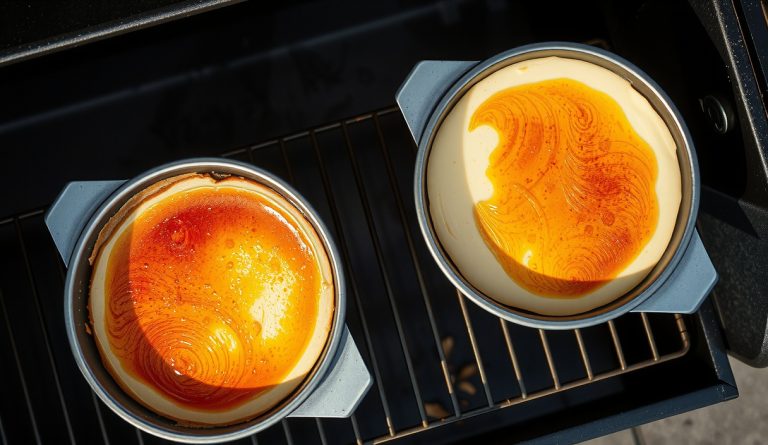
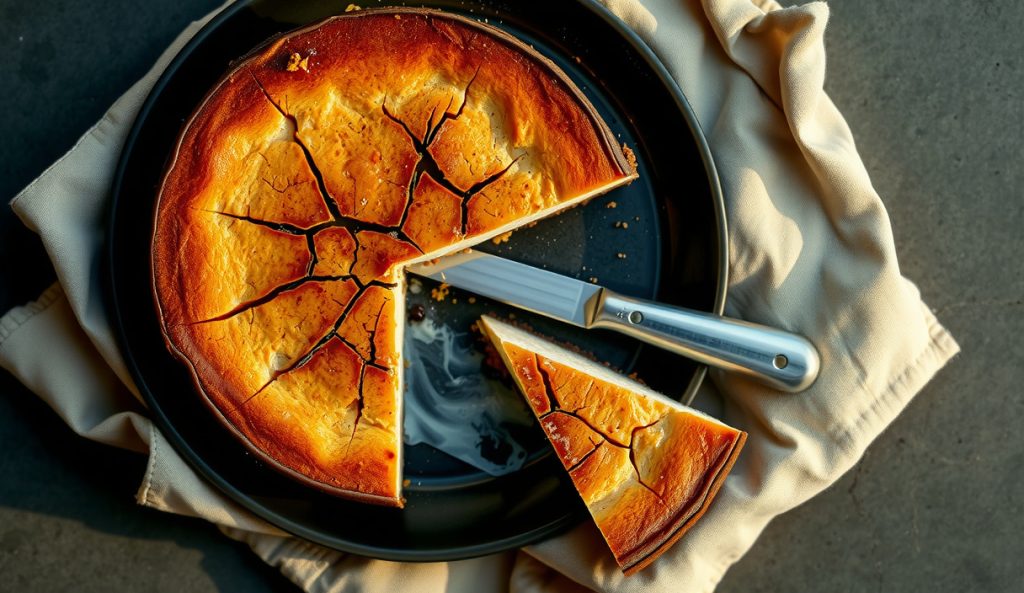
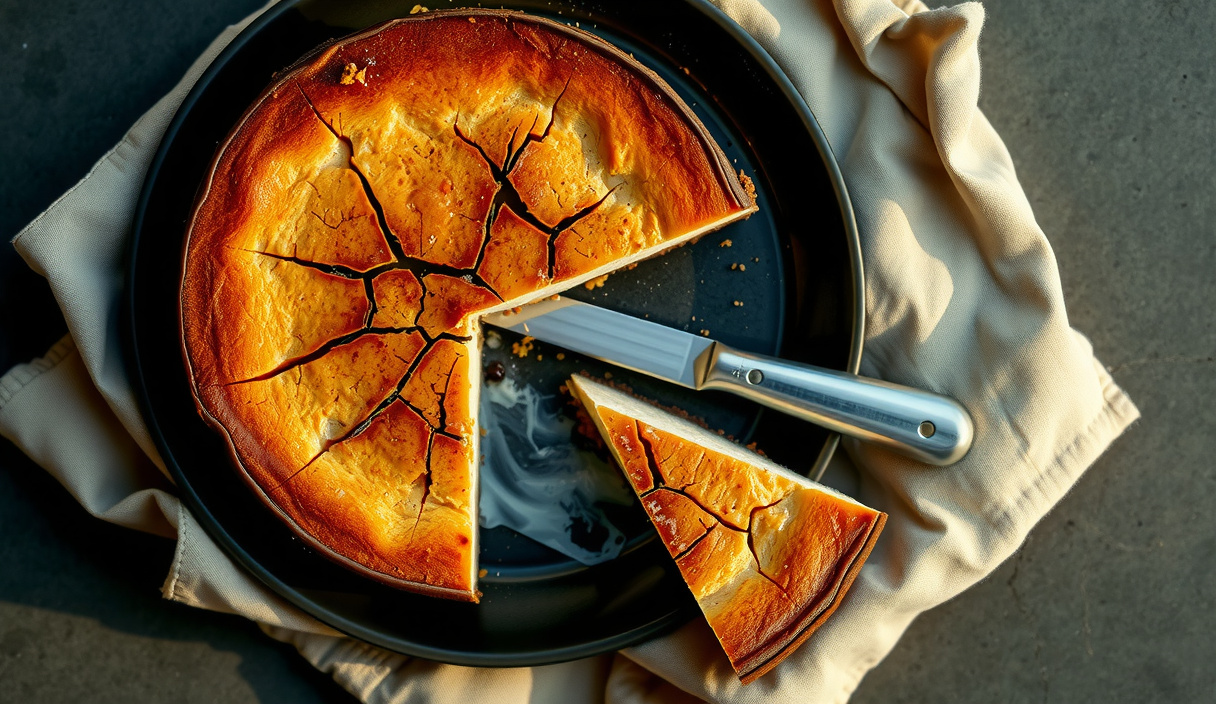
- Smoke at 225°F without opening the lid for the first 90 minutes. After 90 minutes, check the chamber temperature and make any fuel adjustments without allowing a prolonged lid-open period. Continue cooking until the probe reads 150°F internal temperature in the center of the filling — this will take approximately 2.5 to 3 hours total depending on your smoker. The filling should jiggle as one cohesive mass, not slosh. The surface will carry a faint golden-tan smoke blush.
Staged Cooling and Refrigeration
- When the cheesecake reaches 150°F internal, shut down the heat source and prop the smoker lid open 2 to 3 inches. Allow the cheesecake to rest in the cooling smoker for 45 minutes. This prevents thermal shock cracking.
- Transfer the pan (still in its foil wrap) to a wire cooling rack at room temperature. Rest uncovered for another 45 minutes, until the pan is barely warm to the touch on the sides.
- Remove the foil wrap, run a thin offset spatula around the interior edge of the springform pan to release any stuck spots, then transfer the entire pan — without releasing the springform latch — to the refrigerator. Refrigerate uncovered on a wire rack for a minimum of 8 hours, ideally 12 to 24 hours. The erythritol must fully dissolve into the aqueous gel matrix before slicing or you will taste residual grittiness.
- To serve: release the springform latch and remove the ring. Run a sharp knife under hot water, dry it, and slice in a single downward motion without dragging. Wipe the knife clean and reheat between each slice for the cleanest cut.
Notes
Nutrition
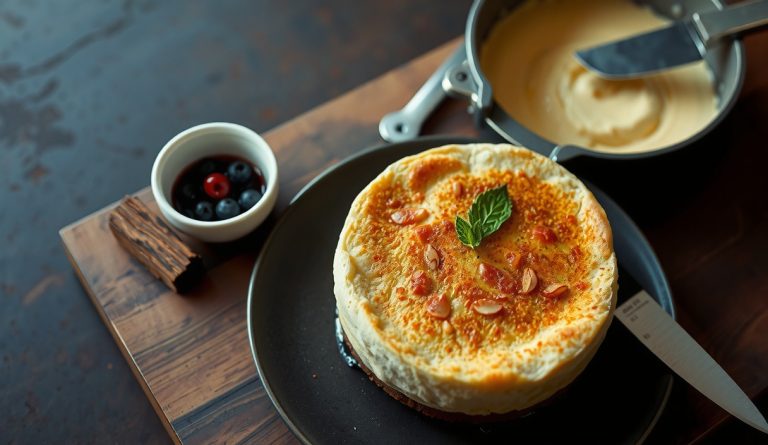
The first time I pulled a cheesecake off my offset smoker, I fully expected disaster — a curdled, weeping mess that would confirm every suspicion that dessert and live fire don’t belong together. What came off the grates instead was the most complex cheesecake I had ever tasted: the clean dairy tang of full-fat cream cheese layered under a whisper of cherry-wood smoke, sitting on a buttery almond crust that shattered like shortbread. That accident is now the most-requested recipe in my house, and today I’m handing you the physics behind exactly why it works.
The key insight is this: a cheesecake filling is a protein gel. You are coaxing egg proteins and casein networks into a soft, trembling solid. Overshoot the temperature and you curdle; undershoot and you get soup. The smoker provides a tool that conventional ovens lack — an almost perfectly stable, radiant-plus-convective heat environment that climbs temperature slowly enough to thread the needle between raw and broken. Cherry wood adds a layer of aromatic volatile organic compounds that ride the fat phase of the cream cheese, embedding themselves deep in the matrix rather than sitting on the surface. This is not gimmick BBQ. This is flavor physics.
Why does keto smoked cheesecake work? The science
A cheesecake filling is a casein-and-egg-protein co-gel suspended in a continuous fat phase — and understanding that structure explains every decision in this recipe. The cream cheese supplies the dominant structural backbone: casein micelles, already partially acid-denatured by the starter culture at pH approximately 4.5 to 4.9, are dispersed through a high-fat continuous phase of roughly 33% w/w. When heat is applied, two sequential denaturation events determine the final texture.
First, ovalbumin — the dominant egg-white protein — begins to unfold around 140°F to 145°F (60°C to 63°C), initiating a loose, viscoelastic network. Second, ovomucin and ovotransferrin reinforce that structure as temperatures climb toward 158°F to 165°F (70°C to 74°C). The target pull temperature of 150°F internal deliberately intercepts this cascade in the first stage: the ovalbumin network is set and stable, but the cook stops well before the temperatures that would violently contract the protein matrix and expel free water as weeping syneresis.
The fat phase is where smoke does its molecular work. Cherry-wood combustion releases a complex VOC payload dominated by guaiacol, syringol, and furfural — phenolic and carbonyl compounds with high lipophilic partition coefficients. Because the filling is approximately 35 to 40% total fat by weight (cream cheese plus sour cream plus egg-yolk lipids), these aromatics partition aggressively into the dispersed fat droplets rather than simply depositing on the surface. The result is a smoke note you taste retronasal across the full mouthfeel of the dessert, not a surface char. A 3-hour low-temperature smoke exposure outperforms a 20-minute hot-smoke blast every single time for dairy-fat matrices.
Water activity at the filling surface must remain above approximately 0.85 throughout the smoke phase to prevent pellicle formation that would block further VOC absorption — another reason the 225°F chamber temperature, with its gentler evaporative gradient, is non-negotiable. The crust operates as a separate thermodynamic system. Almond flour is roughly 50% lipid and 22% protein by mass, with almost zero amylose. There is no starch network to gelatinize, so structural integrity comes entirely from the coagulation of almond proteins and the solidification of butter lipids around the erythritol crystal matrix on cooling.
Erythritol is a four-carbon polyol with steep, fast crystallization kinetics — left alone it would grind into sand on the palate. Keeping the crust thin at 6 to 8mm ensures the butter fat coats the erythritol crystals and delays recrystallization. The Maillard browning visible on the crust edge is genuine: almond proteins and trace reducing sugars naturally present in almonds at roughly 0.2% w/w participate in the amino-carbonyl cascade above approximately 250°F surface temperature, which the crust achieves briefly during the initial 10-minute oven pre-bake before the cheesecake ever touches smoke.
What equipment and ingredients do I need?
Smoker setup: Any indirect-heat smoker that can hold a stable 225°F chamber temperature works — offset stick burners, pellet grills, ceramic kamados, or kettle grills with a snake coal configuration. A reliable probe thermometer capable of reading filling internal temperature is required. If the smoker runs hot, use the top rack and open the exhaust vent wider to bleed heat.
Cherry wood: Use small chunks (not chips) for a 3-hour burn — two to three fist-sized pieces maximum. Cherry is a fruit wood, burning clean and releasing high guaiacol-to-creosote ratios. Hickory and mesquite are too aggressive for dairy-fat matrices and will tip the filling bitter. Apple is a compatible substitute. Avoid treated wood or bark-heavy splits.
Cream cheese: Full-fat block cream cheese only — not whipped or spreadable. Whipped varieties contain added air and stabilizers that disrupt the gel network and cause the filling to deflate after cooling. Pull the cream cheese and eggs to room temperature a full 2 hours before mixing; cold cream cheese will not incorporate smoothly and creates lumps that never fully resolve during baking.
Erythritol: Powdered erythritol (also labeled confectioners erythritol) is essential for the filling — standard granular erythritol will not dissolve fully into the cream cheese matrix and leaves an unpleasant gritty mouthfeel. For the crust, granular is fine since it is baked in butter and the texture reads as a slight crunch rather than sand. Blending erythritol 70:30 with a small amount of allulose is recommended if available — allulose acts as a steric inhibitor that suppresses the endothermic cooling sensation and prevents large erythritol crystals from re-forming in the set filling.
Springform pan: A 9-inch aluminum springform pan is standard. Wrap the entire outside of the pan in two layers of heavy-duty aluminum foil to prevent smoke particulate from baking into the crust edge and to protect against grease drips on the grate. Do not use a water bath — water-bath steam prevents the surface from absorbing the smoke VOC payload.
Keto Smoked Cheesecake — Almond Crust
Equipment
- 1 Offset smoker, pellet grill, or kettle grill with indirect setup Must hold a stable 225°F chamber temperature for 3 hours
- 1 9-inch springform pan Aluminum preferred; wrap exterior in two layers of heavy-duty foil
- 1 Instant-read or leave-in probe thermometer Accurate to within 1°F — this is the only reliable doneness signal
- 1 Stand mixer or hand mixer Use medium-low speed only; excess aeration causes surface cracks
- 2-3 Cherry wood chunks Fist-sized pieces; do not use chips, which burn too fast and spike temp
- 1 Wire cooling rack Required for staged cooling — allows airflow under the pan
Ingredients
Almond Crust
- 2 cups blanched almond flour Super-fine grind; coarse almond meal will produce a crumbly, greasy crust
- 4 tablespoons unsalted butter Melted and cooled to room temperature
- 3 tablespoons granular erythritol Granular is fine here; it provides slight crunch in the finished crust
- 1 teaspoon pure vanilla extract
- ¼ teaspoon fine sea salt
Smoked Cheesecake Filling
- 24 oz full-fat block cream cheese Three 8-oz blocks; room temperature for 2 hours — non-negotiable for a lump-free batter
- 1 cup powdered erythritol Confectioners-style, finely milled; granular will not dissolve fully in the cold fat matrix
- ¾ cup full-fat sour cream Adds lactic acid tang and softens the gel structure for a creamier set
- 3 large eggs Room temperature; cold eggs seize the cream cheese and create lumps
- 1 tablespoon pure vanilla extract
- 1 tablespoon fresh lemon juice Brightens the dairy flavor and lowers pH slightly to support casein network stability
- 1 teaspoon lemon zest Optional; adds limonene that pairs cleanly with cherry-wood guaiacol
Instructions
Build and Pre-Bake the Crust
- Preheat your conventional oven to 325°F. Combine almond flour, granular erythritol, and sea salt in a bowl and mix until uniform. Drizzle in melted butter and vanilla extract, then mix with a fork until the mixture clumps when pressed between your fingers.3 tablespoons granular erythritol, 1/4 teaspoon fine sea salt, 4 tablespoons unsalted butter, 1 teaspoon pure vanilla extract
- Press the crust mixture firmly and evenly into the bottom of the foil-wrapped 9-inch springform pan. Use a flat-bottomed glass to compact the surface — target a thickness of 6 to 8mm. The crust should not climb the sides.
- Bake the crust blind in the 325°F oven for 10 minutes until the edges are just turning golden and the center feels set to the touch. Remove and cool on a wire rack for 20 minutes. This step creates the Maillard-browned foundation and prevents the crust from absorbing filling moisture during the smoke phase.
Mix the Filling
- In the bowl of a stand mixer fitted with the paddle attachment, beat room-temperature cream cheese on medium-low speed for 90 seconds until completely smooth and free of any lumps. Scrape the bowl thoroughly.24 oz full-fat block cream cheese
- Add powdered erythritol and beat on low for 60 seconds until fully incorporated, then increase to medium-low for 30 additional seconds. Scrape the bowl again. Do not beat on high at any point — excess air causes the filling to puff and then crack during baking as the air expands.1 cup powdered erythritol
- Add sour cream, vanilla extract, lemon juice, and lemon zest. Mix on low until just combined, about 30 seconds. Scrape bowl.3/4 cup full-fat sour cream, 1 tablespoon pure vanilla extract, 1 tablespoon fresh lemon juice, 1 teaspoon lemon zest
- Add eggs one at a time, mixing on low after each addition only until the yolk disappears — approximately 15 to 20 seconds per egg. Overmixing after egg addition is the single most common cause of cracking. The finished batter should be silky, slightly fluid, and completely homogeneous.3 large eggs
- Pour the filling over the cooled crust and smooth the top with a small offset spatula. Tap the pan gently on the counter three times to release any trapped air pockets near the surface.
Set Up and Smoke
- Prepare your smoker for indirect cooking at a stable 225°F chamber temperature. Add two to three fist-sized cherry wood chunks directly to your heat source. Allow the smoker to reach temperature and the initial white smoke to transition to thin blue or nearly invisible smoke — this takes approximately 15 to 20 minutes. Thick white smoke contains higher creosote levels that will make the filling bitter.
- Place the foil-wrapped springform pan on the center grate of the indirect cooking zone. Insert the leave-in probe thermometer through the foil collar and into the center of the filling. Close the lid.
- Smoke at 225°F without opening the lid for the first 90 minutes. After 90 minutes, check the chamber temperature and make any fuel adjustments without allowing a prolonged lid-open period. Continue cooking until the probe reads 150°F internal temperature in the center of the filling — this will take approximately 2.5 to 3 hours total depending on your smoker. The filling should jiggle as one cohesive mass, not slosh. The surface will carry a faint golden-tan smoke blush.
Staged Cooling and Refrigeration
- When the cheesecake reaches 150°F internal, shut down the heat source and prop the smoker lid open 2 to 3 inches. Allow the cheesecake to rest in the cooling smoker for 45 minutes. This prevents thermal shock cracking.
- Transfer the pan (still in its foil wrap) to a wire cooling rack at room temperature. Rest uncovered for another 45 minutes, until the pan is barely warm to the touch on the sides.
- Remove the foil wrap, run a thin offset spatula around the interior edge of the springform pan to release any stuck spots, then transfer the entire pan — without releasing the springform latch — to the refrigerator. Refrigerate uncovered on a wire rack for a minimum of 8 hours, ideally 12 to 24 hours. The erythritol must fully dissolve into the aqueous gel matrix before slicing or you will taste residual grittiness.
- To serve: release the springform latch and remove the ring. Run a sharp knife under hot water, dry it, and slice in a single downward motion without dragging. Wipe the knife clean and reheat between each slice for the cleanest cut.
Notes
Nutrition
How do I nail it every time? Tips for success
- Pre-bake the crust blind before the pan goes near smoke. Ten minutes at 325°F in a conventional oven sets the almond-butter matrix and creates the Maillard crust edge. Skipping this step leaves the crust pale, greasy, and structurally weak — it will not support the filling cleanly when sliced.
- Do not crack the oven door or open the smoker lid in the first 90 minutes. Rapid temperature drops shock the protein gel and create the dreaded center crack. If using a pellet grill, set app alerts and walk away. Every lid-lift adds 15 to 20 minutes of recovery time.
- Pull at 150°F internal, not by time. Ambient humidity, wood load, and starting batter temperature all vary. The thermometer is the only reliable signal. Insert the probe in the center of the cheesecake — it should read consistent across two spots within 2°F of each other.
- Cool in stages: smoker off, lid cracked, then room temperature, then refrigerator. Dropping the cheesecake from 150°F to 38°F in one move will crack the surface and force syneresis. Allow 45 minutes on the smoker with the heat off and lid open a few inches, then 45 minutes on the counter, then overnight in the fridge uncovered on a wire rack.
- The filling should jiggle like a thick panna cotta when pulled — not liquid, not solid. A two-inch ring around the center that moves as one cohesive mass, rather than sloshing, is the visual cue for the correct protein-set window.
- Erythritol bloom is real — refrigerate for at least 8 hours before slicing. The erythritol in the filling needs time to fully dissolve into the aqueous phase of the matrix as it cools. Slicing at 4 hours yields a slightly grainy filling; slicing at 12 to 24 hours delivers the clean, creamy texture this recipe is designed to produce.
What variations can I make to this smoked cheesecake?
Apple wood swap: Apple wood delivers a slightly sweeter, lighter smoke than cherry — lower syringol output means less phenolic intensity. This is the right swap if tasters are smoke-shy or if a berry compote topping is planned that should not compete with the smoke. Increase the wood to three to four chunks to compensate for the lower VOC density.
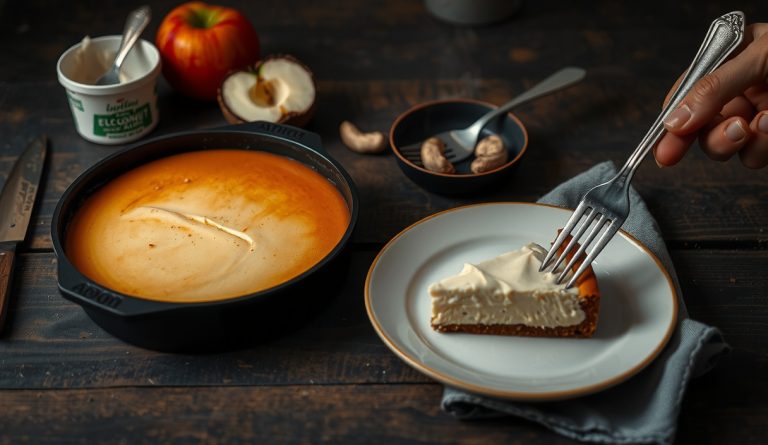
Dairy-free version: Replace the cream cheese with a fermented cashew cream cheese (soak raw cashews 8 hours, blend with 1 tablespoon apple cider vinegar and 1 tablespoon lemon juice, ferment 12 hours at room temperature). Replace sour cream with full-fat coconut cream (refrigerated overnight, solids only). The filling will be slightly less stable structurally because casein micelles are absent — pull at 145°F internal instead of 150°F. This variant is no longer strict keto due to cashew carbohydrates; it clocks at approximately 8g net carbs per slice.
Scaling up for a crowd: A 10-inch springform pan accommodates 1.5x the filling recipe but requires an additional 20 to 30 minutes of smoke time to reach the 150°F internal target. Do not attempt to scale to a 12-inch pan in a single bake — the thermal mass becomes too high and the edges will overcook before the center sets. Two 9-inch pans staged 30 minutes apart is the better production approach.
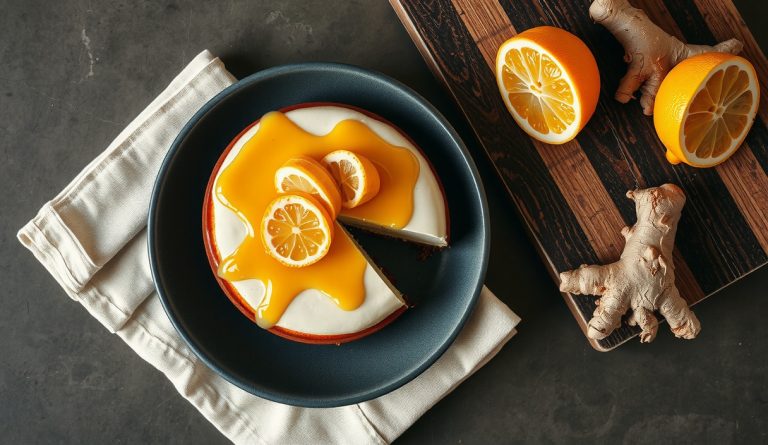
Lemon-ginger variant: Add the zest of one lemon and 1 teaspoon of fresh ginger juice to the filling before mixing. Lemon zest contributes limonene and citronellal — lipophilic terpenes that blend cleanly with cherry-smoke guaiacol. Keep the smoke exposure to 2 hours instead of 3 to prevent the citrus aromatics from being overwhelmed. Finish with a sugar-free lemon curd (erythritol-sweetened) drizzled tableside.
Frequently asked questions
Can I make this on a gas grill? Yes, using a two-zone indirect setup: one burner on low on one side, cheesecake on the opposite side with a foil pouch of cherry wood chunks directly over the lit burner. Chamber temperature control is harder on gas — use an oven thermometer inside the grill lid, not the built-in dome thermometer, which reads several degrees hot. Expect more temperature swings and a slightly lighter smoke flavor due to the less-enclosed smoke environment.
My cheesecake cracked — what went wrong? Cracks in a smoked cheesecake almost always trace to one of three causes: the filling was mixed at too high a speed (incorporating excess air that expands and tears during baking), the chamber temperature spiked above 250°F at some point during the cook, or the cheesecake was cooled too rapidly. The crack does not affect flavor or structure — cover it with a sour cream glaze (1/2 cup sour cream, 1 tablespoon powdered erythritol, vanilla, spread and return to a 325°F oven for 5 minutes) and no one will know.
Is the smoke flavor overpowering? No — three hours at 225°F with two small cherry-wood chunks delivers a second-register smoke note: you smell it before you taste it, and then it unfolds retronasally on the finish rather than announcing itself up front. Tasters who claim to dislike smoked desserts consistently enjoy this cheesecake when they do not know it has been smoked. For a more assertive smoke presence, increase to four cherry-wood chunks. For smoke that is almost imperceptible, one chunk and 90 minutes is the right setting.