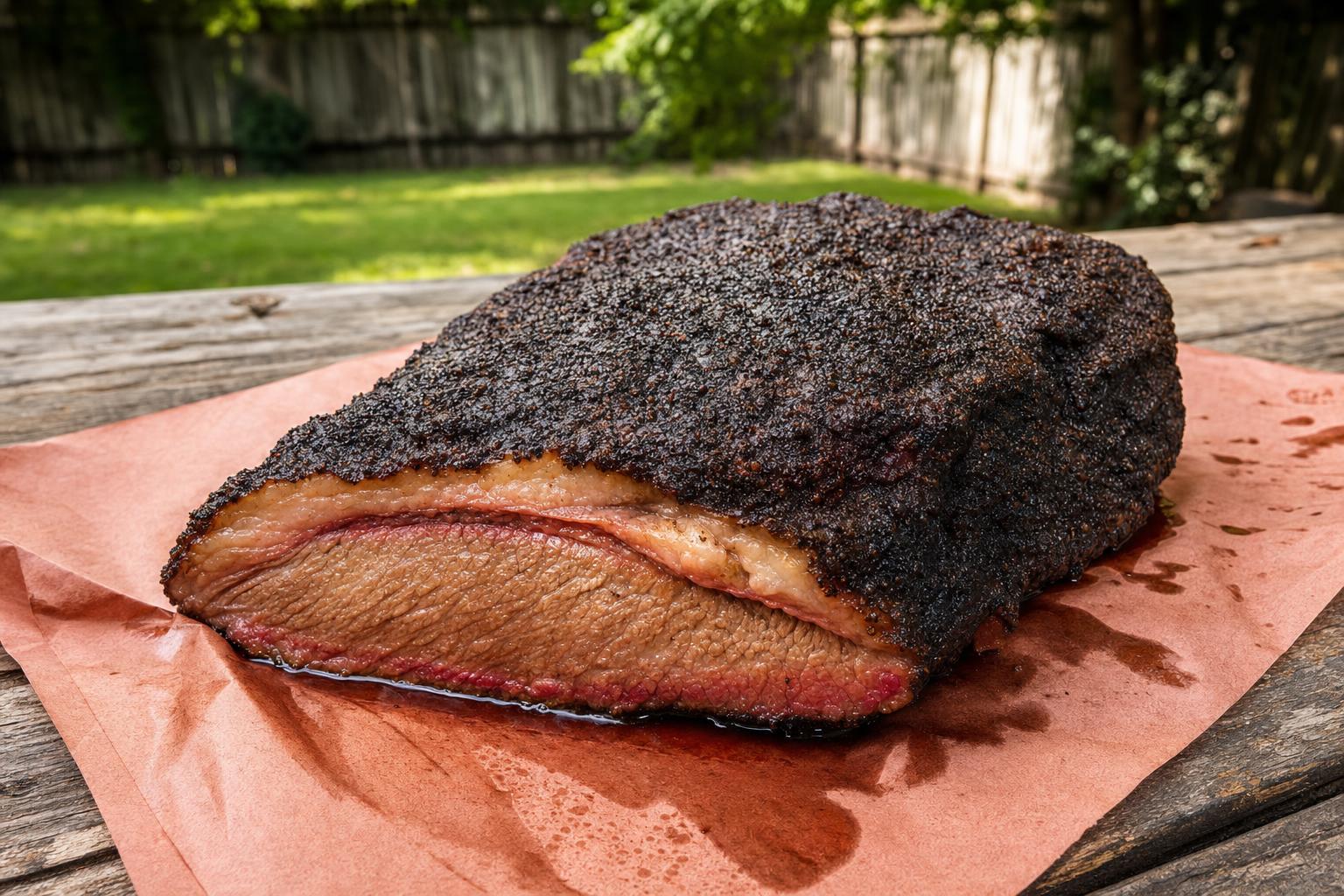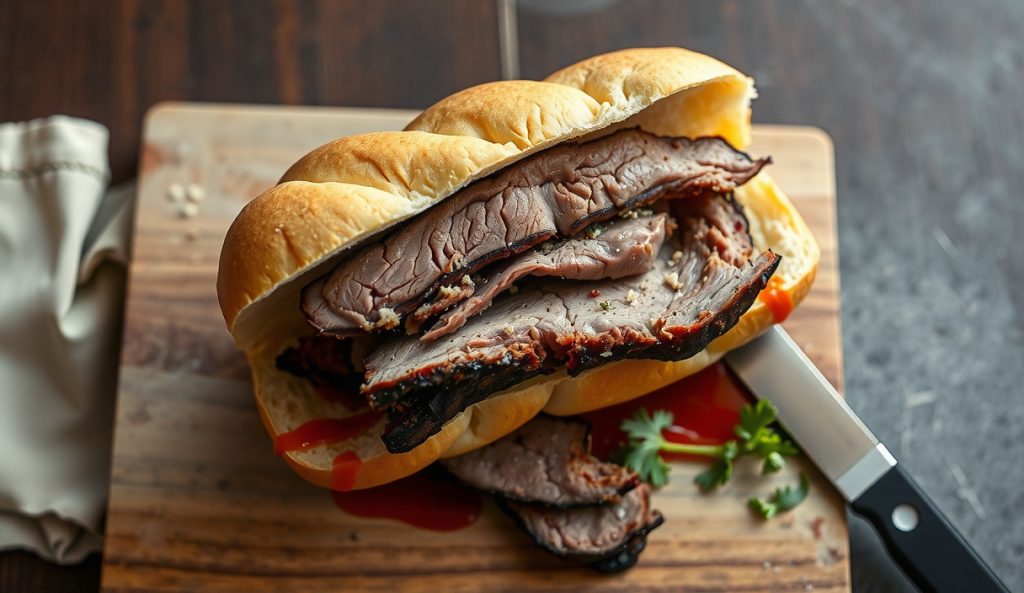
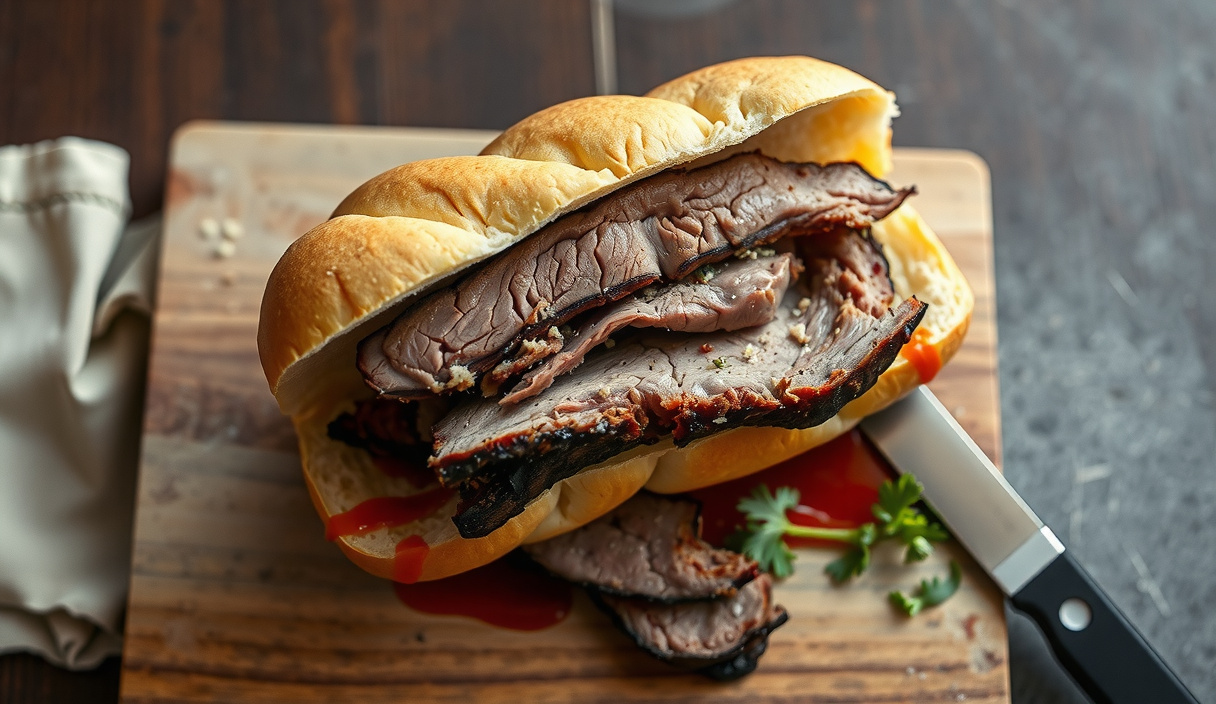
Gluten-Free Smoked Brisket Sandwich on GF Brioche
Equipment
- 1 Offset, drum, kamado, or pellet smoker Must hold 225°F–250°F steadily for 10–14 hours
- 1 Dual-probe digital thermometer One probe at grate level, one in the flat
- 1 Stand mixer with dough hook Or large bowl and wooden spoon for GF brioche
- 1 Kitchen scale Mandatory for psyllium and starch ratios
- 1 large sheet Butcher paper (unlined) For wrapping brisket during the stall — not aluminum foil
- 1 Large cooler For the 60–90 minute rest period
- 1 Baking sheet with parchment
- 1 Bench scraper For portioning and shaping GF brioche dough
- 1 Pastry brush For egg wash on buns
Ingredients
Brisket and Rub
- 12 –16 lb whole packer brisket (USDA Choice or Prime) Fat cap trimmed to 1/4 inch; both flat and point intact
- 3 tbsp coarse kosher salt
- 3 tbsp coarsely ground black pepper 16-mesh or similar coarse grind
- 1 tbsp garlic powder
- 1 tbsp smoked paprika
- 1 tsp cayenne pepper
- 1 tbsp certified GF tamari or coconut aminos Brushed lightly over brisket surface before rub application
- 4 oz post oak wood chunks or chips Soaked 30 min if chips; chunks used dry
GF Brioche Buns
- 280 g superfine white rice flour Not a pre-made GF blend containing xanthan
- 120 g tapioca starch
- 50 g potato starch
- 27 g whole-husk psyllium husk Exactly 6% of total dry flour mass (450g total); measure by weight
- 1.5 g xanthan gum 0.3% w/w of total liquid; do not increase
- 7 g instant dry yeast One standard packet
- 30 g granulated sugar
- 8 g fine sea salt
- 240 ml warm water 100°F–105°F; activates yeast and hydrates psyllium
- 120 ml warm whole milk or full-fat plant milk 105°F; adds richness and Maillard precursors
- 3 large eggs Room temperature; 2 for dough, 1 for egg wash
- 85 g unsalted butter Cold, cubed into 1/2-inch pieces; freeze 30 min before use
- 1 tsp apple cider vinegar Prevents psyllium gray discoloration by maintaining slight acidity
- 1 tbsp sesame seeds (certified GF, optional) For topping; skip if sesame is a concern
- 1 tbsp water Mixed with egg for egg wash
Assembly and Sauce
- 1 cup reserved brisket drippings Collected from the butcher paper wrap; skim excess fat
- 3 tbsp certified GF apple cider vinegar
- 2 tbsp certified GF tamari or coconut aminos
- 1 tbsp brown sugar or coconut sugar
- 1 tsp black pepper, coarsely ground
- 2 large yellow onions, thinly sliced For caramelizing
- 2 tbsp avocado oil or neutral high-heat oil
- 1 tbsp unsalted butter Added at the end of onion caramelization for gloss
- 8 leaves butter lettuce or iceberg lettuce
- 2 medium dill pickles, thinly sliced Certified GF brand; acid contrast cuts richness

Instructions
Day Before — Dry Brine and Rub
- Trim the fat cap of the packer brisket to a uniform 1/4 inch. Brush the entire surface lightly with GF tamari or coconut aminos. Combine coarse salt, coarsely ground black pepper, garlic powder, smoked paprika, and cayenne. Apply the rub liberally on all sides, pressing it firmly into the meat surface. Wrap loosely in butcher paper or plastic wrap and refrigerate uncovered for 8–12 hours (overnight). The salt draws surface moisture out, then the brine is reabsorbed, seasoning deeper layers and raising the surface water activity before the cook.3 tbsp coarse kosher salt, 3 tbsp coarsely ground black pepper, 1 tbsp garlic powder, 1 tbsp smoked paprika, 1 tsp cayenne pepper, 1 tbsp certified GF tamari or coconut aminos
Smoke the Brisket
- Remove the brisket from the refrigerator 45–60 minutes before smoking to temper the surface temperature. Meanwhile, establish your smoker at a steady 225°F–250°F with indirect heat. Place post oak wood chunks on the coals or in the wood box. The initial smoke exposure is most important — myoglobin forms a stable carboxy-myoglobin smoke ring only before the surface fully dries.4 oz post oak wood chunks or chips
- Place the brisket fat-cap-up on the grate, away from direct heat. Insert one probe into the thickest part of the flat (not the point, which cooks faster). Set a second probe at grate level 2–3 inches from the meat. Monitor both. Cook undisturbed for the first 4 hours — opening the lid drops chamber temp and stalls bark formation.
- After 4 hours, begin spot-checking the bark. You want a deep mahogany crust that does not smear when pressed with a finger. The flat internal temp will likely be in the 145°F–155°F range. Continue smoking. When the internal temp plateaus in the stall (typically 155°F–170°F for 1–3 hours), assess the bark: if it is set and deep, wrap the brisket fat-side-up in two layers of unlined butcher paper, returning it to the smoker. If you want more bark development, push through the stall unwrapped, accepting that the flat will be drier. Butcher paper is the correct call for this sandwich application — you need sliceable flat moisture.
- Continue cooking wrapped until the flat internal temperature reaches 195°F for sliceable brisket (or 203°F–205°F for pull-apart tenderness). Verify doneness by inserting the probe through the paper into the flat — it should slide in with almost no resistance, like warm butter. The point will be a few degrees warmer; that is expected. Total cook time is typically 10–14 hours depending on the size of the packer and smoker consistency.
- Remove the brisket from the smoker. Without unwrapping, place it in a dry cooler and close the lid. Rest for a minimum of 60 minutes, ideally 90 minutes. This rest allows the gelatin-water sol to partially re-gel around fiber bundles, reducing purge loss on the cutting board. Collect and reserve any drippings that accumulate in the butcher paper for the sauce.1 tsp black pepper, coarsely ground
GF Brioche Buns — Mix and First Proof
- Begin the brioche dough approximately 4–5 hours before you plan to serve (it can be baked while the brisket rests). In a large bowl or stand mixer bowl, whisk together the superfine white rice flour, tapioca starch, potato starch, whole-husk psyllium husk, xanthan gum, instant yeast, granulated sugar, and fine sea salt until evenly distributed.280 g superfine white rice flour, 120 g tapioca starch, 50 g potato starch, 27 g whole-husk psyllium husk, 1.5 g xanthan gum, 7 g instant dry yeast, 30 g granulated sugar, 8 g fine sea salt
- Combine the warm water (100°F–105°F), warm milk, 2 of the 3 eggs, and apple cider vinegar in a separate bowl. Whisk briefly. Pour the wet ingredients into the dry ingredients all at once. Mix on medium speed (or by hand with a stiff spatula) for 2 minutes until the dough comes together. The psyllium will begin absorbing liquid immediately — the dough will stiffen visibly within 60 seconds of mixing. Do not panic: this is the hydrocolloid network forming.240 ml warm water, 120 ml warm whole milk or full-fat plant milk, 3 large eggs, 1 tsp apple cider vinegar, 1 tbsp sesame seeds (certified GF, optional)
- With the mixer running on low, add the cold cubed butter piece by piece, waiting until each piece is incorporated before adding the next. The dough will look broken briefly — that is the fat disrupting the hydrocolloid surface — then come back together. Once all butter is incorporated, increase speed to medium and mix for 3 minutes. The final dough should be tacky but not wet, hold its shape when scooped, and not stick aggressively to the sides of the bowl. If it is too slack, add rice flour 1 tablespoon at a time. If it crumbles and does not hold, add warm water 1 tablespoon at a time.85 g unsalted butter
- Cover the bowl with plastic wrap or a damp towel. Proof at room temperature (70°F–75°F) for 60–75 minutes until the dough has increased noticeably in volume — GF dough will not double the way wheat dough does; a 50%–70% volume increase is correct. The psyllium network is trapping CO2 from the yeast, not gluten, so the rise will be denser and slower.
GF Brioche Buns — Shape, Second Proof, and Bake
- Preheat your oven to 375°F. Line a baking sheet with parchment paper. Lightly oil your hands and a bench scraper — do not flour the work surface; water or oil only, as rice flour makes a gummy paste on contact with wet dough. Divide the dough into 8 equal portions (approximately 120–130g each) using the bench scraper. Shape each into a smooth ball by tucking the edges underneath and rotating against the work surface. The dough is forgiving but moves fast — work with purpose.
- Place shaped buns on the prepared baking sheet, spacing them 3 inches apart. Press each gently to flatten to approximately 1 inch thick — this encourages lateral rather than vertical rise, giving a bun with better structural width for a loaded sandwich. Refrigerate the sheet for 15 minutes; cold butter resolidifies, which improves oven spring.
- Remove from refrigerator. Proof at room temperature for an additional 30–40 minutes while the oven preheats. The buns should look slightly puffed and feel light when picked up. Whisk the remaining egg with 1 tablespoon water to make egg wash. Brush generously over the top and sides of each bun. Sprinkle with certified GF sesame seeds if using.3 large eggs, 1 tbsp water, 1 cup reserved brisket drippings
- Bake at 375°F for 22–26 minutes until the tops are deep golden brown and the internal temperature of the center bun reads 190°F–195°F on an instant-read thermometer. A GF crumb that reads below 185°F will be gummy and wet; do not pull them early based on color alone. Transfer to a wire rack and cool for a minimum of 20 minutes before slicing. The crumb continues to set structurally during cooling as the starch network firms.
Pan Dripping Sauce and Caramelized Onions
- Heat avocado oil in a wide skillet over medium heat. Add sliced onions and 1/2 teaspoon of salt. Cook, stirring every 3–5 minutes, for 35–45 minutes until the onions are deeply caramelized — mahogany in color, jammy in texture. Maillard browning of the onion sugars accelerates after the first 20 minutes as moisture evaporates; resist the urge to rush with high heat, which causes burning, not browning. Add butter in the final 2 minutes for gloss. Hold warm.2 medium dill pickles, thinly sliced
- Skim the excess rendered fat from the reserved brisket drippings. In a small saucepan over medium heat, combine the skimmed drippings, GF apple cider vinegar, GF tamari, brown sugar, and coarsely ground black pepper. Simmer for 5–8 minutes, stirring occasionally, until the sauce reduces by one-third and coats a spoon. Taste and adjust salt. This sauce carries concentrated Maillard polymers and dissolved collagen from the cook — it does not need much else.1 tsp black pepper, coarsely ground, 2 large yellow onions, thinly sliced, 2 tbsp avocado oil or neutral high-heat oil, 1 tbsp unsalted butter, 8 leaves butter lettuce or iceberg lettuce
Slice the Brisket and Assemble
- Unwrap the rested brisket. Identify the seam of fat between the flat and the point. Separate them by running a long slicing knife along the fat layer. Set the point aside (or cube it for burnt ends). Identify the grain direction of the flat — the long muscle fibers run lengthwise. Rotate the flat 90 degrees and slice against the grain into 1/4-inch-thick slices. Slicing with the grain produces stringy, tough beef regardless of how well it was cooked. Slice the point separately, against its own grain direction.
- Split each GF brioche bun horizontally. Toast cut-side-down in a dry skillet over medium-high heat for 60–90 seconds until golden and slightly crisped — this seals the crumb and prevents sogginess under the juicy brisket. To assemble: spoon a tablespoon of pan dripping sauce onto the bottom bun. Layer butter lettuce, 3–4 slices of brisket (or a generous mound of point slices), a spoonful of caramelized onions, sliced pickles, and a final drizzle of sauce. Crown with the top bun and serve immediately.
Notes
Nutrition
The first time I pulled a gluten-free brioche bun off the smoker rack — baked alongside the flat while the brisket rested — I had exactly zero confidence it would hold together under a half-pound of sliced point meat. It held. Better than held: the crust crackled, the crumb stretched, and not a single slice of beef hit the plate. That bun was engineered, not baked by luck, and the engineering is the entire story.
Here at American Meathead, we treat fire as a tunable heat-transfer instrument and the cutting board as a laboratory bench. This recipe marries two bodies of science: the low-and-slow collagen hydrolysis that turns a tough packer brisket into gelatinous, pull-apart beef, and the hydrocolloid physics of gluten-free bread that replaces wheat’s viscoelastic network with something arguably more elegant. Neither half of this sandwich is a compromise. Both are the result of understanding what is actually happening at the molecular level.
Why does a gluten-free smoked brisket sandwich work? The science
Brisket becomes tender when collagen converts to gelatin — and that conversion only accelerates above 160°F internal temperature. The pectoralis muscles of a steer carry dense type-I cross-linked collagen fibrils that hold fiber bundles together under the animal’s own weight. Below 160°F those fibrils remain intact and the brisket stays tough regardless of cook time. Above 160°F, hydrolysis follows first-order kinetics: the triple-helix collagen lattice absorbs water, unravels, and converts to soluble gelatin. Processing at 203°F finishes in 8–10 hours what 180°F would require 20 hours to achieve. That dissolved gelatin re-coats every fiber bundle, creating the self-basting, sliceable-yet-moist texture that defines great brisket.
The stall — that infuriating plateau between 155°F and 170°F — is pure evaporative physics. Surface moisture absorbs the latent heat of vaporization at roughly 970 BTU/lb, matching the smoker’s energy delivery and anchoring the surface near 212°F until the bark dries. Wrapping the flat at the stall or pushing through both work, because the only variable that matters is total time above the collagen hydrolysis threshold.
The gluten-free brioche bun works because a composite hydrocolloid matrix replaces wheat’s viscoelastic network with equal mechanical precision. Conventional brioche relies on glutenin and gliadin proteins forming disulfide bridges that stretch around CO2 bubbles and hold them through oven spring. Remove wheat flour and gas escapes before the starch can set, leaving a dense, gummy puck. Psyllium husk at 6% w/w of the dry flour mass solves this: it forms a highly pseudoplastic (shear-thinning) gel in water, creating an elastic film around gas bubbles that mimics gluten’s strain-hardening under expansion pressure. Rice flour provides the starch granule backbone, with a gelatinization window of 140°F–158°F that aligns with the oven-spring window. Tapioca starch — waxy, high-amylopectin — contributes chew and extensibility while resisting rapid retrogradation. Xanthan gum at 0.3% w/w of total liquid synergizes with the psyllium, reducing the flow behavior index below 0.55 so the dough behaves like a solid at rest but flows smoothly under mixing shear. Egg yolk closes the loop: its LDL-phospholipoprotein complexes stabilize the butter-in-water emulsion, delivering brioche-characteristic richness and a golden crust.
The smoke is a Maillard amplifier operating at the bark surface. Water activity drops below 0.70 during the first 3–4 hours of the cook — the sweet spot for the Maillard cascade. Reducing sugars from the rub’s brown-sugar analog react with free amino acids via Schiff base formation, Amadori rearrangement, and Strecker degradation to generate hundreds of volatile pyrazines and furanones that define smoke-ring bark. The smoke ring itself is a myoglobin-CO interaction: carbon monoxide from incomplete combustion binds ferrous myoglobin before oxidation, locking it as the pink carboxy-myoglobin complex to a depth of roughly 5mm. The smoke ring adds zero flavor, but it signals correct low-oxygen combustion and a well-managed fire.
What equipment and ingredients do I need?
Smoker setup determines cook consistency: indirect heat capable of holding 225°F–250°F for 10–14 hours is non-negotiable. An offset, drum, kamado, or pellet grill all qualify. A reliable dual-probe thermometer is equally essential — one probe in the thickest part of the flat, one at grate level near the meat. The two readings will diverge by 25°F–50°F; always cook to internal meat temperature, never the lid gauge.
Psyllium husk quality determines crumb structure. Buy whole-husk psyllium, not the fine powder sold as a fiber supplement — the whole husk retains more of its native mucilage architecture and produces a more cohesive network. Measure by weight, not volume. At 6% w/w of the dry flour mass, the ratio is non-negotiable: too little and the buns won’t hold shape; too much and the crumb turns gummy and gray.
Superfine white rice flour produces a smoother crumb than grittier commercial GF blends. Bob’s Red Mill Super-Fine or Anthony’s both perform well here. Avoid any rice flour blend that already contains xanthan gum — precise control of the hydrocolloid ratios is critical, and pre-blended xanthan throws off the psyllium-xanthan synergy.
Tapioca starch and potato starch are not interchangeable in this formula. Tapioca is high-amylopectin and sets a chewy, extensible gel. Potato starch sets stiffer and cools to a more fragile crumb. Use tapioca as written.
Brisket selection: a full packer — both flat and point, 12–16 lbs untrimmed — gives a better bark-to-meat ratio and a deckle fat cap that bastes the flat throughout the cook. Grade up to USDA Choice or Prime; higher intramuscular fat acts as a moisture buffer when actin begins denaturing above 160°F.
The rub contains a splash of soy sauce for free glutamates and Maillard precursors. Standard soy sauce contains wheat. Use tamari labeled gluten-free or coconut aminos as a direct swap.
Gluten-Free Smoked Brisket Sandwich on GF Brioche
Equipment
- 1 Offset, drum, kamado, or pellet smoker Must hold 225°F–250°F steadily for 10–14 hours
- 1 Dual-probe digital thermometer One probe at grate level, one in the flat
- 1 Stand mixer with dough hook Or large bowl and wooden spoon for GF brioche
- 1 Kitchen scale Mandatory for psyllium and starch ratios
- 1 large sheet Butcher paper (unlined) For wrapping brisket during the stall — not aluminum foil
- 1 Large cooler For the 60–90 minute rest period
- 1 Baking sheet with parchment
- 1 Bench scraper For portioning and shaping GF brioche dough
- 1 Pastry brush For egg wash on buns
Ingredients
Brisket and Rub
- 12 –16 lb whole packer brisket (USDA Choice or Prime) Fat cap trimmed to 1/4 inch; both flat and point intact
- 3 tbsp coarse kosher salt
- 3 tbsp coarsely ground black pepper 16-mesh or similar coarse grind
- 1 tbsp garlic powder
- 1 tbsp smoked paprika
- 1 tsp cayenne pepper
- 1 tbsp certified GF tamari or coconut aminos Brushed lightly over brisket surface before rub application
- 4 oz post oak wood chunks or chips Soaked 30 min if chips; chunks used dry
GF Brioche Buns
- 280 g superfine white rice flour Not a pre-made GF blend containing xanthan
- 120 g tapioca starch
- 50 g potato starch
- 27 g whole-husk psyllium husk Exactly 6% of total dry flour mass (450g total); measure by weight
- 1.5 g xanthan gum 0.3% w/w of total liquid; do not increase
- 7 g instant dry yeast One standard packet
- 30 g granulated sugar
- 8 g fine sea salt
- 240 ml warm water 100°F–105°F; activates yeast and hydrates psyllium
- 120 ml warm whole milk or full-fat plant milk 105°F; adds richness and Maillard precursors
- 3 large eggs Room temperature; 2 for dough, 1 for egg wash
- 85 g unsalted butter Cold, cubed into 1/2-inch pieces; freeze 30 min before use
- 1 tsp apple cider vinegar Prevents psyllium gray discoloration by maintaining slight acidity
- 1 tbsp sesame seeds (certified GF, optional) For topping; skip if sesame is a concern
- 1 tbsp water Mixed with egg for egg wash
Assembly and Sauce
- 1 cup reserved brisket drippings Collected from the butcher paper wrap; skim excess fat
- 3 tbsp certified GF apple cider vinegar
- 2 tbsp certified GF tamari or coconut aminos
- 1 tbsp brown sugar or coconut sugar
- 1 tsp black pepper, coarsely ground
- 2 large yellow onions, thinly sliced For caramelizing
- 2 tbsp avocado oil or neutral high-heat oil
- 1 tbsp unsalted butter Added at the end of onion caramelization for gloss
- 8 leaves butter lettuce or iceberg lettuce
- 2 medium dill pickles, thinly sliced Certified GF brand; acid contrast cuts richness
Instructions
Day Before — Dry Brine and Rub
- Trim the fat cap of the packer brisket to a uniform 1/4 inch. Brush the entire surface lightly with GF tamari or coconut aminos. Combine coarse salt, coarsely ground black pepper, garlic powder, smoked paprika, and cayenne. Apply the rub liberally on all sides, pressing it firmly into the meat surface. Wrap loosely in butcher paper or plastic wrap and refrigerate uncovered for 8–12 hours (overnight). The salt draws surface moisture out, then the brine is reabsorbed, seasoning deeper layers and raising the surface water activity before the cook.3 tbsp coarse kosher salt, 3 tbsp coarsely ground black pepper, 1 tbsp garlic powder, 1 tbsp smoked paprika, 1 tsp cayenne pepper, 1 tbsp certified GF tamari or coconut aminos
Smoke the Brisket
- Remove the brisket from the refrigerator 45–60 minutes before smoking to temper the surface temperature. Meanwhile, establish your smoker at a steady 225°F–250°F with indirect heat. Place post oak wood chunks on the coals or in the wood box. The initial smoke exposure is most important — myoglobin forms a stable carboxy-myoglobin smoke ring only before the surface fully dries.4 oz post oak wood chunks or chips
- Place the brisket fat-cap-up on the grate, away from direct heat. Insert one probe into the thickest part of the flat (not the point, which cooks faster). Set a second probe at grate level 2–3 inches from the meat. Monitor both. Cook undisturbed for the first 4 hours — opening the lid drops chamber temp and stalls bark formation.
- After 4 hours, begin spot-checking the bark. You want a deep mahogany crust that does not smear when pressed with a finger. The flat internal temp will likely be in the 145°F–155°F range. Continue smoking. When the internal temp plateaus in the stall (typically 155°F–170°F for 1–3 hours), assess the bark: if it is set and deep, wrap the brisket fat-side-up in two layers of unlined butcher paper, returning it to the smoker. If you want more bark development, push through the stall unwrapped, accepting that the flat will be drier. Butcher paper is the correct call for this sandwich application — you need sliceable flat moisture.
- Continue cooking wrapped until the flat internal temperature reaches 195°F for sliceable brisket (or 203°F–205°F for pull-apart tenderness). Verify doneness by inserting the probe through the paper into the flat — it should slide in with almost no resistance, like warm butter. The point will be a few degrees warmer; that is expected. Total cook time is typically 10–14 hours depending on the size of the packer and smoker consistency.
- Remove the brisket from the smoker. Without unwrapping, place it in a dry cooler and close the lid. Rest for a minimum of 60 minutes, ideally 90 minutes. This rest allows the gelatin-water sol to partially re-gel around fiber bundles, reducing purge loss on the cutting board. Collect and reserve any drippings that accumulate in the butcher paper for the sauce.1 tsp black pepper, coarsely ground
GF Brioche Buns — Mix and First Proof
- Begin the brioche dough approximately 4–5 hours before you plan to serve (it can be baked while the brisket rests). In a large bowl or stand mixer bowl, whisk together the superfine white rice flour, tapioca starch, potato starch, whole-husk psyllium husk, xanthan gum, instant yeast, granulated sugar, and fine sea salt until evenly distributed.280 g superfine white rice flour, 120 g tapioca starch, 50 g potato starch, 27 g whole-husk psyllium husk, 1.5 g xanthan gum, 7 g instant dry yeast, 30 g granulated sugar, 8 g fine sea salt
- Combine the warm water (100°F–105°F), warm milk, 2 of the 3 eggs, and apple cider vinegar in a separate bowl. Whisk briefly. Pour the wet ingredients into the dry ingredients all at once. Mix on medium speed (or by hand with a stiff spatula) for 2 minutes until the dough comes together. The psyllium will begin absorbing liquid immediately — the dough will stiffen visibly within 60 seconds of mixing. Do not panic: this is the hydrocolloid network forming.240 ml warm water, 120 ml warm whole milk or full-fat plant milk, 3 large eggs, 1 tsp apple cider vinegar, 1 tbsp sesame seeds (certified GF, optional)
- With the mixer running on low, add the cold cubed butter piece by piece, waiting until each piece is incorporated before adding the next. The dough will look broken briefly — that is the fat disrupting the hydrocolloid surface — then come back together. Once all butter is incorporated, increase speed to medium and mix for 3 minutes. The final dough should be tacky but not wet, hold its shape when scooped, and not stick aggressively to the sides of the bowl. If it is too slack, add rice flour 1 tablespoon at a time. If it crumbles and does not hold, add warm water 1 tablespoon at a time.85 g unsalted butter
- Cover the bowl with plastic wrap or a damp towel. Proof at room temperature (70°F–75°F) for 60–75 minutes until the dough has increased noticeably in volume — GF dough will not double the way wheat dough does; a 50%–70% volume increase is correct. The psyllium network is trapping CO2 from the yeast, not gluten, so the rise will be denser and slower.
GF Brioche Buns — Shape, Second Proof, and Bake
- Preheat your oven to 375°F. Line a baking sheet with parchment paper. Lightly oil your hands and a bench scraper — do not flour the work surface; water or oil only, as rice flour makes a gummy paste on contact with wet dough. Divide the dough into 8 equal portions (approximately 120–130g each) using the bench scraper. Shape each into a smooth ball by tucking the edges underneath and rotating against the work surface. The dough is forgiving but moves fast — work with purpose.
- Place shaped buns on the prepared baking sheet, spacing them 3 inches apart. Press each gently to flatten to approximately 1 inch thick — this encourages lateral rather than vertical rise, giving a bun with better structural width for a loaded sandwich. Refrigerate the sheet for 15 minutes; cold butter resolidifies, which improves oven spring.
- Remove from refrigerator. Proof at room temperature for an additional 30–40 minutes while the oven preheats. The buns should look slightly puffed and feel light when picked up. Whisk the remaining egg with 1 tablespoon water to make egg wash. Brush generously over the top and sides of each bun. Sprinkle with certified GF sesame seeds if using.3 large eggs, 1 tbsp water, 1 cup reserved brisket drippings
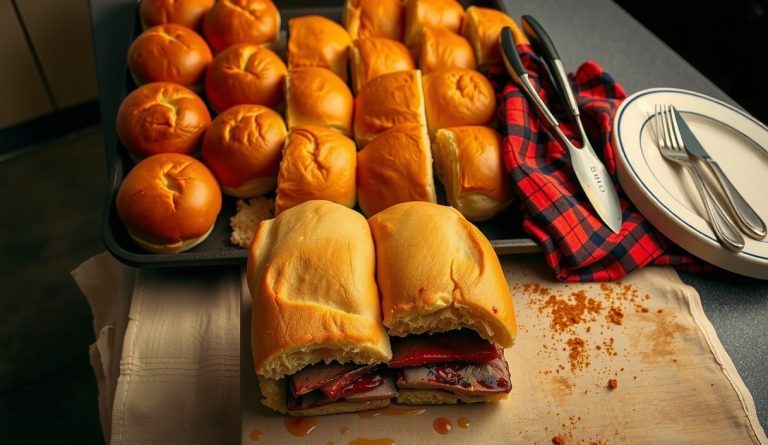
- Bake at 375°F for 22–26 minutes until the tops are deep golden brown and the internal temperature of the center bun reads 190°F–195°F on an instant-read thermometer. A GF crumb that reads below 185°F will be gummy and wet; do not pull them early based on color alone. Transfer to a wire rack and cool for a minimum of 20 minutes before slicing. The crumb continues to set structurally during cooling as the starch network firms.
Pan Dripping Sauce and Caramelized Onions
- Heat avocado oil in a wide skillet over medium heat. Add sliced onions and 1/2 teaspoon of salt. Cook, stirring every 3–5 minutes, for 35–45 minutes until the onions are deeply caramelized — mahogany in color, jammy in texture. Maillard browning of the onion sugars accelerates after the first 20 minutes as moisture evaporates; resist the urge to rush with high heat, which causes burning, not browning. Add butter in the final 2 minutes for gloss. Hold warm.2 medium dill pickles, thinly sliced
- Skim the excess rendered fat from the reserved brisket drippings. In a small saucepan over medium heat, combine the skimmed drippings, GF apple cider vinegar, GF tamari, brown sugar, and coarsely ground black pepper. Simmer for 5–8 minutes, stirring occasionally, until the sauce reduces by one-third and coats a spoon. Taste and adjust salt. This sauce carries concentrated Maillard polymers and dissolved collagen from the cook — it does not need much else.1 tsp black pepper, coarsely ground, 2 large yellow onions, thinly sliced, 2 tbsp avocado oil or neutral high-heat oil, 1 tbsp unsalted butter, 8 leaves butter lettuce or iceberg lettuce
Slice the Brisket and Assemble
- Unwrap the rested brisket. Identify the seam of fat between the flat and the point. Separate them by running a long slicing knife along the fat layer. Set the point aside (or cube it for burnt ends). Identify the grain direction of the flat — the long muscle fibers run lengthwise. Rotate the flat 90 degrees and slice against the grain into 1/4-inch-thick slices. Slicing with the grain produces stringy, tough beef regardless of how well it was cooked. Slice the point separately, against its own grain direction.
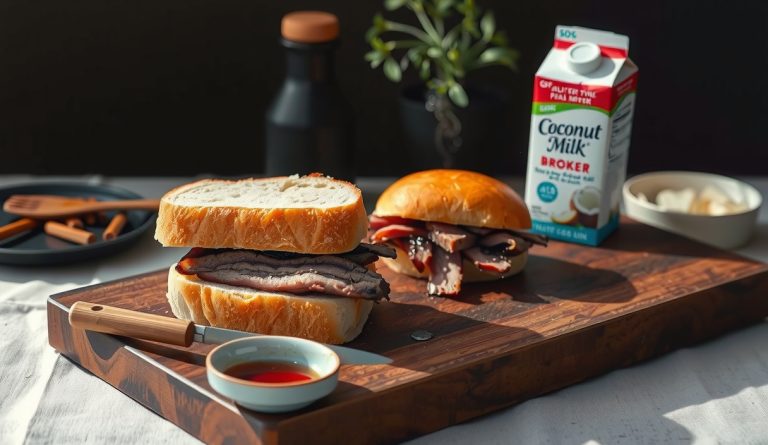
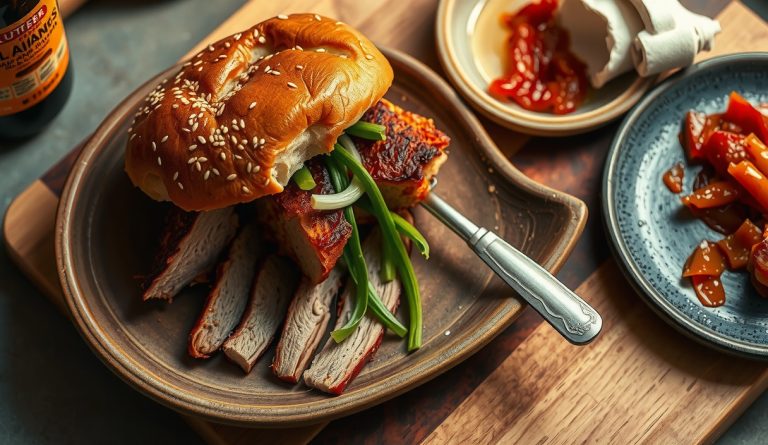
- Split each GF brioche bun horizontally. Toast cut-side-down in a dry skillet over medium-high heat for 60–90 seconds until golden and slightly crisped — this seals the crumb and prevents sogginess under the juicy brisket. To assemble: spoon a tablespoon of pan dripping sauce onto the bottom bun. Layer butter lettuce, 3–4 slices of brisket (or a generous mound of point slices), a spoonful of caramelized onions, sliced pickles, and a final drizzle of sauce. Crown with the top bun and serve immediately.
Notes
Nutrition
How do I nail it every time?
- Cold butter, fast shaping. GF brioche dough warms fast and loses structure above 75°F. Cube and freeze the butter 30 minutes before mixing, work quickly after shaping, and refrigerate the shaped buns for 15 minutes before the final proof. A warm dough will spread instead of rising, collapsing the psyllium gas network before the oven can set it.
- Never skip the internal temp on brisket. The stall can fool you — the probe may read 165°F for 3 hours straight. Probe drag (resistance when inserting) is the best tactile check: at 195°F the flat probes like soft butter through the deckle; at 203°F–205°F the point probes the same way. Pull the flat at 195°F for clean slices, or at 203°F+ for pull-apart or chopped brisket.
- Rest is non-negotiable. Collagen hydrolysis produces a gelatin-water sol that is still mobile at 200°F. A 60–90 minute rest — wrapped in butcher paper, inside a cooler — allows that sol to partially re-gel around the fiber bundles. Skip the rest and the brisket will lose 15%–20% of its cook weight to purge on the cutting board.
- Hydration is the largest GF baking variable. Ambient humidity changes how aggressively psyllium swells. If the dough looks shaggy and tears during shaping, add warm water 1 tablespoon at a time. If it looks slack and spreads before proofing, the dough is over-hydrated — add 1 tablespoon of rice flour and allow 5 minutes for the psyllium to redistribute moisture.
- Smoke wood selection shifts the flavor register. Post oak is the Central Texas default — medium smoke, no sweetness. Cherry adds fruity top notes and darkens bark color dramatically. Hickory is aggressive; blend it 2:1 with post oak to avoid a medicinal aftertaste. Avoid mesquite on a 10-hour cook — its combustion chemistry generates phenols that concentrate to an acrid level over extended low-and-slow sessions.
- Slice against the grain and against the two-grain problem. The flat and point have perpendicular grain directions. The flat runs front-to-back; the point runs diagonally. Separate them at the fat seam and slice each independently against its own grain for maximum tenderness.
What variations can I make to this recipe?
Dairy-free version: Replace the unsalted butter in the brioche with refined coconut oil (solid state, not melted) and substitute the egg wash with a 1:1 blend of full-fat coconut milk and maple syrup. The brioche will be slightly less rich and the crumb a little tighter — coconut oil’s saturated fatty acid profile sets a stiffer crystal lattice than dairy butter — but the psyllium network compensates adequately. The brisket and sauce components are already dairy-free.
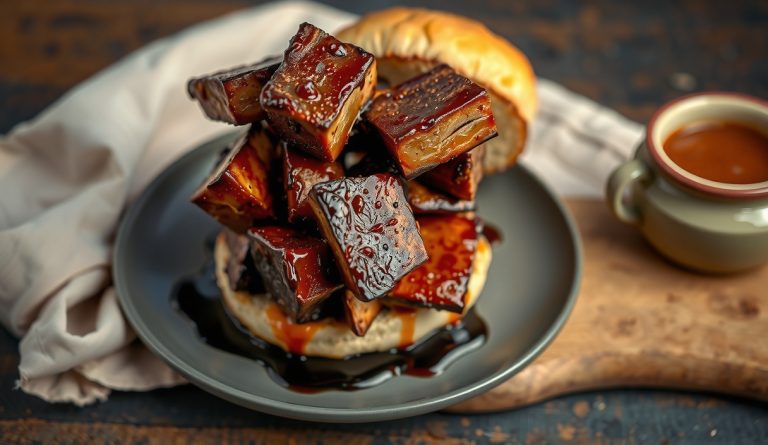
Smoked brisket burnt ends (point only): Separate the point after the initial smoke and the rest period. Cube the point into 1.5-inch pieces, toss with additional GF BBQ sauce and a tablespoon of brown sugar, and return to the smoker at 275°F uncovered for 60–90 minutes until the surface lacquers and the fat renders fully. Pile the burnt ends on the GF brioche instead of sliced flat. The higher fat content of the point means the burnt ends tolerate additional heat without drying out — the actin is already denatured and the extra collagen gelatin acts as a moisture reserve.
Scaling up: The brioche formula scales linearly — double or triple all bun ingredients while maintaining the 6% psyllium ratio. Baking time stays the same; the doneness marker for the buns is still 190°F–195°F internal crumb temperature. For the brisket, a second full packer requires no adjustment to timing or temperature — just ensure the smoker can maintain consistent airflow around both pieces. Stagger them if the grate is cramped; the dripping fat cap from the top piece will baste the lower one, which is beneficial for the flat.
Regional rub swap — Korean-inflected: Replace the black-pepper-heavy Texas rub with equal parts gochugaru, toasted sesame seeds (check GF compliance), fine sea salt, garlic powder, and a tablespoon of coconut aminos brushed over the surface. The gochugaru contains capsaicin, which activates TRPV1 thermoreceptors and amplifies the perception of warmth from the smoke. The sesame seeds contribute Strecker-derived 2-acetylpyrazine via the Maillard reaction at bark temperatures, adding a roasted, nutty top note that pairs unexpectedly well with the brisket’s rendered fat.
Frequently asked questions
Can I make the brioche buns a day ahead? Yes — and the buns actually benefit from it. Bake the buns fully, cool to room temperature, then wrap tightly and store at room temperature overnight. The psyllium-starch network continues to redistribute moisture for 12–18 hours post-bake, resulting in a slightly more cohesive, less crumbly crumb the next day. Do not refrigerate the buns — cold accelerates amylopectin retrogradation, hardening the crumb irreversibly. For longer storage, freeze immediately after cooling, then thaw at room temperature and toast split-side-down in a dry skillet before loading with brisket.
My brisket is at 165°F after 6 hours and the bark looks great — can I skip the wrap? Skipping the wrap is possible, but the tradeoff is real. An unwrapped (naked) brisket continues losing surface moisture, which deepens bark development but risks desiccating the flat as actin denaturation accelerates above 170°F. If the smoker holds tightly at 225°F and the flat is well-marbled, naked is viable. If the flat is lean or the smoker runs hot, wrap in unlined butcher paper — not foil, which traps too much steam and softens the bark — once the internal temperature plateaus in the stall. The paper allows vapor exchange, maintaining bark texture while protecting the flat.
Why did my GF buns turn gray-purple on the inside? The gray-purple tint is the psyllium husk reacting with alkaline ingredients or overhydration. The discoloration is purely cosmetic and the flavor is unaffected. To prevent it: use a slightly acidic liquid (buttermilk, or 1 teaspoon of apple cider vinegar added to the warm water), ensure the baking powder is fresh and aluminum-free, and do not overmix once the psyllium has gelled. The gray tint intensifies with extended mixing time because mechanical shear oxidizes the surface of the hydrocolloid gel.