Plant-Based Smoked Tofu — Pressed and Spiced

Equipment
- 1 Tofu press or heavy plate with weights Spring-tension tofu press preferred for consistent pressure; DIY stack of heavy books on a sheet pan with layered paper towels works equally well.
- 1 Kitchen scale Essential for verifying the pressed weight target of 315–335g from a 454g starting block.
- 1 Smoker (charcoal, pellet, or electric) Capable of holding 225°F at grate level. Measure with a dedicated grate-level probe — lid thermometers are unreliable.
- 1 Wire cooling rack Used for the pre-smoke surface-drying rest and optionally for smoking to allow airflow under the block.
- 1 Sheet pan
- 1 Zip-lock bag or shallow airtight container For marinating; a zip-lock allows you to massage the marinade into all surfaces without excess liquid waste.
- 1 Instant-read thermometer For verifying grate temperature and optionally checking internal tofu temperature (target: no more than 155–160°F internally).
- 2-3 Apple or cherry wood chunks or chips Chunks for charcoal; chips (pre-soaked 30 min) or pellets for electric/pellet smokers. Avoid heavy woods like mesquite for tofu.
Ingredients
Tofu
- 1 block (16 oz / 454g) extra-firm tofu, water-packed Calcium-sulfate coagulated preferred. Do not use silken or firm — only extra-firm withstands 4 hours of pressing without structural collapse.
Marinade
- 3 tbsp soy sauce Use tamari for certified gluten-free. Low-sodium soy sauce is acceptable but reduces surface amino acid delivery — compensate by adding a pinch of MSG or nutritional yeast.
- 2 tbsp pure maple syrup, Grade A Dark Dark Grade A (formerly Grade B) has higher reducing sugar concentration and stronger maple aroma than lighter grades.
- 1.5 tsp smoked paprika Spanish-style hot or sweet — both work. Hot adds a mild capsaicin heat. Sweet is more universally crowd-pleasing.
- 1 tsp liquid smoke Use a clean product with only water and natural smoke flavor listed — no caramel color, no added salt. Wright’s and Colgin are reliable.
- 1 tsp ground cumin
- 0.5 tsp garlic powder
- 0.5 tsp onion powder
- 0.25 tsp black pepper, freshly ground
- 1 tbsp avocado oil or neutral-flavored oil Helps the marinade coat the surface and provides the lipid phase for fat-soluble paprika carotenoids and cumin terpenoids to partition into.

Instructions
Press the Tofu
- Remove the tofu from its packaging and drain. Weigh the block and record the starting weight — this is your baseline. For a standard 454g block, your target pressed weight is 315–335g (approximately 70% of starting mass).
- Wrap the tofu block in 3–4 layers of paper towels or a clean kitchen towel. Place it in a tofu press or on a flat plate, and apply steady weight on top — a second plate loaded with heavy cans or books works well. Press for a minimum of 4 hours at room temperature, changing the paper towels every 45–60 minutes to prevent re-absorption of expelled liquid.
- After pressing, weigh the block again. If it is still above 340g, apply fresh towels and additional weight for another 30–60 minutes. Do not proceed until the target weight is reached — this is the most important quality checkpoint in the recipe.
- Pat the pressed block completely dry with paper towels. Remove any visible surface moisture. Optionally, slice the block into two equal slabs horizontally (cutting parallel to the larger flat face) to double the exposed surface area — this accelerates marinade penetration and increases the bark-to-interior ratio.
Make and Apply the Marinade
- In a small bowl or measuring cup, whisk together the soy sauce, maple syrup, smoked paprika, liquid smoke, ground cumin, garlic powder, onion powder, black pepper, and avocado oil until fully combined.2 tbsp pure maple syrup, Grade A Dark, 1.5 tsp smoked paprika, 1 tsp liquid smoke, 1 tsp ground cumin, 0.5 tsp garlic powder, 0.5 tsp onion powder, 0.25 tsp black pepper, freshly ground, 1 tbsp avocado oil or neutral-flavored oil
- Place the pressed tofu into a zip-lock bag or shallow airtight container. Pour the marinade over the tofu. Seal and massage the marinade into all surfaces. Lay the bag flat so the tofu is in full contact with the liquid on both sides.2 tbsp pure maple syrup, Grade A Dark, 1.5 tsp smoked paprika, 1 tsp liquid smoke, 1 tsp ground cumin, 0.5 tsp garlic powder, 0.5 tsp onion powder, 0.25 tsp black pepper, freshly ground, 1 tbsp avocado oil or neutral-flavored oil
- Marinate for at least 2 hours in the refrigerator — overnight (8–12 hours) is strongly preferred. The marinade penetrates via diffusion; time is the only lever. Flip the bag once at the halfway point to ensure even coating.
Pre-Smoke Rest
- Remove the tofu from the marinade and place it on a wire rack set over a sheet pan. Do not pat it dry at this stage — you want the marinade coating intact. Let it rest uncovered at room temperature for 20 minutes. This drives off surface liquid and drops the boundary-layer water activity before smoke exposure, accelerating bark formation once the tofu hits the smoker.
Smoke
- Preheat your smoker to 225°F (107°C) measured at grate level. Add 2–3 apple or cherry wood chunks (or an equivalent of soaked chips or pellets). Allow the smoker to reach temperature and the initial heavy white smoke to clear — you want thin blue smoke, not billowing white smoke, before loading the tofu.
- Place the tofu directly on the smoker grate, or on the wire rack over a sheet pan if you prefer easy removal. Position pieces with at least 1.5 inches of space between them for airflow. Close the smoker lid and do not open it for the first 50 minutes.
- After 50 minutes, check the underside of the tofu with a thin spatula. It should release cleanly with no tearing — if it sticks, the bark has not yet set. Do not force it. Give it another 10 minutes and check again. Once the bottom surface releases cleanly and shows a deep mahogany crust, flip the tofu gently.
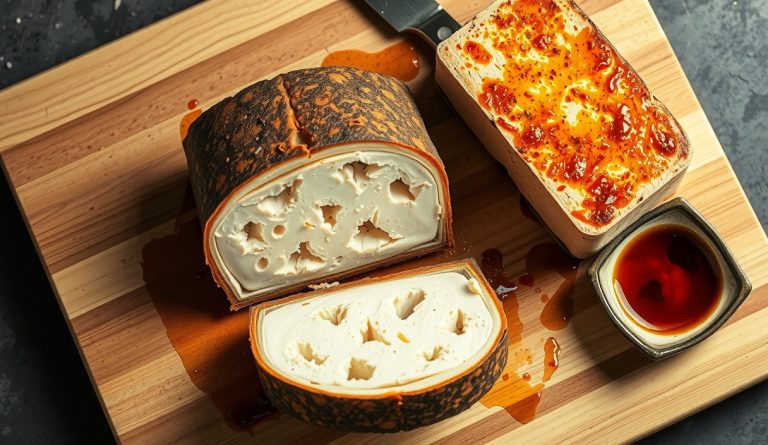
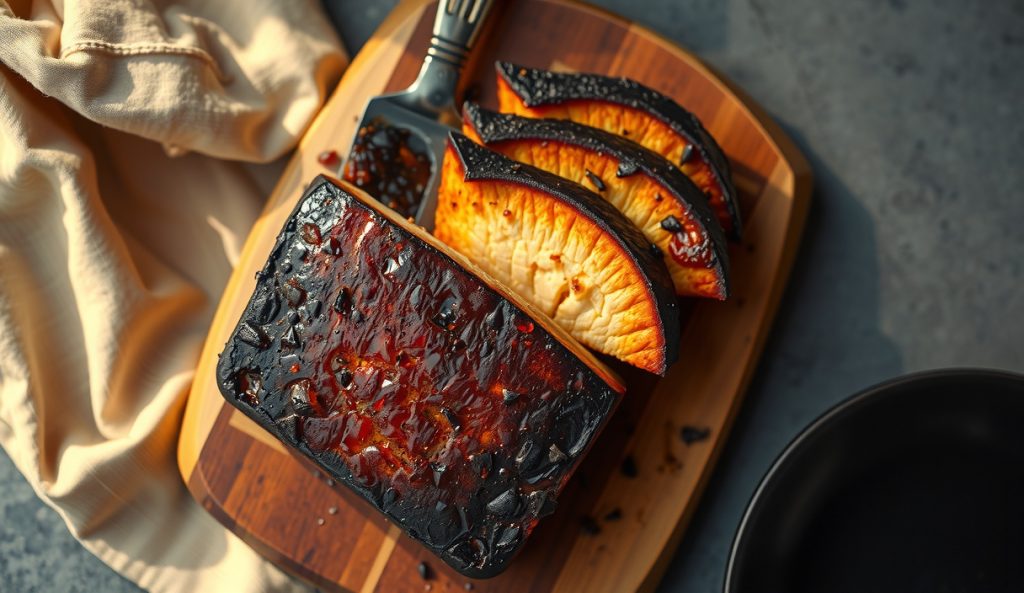
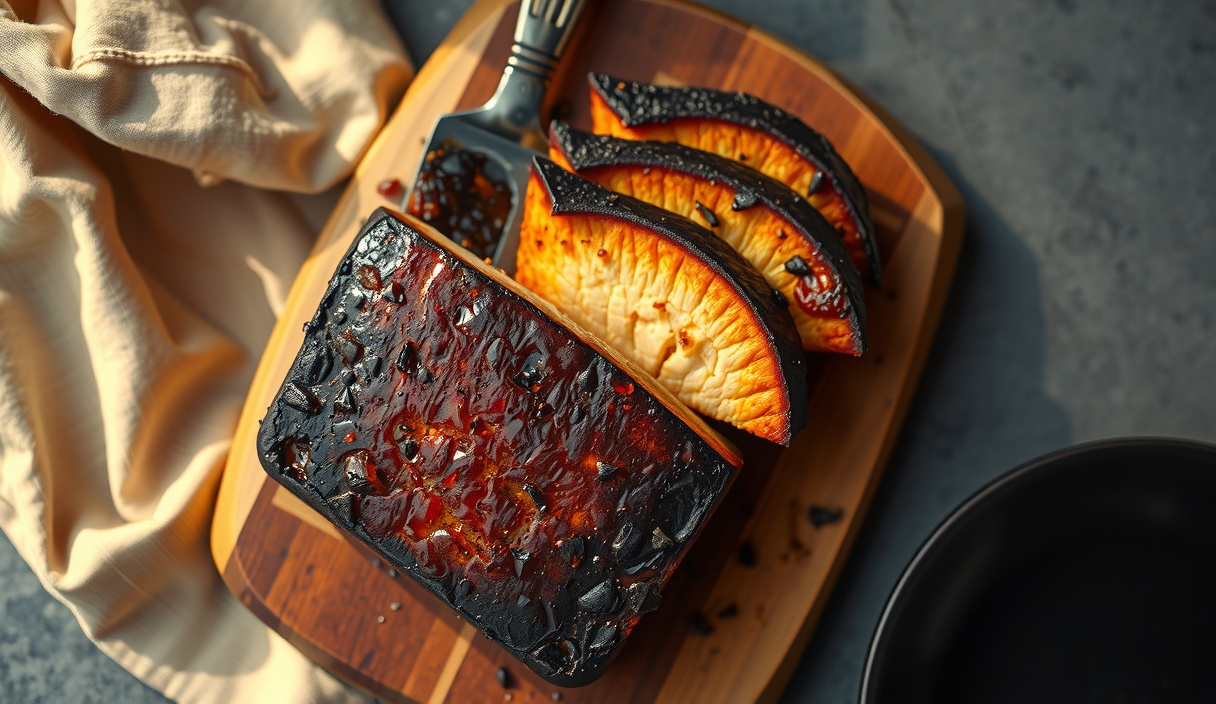
- Continue smoking for the remaining 30–40 minutes (total cook time: 90 minutes) until both sides carry a dark, dry, slightly tacky bark. The internal temperature of the tofu should read 145–155°F — do not let it exceed 165°F or the interior soy protein will begin to over-aggregate and turn chalky.
Rest and Serve
- Remove the tofu from the smoker and place it on the wire rack. Rest for 10 minutes uncovered before slicing. The bark firms as it cools and the interior temperature equilibrates — cutting immediately causes the crust to shatter and the interior to compress.
- Slice with a sharp knife into planks, cubes, or strips depending on your intended use. Serve immediately, or cool completely and refrigerate for up to 5 days. The bark continues to firm overnight and the smoke flavor deepens — slices cut cold are exceptionally clean.
Notes
Nutrition
The first time I pressed a block of extra-firm tofu and held it over live smoke, I stopped thinking about it as a protein substitute. It became its own thing entirely — a dense, chewy slab with a bark-like exterior and a custardy interior that pulled apart in satisfying ribbons. The transformation is entirely mechanical and thermal, and once you understand the physics driving it, you can reproduce it precisely every single time.
Most home cooks press tofu for twenty minutes and call it done. That is not pressing — that is patting. To achieve the structural density that makes smoked tofu genuinely satisfying, you need four hours of steady mechanical compression targeting a final water mass of roughly 70% of the block’s starting weight. That single decision — real pressing — is what separates a spongy, marinade-repelling block from a dense protein matrix that browns aggressively and holds texture through ninety minutes of live fire.
Why does smoked tofu work? The science behind pressing and bark formation
Smoked tofu develops its bark and satisfying bite because sustained mechanical pressing drops the block’s water activity low enough to ignite the Maillard reaction rapidly under moderate heat. Tofu is a calcium- or magnesium-coagulated soy protein hydrogel — extra-firm tofu still contains roughly 82–85% water by mass. Pressing applies mechanical stress to that gel network, forcing interstitial water out through syneresis, the same expulsion phenomenon seen in an over-crosslinked alginate or a poorly managed casein gel.
Syneresis is not linear: the first 20 minutes of pressing removes surface water quickly, but deep structural dehydration requires sustained, moderate pressure over several hours. Targeting a final water content of roughly 70% of the original block weight means removing approximately 12–15% of total mass as expelled liquid — enough to convert a slack, porous gel into a dense, almost meat-like matrix with dramatically reduced surface water activity (a_w). That low surface a_w is what allows the Maillard reaction to ignite quickly during smoking.
The marinade does two things simultaneously. Soy sauce delivers free amino acids — glutamic acid, lysine, leucine — directly to the surface of the compressed protein matrix, flooding it with Maillard reactants. The maple syrup provides reducing sugars (glucose and fructose) that intercept the activation barrier for the Maillard cascade at significantly lower temperatures than sucrose, which is why surface color begins developing well before 250°F. Smoked paprika contributes fat-soluble carotenoid pigments that reinforce the visual depth of browning, and liquid smoke is a controlled delivery of guaiacol and syringol — the same phenolic compounds produced by genuine wood combustion — which adsorb onto the protein surface and bind into the melanoidin matrix forming during the cook. Cumin adds terpenoid volatiles (cuminaldehyde) that partition into the surface lipid fraction and release slowly through the smoke session, providing aromatic persistence.
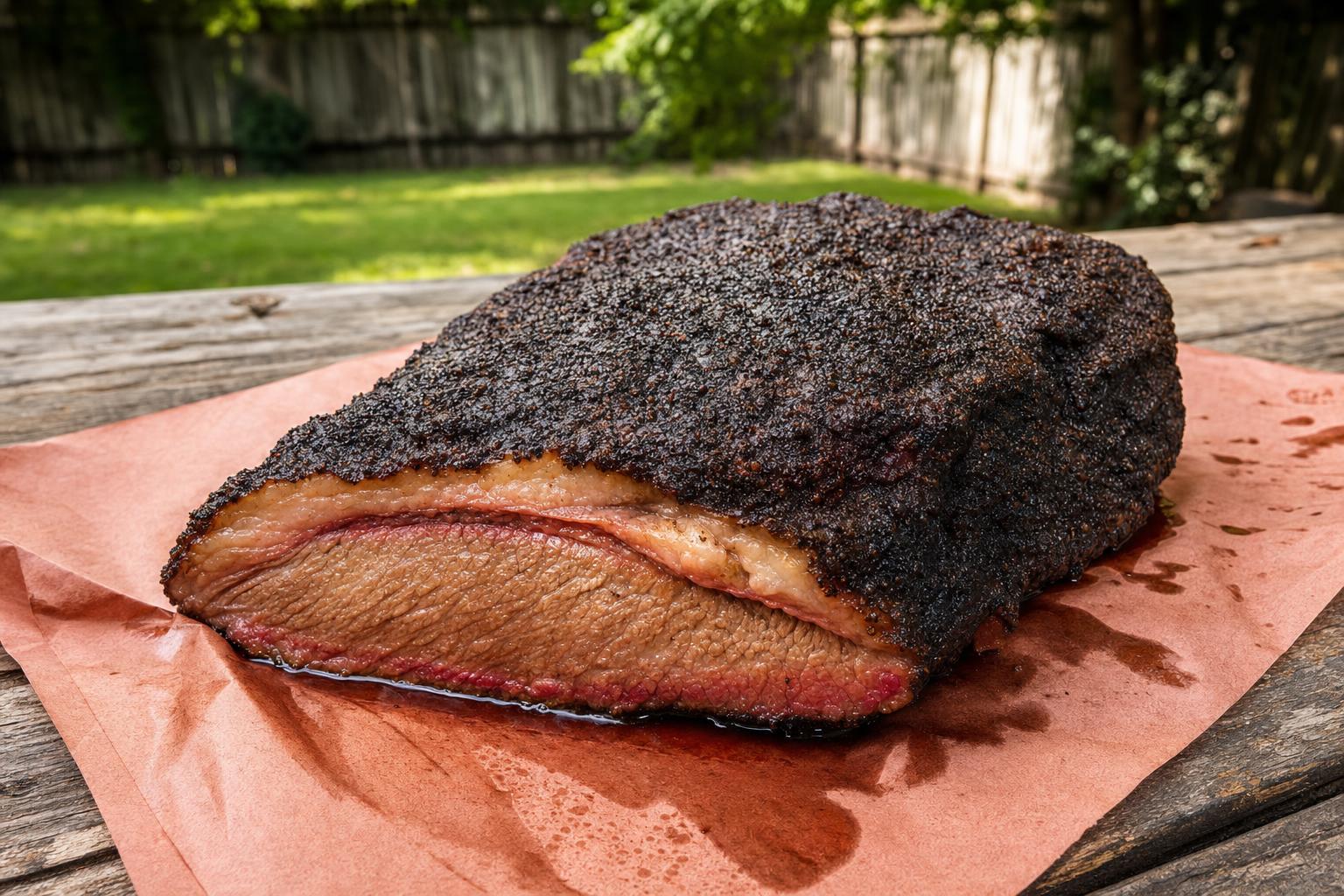
At 225°F (107°C), the smoker operates in a deliberate sweet spot: surface water continues to evaporate, maintaining low local a_w at the boundary layer and sustaining Maillard kinetics, while the interior stays below the 160°F threshold where soy protein begins catastrophic aggregation and the tofu would turn chalky and hard. The extended 90-minute cook at this conservative setpoint prioritizes deep smoke penetration and full surface bark formation without overcooking the interior gel. This is the same logic pitmasters apply to low-and-slow collagen hydrolysis in brisket: patience at a controlled temperature beats high heat and ruined texture every time.
What equipment and ingredients do I actually need?
- Tofu block weight: Buy a 16 oz (454g) block of extra-firm tofu packed in water. After 4 hours of pressing you are targeting a final pressed weight of roughly 320–330g. Weigh it — this is the single most objective quality check in the recipe.
- Pressing rig: A tofu press with a spring mechanism gives consistent, calibrated pressure. A DIY stack of heavy books on a sheet pan with paper towels works fine — change the towels every 30–45 minutes to prevent re-absorption.
- Smoker temperature management: Use an ambient probe at grate level. The 225°F setpoint must be at grate, not lid. A 30°F error here changes the surface dehydration rate significantly.
- Wood choice: Apple or cherry wood delivers a mild, slightly sweet smoke that does not overwhelm the soy-maple marinade. Hickory works but is aggressive — use half the quantity.
- Liquid smoke: Use a clean, no-additive product — water and natural smoke flavor only. Wright’s and Colgin are reliable. Cheap versions add caramel color and salt that throw off the marinade balance.
- Soy sauce vs tamari: Standard soy sauce is fine. For a certified gluten-free version, substitute tamari 1:1. The sodium and free amino acid content is comparable.
- Maple syrup grade: Grade A Dark (formerly Grade B) has a more pronounced maple flavor and higher reducing sugar concentration — use it. Grade A Light works but delivers less aromatic depth.
Plant-Based Smoked Tofu — Pressed and Spiced
Equipment
- 1 Tofu press or heavy plate with weights Spring-tension tofu press preferred for consistent pressure; DIY stack of heavy books on a sheet pan with layered paper towels works equally well.
- 1 Kitchen scale Essential for verifying the pressed weight target of 315–335g from a 454g starting block.
- 1 Smoker (charcoal, pellet, or electric) Capable of holding 225°F at grate level. Measure with a dedicated grate-level probe — lid thermometers are unreliable.
- 1 Wire cooling rack Used for the pre-smoke surface-drying rest and optionally for smoking to allow airflow under the block.
- 1 Sheet pan
- 1 Zip-lock bag or shallow airtight container For marinating; a zip-lock allows you to massage the marinade into all surfaces without excess liquid waste.
- 1 Instant-read thermometer For verifying grate temperature and optionally checking internal tofu temperature (target: no more than 155–160°F internally).
- 2-3 Apple or cherry wood chunks or chips Chunks for charcoal; chips (pre-soaked 30 min) or pellets for electric/pellet smokers. Avoid heavy woods like mesquite for tofu.
Ingredients
Tofu
- 1 block (16 oz / 454g) extra-firm tofu, water-packed Calcium-sulfate coagulated preferred. Do not use silken or firm — only extra-firm withstands 4 hours of pressing without structural collapse.
Marinade
- 3 tbsp soy sauce Use tamari for certified gluten-free. Low-sodium soy sauce is acceptable but reduces surface amino acid delivery — compensate by adding a pinch of MSG or nutritional yeast.
- 2 tbsp pure maple syrup, Grade A Dark Dark Grade A (formerly Grade B) has higher reducing sugar concentration and stronger maple aroma than lighter grades.
- 1.5 tsp smoked paprika Spanish-style hot or sweet — both work. Hot adds a mild capsaicin heat. Sweet is more universally crowd-pleasing.
- 1 tsp liquid smoke Use a clean product with only water and natural smoke flavor listed — no caramel color, no added salt. Wright’s and Colgin are reliable.
- 1 tsp ground cumin
- 0.5 tsp garlic powder
- 0.5 tsp onion powder
- 0.25 tsp black pepper, freshly ground
- 1 tbsp avocado oil or neutral-flavored oil Helps the marinade coat the surface and provides the lipid phase for fat-soluble paprika carotenoids and cumin terpenoids to partition into.
Instructions
Press the Tofu
- Remove the tofu from its packaging and drain. Weigh the block and record the starting weight — this is your baseline. For a standard 454g block, your target pressed weight is 315–335g (approximately 70% of starting mass).
- Wrap the tofu block in 3–4 layers of paper towels or a clean kitchen towel. Place it in a tofu press or on a flat plate, and apply steady weight on top — a second plate loaded with heavy cans or books works well. Press for a minimum of 4 hours at room temperature, changing the paper towels every 45–60 minutes to prevent re-absorption of expelled liquid.
- After pressing, weigh the block again. If it is still above 340g, apply fresh towels and additional weight for another 30–60 minutes. Do not proceed until the target weight is reached — this is the most important quality checkpoint in the recipe.
- Pat the pressed block completely dry with paper towels. Remove any visible surface moisture. Optionally, slice the block into two equal slabs horizontally (cutting parallel to the larger flat face) to double the exposed surface area — this accelerates marinade penetration and increases the bark-to-interior ratio.
Make and Apply the Marinade
- In a small bowl or measuring cup, whisk together the soy sauce, maple syrup, smoked paprika, liquid smoke, ground cumin, garlic powder, onion powder, black pepper, and avocado oil until fully combined.2 tbsp pure maple syrup, Grade A Dark, 1.5 tsp smoked paprika, 1 tsp liquid smoke, 1 tsp ground cumin, 0.5 tsp garlic powder, 0.5 tsp onion powder, 0.25 tsp black pepper, freshly ground, 1 tbsp avocado oil or neutral-flavored oil
- Place the pressed tofu into a zip-lock bag or shallow airtight container. Pour the marinade over the tofu. Seal and massage the marinade into all surfaces. Lay the bag flat so the tofu is in full contact with the liquid on both sides.2 tbsp pure maple syrup, Grade A Dark, 1.5 tsp smoked paprika, 1 tsp liquid smoke, 1 tsp ground cumin, 0.5 tsp garlic powder, 0.5 tsp onion powder, 0.25 tsp black pepper, freshly ground, 1 tbsp avocado oil or neutral-flavored oil
- Marinate for at least 2 hours in the refrigerator — overnight (8–12 hours) is strongly preferred. The marinade penetrates via diffusion; time is the only lever. Flip the bag once at the halfway point to ensure even coating.
Pre-Smoke Rest
- Remove the tofu from the marinade and place it on a wire rack set over a sheet pan. Do not pat it dry at this stage — you want the marinade coating intact. Let it rest uncovered at room temperature for 20 minutes. This drives off surface liquid and drops the boundary-layer water activity before smoke exposure, accelerating bark formation once the tofu hits the smoker.
Smoke
- Preheat your smoker to 225°F (107°C) measured at grate level. Add 2–3 apple or cherry wood chunks (or an equivalent of soaked chips or pellets). Allow the smoker to reach temperature and the initial heavy white smoke to clear — you want thin blue smoke, not billowing white smoke, before loading the tofu.
- Place the tofu directly on the smoker grate, or on the wire rack over a sheet pan if you prefer easy removal. Position pieces with at least 1.5 inches of space between them for airflow. Close the smoker lid and do not open it for the first 50 minutes.
- After 50 minutes, check the underside of the tofu with a thin spatula. It should release cleanly with no tearing — if it sticks, the bark has not yet set. Do not force it. Give it another 10 minutes and check again. Once the bottom surface releases cleanly and shows a deep mahogany crust, flip the tofu gently.
- Continue smoking for the remaining 30–40 minutes (total cook time: 90 minutes) until both sides carry a dark, dry, slightly tacky bark. The internal temperature of the tofu should read 145–155°F — do not let it exceed 165°F or the interior soy protein will begin to over-aggregate and turn chalky.
Rest and Serve
- Remove the tofu from the smoker and place it on the wire rack. Rest for 10 minutes uncovered before slicing. The bark firms as it cools and the interior temperature equilibrates — cutting immediately causes the crust to shatter and the interior to compress.
- Slice with a sharp knife into planks, cubes, or strips depending on your intended use. Serve immediately, or cool completely and refrigerate for up to 5 days. The bark continues to firm overnight and the smoke flavor deepens — slices cut cold are exceptionally clean.
Notes
Nutrition
How do I nail smoked tofu every time?
- Weigh after pressing, not before. Time alone does not tell you if syneresis has completed. A block that started at 454g should land at 315–335g. If you are still above 340g at the four-hour mark, add more weight and wait another hour.
- Pat dry before marinating. Any residual surface moisture creates a water barrier that physically prevents the marinade from contacting the protein surface. Thirty seconds with paper towels pays dividends in bark formation.
- Marinate at minimum 2 hours, ideally overnight. The marinade penetrates through simple diffusion — concentration gradient driving solutes into the porous protein matrix. Time is the only variable you can control; more time means deeper amino acid and sugar penetration and a more uniform Maillard layer across the entire surface.
- Do not skip the pre-smoke surface dry. After pulling the tofu from the marinade, let it rest uncovered on a wire rack for 20 minutes before loading the smoker. This drives off surface liquid, lowering the boundary-layer a_w before smoke even hits it and shaving 15–20 minutes off your bark formation time.
- Resist flipping until the bark sets. If you flip the tofu before the bottom surface has formed a dry, slightly tacky bark — typically around the 50–60 minute mark — you will tear the developing Maillard crust. Check with a thin spatula: the tofu should release cleanly with no resistance.
- Rest before slicing. Allow 10 minutes off the smoker before cutting. The interior temperature equilibrates and the bark firms up — slicing hot causes the crust to shatter and the interior to compress and lose its ribbon-like texture.
What are the best variations on this recipe?
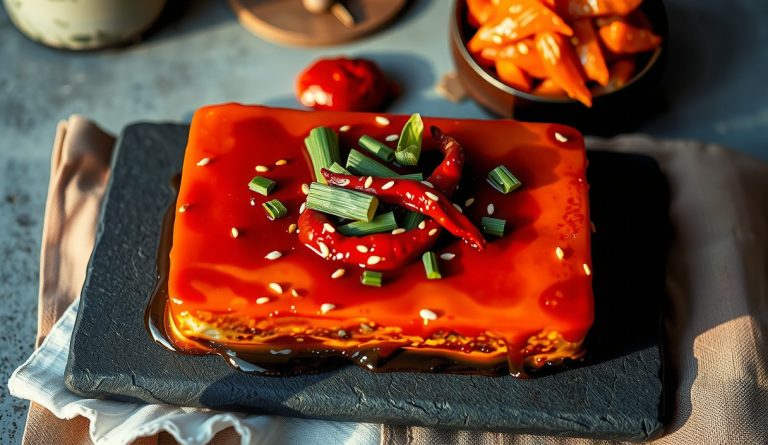
Korean-inspired gochujang version: Replace the smoked paprika with 1.5 tablespoons of gochujang and add 1 teaspoon of toasted sesame oil to the marinade. The fermented chili paste introduces a complex Maillard-ready sugar matrix alongside lactic acid that tenderizes the surface protein slightly, producing a glossier, stickier bark. Finish with a scatter of toasted sesame seeds at the 75-minute mark of the smoke.
High-protein pressing variation: Freeze the tofu block solid, thaw overnight in the refrigerator, and then press. Freeze-thaw cycling ruptures the internal gel network at the ice crystal boundaries, creating a more porous, almost sponge-like matrix that expels water dramatically faster and absorbs marinades at nearly double the rate of never-frozen tofu. Press time drops to 60–90 minutes and marinade saturation is complete in 45 minutes. The final smoked product has a chewier, more meat-like bite.
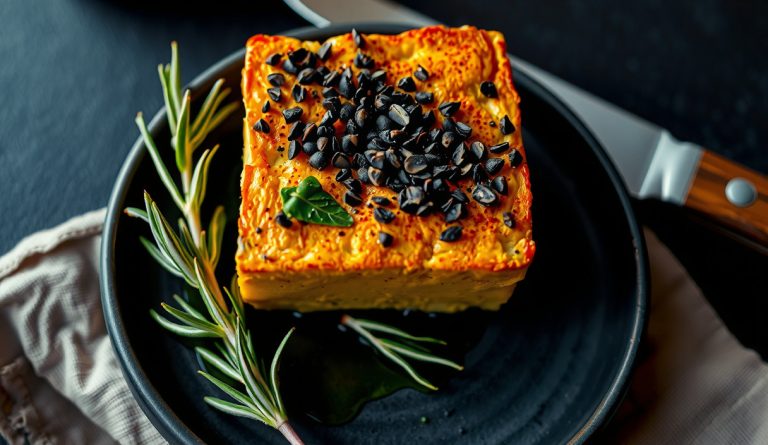
Herb-crusted finishing variation: In the final 15 minutes of the smoke, brush the surface lightly with a thin slick of avocado oil and press a dry rub of finely ground rosemary, black pepper, and nutritional yeast directly into the bark. The nutritional yeast contributes free glutamic acid and additional Maillard reactants at the surface, amplifying savory depth while the rosemary’s volatile terpenes bloom in the residual heat.
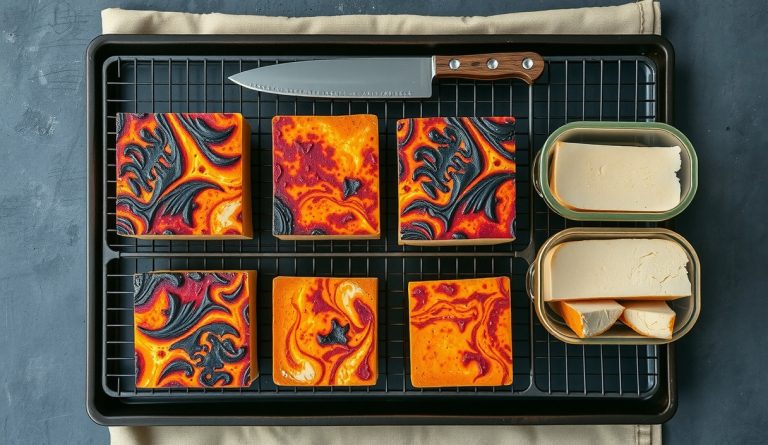
Scaling for meal prep: This recipe scales cleanly to four blocks run simultaneously on a single smoker grate, provided you maintain at least 1.5 inches of clearance between blocks for smoke circulation. Marinade scales 1:1 by block. Pressed and smoked tofu blocks refrigerate well for up to five days — the bark actually firms further overnight and slices even more cleanly cold. The blocks freeze well for up to two months; thaw in the refrigerator and use within 48 hours of thawing.
Frequently asked questions about smoked tofu
Can I make this in an oven with liquid smoke instead of a real smoker? Yes, with meaningful compromise. Preheat the oven to 225°F, place the marinated tofu on a wire rack over a sheet pan, and roast for 90 minutes. Bark formation still happens — Maillard kinetics do not care whether the heat source is electric or wood-fired — but you lose the deposition of genuine wood pyrolysis compounds onto the surface. The liquid smoke in the marinade provides guaiacol and syringol, but those compounds bake into the interior rather than accumulating on the surface crust. The result is good, not identical.
My tofu is not forming a dark bark after 60 minutes. What went wrong? Two causes are most likely: residual surface moisture keeping the boundary-layer a_w too high for Maillard to accelerate, or a smoker temperature running low at grate level. Verify grate-level temperature with a separate probe. If that checks out, pull the tofu, pat it firmly with paper towels, and return it to the smoker. The bark will form once the surface dries sufficiently.
Does the type of coagulant in the tofu matter? Yes, and it is worth understanding. Calcium-set tofu (calcium sulfate) produces a slightly firmer, denser gel with higher initial protein cross-link density — the tofu block presses more uniformly and holds its shape better through the smoke. Nigari-set tofu (magnesium chloride) tends to have a silkier, slightly wetter initial texture and may require 30 additional minutes of pressing to reach the same target weight. Check the label: most North American grocery brands use calcium sulfate, which is ideal for this application.