Smoked Deviled Eggs — The Cold-Smoke Yolk Method

Equipment
- 1 Smoker or covered grill with cold-smoke setup Maintain 85 to 100°F at grate level. A maze pellet smoker, tube smoker, or a kettle with minimal charcoal all work.
- 2 handfuls Applewood chips or chunks Fruitwood preferred. Cherry or pecan are excellent alternatives.
- 1 Probe thermometer Clip to the grate near the eggs. Non-negotiable for temperature control.
- 1 Medium saucepan
- 1 Large bowl with ice water Prepare before the eggs finish boiling.
- 1 Piping bag fitted with a 1M star tip A large zip-lock bag with the corner cut works as a substitute.
- 1 Wire cooling rack For drying eggs before smoking.
Ingredients
Eggs
- 6 large eggs At least 7 to 10 days old for easy peeling. Refrigerator-cold is fine going into the smoker.
Yolk Filling
- 3 tablespoons full-fat mayonnaise Duke’s or Hellmann’s. Do not use reduced-fat.
- 1 teaspoon Dijon mustard
- 1 teaspoon smoked paprika Pimentón de la Vera bittersweet (agridulce) preferred.
- 1 teaspoon apple cider vinegar Start with 1/2 teaspoon and adjust to taste after seasoning.
- ¼ teaspoon kosher salt Season to taste last, after all other ingredients are incorporated.
- ⅛ teaspoon freshly ground black pepper
- ¼ teaspoon hot sauce Optional. Crystal or Texas Pete works well without overwhelming the smoke.
Garnish
- smoked paprika A light dusting over each finished egg.
- 6 small fronds fresh dill Optional. One small frond per egg half.
- flaky sea salt Optional finish. One small crystal per egg.

Instructions
Cold Smoke the Whole Eggs
- Set up your smoker or covered grill for cold smoking. Load the smoke generator with applewood chips or chunks and ignite. Allow the chamber to stabilize between 85°F and 95°F at grate level before placing the eggs. Clip your probe thermometer to the grate near where the eggs will sit and monitor it throughout the smoke.
- Remove the eggs from the refrigerator and pat each one completely dry with paper towels. Place them directly on the grate — upright in an egg carton tray or lying flat, both work. Do not crowd them; leave at least 1 inch of airspace around each egg for smoke circulation.
- Close the lid and cold smoke the eggs for 90 minutes, maintaining the chamber between 85°F and 100°F the entire time. If the temperature climbs above 100°F, crack a vent or place a small pan of ice inside the chamber away from the smoke source. After 90 minutes, remove the eggs. The shells will show a very faint tan tinge and smell distinctly smoky.
Hard Boil and Peel
- Prepare a large bowl of ice water. Bring a medium saucepan of water to a full rolling boil. Using a slotted spoon, gently lower the smoked eggs into the boiling water one at a time. Boil for exactly 11 minutes for a fully set but not over-cooked yolk.
- Immediately transfer the eggs to the ice water bath and let them sit for at least 10 minutes. This halts carryover cooking and prevents the gray-green ferrous sulfide ring from forming around the yolk. Peel under cold running water — the shells should slide off cleanly. Pat the peeled whites dry and refrigerate them on a plate while you make the filling.
Make the Yolk Filling
- Halve each peeled egg lengthwise with a thin, sharp knife. Pop the yolks into a medium bowl. Set the whites hollow-side up on a serving platter or sheet pan.
- Mash the yolks with a fork until no large lumps remain — the finer the texture, the smoother the piped result. Add the mayonnaise and Dijon mustard. Mix vigorously until completely smooth and glossy.1 teaspoon Dijon mustard
- Add the smoked paprika, half of the apple cider vinegar, the black pepper, and hot sauce if using. Stir to fully incorporate. Taste the filling: it should be rich, smoky from both the shell-penetrated yolks and the paprika, with a bright acidic edge. Add more vinegar in 1/4-teaspoon increments as needed. Season with kosher salt last — taste carefully, as the Dijon and paprika both carry salt.1 teaspoon smoked paprika, 1 teaspoon apple cider vinegar, 1/4 teaspoon kosher salt, 1/8 teaspoon freshly ground black pepper, 1/4 teaspoon hot sauce
- Transfer the filling to a piping bag fitted with a 1M star tip. Refrigerate the bag flat for 10 minutes if the filling has become warm from handling — cold filling holds its piped shape far better.1 teaspoon Dijon mustard, 1 teaspoon smoked paprika, 1 teaspoon apple cider vinegar, 1/4 teaspoon kosher salt, 1/8 teaspoon freshly ground black pepper, 1/4 teaspoon hot sauce
Pipe and Garnish
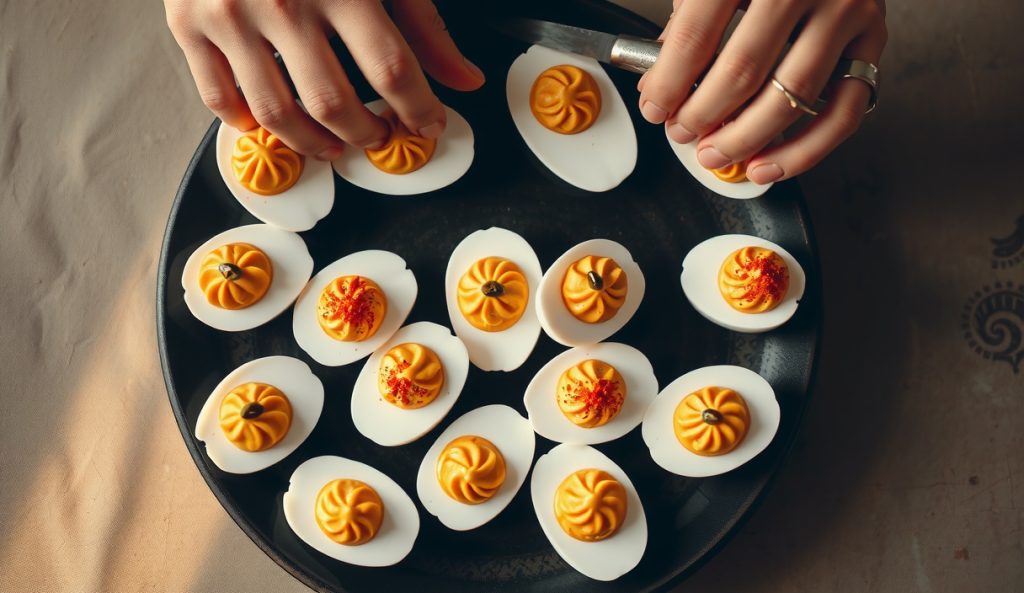
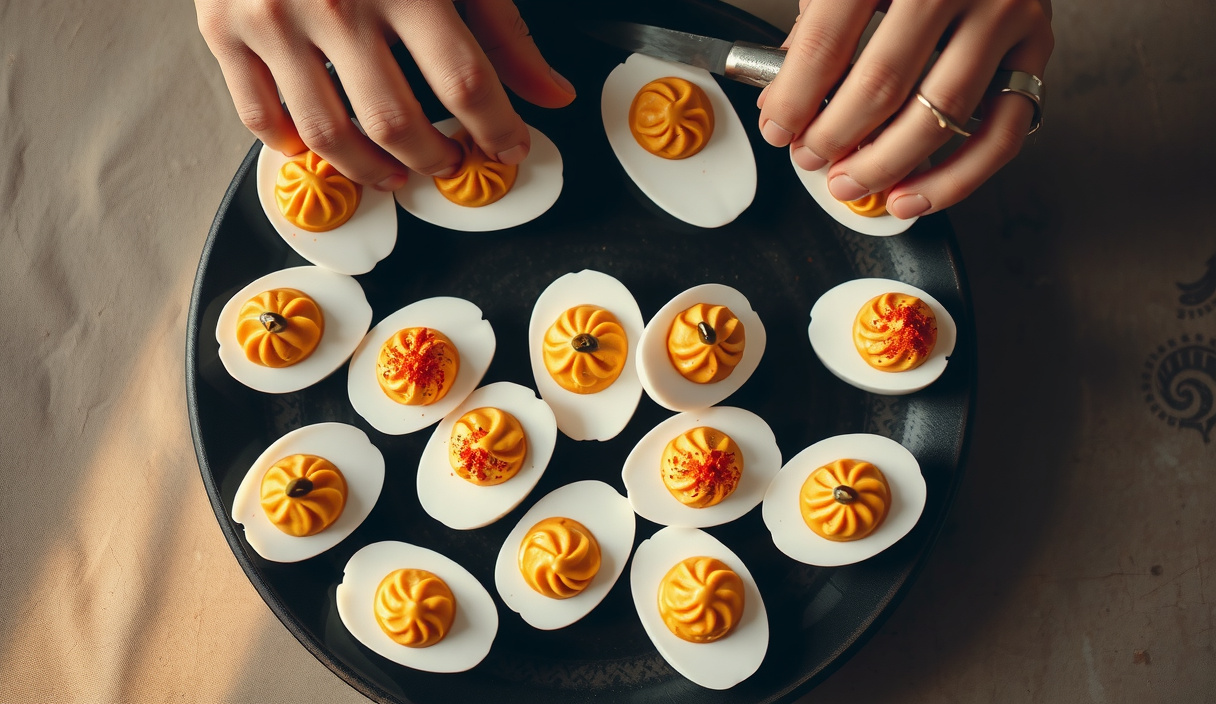
- Pipe the filling into each white half in a single continuous spiral motion, applying even pressure from the shoulder rather than the hand. Start at the outer edge of the hollow and spiral inward and upward to create a domed rosette that rises just above the rim of the white.1 teaspoon Dijon mustard, 1 teaspoon smoked paprika, 1 teaspoon apple cider vinegar, 1/4 teaspoon kosher salt, 1/8 teaspoon freshly ground black pepper, 1/4 teaspoon hot sauce
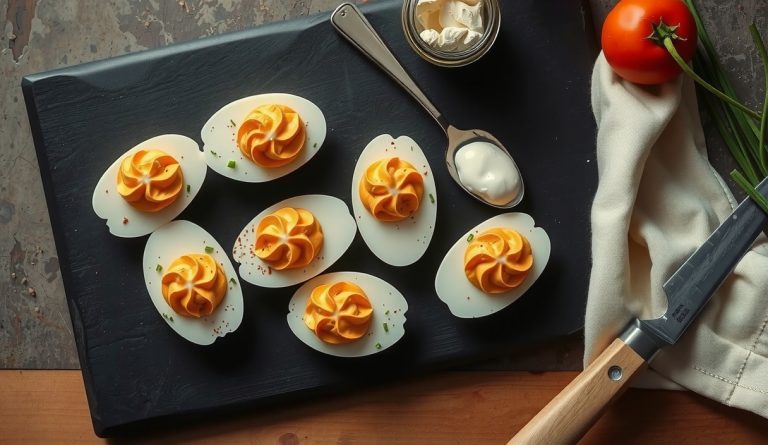
- Dust each finished egg lightly with smoked paprika from a height of about 12 inches for an even, fine coat. Add a small dill frond and a single crystal of flaky sea salt to each if using. Serve immediately or refrigerate on the platter until ready — do not leave at room temperature for more than 2 hours total.smoked paprika, 6 small fronds fresh dill, flaky sea salt
Notes
Nutrition
The first time I cold-smoked a batch of deviled eggs whole — shells on, straight off the grocery shelf — I was skeptical. The shell looks impenetrable. But pull one open after 90 minutes at 90°F over applewood and the white carries a faint tan blush and the yolk smells unmistakably of campfire. Something is clearly moving through that membrane. That something is what makes this version of a classic party dish genuinely different, not just theatrically smoked on the surface.
This recipe has become our go-to appetizer here at American Meathead for any cook where the smoker is already lit. It requires almost no active attention, scales perfectly to a crowd, and delivers a flavor complexity that straight boiled-and-piped eggs simply cannot touch. The technique is also a compelling entry point for anyone who has never attempted cold smoking — the stakes are low, the results are immediate, and the science is genuinely fascinating.
Why do smoked deviled eggs actually taste smoky inside? The science
Eggshells are not solid — each hen’s egg contains 7,000 to 17,000 pores that allow smoke compounds to migrate through the shell and into the egg interior. Under a scanning electron microscope, those pores are visible as direct channels through the outer calcite lattice and the underlying shell membranes (an outer and inner membrane composed primarily of keratin and collagen fibers) into the albumen below. Smoke is a heterogeneous aerosol: a suspension of water droplets, organic particles, and hundreds of volatile organic compounds including guaiacol, syringol, 4-methylguaiacol, and phenolic derivatives generated by the pyrolysis of lignin in the wood. At 90°F — well below the 140°F threshold where the albumen begins significant protein denaturation — these small phenolic molecules and their associated water-vapor carrier phase migrate through the shell pores and partially into the membrane layers, producing genuine, graduated smoke penetration rather than a surface coating.
The 90°F chamber temperature is not arbitrary — it is the sweet spot where maximum phenolic uptake occurs without triggering albumen contraction. At 90°F (32°C), myosin and actin in the albumen remain fully native with no denaturation, no textural change, and no moisture loss. The egg interior is a closed, humid system, and the partial pressure differential between the smoky exterior aerosol and the clean interior atmosphere drives phenolic molecule migration inward. Push the chamber above 130°F and the albumen begins to contract and expel moisture outward, reversing the pressure gradient and sharply reducing absorption. The 90-minute window was arrived at empirically: at 60 minutes the smoke note in the yolk is subtle; at 90 minutes it is distinct; at 120 minutes the whites begin to take on a bitter edge from excessive phenolic loading at the membrane surface.
The yolk filling exploits Maillard-adjacent flavor layering through a carefully engineered fat-phase emulsion. Smoked paprika — a separate, fat-soluble phenolic source — is emulsified into the mayonnaise, which itself is an oil-in-water emulsion stabilized by egg yolk lecithin. Dijon mustard contributes amphiphilic proteins and complex polysaccharides that reinforce emulsion stability and provide glucosinolate-derived isothiocyanate heat notes. The fat phase of the mayo acts as the primary solvent for all lipophilic aroma compounds — smoke phenolics, paprika carotenoid esters, and mustard volatiles — holding them in a thermodynamically buffered dispersion that releases slowly on the palate rather than spiking and dissipating. A measured acid correction via apple cider vinegar lowers the continuous phase pH to approximately 3.8 to 4.2, sharpening perceived brightness without overwhelming the smoke character.
What equipment and ingredients do I need?
Cold smoking at 90°F requires either a dedicated cold-smoke generator (such as a maze-style pellet smoker or a Smoke Daddy tube) placed inside a closed grill, or a kamado or kettle grill with its main firebox charged with a very small amount of lit charcoal — enough to sustain wood chip smoldering but not enough to drive the chamber above 100°F. An accurate probe thermometer clipped to the grate near the eggs is non-negotiable. Ambient temperature matters: on a hot summer day maintaining 90°F becomes harder; on a cool fall morning it is effortless.
- Wood choice: Applewood and cherrywood are our preferred options — mild fruitwood phenolics that complement egg richness without the aggressive resinous notes of hickory or mesquite. Pecan is an excellent middle ground.
- Eggs: Use eggs that are at least 7 to 10 days old. Freshly laid eggs have a very high pH albumen (around 7.6) that bonds tightly to the inner membrane, making the white nearly impossible to peel cleanly. Older eggs equilibrate to a lower pH and peel in one smooth motion.
- Mayonnaise: Full-fat, commercial or homemade. Duke’s or Hellmann’s both work. Avoid reduced-fat versions — the fat phase is the flavor carrier and reducing it mutes everything.
- Smoked paprika: Pimentón de la Vera (Spanish smoked paprika) is the gold standard. The drying and smoking process creates unique carotenoid and phenolic profiles that differ substantially from domestic smoked paprika. Bittersweet (agridulce) is preferred over hot.
- Piping tip: A 1M or 2D open-star tip produces the classic ridged rosette. A large round tip works if you prefer a cleaner, modern look. A zip-lock bag with the corner cut off is a fully functional alternative for a crowd.
Smoked Deviled Eggs — The Cold-Smoke Yolk Method
Equipment
- 1 Smoker or covered grill with cold-smoke setup Maintain 85 to 100°F at grate level. A maze pellet smoker, tube smoker, or a kettle with minimal charcoal all work.
- 2 handfuls Applewood chips or chunks Fruitwood preferred. Cherry or pecan are excellent alternatives.
- 1 Probe thermometer Clip to the grate near the eggs. Non-negotiable for temperature control.
- 1 Medium saucepan
- 1 Large bowl with ice water Prepare before the eggs finish boiling.
- 1 Piping bag fitted with a 1M star tip A large zip-lock bag with the corner cut works as a substitute.
- 1 Wire cooling rack For drying eggs before smoking.
Ingredients
Eggs
- 6 large eggs At least 7 to 10 days old for easy peeling. Refrigerator-cold is fine going into the smoker.
Yolk Filling
- 3 tablespoons full-fat mayonnaise Duke’s or Hellmann’s. Do not use reduced-fat.
- 1 teaspoon Dijon mustard
- 1 teaspoon smoked paprika Pimentón de la Vera bittersweet (agridulce) preferred.
- 1 teaspoon apple cider vinegar Start with 1/2 teaspoon and adjust to taste after seasoning.
- ¼ teaspoon kosher salt Season to taste last, after all other ingredients are incorporated.
- ⅛ teaspoon freshly ground black pepper
- ¼ teaspoon hot sauce Optional. Crystal or Texas Pete works well without overwhelming the smoke.
Garnish
- smoked paprika A light dusting over each finished egg.
- 6 small fronds fresh dill Optional. One small frond per egg half.
- flaky sea salt Optional finish. One small crystal per egg.
Instructions
Cold Smoke the Whole Eggs
- Set up your smoker or covered grill for cold smoking. Load the smoke generator with applewood chips or chunks and ignite. Allow the chamber to stabilize between 85°F and 95°F at grate level before placing the eggs. Clip your probe thermometer to the grate near where the eggs will sit and monitor it throughout the smoke.
- Remove the eggs from the refrigerator and pat each one completely dry with paper towels. Place them directly on the grate — upright in an egg carton tray or lying flat, both work. Do not crowd them; leave at least 1 inch of airspace around each egg for smoke circulation.
- Close the lid and cold smoke the eggs for 90 minutes, maintaining the chamber between 85°F and 100°F the entire time. If the temperature climbs above 100°F, crack a vent or place a small pan of ice inside the chamber away from the smoke source. After 90 minutes, remove the eggs. The shells will show a very faint tan tinge and smell distinctly smoky.
Hard Boil and Peel
- Prepare a large bowl of ice water. Bring a medium saucepan of water to a full rolling boil. Using a slotted spoon, gently lower the smoked eggs into the boiling water one at a time. Boil for exactly 11 minutes for a fully set but not over-cooked yolk.
- Immediately transfer the eggs to the ice water bath and let them sit for at least 10 minutes. This halts carryover cooking and prevents the gray-green ferrous sulfide ring from forming around the yolk. Peel under cold running water — the shells should slide off cleanly. Pat the peeled whites dry and refrigerate them on a plate while you make the filling.
Make the Yolk Filling
- Halve each peeled egg lengthwise with a thin, sharp knife. Pop the yolks into a medium bowl. Set the whites hollow-side up on a serving platter or sheet pan.
- Mash the yolks with a fork until no large lumps remain — the finer the texture, the smoother the piped result. Add the mayonnaise and Dijon mustard. Mix vigorously until completely smooth and glossy.1 teaspoon Dijon mustard
- Add the smoked paprika, half of the apple cider vinegar, the black pepper, and hot sauce if using. Stir to fully incorporate. Taste the filling: it should be rich, smoky from both the shell-penetrated yolks and the paprika, with a bright acidic edge. Add more vinegar in 1/4-teaspoon increments as needed. Season with kosher salt last — taste carefully, as the Dijon and paprika both carry salt.1 teaspoon smoked paprika, 1 teaspoon apple cider vinegar, 1/4 teaspoon kosher salt, 1/8 teaspoon freshly ground black pepper, 1/4 teaspoon hot sauce
- Transfer the filling to a piping bag fitted with a 1M star tip. Refrigerate the bag flat for 10 minutes if the filling has become warm from handling — cold filling holds its piped shape far better.1 teaspoon Dijon mustard, 1 teaspoon smoked paprika, 1 teaspoon apple cider vinegar, 1/4 teaspoon kosher salt, 1/8 teaspoon freshly ground black pepper, 1/4 teaspoon hot sauce
Pipe and Garnish
- Pipe the filling into each white half in a single continuous spiral motion, applying even pressure from the shoulder rather than the hand. Start at the outer edge of the hollow and spiral inward and upward to create a domed rosette that rises just above the rim of the white.1 teaspoon Dijon mustard, 1 teaspoon smoked paprika, 1 teaspoon apple cider vinegar, 1/4 teaspoon kosher salt, 1/8 teaspoon freshly ground black pepper, 1/4 teaspoon hot sauce
- Dust each finished egg lightly with smoked paprika from a height of about 12 inches for an even, fine coat. Add a small dill frond and a single crystal of flaky sea salt to each if using. Serve immediately or refrigerate on the platter until ready — do not leave at room temperature for more than 2 hours total.smoked paprika, 6 small fronds fresh dill, flaky sea salt
Notes
Nutrition
How do I nail smoked deviled eggs every time?
- Do not skip the ice bath. Transferring the boiled eggs to a bowl of ice water within 30 seconds of pulling them from the pot stops carryover cooking instantly. The difference between a perfectly set yolk (solid but not chalky, reaching about 160°F internally) and an overcooked, greenish-tinged yolk is often as little as two minutes of additional residual heat. The ferrous sulfide ring that turns yolks green forms when hydrogen sulfide released from the albumen reacts with iron in the yolk — a time-and-temperature dependent reaction you can entirely prevent with a proper cold shock.
- Monitor grate temperature obsessively. If the chamber climbs above 100°F during smoking, crack a vent or add ice to a pan placed inside the chamber. Phenolic penetration benefits from low temps; protein denaturation does not.
- Dry the shells before smoking. Pat each egg completely dry after the ice bath and let them air on a rack for 10 minutes before loading them into the smoker. Wet shells reduce gas-phase diffusion efficiency at the pore openings by presenting a competing aqueous barrier.
- Taste the filling before piping and adjust salt last. The smoked paprika and Dijon both carry salt. Season the yolk mixture in stages, tasting after each small addition of kosher salt, and make your final acid adjustment (vinegar drops) only after the salt is correct — salt perception dramatically shifts your judgment of acidity.
- Keep the filled eggs cold until 5 minutes before service. Mayonnaise emulsions are microbiologically sensitive and the piped yolk is already at elevated surface area. Plate from refrigeration directly onto a chilled slate or metal platter. Do not leave at room temperature longer than 2 hours total.
- Pipe in a single continuous spiral motion. Pressure should be consistent. If you stop mid-pipe, the break point shows. Practice on a plate first if you have never used a piping bag.
What are the best variations on smoked deviled eggs?
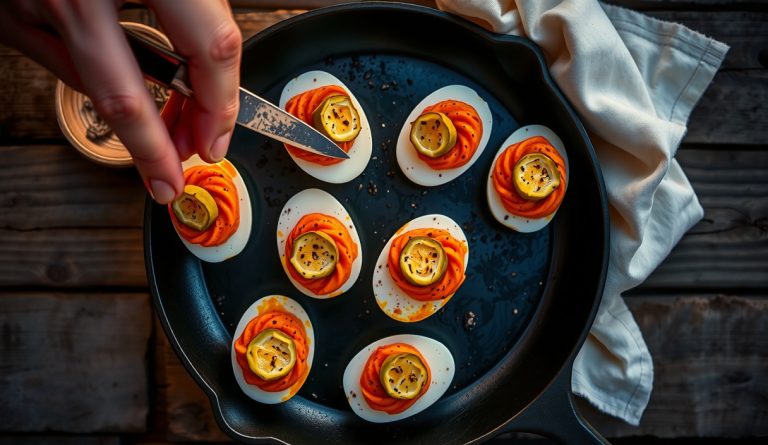
For a Nashville hot riff, add 1 teaspoon of cayenne, 1/2 teaspoon of brown sugar, and a pinch of garlic powder to the yolk mixture, and garnish with a thin slice of dill pickle on each egg. The fat in the mayo tempers the capsaicin heat, delivering a slow, even burn rather than the aggressive upfront spike you get from raw hot sauce, while the pickle brine acidity plays against the smoke note cleanly.
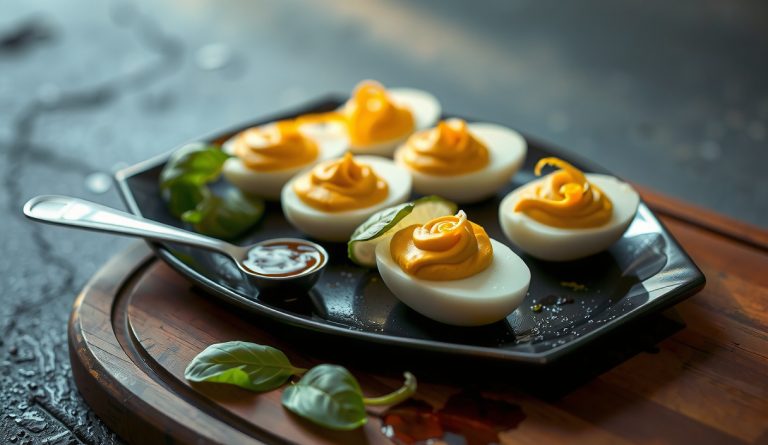
For a Southeast Asian-inspired version, replace the Dijon with 1 teaspoon of fish sauce and 1 teaspoon of Sriracha, and fold in 1 tablespoon of finely sliced scallion greens. Garnish with a small leaf of Thai basil and a microplane of fresh lime zest over the top. The amino acid-rich fish sauce elevates the innate umami of the egg yolk dramatically through glutamate synergy with the yolk’s own ribonucleotides, producing a flavor depth that reads as much richer than the ingredient list suggests.
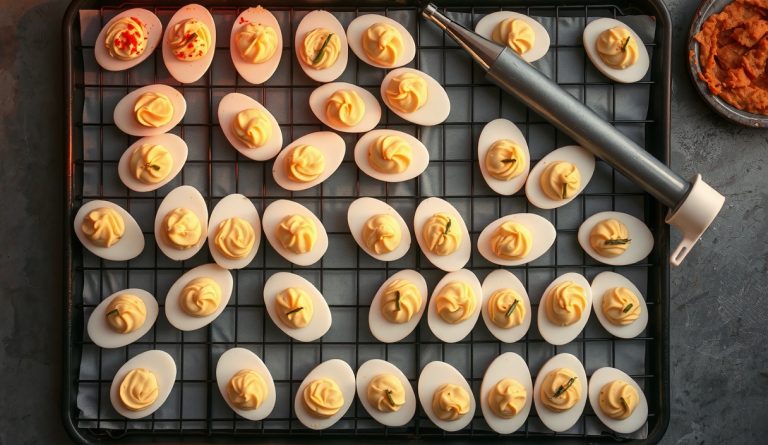
To scale this recipe for a large party, simply multiply all quantities linearly. The smoker can accommodate 24 eggs on a single grate layer without issue — just ensure no eggs are stacked, which would block smoke circulation. The yolk filling can be made up to 24 hours ahead and stored in a piping bag with the tip secured, refrigerated flat. Pipe directly from cold; the filling holds its shape better when chilled.
For a dairy-adjacent richness boost (not a true dairy addition), swap 1 tablespoon of the mayonnaise for full-fat crème fraîche. The higher acidity and the cultured tang of crème fraîche adds a lactic complexity that amplifies the smoke note by contrast, much like how a smoked fish pâté benefits from the pairing with sour cream. This does not qualify the recipe as a dairy recipe since the egg-based mayo remains dominant, but it shifts the flavor register noticeably toward the richness of a smoked salmon filling.
Frequently asked questions about smoked deviled eggs
Can I use liquid smoke instead of a real smoker? Liquid smoke can be added to the yolk filling — start with 1/4 teaspoon and taste before adding more, as liquid smoke is far more concentrated than natural smoke penetration — but the shell-penetration effect cannot be replicated in an oven. The oven produces no smoke aerosol and the pore-diffusion mechanism simply does not operate. The result is a smoked-tasting filling inside an unsmoked white, which is a fundamentally different dish.
Will the shells smell smoky after cold smoking? Yes, distinctly. Rinse the shells briefly under cold water before peeling if you find the exterior smoke odor intense — this does not wash out the interior penetration, which has already migrated through the membrane. After 90 minutes at 90°F, the white itself will carry a subtle but noticeable smoke blush.
What if I don’t own a smoker? A tight-fitting lidded wok or a large stockpot can function as a stove-top cold smoker with a stainless steel rack, a thin layer of dry wood chips scattered on the bottom of the pot, and a sheet of foil loosely tented over the eggs to direct smoke upward. Bring the chips to a light smolder over medium heat, reduce to low, and hold at the lowest stable smoke output for 60 to 75 minutes. Ventilate your kitchen aggressively and use a remote thermometer to confirm the egg-level temperature stays below 100°F. The method works — it is simply less convenient than a dedicated setup.