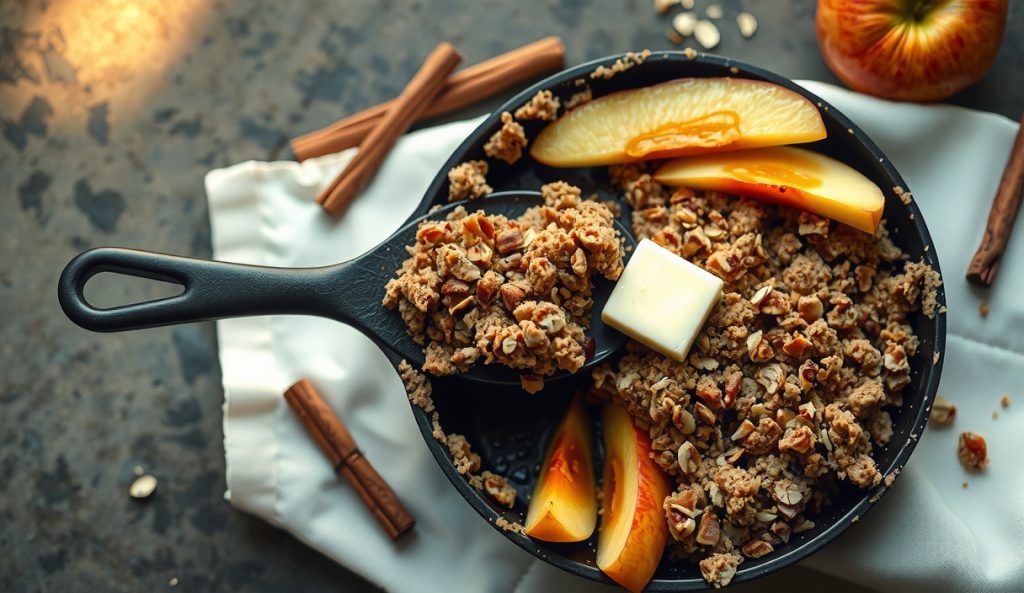
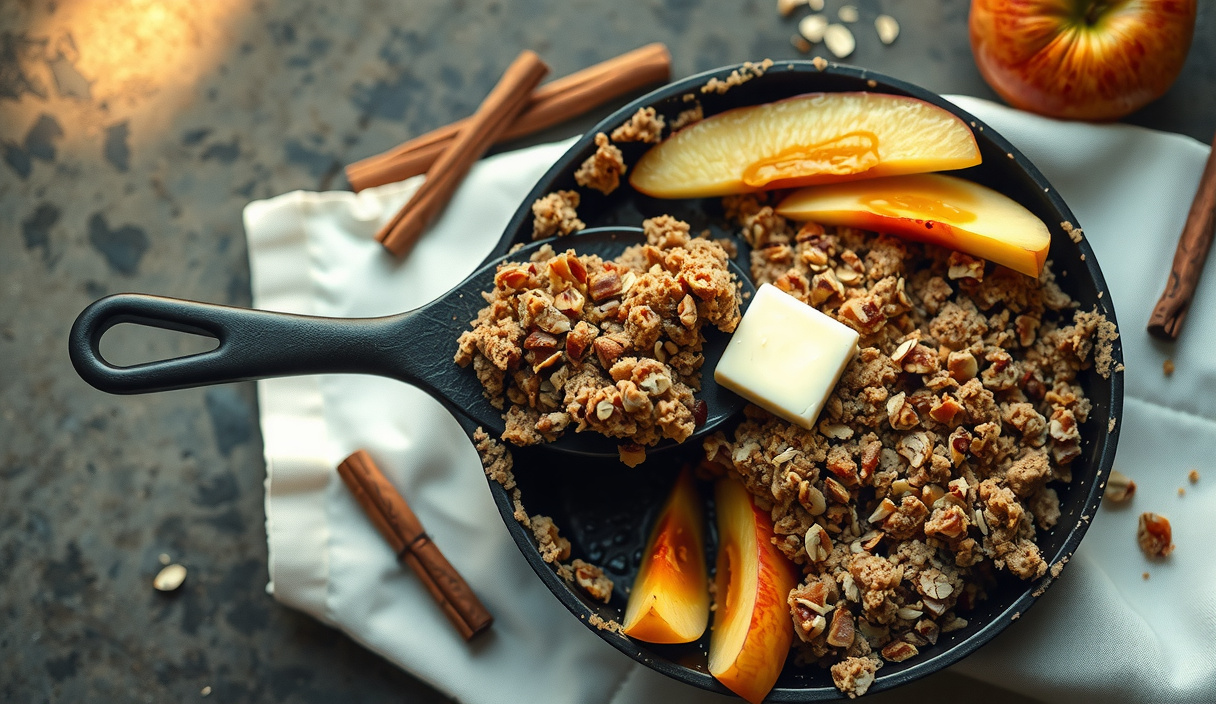
Smoked Apple Crisp — Skillet-Baked
Equipment
- 1 10-inch cast-iron skillet Pre-heat on the smoker grate for 10 minutes before adding the filling
- 1 Offset smoker or pellet grill Calibrated to 350°F at grate level with a grate-mounted thermometer
- 2 to 3 small chunks Apple wood or cherry wood chunks Fruitwood only — hickory and mesquite are too aggressive for dessert applications
- 1 Instant-read or probe thermometer For monitoring apple filling internal temperature; pull at 185 to 190°F
- 1 Grate-level thermometer Dome thermometers on smokers often read 20 to 40°F high; measure where the skillet sits
- 1 Pastry cutter or two forks For cutting cold butter into the crumble dry ingredients
- 1 set Heavy silicone handle cover and oven mitt Cast-iron handle can exceed 400°F after 40 minutes of radiant exposure
Ingredients
Apple Filling
- 3 medium Granny Smith apples Peeled, cored, sliced 1/4 inch thick; approximately 1 lb prepared weight
- 2 medium Honeycrisp apples Peeled, cored, sliced 1/4 inch thick; approximately 10 oz prepared weight
- ⅓ cup light brown sugar Packed
- 2 tablespoons cornstarch
- 1 tablespoon fresh lemon juice
- 1 teaspoon ground cinnamon
- ¼ teaspoon ground nutmeg Freshly grated preferred
- ¼ teaspoon fine kosher salt
- 1 teaspoon pure vanilla extract
Oat Crumble Topping
- 1 cup old-fashioned rolled oats Not instant oats; the larger surface area of rolled oats maximizes Maillard browning
- ¾ cup all-purpose flour
- ½ cup light brown sugar Packed; provides reducing sugars for Maillard cascade and molasses-derived umami depth
- ¼ cup granulated sugar
- ½ teaspoon ground cinnamon
- ¼ teaspoon fine kosher salt
- 8 tablespoons unsalted butter Cold, cut into 1/2-inch cubes; do not use softened or melted — cold fat is essential for discrete crumble structure
For Serving
- Vanilla ice cream or crème fraîche Optional but highly recommended; the cold dairy fat against the warm filling creates a temperature-driven flavor release

Instructions
Prepare the Smoker and Skillet
- Set up your smoker for indirect heat and bring it to a stable 350°F at grate level using a grate-mounted thermometer — not the dome gauge. Add 2 to 3 small chunks of apple wood or cherry wood to the fire. Wait for clean, thin blue smoke before proceeding. White or billowing smoke indicates incomplete combustion and will deposit bitter creosote on the crumble.
- Place the empty 10-inch cast-iron skillet on the grate over the indirect zone. Allow it to pre-heat for 10 minutes. This creates the high-temperature contact surface that initiates caramelization of the Honeycrisp sugars at the bottom of the filling from the moment the apples hit the pan.
Make the Crumble Topping
- In a large bowl, combine the rolled oats, all-purpose flour, 1/2 cup light brown sugar, granulated sugar, 1/2 teaspoon cinnamon, and 1/4 teaspoon kosher salt. Whisk briefly to distribute evenly.1 cup old-fashioned rolled oats, 3/4 cup all-purpose flour, 1/2 cup light brown sugar, 1/4 cup granulated sugar, 1/2 teaspoon ground cinnamon, 1/4 teaspoon fine kosher salt
- Add the cold butter cubes to the dry ingredients. Using a pastry cutter or your fingertips, work the butter into the mixture until it resembles coarse, uneven crumbs — the largest pieces should be the size of small peas and the smallest should be sandy. Discrete fat pockets are essential: they melt individually in the smoker, creating the irregular craggy texture that catches and holds the smoke phenolics. Refrigerate the crumble while you prepare the filling.8 tablespoons unsalted butter
Prepare the Apple Filling
- Peel, core, and slice the Granny Smith apples and Honeycrisp apples to a uniform 1/4-inch thickness. Consistent thickness is critical — thicker slices will not reach the 180°F pectin-depolymerization threshold within the 40-minute cook window and will retain a waxy, under-softened texture.2 medium Honeycrisp apples
- In a large bowl, toss the sliced apples with 1/3 cup light brown sugar, cornstarch, lemon juice, 1 teaspoon cinnamon, nutmeg, 1/4 teaspoon salt, and vanilla extract. Toss until the apples are evenly coated and the cornstarch is fully incorporated with no dry white pockets visible. The cornstarch will gelatinize as the filling heats, binding the pectin-rich juices released during depolymerization into a cohesive sauce rather than a watery pool.1/3 cup light brown sugar, 2 tablespoons cornstarch, 1 tablespoon fresh lemon juice, 1 teaspoon ground cinnamon, 1/4 teaspoon ground nutmeg, 1/4 teaspoon fine kosher salt, 1 teaspoon pure vanilla extract
Assemble and Smoke
- Using a heavy silicone handle cover and oven mitt, carefully remove the pre-heated skillet from the smoker. Working quickly, transfer the apple filling into the hot skillet and spread into an even layer. You should hear an immediate sizzle as the apple sugars contact the hot cast iron — this is the caramelization reaction initiating at the bottom crust.2 medium Honeycrisp apples, 1/3 cup light brown sugar, 2 tablespoons cornstarch, 1 tablespoon fresh lemon juice, 1 teaspoon ground cinnamon, 1/4 teaspoon ground nutmeg, 1/4 teaspoon fine kosher salt, 1 teaspoon pure vanilla extract
- Remove the crumble from the refrigerator and scatter it evenly over the apple filling in an even layer, covering the fruit to the edges of the skillet. Do not press the crumble down — loose, airy distribution maximizes the surface area exposed to smoke and heat.1 cup old-fashioned rolled oats, 3/4 cup all-purpose flour, 1/2 cup light brown sugar, 1/4 cup granulated sugar, 1/2 teaspoon ground cinnamon, 1/4 teaspoon fine kosher salt, 8 tablespoons unsalted butter
- Return the skillet to the smoker over the indirect zone. Close the lid and cook at 350°F for 35 to 40 minutes. At the 30-minute mark, check the crumble color: it should be transitioning to deep amber. If the crumble peaks are already deeply browned, tent loosely with foil for the remaining time to prevent the oats from entering the bitter charring zone above approximately 360°F surface temperature.
- The crisp is done when the crumble is deep amber and set across the entire surface, the edges of the filling are bubbling actively around the crumble border, and a probe thermometer inserted into the center of the filling reads 185 to 190°F. The filling internal temperature is the definitive doneness signal — visual cues on the crumble can be reached 5 to 8 minutes earlier than full pectin depolymerization in the filling center.
Rest and Serve
- Remove the skillet from the smoker using the silicone handle cover and oven mitt — the handle will be extremely hot. Place on a heavy trivet or folded towel and allow the crisp to rest for 15 minutes before serving. At 185 to 190°F the filling is fully liquid; as it drops below 150°F, the cornstarch-thickened pectin gel re-sets into a scoopable, cohesive filling. Do not skip this step.
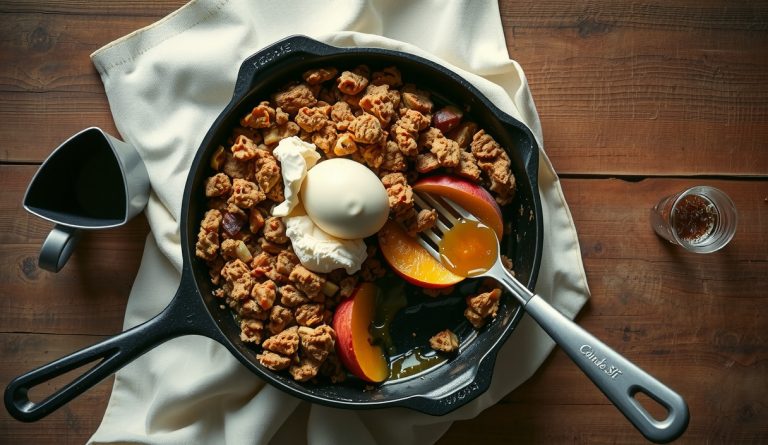
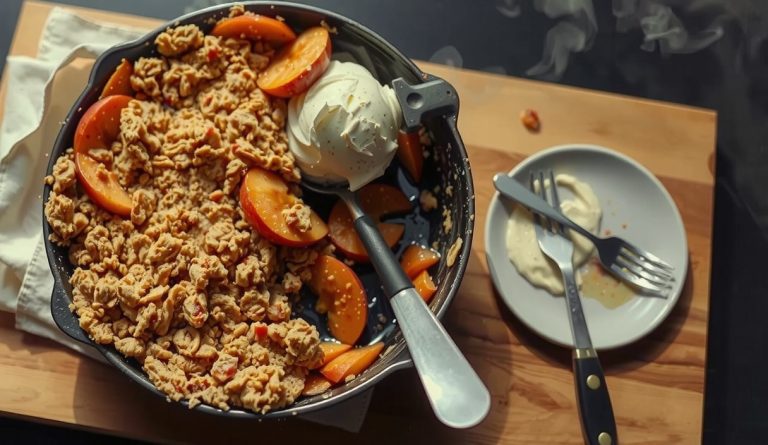
- Serve directly from the skillet with a large spoon, scooping deep to capture both the crisped crumble layer and the jammy apple filling below. Serve immediately with vanilla ice cream or crème fraîche alongside. The thermal contrast between the warm filling and cold dairy accelerates the release of volatile smoke phenolics — the crisp will smell most intensely of wood smoke in the first 30 seconds after the cold dairy hits the surface.Vanilla ice cream or crème fraîche
Notes
Nutrition
The first time a cast-iron skillet of apple crisp went into a live wood-fire smoker instead of a conventional oven, the expectation was novelty. What came out forty minutes later was structurally and aromatically different from every apple crisp made before it. The fruit had collapsed into a translucent, jammy slab. The crumble had crisped into something that crackled. And underneath both was a low, resonant smoke note that read less like barbecue and more like a very old orchard in October. This recipe is the refined version of that accident.
The technique is not complicated. A cast-iron skillet runs inside a smoker held at 350°F — the same temperature used in a conventional oven — and the process gains two things an oven cannot give: convective smoke deposition on the crumble surface, and the radiant heat envelope of a live fire that produces more aggressive bottom-crust browning on the fruit side of the skillet. The result lands somewhere between a classic Midwestern crisp and a wood-fired apple tart. It belongs on this site.
Why does smoked apple crisp work? The science
Smoked apple crisp works because a 350°F smoker drives the apple filling past the 180°F pectin-breakdown threshold within 20 to 25 minutes, while simultaneously depositing fat-soluble phenolic compounds directly into the butter matrix of the crumble. Apple texture during cooking is governed almost entirely by pectin — specifically polygalacturonic acid chains cross-linked by calcium ions in the cell walls of the fruit. Below roughly 140°F, endogenous pectin methylesterase (PME) remains active and actually strengthens the pectin network by de-methylating chains, allowing more calcium bridging. This is why low-and-slow cooking can leave apples with a strange, firm, almost waxy texture.
Above roughly 180°F, those polygalacturonic acid chains undergo beta-elimination: the glycosidic bond at C-4 is cleaved, the chain depolymerizes, and the cell wall collapses. Inside a 350°F smoker, the fruit layer of this skillet crosses 180°F internal within the first 20 to 25 minutes, which means the depolymerization window is long enough to produce a fully softened, jammy interior without losing all structural identity. Granny Smith provides high-acidity pectin at pH 3.2 to 3.5 that gels more firmly post-depolymerization, while Honeycrisp contributes natural fructose and glucose — both reducing sugars — that accelerate Maillard browning at the fruit-skillet interface where temperatures can approach 300°F on cast iron.
The crumble layer is a fat-render Maillard system. Cold butter is cut into oats, flour, brown sugar, and salt. When heat is applied, the butter melts and renders into the dry matrix, creating a thin lipid film around each oat and sugar crystal. Once the free water in the butter has evaporated — water activity drops below 0.7 — the surface temperature of the crumble climbs past 280°F and the Maillard cascade initiates between the reducing sugars in brown sugar and the free amino groups of the oat proteins. The Strecker degradation pathway generates pyrazines and furans responsible for the toasty, nutty aroma.
Critically, the smoke environment deposits phenolic compounds — guaiacol, syringol, eugenol — primarily onto the crumble surface, which is the most exposed layer. These phenolics are fat-soluble and partition directly into the rendered butter matrix of the crumble, creating a chemically bonded smoke character rather than a superficial smoke smell. The result is a crumble that tastes like it was baked on wood even after the smoke dissipates.
Brown sugar carries a water activity of roughly 0.55 to 0.60 in its raw state — right in the optimal Maillard window — but once it enters the crumble and the butter renders, the effective water activity at the crumble surface drops rapidly. This is why crumble toppings brown faster than cake batters of similar composition: the thin geometry and high fat content accelerate desiccation. In a smoker environment, the convective airflow enhances surface drying further, so the crumble may set and begin browning 5 to 8 minutes earlier than in a still oven. Watch at the 30-minute mark. The target visual cue is deep amber at the crumble peaks with no raw-oat pale spots.
What equipment and ingredients do I need?
The skillet. A 10-inch or 12-inch cast-iron skillet is non-negotiable here. Cast iron retains heat aggressively and creates a high-temperature contact zone at the bottom of the fruit layer that a ceramic or glass baking dish cannot replicate. Pre-heat the skillet on the smoker grate for 10 minutes before adding the filling — this jumpstarts the bottom-crust caramelization on the Honeycrisp sugars.
The apple blend. Granny Smith alone produces a filling that is too tart and too firm post-depolymerization. Honeycrisp alone produces a filling that turns to applesauce. The 60/40 Granny Smith to Honeycrisp ratio used here balances structural integrity with sweetness. Peel both — the skins contain insoluble cellulose that does not soften through pectin breakdown and creates unpleasant texture pockets in the finished filling.
The wood. Apple wood or cherry wood. Both are low-resin fruitwoods with phenolic profiles that complement rather than compete with the fruit. Hickory and mesquite produce guaiacol concentrations that overwhelm the dessert register. Use two to three small chunks, not a full log — a clean, thin blue smoke is the target, not a rolling white smoke that deposits acrid particulates.
The butter. Use cold, unsalted butter cut into small cubes for the crumble. Cold butter coats the oat particles before it melts, creating discrete pockets of fat that render and crisp individually. Melted butter produces a paste-like crumble with less textural differentiation. European-style butter at 84% butterfat will produce a richer, faster-browning crumble than standard 80% butterfat butter — reduce cook time by 3 to 5 minutes if using it.
The smoker temperature. Hold 350°F at the grate level where the skillet sits. Offset smokers and pellet grills can have 20 to 40°F differentials between the firebox end and the stack end. Use a grate-level thermometer, not the dome thermometer, and place the skillet at the cooler end of a two-zone setup if one is available.
Smoked Apple Crisp — Skillet-Baked
Equipment
- 1 10-inch cast-iron skillet Pre-heat on the smoker grate for 10 minutes before adding the filling
- 1 Offset smoker or pellet grill Calibrated to 350°F at grate level with a grate-mounted thermometer
- 2 to 3 small chunks Apple wood or cherry wood chunks Fruitwood only — hickory and mesquite are too aggressive for dessert applications
- 1 Instant-read or probe thermometer For monitoring apple filling internal temperature; pull at 185 to 190°F
- 1 Grate-level thermometer Dome thermometers on smokers often read 20 to 40°F high; measure where the skillet sits
- 1 Pastry cutter or two forks For cutting cold butter into the crumble dry ingredients
- 1 set Heavy silicone handle cover and oven mitt Cast-iron handle can exceed 400°F after 40 minutes of radiant exposure
Ingredients
Apple Filling
- 3 medium Granny Smith apples Peeled, cored, sliced 1/4 inch thick; approximately 1 lb prepared weight
- 2 medium Honeycrisp apples Peeled, cored, sliced 1/4 inch thick; approximately 10 oz prepared weight
- ⅓ cup light brown sugar Packed
- 2 tablespoons cornstarch
- 1 tablespoon fresh lemon juice
- 1 teaspoon ground cinnamon
- ¼ teaspoon ground nutmeg Freshly grated preferred
- ¼ teaspoon fine kosher salt
- 1 teaspoon pure vanilla extract
Oat Crumble Topping
- 1 cup old-fashioned rolled oats Not instant oats; the larger surface area of rolled oats maximizes Maillard browning
- ¾ cup all-purpose flour
- ½ cup light brown sugar Packed; provides reducing sugars for Maillard cascade and molasses-derived umami depth
- ¼ cup granulated sugar
- ½ teaspoon ground cinnamon
- ¼ teaspoon fine kosher salt
- 8 tablespoons unsalted butter Cold, cut into 1/2-inch cubes; do not use softened or melted — cold fat is essential for discrete crumble structure
For Serving
- Vanilla ice cream or crème fraîche Optional but highly recommended; the cold dairy fat against the warm filling creates a temperature-driven flavor release
Instructions
Prepare the Smoker and Skillet
- Set up your smoker for indirect heat and bring it to a stable 350°F at grate level using a grate-mounted thermometer — not the dome gauge. Add 2 to 3 small chunks of apple wood or cherry wood to the fire. Wait for clean, thin blue smoke before proceeding. White or billowing smoke indicates incomplete combustion and will deposit bitter creosote on the crumble.
- Place the empty 10-inch cast-iron skillet on the grate over the indirect zone. Allow it to pre-heat for 10 minutes. This creates the high-temperature contact surface that initiates caramelization of the Honeycrisp sugars at the bottom of the filling from the moment the apples hit the pan.
Make the Crumble Topping
- In a large bowl, combine the rolled oats, all-purpose flour, 1/2 cup light brown sugar, granulated sugar, 1/2 teaspoon cinnamon, and 1/4 teaspoon kosher salt. Whisk briefly to distribute evenly.1 cup old-fashioned rolled oats, 3/4 cup all-purpose flour, 1/2 cup light brown sugar, 1/4 cup granulated sugar, 1/2 teaspoon ground cinnamon, 1/4 teaspoon fine kosher salt
- Add the cold butter cubes to the dry ingredients. Using a pastry cutter or your fingertips, work the butter into the mixture until it resembles coarse, uneven crumbs — the largest pieces should be the size of small peas and the smallest should be sandy. Discrete fat pockets are essential: they melt individually in the smoker, creating the irregular craggy texture that catches and holds the smoke phenolics. Refrigerate the crumble while you prepare the filling.8 tablespoons unsalted butter
Prepare the Apple Filling
- Peel, core, and slice the Granny Smith apples and Honeycrisp apples to a uniform 1/4-inch thickness. Consistent thickness is critical — thicker slices will not reach the 180°F pectin-depolymerization threshold within the 40-minute cook window and will retain a waxy, under-softened texture.2 medium Honeycrisp apples
- In a large bowl, toss the sliced apples with 1/3 cup light brown sugar, cornstarch, lemon juice, 1 teaspoon cinnamon, nutmeg, 1/4 teaspoon salt, and vanilla extract. Toss until the apples are evenly coated and the cornstarch is fully incorporated with no dry white pockets visible. The cornstarch will gelatinize as the filling heats, binding the pectin-rich juices released during depolymerization into a cohesive sauce rather than a watery pool.1/3 cup light brown sugar, 2 tablespoons cornstarch, 1 tablespoon fresh lemon juice, 1 teaspoon ground cinnamon, 1/4 teaspoon ground nutmeg, 1/4 teaspoon fine kosher salt, 1 teaspoon pure vanilla extract
Assemble and Smoke
- Using a heavy silicone handle cover and oven mitt, carefully remove the pre-heated skillet from the smoker. Working quickly, transfer the apple filling into the hot skillet and spread into an even layer. You should hear an immediate sizzle as the apple sugars contact the hot cast iron — this is the caramelization reaction initiating at the bottom crust.2 medium Honeycrisp apples, 1/3 cup light brown sugar, 2 tablespoons cornstarch, 1 tablespoon fresh lemon juice, 1 teaspoon ground cinnamon, 1/4 teaspoon ground nutmeg, 1/4 teaspoon fine kosher salt, 1 teaspoon pure vanilla extract
- Remove the crumble from the refrigerator and scatter it evenly over the apple filling in an even layer, covering the fruit to the edges of the skillet. Do not press the crumble down — loose, airy distribution maximizes the surface area exposed to smoke and heat.1 cup old-fashioned rolled oats, 3/4 cup all-purpose flour, 1/2 cup light brown sugar, 1/4 cup granulated sugar, 1/2 teaspoon ground cinnamon, 1/4 teaspoon fine kosher salt, 8 tablespoons unsalted butter
- Return the skillet to the smoker over the indirect zone. Close the lid and cook at 350°F for 35 to 40 minutes. At the 30-minute mark, check the crumble color: it should be transitioning to deep amber. If the crumble peaks are already deeply browned, tent loosely with foil for the remaining time to prevent the oats from entering the bitter charring zone above approximately 360°F surface temperature.
- The crisp is done when the crumble is deep amber and set across the entire surface, the edges of the filling are bubbling actively around the crumble border, and a probe thermometer inserted into the center of the filling reads 185 to 190°F. The filling internal temperature is the definitive doneness signal — visual cues on the crumble can be reached 5 to 8 minutes earlier than full pectin depolymerization in the filling center.
Rest and Serve
- Remove the skillet from the smoker using the silicone handle cover and oven mitt — the handle will be extremely hot. Place on a heavy trivet or folded towel and allow the crisp to rest for 15 minutes before serving. At 185 to 190°F the filling is fully liquid; as it drops below 150°F, the cornstarch-thickened pectin gel re-sets into a scoopable, cohesive filling. Do not skip this step.
- Serve directly from the skillet with a large spoon, scooping deep to capture both the crisped crumble layer and the jammy apple filling below. Serve immediately with vanilla ice cream or crème fraîche alongside. The thermal contrast between the warm filling and cold dairy accelerates the release of volatile smoke phenolics — the crisp will smell most intensely of wood smoke in the first 30 seconds after the cold dairy hits the surface.Vanilla ice cream or crème fraîche
Notes
Nutrition
How do I nail it every time?
- Pre-heat the skillet. Set the empty cast-iron on the grate while the smoker comes up to temperature. A cold skillet placed on a hot grate loses 8 to 12 minutes of bottom-crust browning time. The first contact of the fruit sugars with a screaming-hot pan surface initiates caramelization before the skillet even stabilizes — that is where the jam-layer at the bottom of the filling comes from.
- Do not cut apple slices thicker than 1/4 inch. Thick slices require more time to reach the 180°F pectin-breakdown threshold and risk emerging with a waxy, under-softened texture. Uniform 1/4-inch slices ensure even depolymerization across the entire filling depth within the 40-minute cook window.
- Watch the crumble at 30 minutes. Convective airflow in a smoker accelerates surface drying and browning. If the crumble peaks are deeply amber at the 30-minute mark, tent loosely with foil for the remaining 10 minutes to prevent the oats from crossing into bitter charring territory above 350°F surface temperature.
- Rest the skillet 15 minutes before serving. The filling exits the smoker at approximately 185 to 195°F internal and continues to set as it cools. Cutting into the smoked apple crisp immediately produces a soup. After 15 minutes, the fruit pectin re-gels slightly as the temperature drops, producing a cohesive, scoopable filling rather than a liquid pool.
- Use thin blue smoke only. Rolling white smoke deposits creosote — the heavy, bitter, polycyclic aromatic fraction of incomplete combustion — directly onto the crumble surface. White smoke is caused by insufficient combustion air or wet wood. If white smoke appears, open the intake damper fully and wait for it to clear before placing the skillet.
- The skillet handle will be extremely hot. Cast iron retains heat long after leaving a 350°F smoker. Use a silicone handle cover and a heavy oven mitt. This is not a suggestion — the handle temperature can exceed 400°F after 40 minutes of radiant exposure.
What variations can I make on smoked apple crisp?
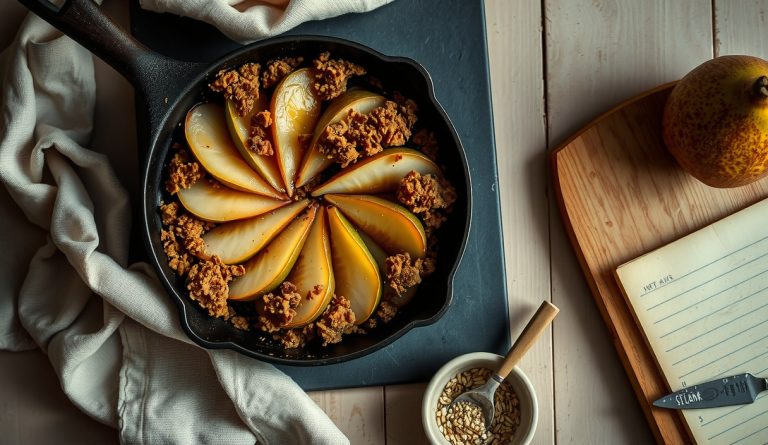
Pear and cardamom. Substitute Bosc pears for the Honeycrisp and add 1/2 teaspoon of ground cardamom to the filling spice blend. Bosc pears have a slightly lower natural pectin content than apples, so the filling will be somewhat looser — add an extra 1/2 tablespoon of cornstarch to compensate. The floral, citrus-forward character of cardamom pairs exceptionally well with cherry wood smoke.
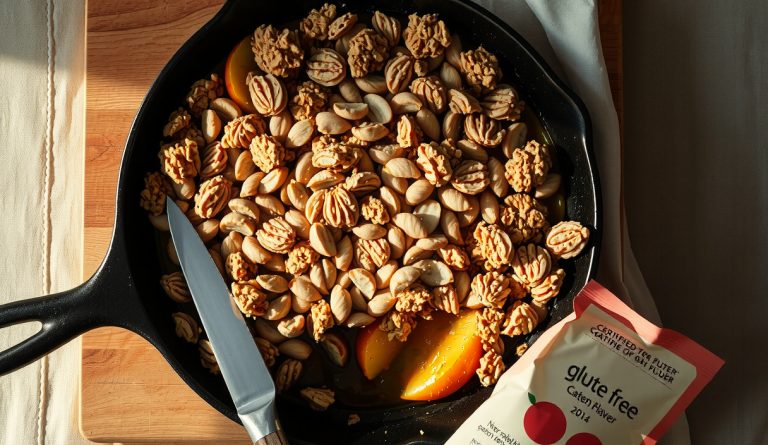
Gluten-free adaptation. Replace the all-purpose flour in the crumble with certified gluten-free oat flour at a 1:1 substitution by weight. The crumble will be slightly more sandy in texture because oat flour lacks the gluten network that provides some cohesion, but the Maillard browning and smoke uptake are essentially identical. Verify that the rolled oats are also certified gluten-free — cross-contact in oat processing facilities is a real concern.
Bourbon-brown-butter version. Brown 6 tablespoons of butter in a small saucepan over medium heat until the milk solids turn amber and smell nutty — approximately 5 to 7 minutes. The browning initiates the same Maillard reactions that will occur in the crumble, front-loading complexity. Cool the brown butter until it solidifies slightly (about 20 minutes in the refrigerator), then cut it into the crumble as you would cold butter. Add 2 tablespoons of bourbon to the apple filling with the other liquids. The ethanol evaporates during the first 15 minutes of cooking, leaving behind congeners — isoamyl alcohol derivatives and wood-derived vanillin — that amplify the smoke character of the finished dessert.
Scaling up for a crowd. This recipe is calibrated for a 10-inch skillet serving 6 to 8. To scale for a 12-inch skillet serving 10 to 12, multiply all filling ingredients by 1.5 and all crumble ingredients by 1.5. Cook time increases to approximately 50 minutes at 350°F — the larger thermal mass of the filling takes longer to drive to the 180°F pectin-breakdown threshold. A 14-inch skillet is not recommended because the crumble-to-fruit ratio shifts toward excess crumble and the center of the filling may underperform the edges.
Frequently asked questions
Can I make smoked apple crisp in a conventional oven instead of a smoker? Yes. Bake at 350°F for 40 to 45 minutes on the center rack. The oven version loses the smoke-deposited phenolics on the crumble surface and the aggressive bottom-crust Maillard from convective radiant heat, but the underlying apple crisp is excellent on its own terms. Consider adding 1/4 teaspoon of smoked sea salt to the crumble to gesture toward the smoke register.
Why do the apples turn mushy instead of jammy? Mushy filling is almost always caused by cutting apple slices too thin (under 3/16 inch) or by running the smoker above 375°F. At higher temperatures, pectin depolymerization is so rapid and complete that the cell wall collapses entirely before any residual structure can set. The fix is thicker, more uniform 1/4-inch slices and strict temperature control at the grate level. A probe thermometer in the filling is the definitive tool — pull the skillet at 185 to 190°F internal filling temperature.
Can the crumble be made ahead of time? Yes, and making it ahead actually improves the result. Combine the dry crumble ingredients with cold butter cubes, work the mixture until it forms pea-sized clumps, and refrigerate covered for up to 48 hours. The resting time allows the butter to fully coat the oat and flour particles, and the cold fat will crisp more dramatically when it hits the hot smoker environment. Do not add the crumble to the skillet until ready to cook — the butter will begin to soften and lose its discrete clump structure at room temperature.