Grilled Pineapple with Tajín

Equipment
- 1 Gas or charcoal grill Must reach 450°F minimum surface temperature. Preheat 15 minutes with lid closed.
- 1 Infrared thermometer Optional but highly recommended for confirming grate temperature.
- 1 pair Long-handled tongs
- 1 Chef’s knife Sharp knife essential for clean spear cuts without crushing the fruit.
- 1 Cutting board
- several Paper towels For drying cut faces before grilling.
- 1 Pastry brush For oiling the grate and fruit.
Ingredients
- 1 large ripe pineapple Golden-yellow exterior, fragrant at the base. Do not substitute pre-cut rings.
- 2 tablespoons avocado oil or refined coconut oil High smoke point required. Divided — half for grate, half for fruit.
- 1.5 tablespoons Tajín Clásico seasoning The standard salted version; do not substitute Tajín Sin Sal.
- 1 lime Cut into wedges for serving.

Instructions
Prep the pineapple
- Lay the pineapple on its side and slice off the top crown and the bottom base, removing about 1/2 inch on each end to expose fresh flesh. Stand the pineapple upright and cut straight down to remove the skin in strips, following the curve of the fruit and cutting just deep enough to remove the eyes. Aim to waste as little flesh as possible.1 large ripe pineapple
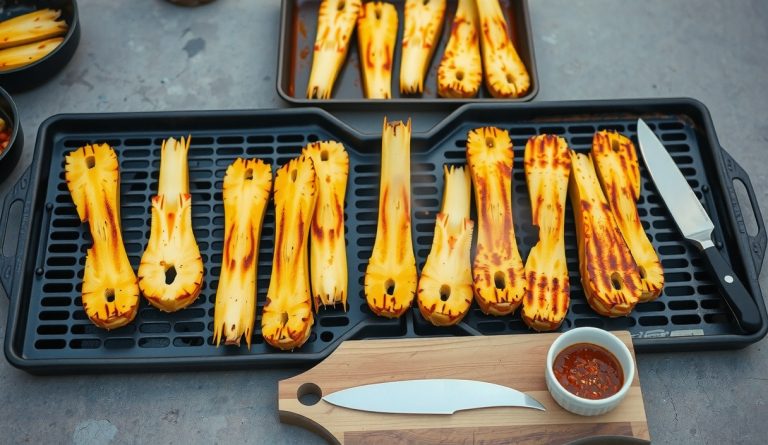
- Cut the peeled pineapple in half lengthwise through the core. Cut each half into 2 equal wedges lengthwise, giving you 4 long spears. For thicker pineapples, cut into thirds to produce 6 spears. Optional: trim the fibrous central core from each spear by running your knife along its edge — the core cooks unevenly and tends to be tough.1 large ripe pineapple
- Pat every cut face of each spear thoroughly dry with paper towels. This step removes surface moisture that would otherwise flash to steam on the grate and delay caramelization by 2 to 3 minutes. Dry surfaces brown faster and more evenly.1 large ripe pineapple
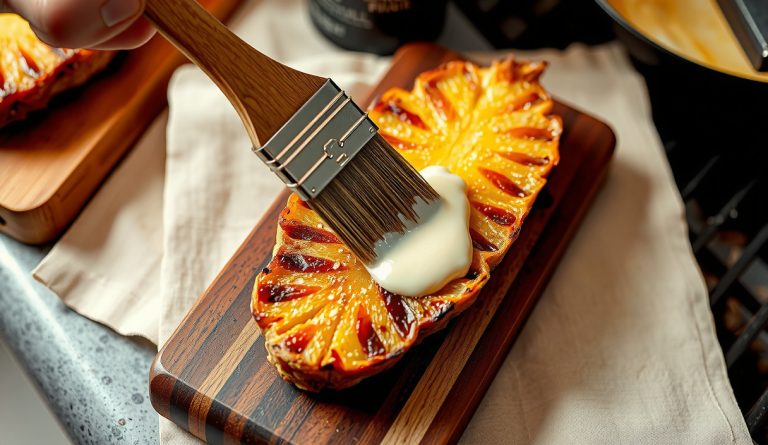
- Brush all cut faces of the spears lightly with oil. Use just enough to coat — a thin film prevents the caramelizing sugars from cementing to the grate prematurely.2 tablespoons avocado oil or refined coconut oil
Preheat and oil the grill
- Preheat your grill on high with the lid closed for at least 15 minutes. Verify the grate surface temperature has reached 450°F (232°C) using an infrared thermometer, or use the palm test: hold your hand 3 inches above the grate — if you cannot hold it there for more than 2 seconds, the grate is hot enough.
- Using a folded paper towel held with tongs, wipe the grate with a thin coat of avocado oil just before adding the pineapple. A well-oiled, properly preheated grate is critical for clean release.2 tablespoons avocado oil or refined coconut oil
Grill the pineapple
- Place the pineapple spears cut-face-down on the hot grate. Do not move them for the first 3 to 4 minutes. The caramelizing sugar crust needs to set and polymerize before the spear will release cleanly. Attempting to move the spear before it is ready will tear the caramel layer off and leave it on the grate.1 large ripe pineapple
- After 3 to 4 minutes, check one spear: slide tongs under it gently. If it resists, wait 30 to 60 more seconds and check again. When it releases cleanly, the cut face should show deep amber to dark-brown char with visible caramel color. Rotate each spear 90 degrees onto the second cut face and grill another 3 to 4 minutes for the second set of char marks.1 large ripe pineapple
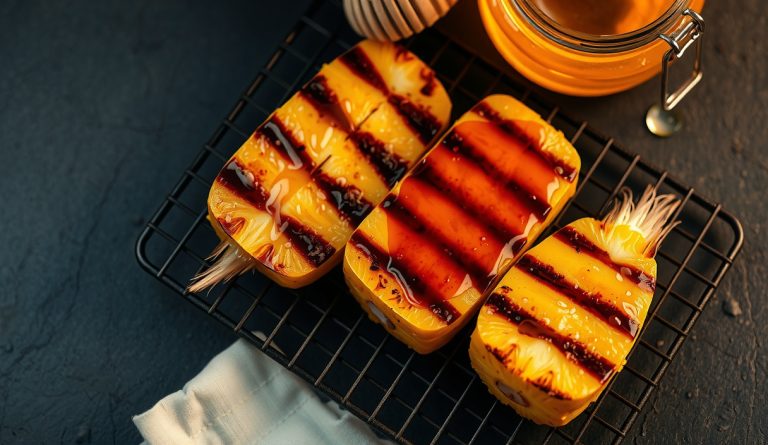
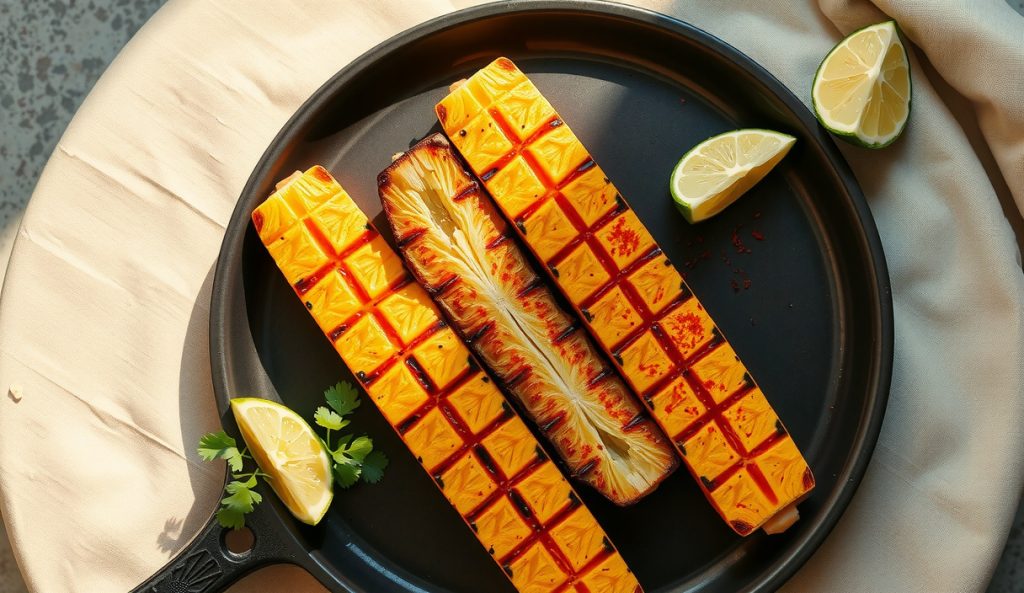
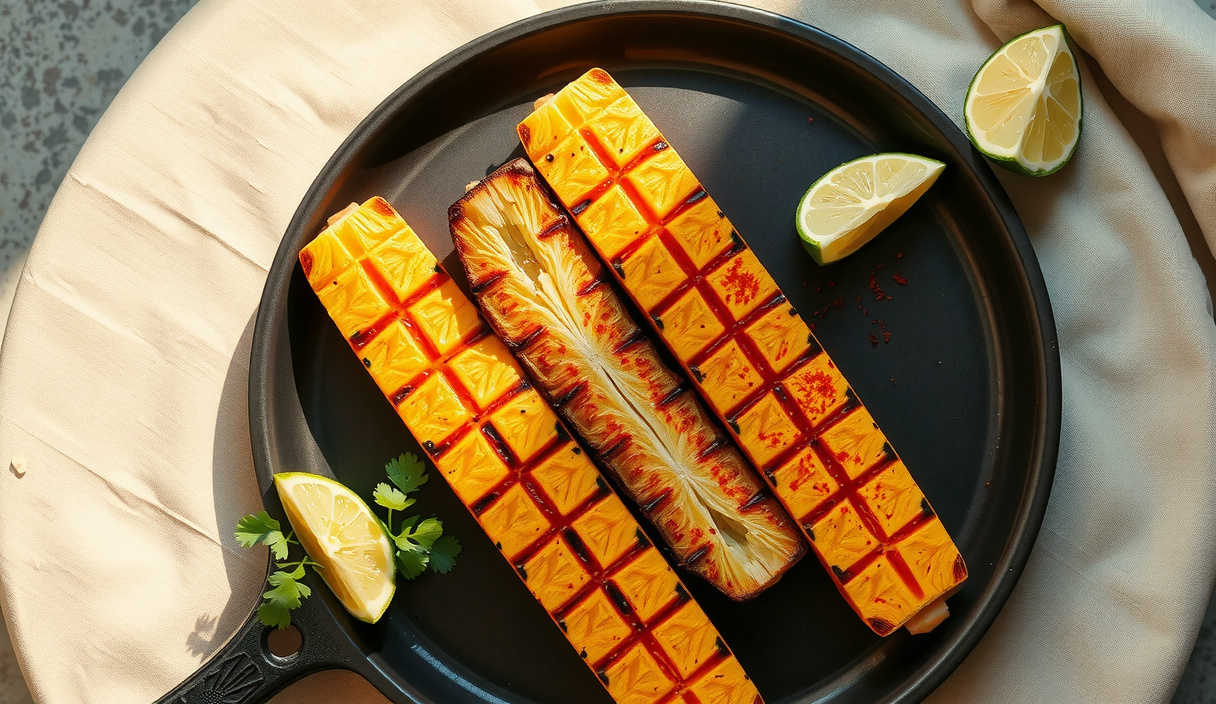
- Optionally rotate to the skin side for 1 to 2 minutes to heat through completely, though this side does not caramelize. Total grill time per spear: 7 to 10 minutes. Target visual cue: both flat faces show uniform golden-amber caramelization with dark grill marks. Pale beige indicates insufficient temperature or early flipping.1 large ripe pineapple
Finish and serve
- Transfer spears to a serving platter or board. Let them rest uncovered for 2 minutes — the caramel surface, still molten from the grate, will firm into a crackable shell as it cools slightly. Do not cover; steam will dissolve the crust.
- Immediately before serving, dust each spear generously and evenly with Tajín Clásico. Apply it now — not before grilling — so the citric acid in the seasoning remains bright and sharp rather than burning to a bitter residue on the grate. The salt in Tajín will begin amplifying the sweetness of the caramel within seconds of contact.1.5 tablespoons Tajín Clásico seasoning
- Serve immediately with lime wedges on the side. A squeeze of fresh lime over the spear just before eating adds a final hit of volatile citrus terpenes that the dehydrated lime in the Tajín alone cannot fully replicate.1 lime
Notes
Nutrition
The first time I put a pineapple spear on a screaming-hot grate I expected sweetness. What I got instead was something closer to a dessert cooked over open flame — amber char lines, a caramel shell that cracked under the tooth, and a molten core still holding its acid. Add Tajín — that Mexican chili-lime-salt powder that has colonized every fruit cart from Tijuana to Chicago — and you have one of the shortest ingredient lists in the barbecue canon delivering one of the most complex flavor arcs on the plate.
Grilled pineapple with Tajín is a recipe about heat management and chemistry, not about babysitting fruit. Five minutes of prep, ten minutes on the grill, and the result works as a side for smoked pork shoulder, a shareable appetizer, or a legitimate dessert with a scoop of coconut sorbet alongside. What follows is an exact account of what is happening at the molecular level so you can replicate the dish every single time without guesswork.
Why does grilled pineapple with Tajín work? The science
Grilled pineapple develops its caramel crust and jammy interior through a precise sequence of physical and chemical events triggered by grill heat. Pineapple flesh is roughly 12–15% total dissolved sugars, predominantly sucrose with smaller fractions of glucose and fructose. When a spear contacts a 450°F grill grate, the surface temperature of the cut face climbs rapidly — but the first event is not browning, it is evaporation. Free surface moisture must vaporize before the boundary-layer temperature can exceed 212°F, which is why the initial 60 to 90 seconds on the grate produce steam rather than color.
Once surface moisture clears, the temperature at the cut face surges past the threshold for sucrose pyrolysis and the Maillard cascade. Sucrose caramelizes beginning around 320°F (160°C), fragmenting into hundreds of furanones, diacetyl, and volatile lactones that register as butterscotch, tropical stone fruit, and faint rum. This is pure non-enzymatic browning driven by thermal energy alone — identical chemistry to a traditional sugar reduction in a copper pan, executed over a radiant charcoal or gas flame instead of a burner.
Simultaneously, pineapple contains bromelain, a cysteine protease that operates optimally between 50°C and 60°C (122–140°F). As the interior of the spear slowly climbs through that range during grilling, bromelain hydrolyzes some of the cell-wall proteins, softening texture and releasing additional free amino acids into the matrix. Those amino acids become new Maillard reactants at the surface once temperatures climb higher, layering savory depth onto the caramel sweetness. Above approximately 70°C (158°F) the enzyme denatures irreversibly — which is why grilled pineapple does not produce the tongue-tingling sting of raw pineapple. The structural consequence is a spear with a lightly crisp, deeply browned exterior and a yielding, jammy interior rather than the fibrous chew of raw fruit.
Tajín brings three interacting variables to the flavor equation. The salt (sodium chloride) suppresses the perception of bitterness from char and simultaneously enhances sweetness through a well-documented cross-modal receptor interaction — salt at low concentrations sharpens sweetness without adding its own noticeable flavor. The chili (a guajillo and pasilla blend) delivers capsaicin and dihydrocapsaicin, activating TRPV1 thermoreceptors and creating chemesthetic heat that amplifies the perceived warmth from the grill itself. The dehydrated lime juice (pH approximately 2.5–3.0) adds citric acid, which brightens the retronasal olfactory profile by increasing the volatility of the terpene fraction — specifically limonene and citral — locked in the fruit’s cell walls. The result is a flavor system with genuine trigeminal complexity: sweet, sour, spicy, savory, and smoky operating in sequence across the palate.
What equipment and ingredients do I need?
The grill: Gas and charcoal both work. A surface temperature of 450°F minimum is required — use an infrared thermometer if available, or hold your palm 3 inches above the grate; if you cannot keep it there for more than 2 seconds, the grill is in range. A cooler grill will steam the pineapple rather than char it, and proper caramelization will never develop.
Cast iron grill grates: Cast iron is highly recommended because it holds radiant heat more evenly than thin stainless steel rods, creating wider, more uniform char marks and better heat retention when cold fruit contacts the surface. If your grill has thin stainless grates, preheat an extra 10 minutes before grilling.
Pineapple selection: Choose a pineapple with a golden-yellow exterior, a fragrant base, and leaves that pull free easily. An underripe pineapple — green exterior, no aroma — has higher citric and malic acid concentration and lower sugar content, which means less caramelization potential and a sharper, one-dimensional result. Avoid pre-cut grocery store rings; the cut face has been oxidizing and drying since packaging, which disrupts the even moisture evaporation phase that precedes browning.
Tajín Clásico vs. Tajín Sin Sal: The standard Clásico formulation is what this recipe requires. The sin sal (no-salt) version removes the cross-modal sweetness-amplification effect described in the science section above. To control sodium precisely, use Clásico sparingly rather than switching products.
Oil: A thin coat of neutral high-smoke-point oil — avocado or refined coconut, both rated above 400°F — applied to the grate and to the fruit prevents caramelizing sugars from cementing to the metal before browning is complete. Do not use extra-virgin olive oil; it smokes heavily below grill temperature and introduces bitter polyphenol oxidation products.
Grilled Pineapple with Tajín
Equipment
- 1 Gas or charcoal grill Must reach 450°F minimum surface temperature. Preheat 15 minutes with lid closed.
- 1 Infrared thermometer Optional but highly recommended for confirming grate temperature.
- 1 pair Long-handled tongs
- 1 Chef’s knife Sharp knife essential for clean spear cuts without crushing the fruit.
- 1 Cutting board
- several Paper towels For drying cut faces before grilling.
- 1 Pastry brush For oiling the grate and fruit.
Ingredients
- 1 large ripe pineapple Golden-yellow exterior, fragrant at the base. Do not substitute pre-cut rings.
- 2 tablespoons avocado oil or refined coconut oil High smoke point required. Divided — half for grate, half for fruit.
- 1.5 tablespoons Tajín Clásico seasoning The standard salted version; do not substitute Tajín Sin Sal.
- 1 lime Cut into wedges for serving.
Instructions
Prep the pineapple
- Lay the pineapple on its side and slice off the top crown and the bottom base, removing about 1/2 inch on each end to expose fresh flesh. Stand the pineapple upright and cut straight down to remove the skin in strips, following the curve of the fruit and cutting just deep enough to remove the eyes. Aim to waste as little flesh as possible.1 large ripe pineapple
- Cut the peeled pineapple in half lengthwise through the core. Cut each half into 2 equal wedges lengthwise, giving you 4 long spears. For thicker pineapples, cut into thirds to produce 6 spears. Optional: trim the fibrous central core from each spear by running your knife along its edge — the core cooks unevenly and tends to be tough.1 large ripe pineapple
- Pat every cut face of each spear thoroughly dry with paper towels. This step removes surface moisture that would otherwise flash to steam on the grate and delay caramelization by 2 to 3 minutes. Dry surfaces brown faster and more evenly.1 large ripe pineapple
- Brush all cut faces of the spears lightly with oil. Use just enough to coat — a thin film prevents the caramelizing sugars from cementing to the grate prematurely.2 tablespoons avocado oil or refined coconut oil
Preheat and oil the grill
- Preheat your grill on high with the lid closed for at least 15 minutes. Verify the grate surface temperature has reached 450°F (232°C) using an infrared thermometer, or use the palm test: hold your hand 3 inches above the grate — if you cannot hold it there for more than 2 seconds, the grate is hot enough.
- Using a folded paper towel held with tongs, wipe the grate with a thin coat of avocado oil just before adding the pineapple. A well-oiled, properly preheated grate is critical for clean release.2 tablespoons avocado oil or refined coconut oil
Grill the pineapple
- Place the pineapple spears cut-face-down on the hot grate. Do not move them for the first 3 to 4 minutes. The caramelizing sugar crust needs to set and polymerize before the spear will release cleanly. Attempting to move the spear before it is ready will tear the caramel layer off and leave it on the grate.1 large ripe pineapple
- After 3 to 4 minutes, check one spear: slide tongs under it gently. If it resists, wait 30 to 60 more seconds and check again. When it releases cleanly, the cut face should show deep amber to dark-brown char with visible caramel color. Rotate each spear 90 degrees onto the second cut face and grill another 3 to 4 minutes for the second set of char marks.1 large ripe pineapple
- Optionally rotate to the skin side for 1 to 2 minutes to heat through completely, though this side does not caramelize. Total grill time per spear: 7 to 10 minutes. Target visual cue: both flat faces show uniform golden-amber caramelization with dark grill marks. Pale beige indicates insufficient temperature or early flipping.1 large ripe pineapple
Finish and serve
- Transfer spears to a serving platter or board. Let them rest uncovered for 2 minutes — the caramel surface, still molten from the grate, will firm into a crackable shell as it cools slightly. Do not cover; steam will dissolve the crust.
- Immediately before serving, dust each spear generously and evenly with Tajín Clásico. Apply it now — not before grilling — so the citric acid in the seasoning remains bright and sharp rather than burning to a bitter residue on the grate. The salt in Tajín will begin amplifying the sweetness of the caramel within seconds of contact.1.5 tablespoons Tajín Clásico seasoning
- Serve immediately with lime wedges on the side. A squeeze of fresh lime over the spear just before eating adds a final hit of volatile citrus terpenes that the dehydrated lime in the Tajín alone cannot fully replicate.1 lime
Notes
Nutrition
How do I nail grilled pineapple every time?
- Dry the surface before the pineapple hits the grate. Pat cut faces with paper towels. Any pooled juice will flash to steam on contact, dramatically slowing the surface temperature rise and delaying caramelization by 2 to 3 minutes. A dry surface equals faster, deeper browning.
- Do not move the spears for the first 3 minutes. The Maillard crust needs to polymerize and release naturally from the grate. Flipping before the sugars have set tears the char off and destroys the caramel layer entirely. The spear releases cleanly when it is ready — this is physics, not patience.
- Apply Tajín after pulling from the grill, not before. Applying Tajín to raw fruit before grilling drives the dehydrated lime powder into the surface where it carbonizes. The citric acid in Tajín produces acrid, bitter pyrolysis products above 300°F. Dust Tajín on the moment the spear comes off the heat so salt and acid perform their sensory functions without burning.
- Watch for color, not the clock. Times are given as a range because pineapple sugar content and grill output vary significantly. Pull pineapple spears when char marks are deep amber to dark brown and the cut face shows uniform golden caramelization. Pale beige means the grill was not hot enough or the spear was flipped too early.
- Rest 2 minutes before serving. The internal temperature will continue to equalize, and the caramel surface will harden slightly from its molten state into a crackable shell. Serving immediately off the grate means the caramel is still liquid and will smear rather than shatter.
- Avoid the core on thick spears. The fibrous central core of pineapple resists heat penetration and stays undercooked even when the outer flesh is perfectly caramelized. Cut spears to include minimal core, or trim it entirely for a more uniform eating experience.
What variations can I make with this recipe?
Honey-glazed version: Brush each spear with a thin layer of raw wildflower honey 90 seconds before pulling from the grill. Honey is roughly 70–80% fructose and glucose — both reducing sugars with lower Maillard activation energy than sucrose — so the glaze browns intensely in under two minutes. Watch carefully; at 450°F the honey glaze moves from deep amber to burnt in under 30 seconds. The honey layer adds a floral aromatic register and a lacquered surface. Still apply Tajín post-grill.
Coconut-rum finish: Pull the spears, brush immediately with a 50/50 mix of dark rum and coconut cream, then dust with Tajín. The ethanol in the rum dissolves and carries lipophilic aroma compounds from both the caramelized pineapple surface and the chili in the Tajín, briefly amplifying the nose before evaporating. This variation pairs with grilled fish tacos or smoked pork belly. Note that the alcohol flares briefly if the spear is still hot enough — keep the brushed spears away from an open flame.
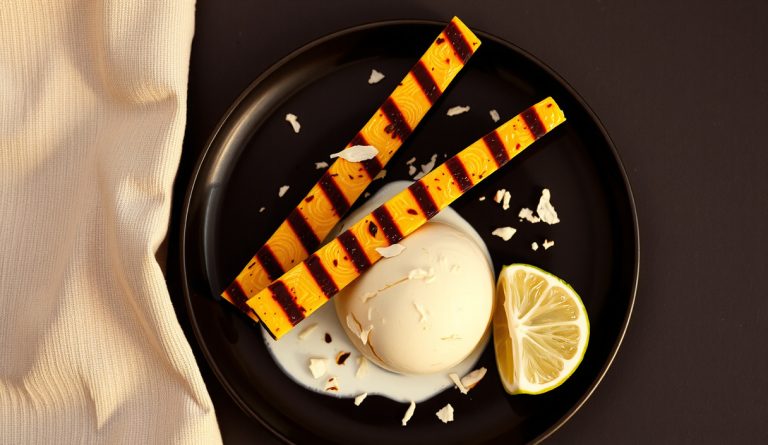
Vegan dessert plate: Serve two spears over a scoop of coconut sorbet with a sprinkle of toasted unsweetened coconut flakes and a lime wedge. The cold sorbet creates a dramatic thermal contrast that accelerates flavor release from the warm caramelized surface — fat-soluble aromatic compounds partition rapidly into the coconut lipid phase of the sorbet, extending the finish on the palate. This presentation is fully plant-based with no modifications to the core recipe.
Scaling for a crowd: This recipe scales linearly — one pineapple yields 8 spears, two pineapples yield 16. The only constraint is grill real estate. Do not crowd spears; each piece needs direct radiant contact with the grate for proper caramelization. Work in batches if needed, holding finished spears in a 200°F oven loosely tented with foil for up to 15 minutes before Tajín application and service. Do not apply Tajín until the moment of plating regardless of hold time.
Frequently asked questions
Can I make grilled pineapple on a grill pan indoors? Yes, with caveats. A cast-iron grill pan preheated over high heat for 5 to 7 minutes will reach sufficient surface temperature for caramelization, though it will not replicate the radiant smoke character of an outdoor grill. Use your kitchen exhaust fan on high — caramelizing sugars at this temperature produce significant smoke. The underlying chemistry is identical; the grill pan simply lacks the convective smoke environment that deposits pyrolysis compounds onto the fruit surface.
Why does pineapple stick to the grate even when oiled? Two likely causes: the grill was not hot enough when the fruit went on, or the fruit surface was wet. At the proper temperature of 450°F, caramelizing sugars form a crust that polymerizes and releases naturally in 3 to 4 minutes. At lower temperatures, the sugars remain viscous and sticky throughout the cook, cementing to the grate. Re-oil the grate between batches and ensure it returns to full temperature before adding the next round.
Is grilled pineapple safe for people sensitive to bromelain? Grilling fully inactivates bromelain above approximately 158°F (70°C), eliminating the enzymatic activity that causes oral allergy syndrome in some raw-pineapple-sensitive individuals. However, the underlying fruit proteins that trigger IgE-mediated pineapple allergy are distinct from bromelain activity and may or may not be fully denatured by cooking. Anyone with a diagnosed pineapple allergy should consult their allergist before consuming grilled pineapple — do not rely on cooking as a guaranteed mitigation for true allergic reactions.