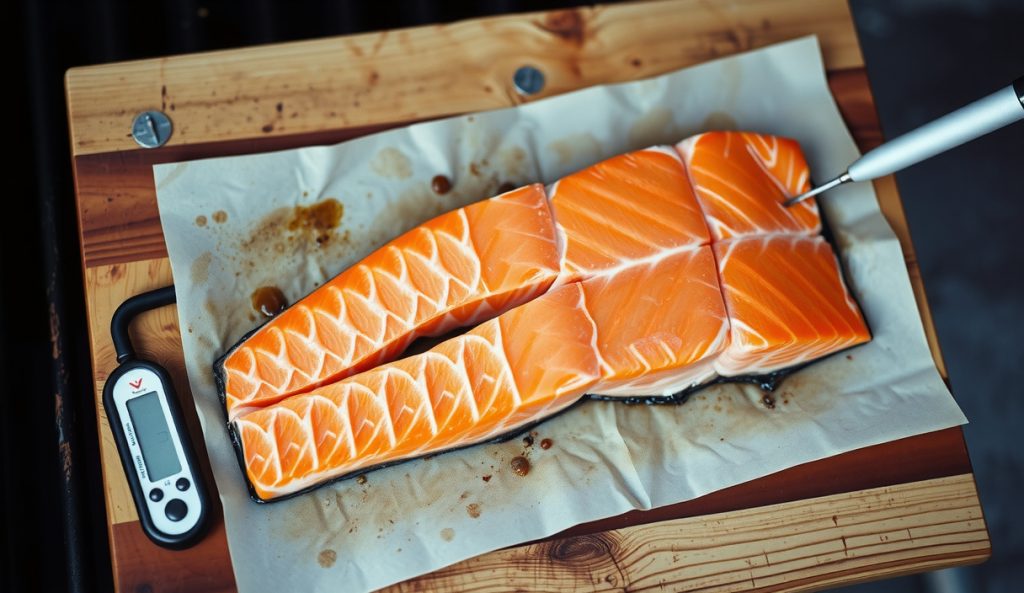
King salmon carries 15 to 20 percent intramuscular fat by weight at peak season, making it the richest Pacific salmon species. That fat acts as both a moisture reservoir and a thermal buffer during smoking, which is why the canonical cure window and finish temperature are calibrated specifically for King. Sockeye and coho are leaner species, typically landing between 6 and 12 percent fat depending on season and origin — and that difference is not cosmetic. Lower fat content changes how the cure behaves, how quickly the fish dries, and how unforgiving the final few degrees of cook become.
What changes when smoking sockeye or coho instead of King?
Reduce the cure window to 2 to 2.5 hours maximum — do not push to the 3-hour ceiling used for King salmon. Because lower intramuscular fat means the osmotic gradient of the salt cure acts more aggressively on muscle water (less lipid phase is present to buffer the draw), leaner fish firm up faster and risk over-curing at longer exposures. Check the fillet at the 2-hour mark: the flesh should feel noticeably firmer than raw, with surface moisture visible but not pooling.
Target a finish internal temperature of 125°F rather than the 130°F used for King salmon. The actin denaturation threshold — the point at which muscle proteins tighten and begin expressing moisture aggressively — is the same across salmon species, around 140°F. The difference is that the lipid buffer carrying a King fillet safely through the 125–130°F window is largely absent in sockeye and coho. Pulling the leaner fillet at 125°F preserves a slightly custardy interior and eliminates the chalky, dry result that comes from even modest overcooking in low-fat fish. Rest the fillet loosely tented for 5 minutes before serving; carryover heat will bring the center up 2 to 3°F.
What stays the same when adapting to sockeye or coho?
The cure ratio (3:1 salt to sugar by weight, scaled to fish weight), the rinse and air-dry pellicle step, the smoker temperature of 180°F, and the smoke wood selection all remain unchanged from the King salmon method. The structural logic of the technique — cure, dry, smoke low and slow — is as appropriate for leaner species as it is for King. Only the cure duration and the pull temperature shift.
When is this adaptation the better choice?
This adaptation is the correct path any time King salmon is unavailable or cost-prohibitive. Sockeye’s deeper red pigmentation and more assertive flavor make it an excellent smoking fish in its own right; coho sits between King and sockeye in richness and works well for guests who prefer a lighter-textured result. Both species benefit from the same albumin-control technique — a slow-rise pellicle and a 180°F smoker temperature — that makes the canonical method effective.
Use the full method, equipment, and rub measurements from the original Pellet-Smoked King Salmon, applying only the cure time and finish temperature changes described here.