Scaling smoked beef jerky for a crowd introduces one counterintuitive truth: more meat does not mean more time in the smoker, provided your equipment can maintain airflow across every rack. The marinade formula is strictly linear — doubling raw weight from two pounds to four pounds means doubling every ingredient with no chemistry to recalculate. The challenge is entirely mechanical, centering on convection management rather than seasoning math.
What changes when you scale smoked beef jerky to a large batch?
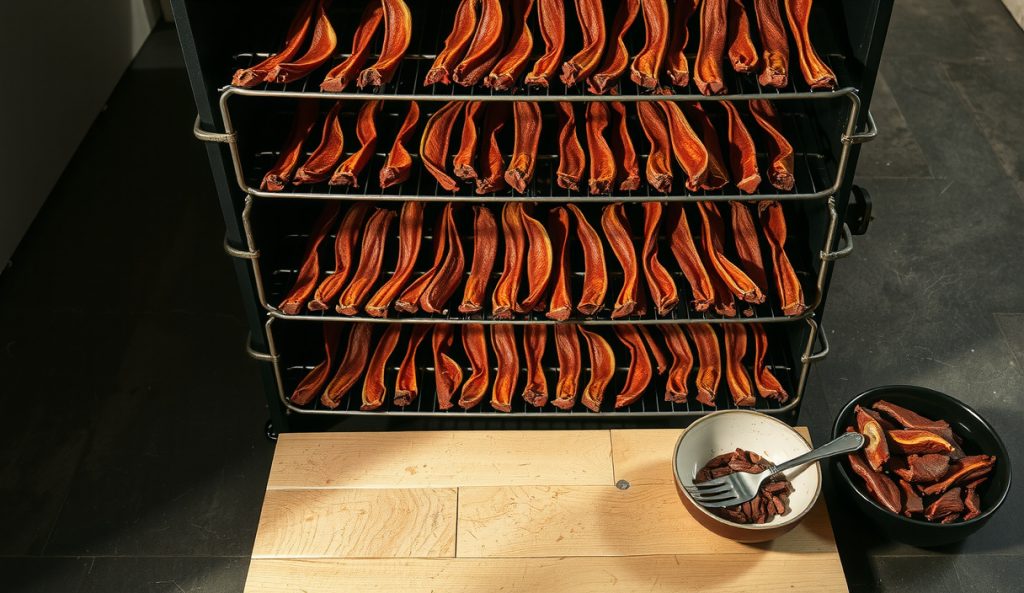
Double the meat, double every marinade component proportionally. A 4-pound batch distributed across two racks — single-layer strips with visible space between them — occupies the same effective drying surface area as a 2-pound single-rack batch, and therefore falls within the same 4-to-6-hour drying window at 225°F.
What does not scale is convection. Hot-air smokers, bullet smokers, and pellet units are engineered around specific internal airflow paths. Inserting additional racks beyond the manufacturer’s intended configuration creates convection dead zones, particularly at center grates where exhaust airflow is partially blocked by upper racks. Strips in those dead zones dry significantly more slowly than strips at the top or bottom, producing batches where some pieces finish underweight in moisture while others remain above safe water activity.
If your smoker physically supports a third rack but was not engineered for three-rack simultaneous loads, stagger the batches rather than crowding: pull and rest the first two racks, then run the third separately. Rack discipline is the single variable that determines whether large-batch jerky matches the quality of a standard 2-pound run.
What stays the same when scaling smoked beef jerky?
Marinade soak time, smoker temperature (225°F), the bend-test doneness standard, and the post-smoke resting protocol are all identical to the canonical single-batch method. Scaling a large batch of smoked beef jerky does not change the recipe — it is a logistics exercise around a fixed drying process, not a reformulation.
When is large-batch smoked beef jerky the better choice?
Large-batch smoked beef jerky is the right approach for batch gifting, long road trips, hunting and camping provisioning, or any scenario where a standard 2-pound yield is insufficient. It is also the correct framework for anyone moving toward regular weekly production: establishing clean rack discipline and airflow habits at 4 pounds makes the process repeatable at scale without quality drift over successive sessions.
Use the full method, equipment notes, and marinade formula from the original Smoked Beef Jerky — Lean Round and scale marinade ingredients proportionally to your target weight.