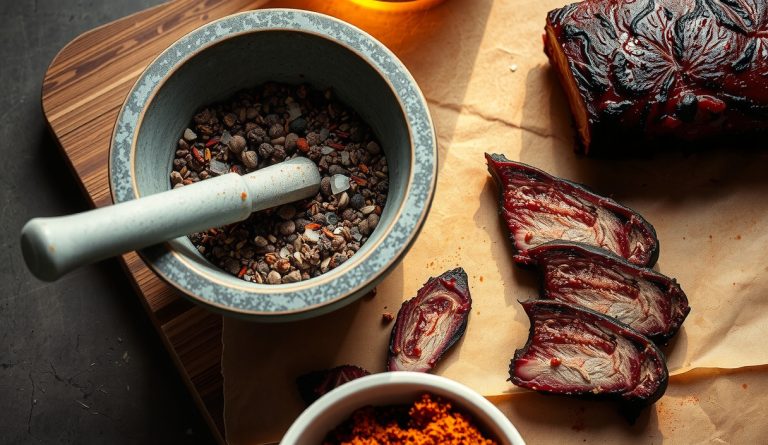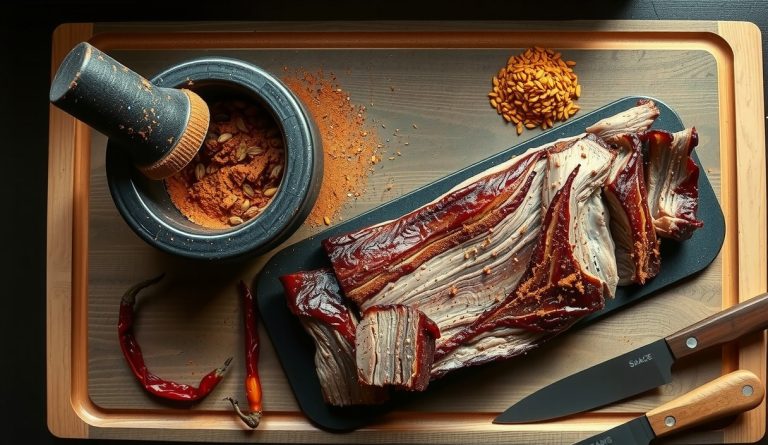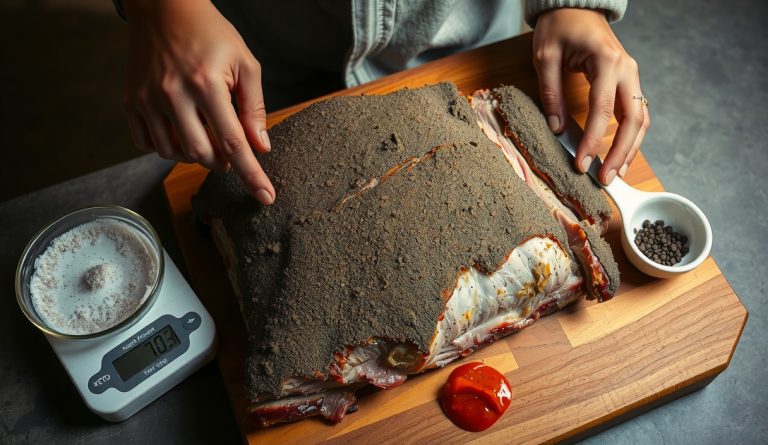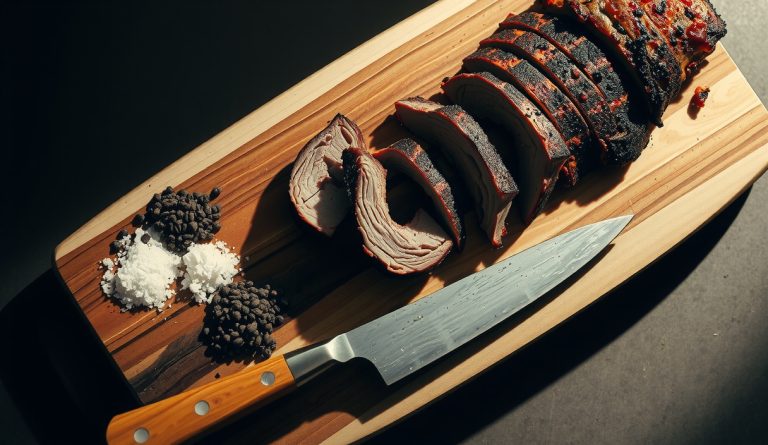
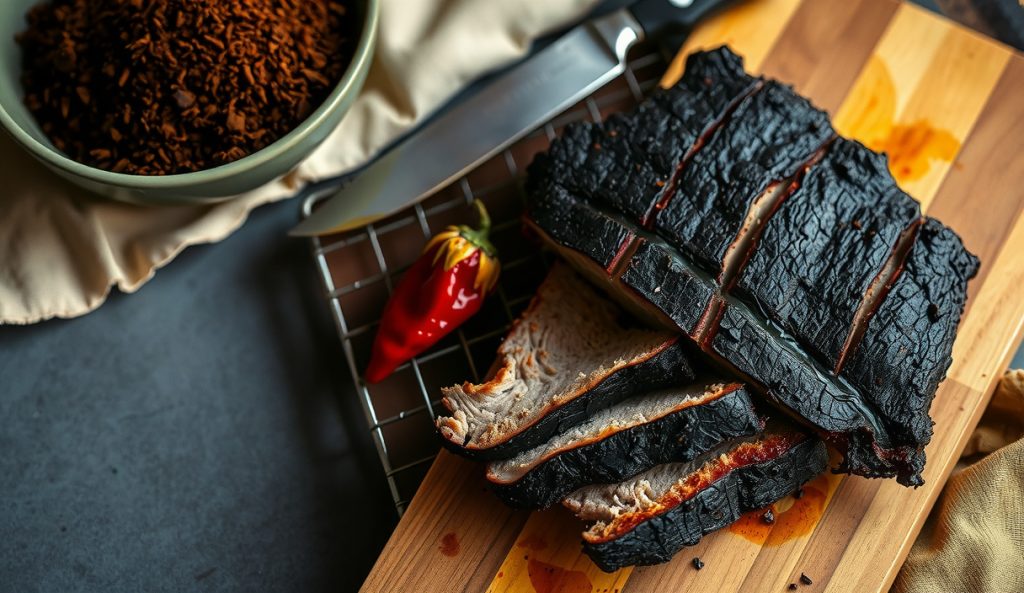
Coffee and beef share a deep chemical kinship: both undergo extensive Maillard browning during processing or cooking, and both accumulate furans, pyrazines, and melanoidins as the end products of that browning. Adding 10 grams of finely ground espresso roast to the keto brisket rub exploits that overlap deliberately, seeding the brisket’s surface with pre-formed roast compounds before the cook even begins.
The result is a bark that reads darker and more complex than the base recipe — pronounced roasted bitterness upfront, with the ancho chile providing a slow-building dried-fruit finish underneath. This coffee-ancho variant is particularly suited to the fatty point-cut, where the richness of rendered intramuscular fat benefits from the coffee’s bittering counterbalance.
What changes in the coffee-ancho variation?
Add 10 grams of finely ground espresso roast — medium-fine grind, the consistency of table salt, not coarse-ground. Coarser coffee particles sit proud of the bark surface and can char to acrid carbon during long cooks at 250–275°F. Medium-fine grind integrates into the rub matrix and browns more uniformly. Keep allulose at the standard 5% w/w; while roasted coffee contains trace reducing sugars from its own processing, the contribution to total carbohydrate load at this application rate is negligible and does not affect keto macros in any meaningful way.
Mechanistically, coffee’s pyrazines and furans are volatile at cooking temperatures and migrate into the brisket’s surface fat layer during the early stages of the cook — specifically between 140°F and 180°F internal temperature, before the bark sets. This means those roast compounds integrate into the crust chemistry rather than simply sitting on top of it. The ancho chile powder in the base recipe remains unchanged; its dried-fruit volatile organic compounds (linalool, geraniol) counterpoint the roast bitterness effectively and should not be reduced.
What stays the same as the base keto brisket rub?
All other ingredient ratios in the base rub remain unchanged. Application rate, timing, wrap protocol, and cook temperature are identical to the canonical recipe. The 5% allulose loading, the smoked paprika and ancho proportions, and the salt-to-total-rub ratio are preserved — coffee is an additive in this variation, not a substitution for any existing component.
When is the coffee-ancho variation the better choice?
This coffee-ancho variant performs best on point-cut or whole packer briskets where fat rendering is aggressive and a bittering element is welcome. It is also the right call when cooking for guests who associate coffee-rubbed beef with high-end steakhouse preparations — the flavor profile reads as sophisticated rather than smoky-sweet. Avoid this variation on flat-only brisket, where the lower fat content can allow the roast bitterness to read as sharp rather than balanced.
Use the full method, equipment, and rub measurements from the original Keto Brisket Rub — No-Sugar Bark That Actually Forms.