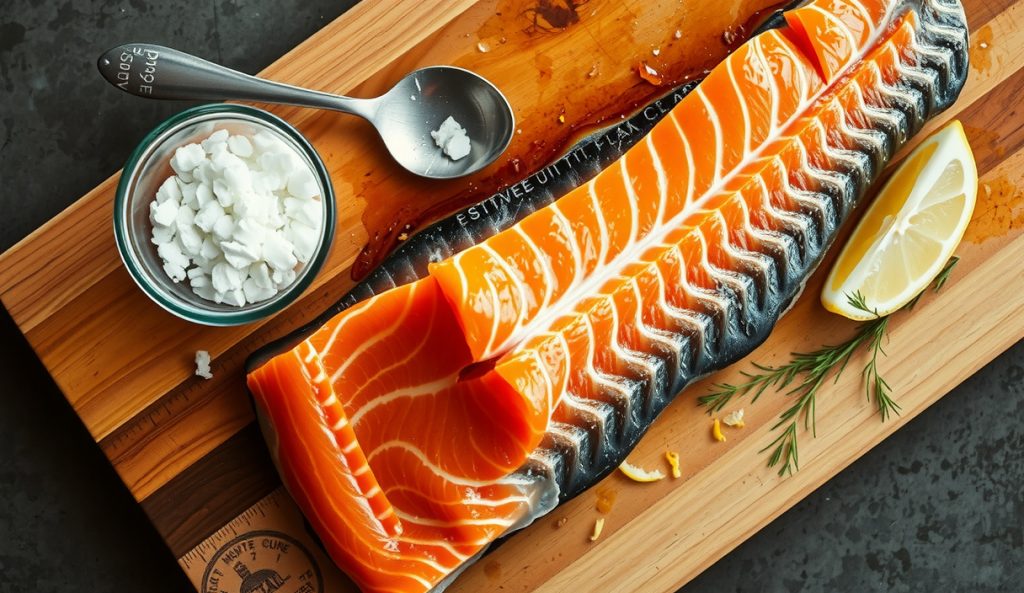
When the standard half-salt cure still delivers more sodium than a strict dietary protocol allows, a partial potassium chloride swap is the logical next step. By substituting up to 25% of the NaCl with food-grade KCl, you can meaningfully cut the sodium load while keeping the cure’s core mechanics intact. This is a precision modification — the ceiling matters as much as the floor.
What changes when you swap NaCl for KCl in a salmon cure?
Substitute up to 25% of the NaCl by weight with food-grade potassium chloride. KCl activates the same ionic conductance pathways in the taste system as NaCl and exerts a nearly identical osmotic driving force for dewatering muscle tissue, so the denaturation and pellicle-forming steps proceed on schedule. Beyond 25–30% substitution, free K+ ions become perceptible as a distinct bitterness on the back palate for most tasters — a threshold that holds consistently across the sensory literature on salt replacers.
Because KCl diffuses through salmon muscle tissue marginally faster than NaCl under equivalent ionic concentration gradients, reduce total cure contact time by 30 minutes relative to the canonical schedule. This adjustment prevents over-firming of the flesh and keeps texture within the intended range. If you are combining KCl with citrus zest and dill as a pre-blended cure, the 30-minute reduction applies from the moment the mix contacts the fish. One clinical note: individuals on ACE inhibitors or ARBs should consult a physician before meaningfully increasing dietary potassium, as these drug classes impair renal potassium excretion.
What stays the same in the low-sodium KCl variant?
The 1.5% w/w total cure ratio, the dill-citrus aromatic blend, the smoke temperature window, and all pellicle and finishing steps remain exactly as written in the canonical recipe. The KCl swap alters only the ionic composition of the salt portion — not the cure percentage, the rub application method, or the smoke protocol.
When is the KCl partial-swap variant the better choice?
This variant is best suited to cooks preparing smoked salmon for guests or household members on medically supervised sodium-restriction diets where even a half-salt cure lands above daily targets. The KCl swap is also appropriate when you want to test the sensory threshold of KCl bitterness in a controlled, small-batch context before committing to full production — the salmon format makes a direct side-by-side comparison straightforward to evaluate.
Use the full method, equipment, and rub measurements from the original Low-Sodium Smoked Salmon with Dill-Citrus Cure.