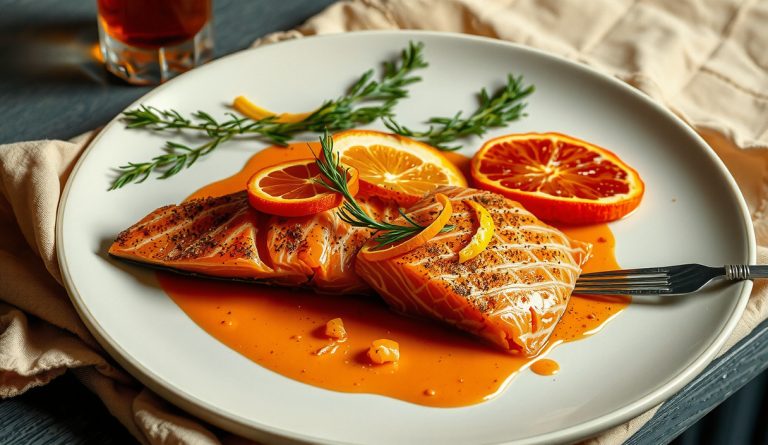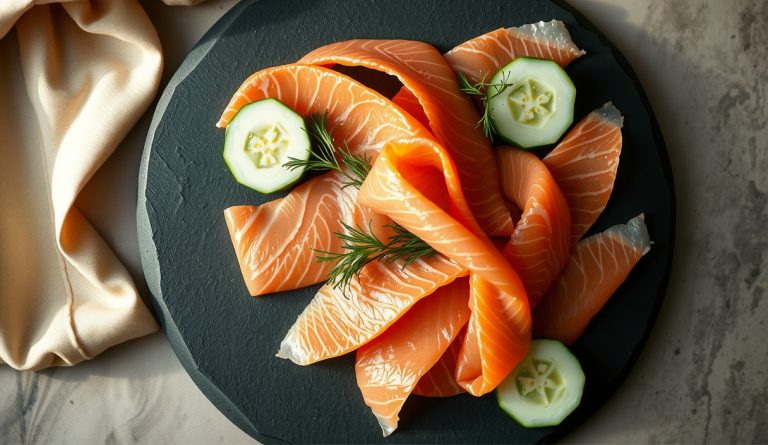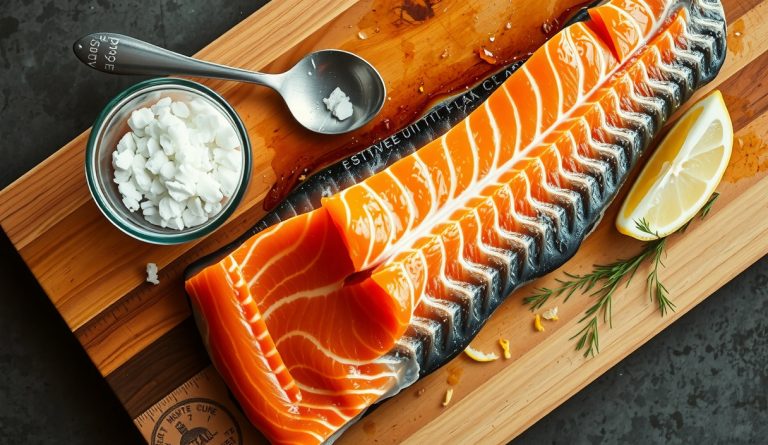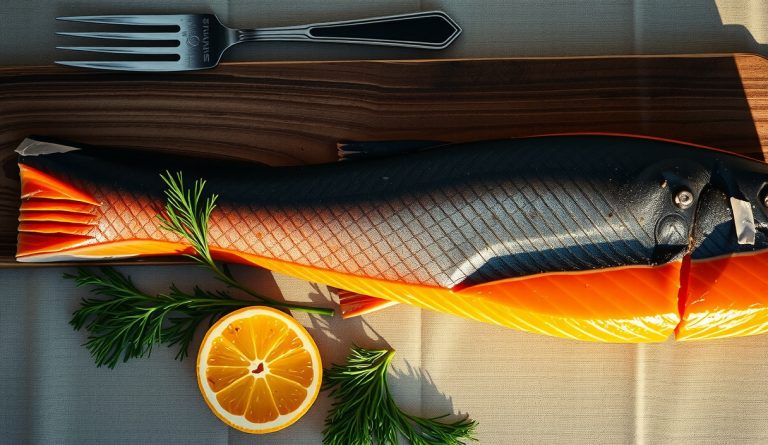
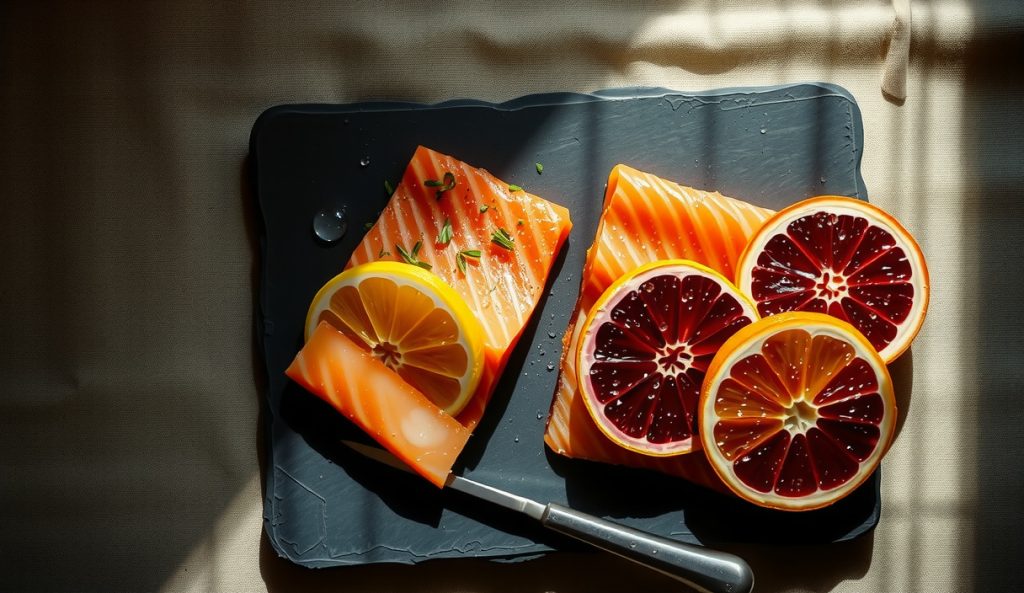
The dill-citrus combination in the canonical cure is a framework, not a fixed formula. The salt percentage does the structural work; the aromatics are a separate creative layer that rotates with the season without altering cure kinetics, contact time, or smoke protocol. Two tested rotations — tarragon-Meyer lemon for winter, and fennel frond-blood orange for a Sicilian-leaning spring or autumn build — demonstrate how far the aromatic profile can travel while the underlying method stays completely unchanged.
What changes when you substitute the herbs and citrus?
For a winter cure, replace dill with fresh tarragon and substitute Meyer lemon zest for standard lemon. Tarragon’s primary volatile compounds — estragole and ocimene — are more anise-forward and less grassy than dill’s carvone-driven profile, producing a more delicate, slightly sweet aromatic impression that reads as elegant against fatty salmon. Meyer lemon zest carries higher sugar content and lower acidity than Eureka lemon, softening the citrus edge without removing it.
For the Sicilian-inspired variant, use fresh fennel frond in place of dill and blood orange zest in place of standard lemon. Fennel frond’s dominant compound, anethole, shares structural family with tarragon’s estragole and delivers a clean, herbaceous anise note. Blood orange zest adds berry-adjacent anthocyanin-derived color to the cure surface and a rounder acid profile than navel or Eureka citrus. In both cases, blend the chosen herb and zest with the salt and allow the mixture to sit for 5 minutes before applying it to the fish — this brief bloom period gives heat-sensitive essential oils time to transfer into the ionic salt matrix rather than remaining as an inert surface layer that rinses away during pellicle formation.
What stays exactly the same as the canonical recipe?
The 1.5% w/w cure ratio, total contact time, pellicle-drying step, smoke temperature, and all finishing steps remain exactly as specified in the canonical recipe. The substitution is aromatic only — the cure’s dewatering function, antimicrobial activity, and pellicle chemistry are entirely salt-driven and are unaffected by which herbs or citrus zest accompany the salt.
When is the herb-substitution variant the better choice?
This variant is the right call whenever the occasion demands a more tailored or distinctive flavor presentation. A winter holiday spread calls for the restrained elegance of tarragon and Meyer lemon; a Mediterranean-themed table benefits from the fennel-blood orange build. The herb-substitution variant is also the lowest-risk modification available: because nothing in the cure chemistry changes at the 1.5% w/w salt level, the result is fully predictable for any cook already comfortable with the canonical method.
Use the full method, equipment, and rub measurements from the original Low-Sodium Smoked Salmon with Dill-Citrus Cure.