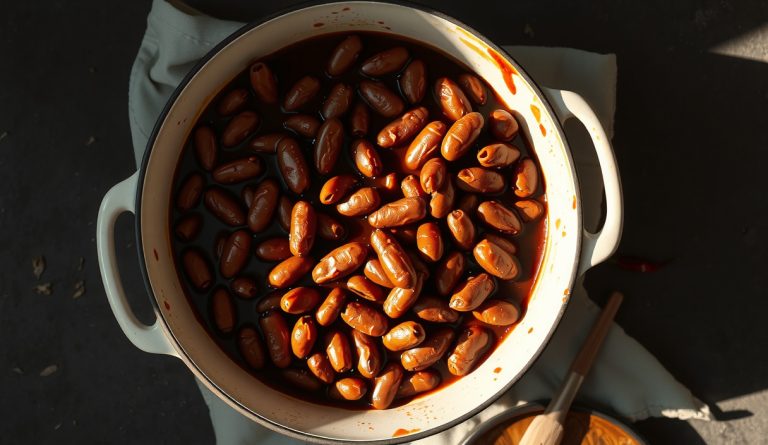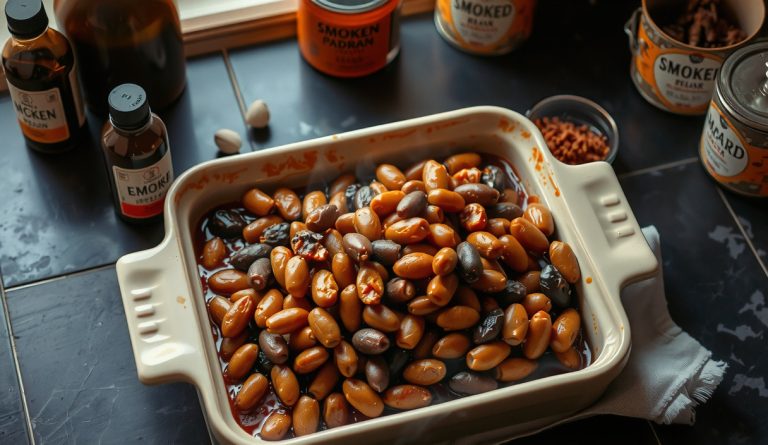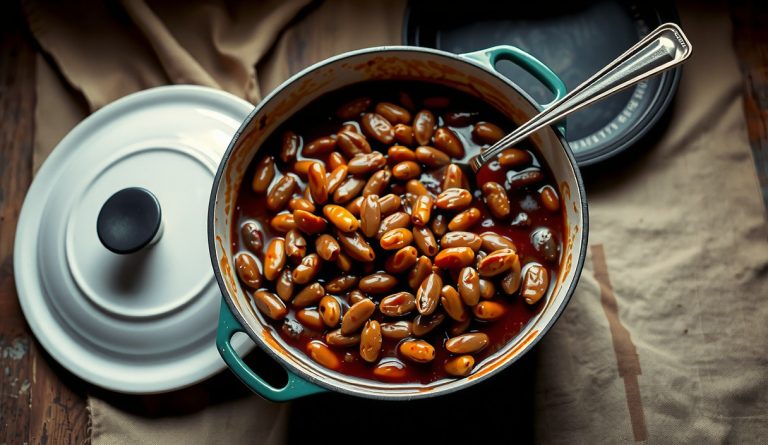
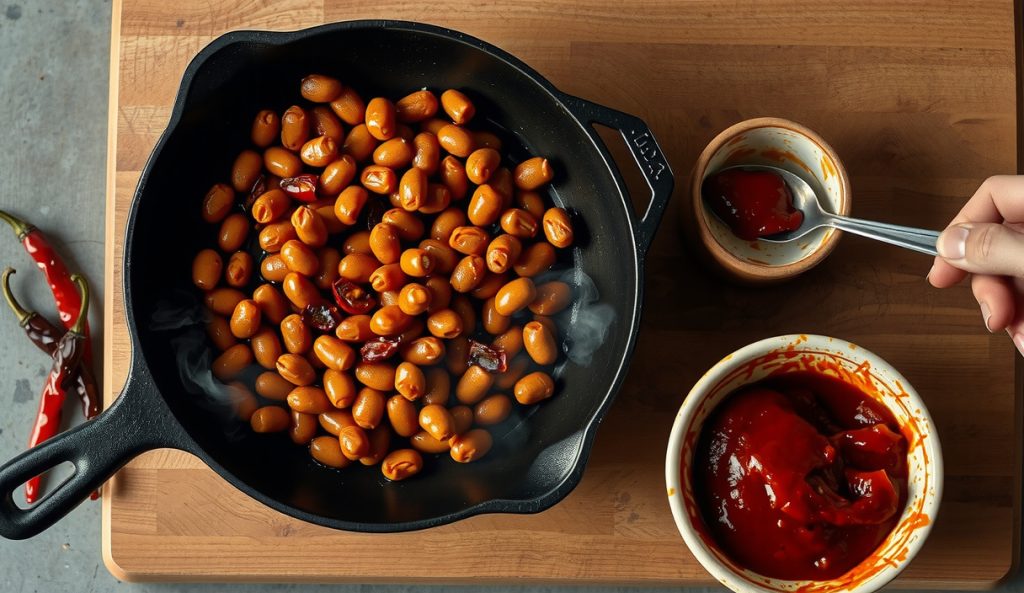
The canonical Vegan BBQ Beans recipe is calibrated for a broad crowd: mild enough to sit next to aggressively spiced grilled proteins without competing, but not so restrained that the beans read as bland. When the table is heat-seeking, or when the rest of the menu is mild and you want the beans to carry the fire, two well-defined paths take you there — each built on distinct flavor chemistry.
What changes when you dial up the heat?
For a straightforward American BBQ kick, add 1–2 tsp chipotle powder alongside the smoked paprika. Chipotle powder does double work here: capsaicin delivers the heat, while the dried smoke compounds in the chipotle reinforce the phenolic smoke layer already coming off the wood, deepening the overall smoke axis without muddying the sauce.
If you want pure heat without additional smoke character, substitute 1 tsp cayenne instead. Capsaicin in cayenne registers around 30,000–50,000 Scoville units and disperses evenly through the braising liquid during the long cook, so the finished beans have no hot spots — uniform heat from edge to edge.
For a Korean-inflected direction, replace the chipotle entirely with 1 tbsp gochujang and reduce the Dijon mustard to 1 tsp. Gochujang is a fermented chili paste: its lactic acid fermentation produces glutamates and short-chain organic acids that layer umami into the sauce in a way that echoes and amplifies the nutritional yeast already in the recipe. The result is noticeably more savory and complex, with a rounded, slow-building heat rather than the immediate front-of-palate punch of cayenne.
What stays the same across all three heat paths?
All three heat paths — mild canonical, chipotle-cayenne, and gochujang — use the identical cook method, sauté sequence, bean prep, smoke time, and reduction phase. No timing adjustments are needed for any heat level. The structural chemistry of the sauce holds regardless of which chili source you choose.
When is each heat variation the better choice?
Use the chipotle-cayenne build when the rest of your spread is mild and you want one component to provide heat, or when you want to reinforce a heavy smoke profile across the whole plate. The added phenolic smoke compounds stack directly onto the existing wood smoke, creating a louder, more insistent smoke axis.
Use the gochujang build when you are cooking for an audience that responds to umami-forward heat, or when the plate is already carrying cumin, lime, and fresh chili flavors and needs a fermented counterpoint in the beans. The lactic acid fermentation in gochujang provides acidity and depth that raw chili powders cannot replicate.
Use the full method, equipment, and rub measurements from the original Vegan BBQ Beans — Smoked Pinto.