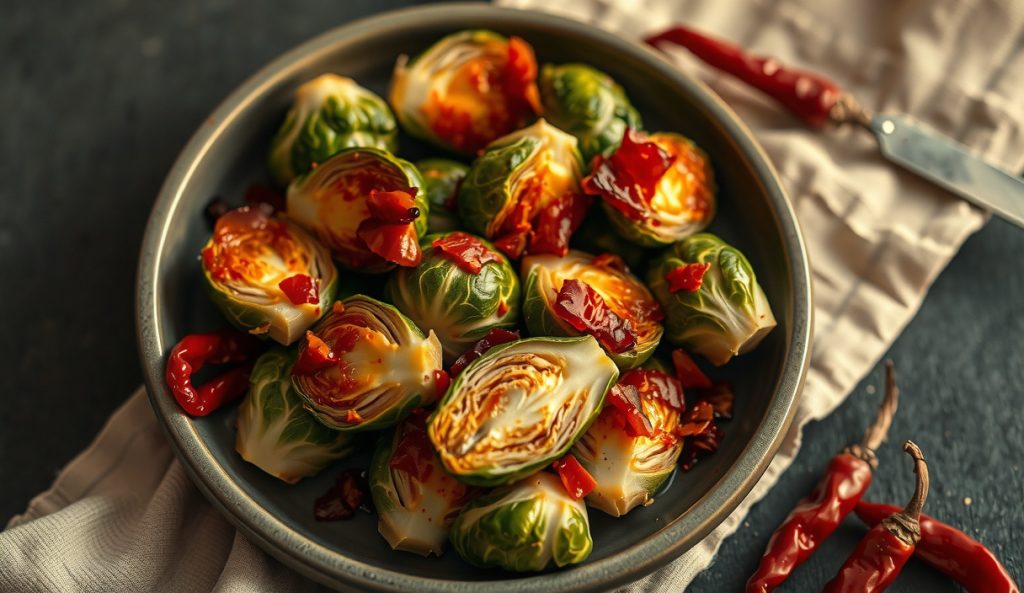
The canonical Maple-Dijon glaze sits at a balanced sweet-tangy register. This spiced heat variant breaks that equilibrium with chili fire, producing a smoky-sweet-hot profile that excels alongside rich, fatty mains — brisket, pork belly, short ribs — where sharp contrast is an asset rather than noise. Two heat sources are available, and they behave differently enough that the choice is worth making deliberately.
What changes in the spiced heat variant?
Add either 1 teaspoon of gochugaru or a pinch of cayenne (start at 1/8 teaspoon) directly to the Maple-Dijon glaze before brushing. Gochugaru — Korean coarse red pepper — registers roughly 1,500–2,500 Scoville Heat Units, low by chili standards, yet delivers exceptional color, a fruity undertone, and a slow-building, back-of-the-throat warmth that does not peak until after the first few bites. Its capsaicin disperses gradually in the oil-containing glaze, which further softens the onset curve.
Cayenne, by contrast, typically lands in the 30,000–50,000 SHU range and produces a sharper, more immediate heat response that hits the front palate quickly and fades faster. For a first pass, gochugaru is the more forgiving choice; cayenne suits cooks who want a cleaner, punchy contrast against the maple sweetness.
Smoked paprika is a lower-heat alternative — near 500 SHU — that adds color and mild earthiness without meaningful heat, useful when the goal is the visual and aromatic suggestion of spice for heat-sensitive guests. These options are not mutually exclusive: a base of smoked paprika plus a small cayenne addition layers complexity while keeping total heat calibrated to the table.
What stays the same as the canonical recipe?
Every structural element of the cook remains unchanged: fat, bacon, sprout prep, smoke temperature, wood selection, and glaze application timing all proceed exactly as written in the canonical recipe. The spice addition enters the glaze only — the dry seasoning stage is not altered.
When is the spiced heat variant the better choice?
Choose this variation when the rest of the spread is sweet-leaning or fatty and you need a side that cuts through rather than compounds the richness. The spiced Brussels sprouts also hold their own alongside bold spiced rubs and assertive sauces — the heat in the sprouts creates a throughline rather than a flavor gap. Gochugaru specifically is the right call when serving guests who enjoy heat but cannot reliably predict their own tolerance; its slow, 1,500–2,500 SHU build gives a more manageable experience than cayenne’s front-loaded punch.
Use the full method, equipment, bacon quantities, and base glaze ratios from the original Smoked Brussels Sprouts with Bacon and Maple-Dijon Glaze.