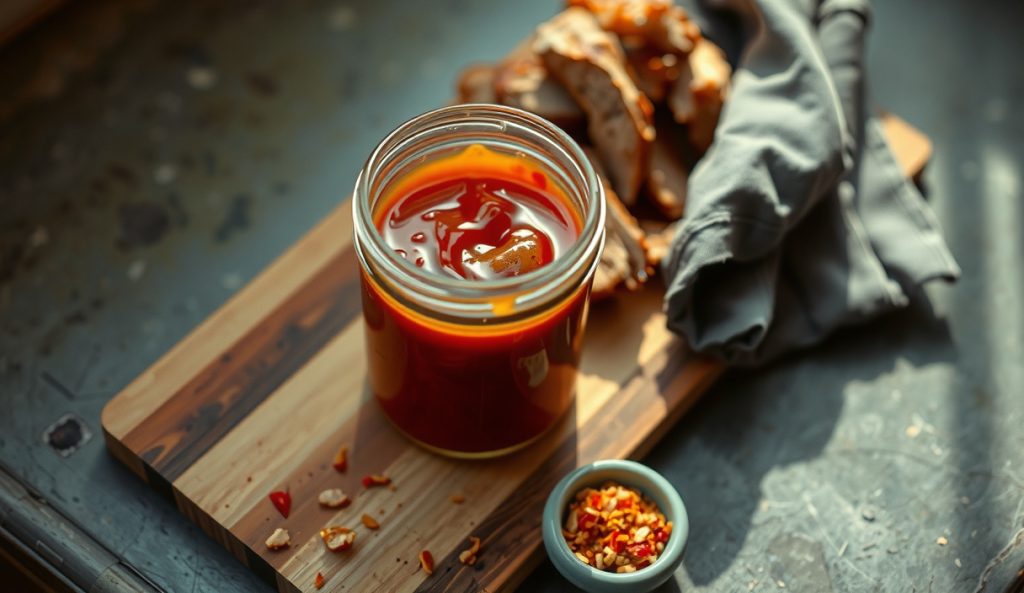
West of Raleigh, somewhere around the Yadkin Valley, the sauce changes. The sharp, austere vinegar-and-pepper formula of the eastern counties softens — ketchup enters the picture, brown sugar follows, and the result is what Piedmont pitmasters call the dip. Lexington-style sauce is not a corruption of the eastern tradition; it is a separate regional dialect, one that serves as the clearest bridge between the acid-dominant east and the fully tomato-forward sauces of Kansas City and the Deep South.
What changes in Lexington-style sauce? The chemistry of the pivot
Adding ketchup and brown sugar to the eastern vinegar base raises pH, increases viscosity, and shifts the sauce from pale gold to soft rust — all from just two ingredients. Add 3 tablespoons of ketchup and 1 tablespoon of brown sugar to the base recipe before heating. The ketchup introduces pectin and tomato solids, both of which raise viscosity and physically buffer the free acetic acid molecules, pushing pH from roughly 3.2–3.4 in the eastern base up to approximately 3.7–4.0 in the Lexington-style version.
That pH shift is chemically meaningful: at pH 3.7, Lexington-style sauce is noticeably less aggressive on fatty pork cuts, and the higher viscosity means it clings to the meat rather than wicking through it the way the eastern version does. The brown sugar contributes a shallow caramelization note when the sauce is served warm, and at 1 tablespoon across a pint-plus batch it does not cross into sweet-sauce territory.
What stays the same between eastern and Lexington-style vinegar sauce?
The apple cider vinegar base, the red pepper flakes, the black pepper ratio, and the salt level remain identical to the canonical eastern recipe. The fundamental purpose of Lexington-style sauce — cutting pork fat, brightening the finish, carrying heat — does not change. Only the intensity and texture of delivery shift when ketchup and brown sugar are added.
When is Lexington-style sauce the better choice?
Choose the Lexington pivot when serving guests who find straight vinegar sauce too sharp, when the pork is leaner (shoulder trimmings or mixed chop with less intramuscular fat), or when you want a sauce that photographs with more color and body. The pH 3.7–4.0 range is gentle enough that it does not overwhelm lean cuts the way a pH 3.2 eastern sauce can.
Lexington-style sauce is also the appropriate choice when cooking for a crowd that spans eastern NC purists and Midwest guests who expect some tomato presence — this version satisfies both without alienating either. Use the full method, ingredient ratios, and resting instructions from the original Eastern North Carolina Vinegar Sauce.